University of South Carolina
Scholar Commons
Theses and Dissertations
2016
Bound Bodies: Book Use And The Early Modern
Reader, 1450-1660
Emily Rendek
University of South Carolina
Follow this and additional works at:https://scholarcommons.sc.edu/etd Part of theEnglish Language and Literature Commons
This Open Access Dissertation is brought to you by Scholar Commons. It has been accepted for inclusion in Theses and Dissertations by an authorized administrator of Scholar Commons. For more information, please [email protected].
Recommended Citation
Rendek, E.(2016).Bound Bodies: Book Use And The Early Modern Reader, 1450-1660.(Doctoral dissertation). Retrieved from
BOUND BODIES:BOOK USE AND THE EARLY MODERN READER,1450-1660
by
Emily Rendek
Bachelor of Arts
University of West Florida, 2005
Master of Arts
Florida State University, 2008
Submitted in Partial Fulfillment of the Requirements
For the Degree of Doctor of Philosophy in
English
College of Arts and Sciences
University of South Carolina
2016
Accepted by:
Ed Gieskes, Major Professor
Holly Crocker, Committee Member
Nina Levine, Committee Member
Adam Hooks, Committee Member
ii
iii DEDICATION
iv
ACKNOWLEDGMENTS
Much as I argue that reading is a many-bodied act, the writing of this dissertation
was not a solitary act and would not have been completed without the support of my
friends, family, and mentors. I am also grateful for the funding provided through the
SPARC Graduate Research Grant, the English Department, and the Folger Shakespeare
Library for making my research possible.
I am blessed with an embarrassment of riches in the friends department: Barbara
Bolt, Lydia Yaitsky Kertz, Mary Learner, Bethany and Errol Tisdale, and Katherine
Upton. Your support, companionship, mentorship, and encouragement have meant the
world to me. To my co-workers at the Graduate School: Thank you for cheering me on
throughout this process and for providing such a supportive environment.
I am incredibly thankful for my wonderful dissertation committee—Ed Gieskes,
Holly Crocker, Nina Levine, and Adam Hooks—for pushing me to be a better scholar
and for providing such wonderful support and encouragement, I am especially indebted
to my director, Ed Gieskes, and Holly Crocker for their encouragement, feedback, and
mentorship. Thank you for modeling what it means to be a good scholar and supportive
mentor.
Last, but certainly not least, I am incredibly grateful for the support my family has
provided over the course of this long journey to my PhD. This dissertation would not
ABSTRACT
This dissertation explores the act of reading during the early modern period.
Examining both the text block and the margins of printed pages, this project contends that
early modern reading practices create a hybrid book/body circuit. The texts selected for
this project provide a depiction of not only how the act of reading functioned during the
early modern period but also reveal the manner in which reading was presented to
audiences and readers on the stage and printed page. This project resists a linear,
chronological narrative of the act of reading and instead makes evident different versions
of reading and the kind of hybridity that reading involves. The chapters in my dissertation
move from exploring how the act of reading was presented on the stage to how the
resulting hybrid book/body functioned once formed; the project then examines how a
play functions on the printed page and acts as a prescriptive reading manual in order to
participate in the formation of early modern readers’ identities. I conclude by studying a
specific commonplace book owner, Edward Pudsey, to show not only how an early
modern reader used playtexts to construct a notion of the self but also how by considering
commonplace books as the material manifestation of the hybrid book/body the text of the
commonplace book should be considered a single authored work and not merely a
TABLE OF CONTENTS
DEDICATION ... iii
ACKNOWLEDGMENTS ... iv
ABSTRACT ... v
LIST OF TABLES ... vii
LIST OF FIGURES ... viii
CHAPTER 1:INTRODUCTION:FORMING THE HYBRID BOOK/BODY CIRCUIT ...1
CHAPTER 2:“THEN I WILL RENT AND TEAR THEM THUS AND THIS”:REVENGE TRAGEDIES AND COMMONPLACE BOOKS ... 27
CHAPTER 3:“THE WORD BECAME FLESH”:THE BOOK AS BODY, THE BODY AS BOOK ... 63
CHAPTER 4:THE PLAYBOOK AS COMMONPLACE BOOK:MARKING HAMLET AND ‘TIS PITY SHE’S AWHORE ... 101
CHAPTER 5:CODA:“IN YE PASSAGES OF &C”:EDWARD PUDSEY’S COMMONPLACE BOOK ... 133
REFERENCES ... 157
APPENDIX A:PLAYS EXCERPTED IN PUDSEY’S COMMONPLACE BOOK ... 166
APPENDIX B:CONTENTS OF PUDSEY’S MANUSCRIPT ... 168
APPENDIX C:EDWARD PUDSEY’S WILL ...172
LIST OF TABLES
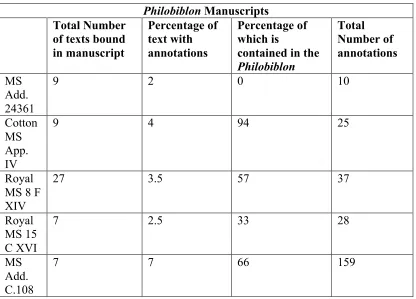
TABLE 1.1ANNOTATIONS IN MANUSCRIPTS OF THE PHILOBIBLON ...21
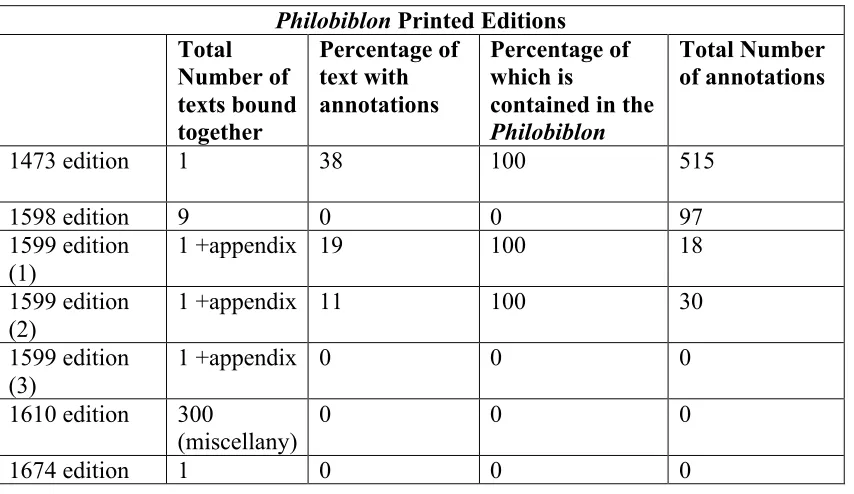
TABLE 1.2ANNOTATIONS IN PRINTED EDITIONS OF THE PHILOBIBLON ... 22
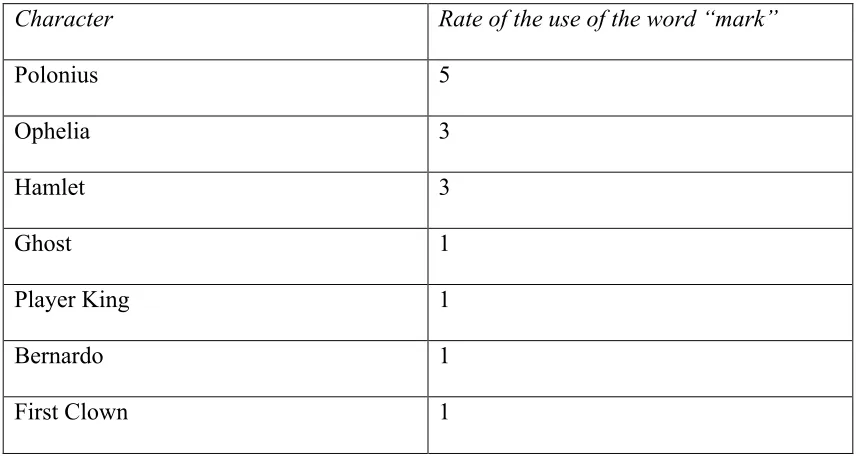
TABLE 4.1FREQUENCY OF THE WORD “MARK” IN HAMLET ... 110
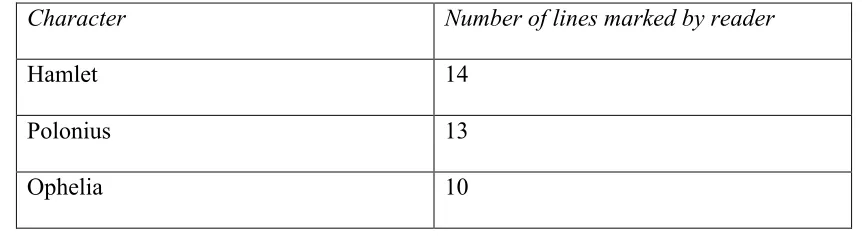
TABLE 4.2READER’S SENTENTIAE MARKS IN Q1(BLC.34.K.3) ... 111
TABLE 4.3PRE-MARKED SENTENTIAE VERSUS READER’S MARKS IN A COPY OF THE 1633EDITION OF ‘TIS PITY SHE’S A WHORE ...115
TABLE 5.1DRAMATISTS INCLUDED IN PUDSEY’S COMMONPLACE BOOK ... 134
TABLE 5.2PUDSEY’S HAMLETEXTRACTS ... 140
TABLE 5.3REPEATED SUBHEADINGS IN PUDSEY’S COMMONPLACE BOOK ...142
TABLE 5.4EXTRACTS WHERE PUDSEY USES DOUBLE INVERTED COMMAS ... 149
LIST OF FIGURES
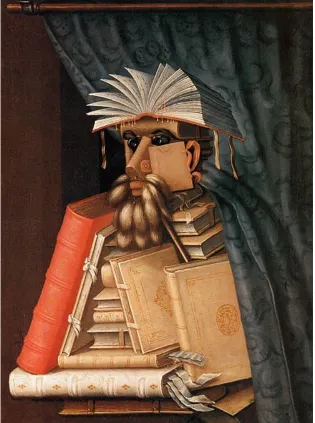
FIGURE 1.1GIUSEPPE ARCIMBOLDO’S LIBRARIAN ... 5
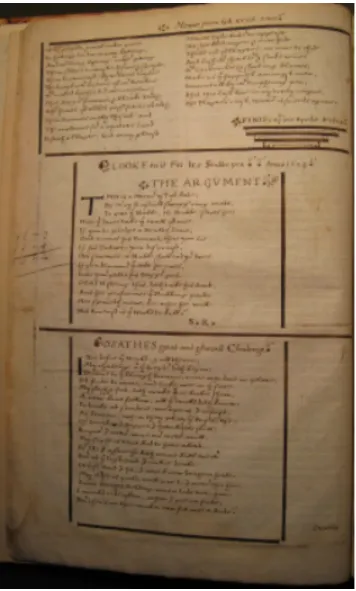
FIGURE 2.1POLITICAL MISCELLANY(V.B.210) ... 52
FIGURE 2.2POLITICAL MISCELLANY(V.B.210) ...53
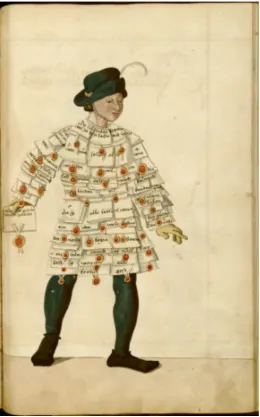
FIGURE 2.3SCHOENBARTBUCH(COLL.170MS351) ... 60
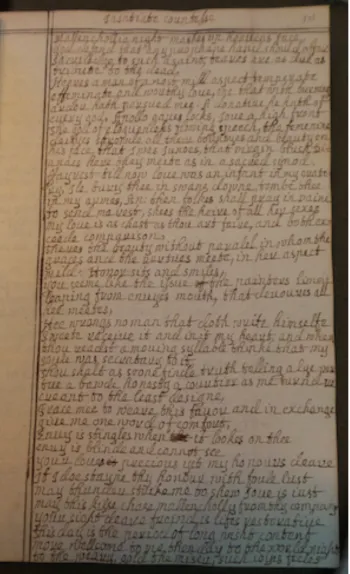
FIGURE 3.1WILLIAM HOWE’S COMMONPLACE BOOK(V.A.87) ... 66
FIGURE 3.2WILLIAM HOWE’S COMMONPLACE BOOK(V.A.87) ... 67
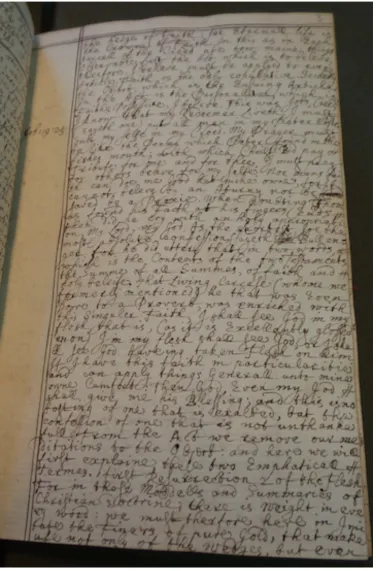
FIGURE 5.1HAMLETQ1(BLC.34.K.1) ... 138
FIGURE 5.2HAMLETQ2(STC22276) ...139
FIGURE 5.3ER82/1/21 ... 139
FIGURE 5.4ER82/1/21 ... 145
FIGURE 5.5SHAKESPEAREAN EXTRACTS FROM EDWARD PUDSEY’S BOOKE ... 148
FIGURE 5.6ER82/1/21 ... 151
1 CHAPTER 1:
INTRODUCTION: FORMING THE HYBRID BOOK/BODY CIRCUIT
“For books are not absolutely dead things, but do contain a potency of life in them to be as active as that soul was whose progeny they are; nay, they do preserve as in a vial the purest efficacy and extraction of that living intellect that bred them.”
-Milton, 1644
This dissertation explores the act of reading during the early modern period. This
project resists a linear, chronological narrative of the act of reading and instead makes
evident different versions of reading; it shows different responses to reading and the kind
of hybridity that reading involves. Examining both the text block and the margins of
printed pages, this project contends that early modern reading practices create a hybrid
book/body circuit. Both Serres’ and Latour’s conception of objects” and
“quasi-subjects” have shaped my conception of the relationship between books and bodies.1
Drawing upon Latour’s emphasis on the networks and interconnectedness of things and
humans,2 I have developed the notion of the hybrid book/body circuit.3 In Serres’ and
Latour’s terms the circulation or networks created by texts and bodies creates the hybrid
being. Serres argues, “This quasi-object, when being passed, makes the collective, if it
1 See Bruno Latour, “The Berlin Key or How to Do Words with Things,” trans. Lydia Davis, in Matter, Materiality, and Modern Culture, ed. P.M. Graves-Brown (London, 2000); Bruno Latour, We Have Never Been Modern, trans. Catherine Porter (Cambridge, MA: Harvard University Press, 1993); Michel Serres, Parasite trans. Lawrence R. Schehr (Baltimore: Johns Hopkins University Press, 1982).
2 Latour asserts, “Consider things and you will have humans. Consider humans, and you are by that very act interested
in things.” “The Berlin Key,” 20.
3 The use of the term “circuit” is indebted to Robert Darnton’s discussion of the “communication circuit,” to be
2
stops, it makes the individual.”4 For Serres, circulation erases the individual. In my own
model of the hybrid book/body circuit, I contend that the act of reading involves a series
of stops; although the book is in circulation, it does not continuously remain so. In the
push and pull that develops between the creation of both a communal reading group (or
“collective” in Serres’ terms) and the formation of self, the ideal text (or Text) is what
makes the collective; each physical, material text makes the individual.5 The book serves
as an artificial device, which augments the reader’s mind, but it does not serve merely as
an augmentation; the book also retains elements of the human. Every physical text is a
unique artifact; interacting with the text develops a notion of self, facilitating mutual
growth and change. In a society consistently preoccupied with the problems of seeming
versus being, early modern books present themselves as being able to be read to result in
an act of creation that makes the inner self potentially more visible and readable to others.
In order to investigate how the act of reading was conceived of during the time
period, this project uses early modern tragedies as its foundation. Why plays, and even
more specifically, why tragedies? Plays provide a medium, which is multivalent in nature.
There is an ambiguity of performance. People watch others on stage, and then the action
is reimagined. Each performance can vary, giving rise to a multitude of possibilities and
interpretations. Reading (as writing) are a performative space. Most importantly, the
different mediums a play goes through is reflective of the hybrid book/body circuit
(moving from manuscript to aural/oral to being re-formed by publishers and printers to
the resulting playtext book). The play itself goes through a embodiment and
4 Serres, 225.
5 Serres continues by stating that “Everyone is on the edge of his or her inexistence. But the ‘I’ as such is not
mediation. Reading is a disfiguring act and its negative potential aligns well with the
violence depicted on the stage in early modern tragedies. Recent scholars have argued
that reading during the early modern period should be viewed as an act of cutting.6 I
agree with this argument but would like to take it further and contend that early modern
tragedies’ backdrop of carnage allowed playwrights to warn readers of the potential
negative creations capable of being produced through reading. Reading creates hybrid
bodies and involves dismemberment and re-membering; and while this does not always
have to function as a negative force, reading has the power to be a dangerous act. My
project is not about good or bad readers but rather about use. People read differently, but
the point is that they are all readers. Examining early modern playwrights’ tragedies
allows the audience to be forewarned about the potential tragic consequences of improper
reading. The act of reading is a negotiation where change is enacted upon both reader and
text, ultimately creating a new hybrid body. Early modern plays make evident that texts
were imagined as becoming lifelike (becoming human): texts have the ability to influence
and are capable of action,7 and in the reverse, early modern peoples often aligned their
own experiences with that of books.8
In arguing that both entities contain elements of the other, thereby creating a new
hybrid entity, it may perhaps be useful to turn to Giuseppe Arcimboldo’s Librarian
6 See Jeffrey Todd Knight. Bound to Read: Compilations, Collections, and the Making of Renaissance Literature.
(Philadelphia: University of Pennsylvania Press, 2013). Juliet Fleming claims that we should use the metaphor of “cutting” for reading, noting that early modern readers held no anxieties about cutting books. See Fleming, “Afterword.”
HLQ 73.3 (Sept. 2010): 543. Ann Blair sees the act as destructive while Adam Smyth feels it is a part of the history of reading that has been “largely overlooked.” See Blair, “Reading Strategies for Coping with Information Overload, ca. 1550-1700.” Journal of the History of Ideas 64 (2003), 11-28 and Smyth “ ‘Rend and teare in peeces’: Textual Fragmentation in Seventeenth-Century England,” The Seventeenth Century 19 (2004): 36-52. Perhaps the most overt example of reading as an act of cutting occurs with the Little Gidding Harmonies. The women of this community composed texts by cutting up various printed Gospels and reassembled the pieces to create a continuous narrative.
7 The Cardinal’s Bible kills Julia in The Duchess of Malfi.
8 See also Frederick Kiefer. Writing on the Renaissance Stage: Written Word, Printed Page, Metaphoric Books
(c.1566) (see Figure 1.1).9 The figure in this painting is composed almost entirely of
books,10 or, to put it another way, a multitude of books are brought together to form a
human figure. This painting encapsulates key components of my argument for this
project—most significantly the figure is neither fully human nor fully book, rather it is a
hybrid figure composed of elements from both entities.
The hat atop the figure, or what could instead be considered representative of the
figure’s mind, is literally an open book. Its pages are splayed open and the book clasps
hang loose from the binding. The hat/mind is representative of books, which contain their
own agency. The visibly bookmarked passages suggest that the hat/mind is receptive to
outside forces (other readers and texts), and through its effort to influence what is
considered important in the text, it can also serve to influence those same external forces.
Conversely, most of the books that compose the torso of the body and whose fore-edges
are visible to the viewer are clasped shut, attempting to construct a barrier between book
and reader. The keys used for the figure’s eyes reinforce this effort to restrict knowledge.
This attempt at restricting knowledge and preventing the circulation of texts (and thereby
the development of the self) is a demonstration of the denial of the porousness of both
bodies (book and man) that is often evident in early modern drama. The figure’s hat/mind,
however, belies this attempt at constructing boundaries and instead reinforces the
permeable nature of the hybrid book/body. The keys also suggest an ambiguity, which
9 No official title for this painting has been found in written records until the twentieth century, when Olof Granberg
catalogued the collections at Skokloster Castle. The title given by Granberg has thus influenced modern interpretations of the work. K. C. Elhard’s “Reopening the Book on Arcimboldo’s Librarian” attempts to provide a new interpretation of the famous painting, one that is not an interpretation of the work “as a parody of librarianship and of intellectualism” nor a satiric portrait of an historical person but rather one that provides a generic portrait of “anyone associated with book ownership, anyone with a personal collection.” K.C. Ellhard, “Reopening the Book on Arcimboldo’s Librarian,” Libraries & Culture 40.2 (Spring 2005): note 4, 123; 115; 119.
reinforces the hybrid book/body’s ability to be both/and, by their capability to both lock
away and open up. The hand on the visible arm is ineffectual, as the fingers are
composed of flimsy bookmarks/slips of paper; this impassivity, however, is undercut by
Figure 1.1 Giuseppe Arcimboldo's Librarian (c.1566)
acknowledging the dual nature of the hybrid. The hidden arm, ostensibly covered by the
curtain around the figure’s shoulder, suggests in its invisibility the ability to create, to act.
the act of reading as the hand itself appears dismembered with “fingers” detached from
the main hand and placed in the book above.
The multitude of books and objects used to create the Librarian is reflective of
reading being a many-bodied act. Robert Darnton suggests this with his claim that there
is a “communication circuit”—or life phase—of the book, starting from the conception of
the text by the author and moving eventually to the reception of the text by its readers.11
Darnton argues that “[t]he reader completes the circuit, because he influences the author
both before and after the act of composition.”12 Darnton, however, does not adequately
account for the material aspect of the book. In the visual depiction of this circuit, he in
fact focuses on the people who affect the text—the publisher, printers, suppliers, shippers,
booksellers, readers, the binder, and author—but does not portray the working force the
book has on these people, especially on the reader. The book acts as another agent within
this circuit; one where the book is tied to its physical, embodied, and bodily nature. Other
scholars have noted this lack in Darnton’s diagram, including Darnton himself.13 Thomas
R. Adams and Nicolas Barker, who revised Darnton’s model, do consider the object of
the book itself.14 However, current scholarship has not fully acknowledged the agency
available to both the book and the body and their ability to each impart qualities onto the
other.
11 Robert Darnton, “What is the History of Books?” Daedalus 111.3 (Summer 1982): 65-83. See page 68 for a figure of
the “communication circuit.” Similarly, Simon Eliot argues that the reading of books “represents a very complex feedback loop” (“The R.E.D., or what are we to do about the history of reading?”
http://www.open.ac.uk/ARTS/RED/redback.htm Accessed 8 November 2012).
12 Darnton, “What is the History of Books?”, 67. See page 68 for a figure of the “communication circuit.”
13 See Robert Darnton, “‘What is the History of Books?’ Revisited,” Modern Intellectual History 4.3 (Nov. 2007):
495-508.
14 See “A New Model for the Study of the Book,” A Potencie of Life: Books on Society, Ed. Nicolas Barker (London:
Texts have been made from other lives and are also intimately tied to the human
body (demonstrating the cycle and transference of life). A variety of bodies are also
represented visually on the page in the marginalia of the Middle Ages and the
Renaissance—from the bodies sticking out of initials to manicules placed around the
page. Michael Camille asserts that at the level of the page there is a “mingling of bodies
of discourse as reading became a kind of writing”;15 I contend that in the early modern
period this is not just a “mingling” of bodies interacting but one that creates a new,
hybrid body. Additionally, it is important to remember that books were actually
produced from bodies—“the parchment pages […] were stretched and treated skin of
animals. Inks and colors were often produced with human spittle and urine [. . .] the
manuscript is a product of the hands and body of human labor that have registered every
pressure point of contact upon the flesh itself.”16 The parchment in manuscript texts can
also literally move on its own, demonstrating its ability to effect action; changing
temperatures and the humidity in a room can cause the parchment to expand and the
books (if they are without clasps) to move along the shelves—sometimes as quickly as in
the span of a few hours.17 Books’ physical ties to the human body are also present in
printed books’ pages, which were made from rags (recycled clothing) off their future
owners’ bodies.
That early modern reading practices created a text that transforms into an
extension of a reader’s body reinforced the concurrent shift in the understanding of the
human body that occurred between the end of the fifteenth and the end of the seventeenth
15 Michael Camille, “Glossing the Flesh: Scopophilia and the Margins of the Medieval Book.” The Margins of the Text.
ed. D. C. Greetham (Ann Arbor: U of Michigan Press, 2007), 257.
16 Camille, “Glossing the Flesh,” 259.
century. As Jonathan Sawday has noted, “the birth of a ‘new science’ of the human
body…transform[ed] entirely people’s understanding not only of themselves, and their
sense of identity or ‘selfhood’, but of the relationship of their minds to their bodies, and
even their feeling of location in human society and the natural world.”18 The study of the
history of the human body is itself expressly tied up with books. Prior to the sixteenth
century, those who were in the medical field used books, not bone and flesh, in their
study of the human body. As late as 1509 it was still a common practice to see the
lecturer reading from an ancient text distinctly separate from the physical labor the
surgeon performed on the body. As Richard Sugg argues, the connection between the
body and the book is one that can be seen even in the use of language.19 The OED notes
that the word “section” in 1559 referred to “[t]he action, or an act, of cutting or dividing”
in relation to “surgery or anatomical operations,” but by 1576 the word refers to “a
subdivision of a written or printed work.”20 By 1577 books begin to advertise themselves
as having “sections,” demonstrating how the boundariesbetween body and book can be
blurred.21
“In books I find the dead as if they were alive”: Traces of Readers
Books become hybrid bodies through the act of reading, and the physical traces of
that act are most evident in early modern annotations in texts. My examination of early
modern marginalia pushes the boundaries of text and margins to include early modern
18 Jonathan Sawday, The Body Emblazoned: Dissection and the Human Body in Renaissance Culture (New York:
Routledge, 1995), viii-ix.
19 Richard Sugg, Murder After Death: Literature and Anatomy in Early Modern England (Ithaca: Cornell UP, 2007), 2.
20Oxford English Dictionary, s.v. “section”, accessed 15 October 2012, http://www.oed.com/.
commonplace books, establishing that the act of reading itself results in the creation of
new texts. Current scholarly assessment of early modern marginalia fixates on whether
the annotations relate to the text itself.22 The development of this type of binary impedes
a deeper understanding of the act of reading during the early modern period. The hybrid
book/body circuit does not allow for any distinct dividing point between book and body,
annotations relating to the text, and annotations seemingly outside of the text. That the
majority of early modern annotations do not appear to relate to the texts that they are
found in demonstrates the readers used the printed page as a way to work out their
developing notions of the self. The reader becomes part of the text, making the text a part
of the reader’s body—a part that functions as a form of prosthesis. The markings that
have been left behind by early modern readers are traces of their bodily imprints upon the
text. Julie Singer’s discussion of the “transhuman”—“the addition of something to the
body in order to make it different [and] to enhance its capacities”23—fits well here with
my argument in that it supports the notion that adding the book to the body creates a new,
hybrid being.24
By focusing on early modern marginalia and extending the margins of the book to
commonplace books, I see writing as a function of reading, demonstrating reading’s
generative, creative capabilities. Even if a reader is not explicitly writing in the text in
22 One of the primary obstacles to the study of early modern marginalia is that there remains no consistent cataloguing
practice for noting marginalia.
23 Julie Singer, “Toward a Transhuman Model of Medieval Disability,” postmedieval 1(1-2): 175.
some way, shape, or form, the reader is marking the text. Ann Boleyn, for example,
marked some of her books by underlining parts of the text with her fingernails.25 Kathryn
Rudy’s work on medieval manuscripts, employing a densitometer to study the often
slightly less visible marks left behind by book users, addresses non-textual traces of users
interacting with the codex.26 Marks can include anything from oils to fingerprints, food
stains, tears, and even blood stains—all of which serve to indicate not only what parts of
a text a reader read and how often the text was read but also indicates further how reader
and text imprint upon one another.27 The bodily remnants on the page demonstrate the
numerous ways in which readers left their marks on books, mingling physical
representations of the body with representations of the inward self; for example, inky
fingerprints are commonly found in early modern texts, as is the occasional hair.28
By examining early modern reading practices, I want to argue that we should
consider books as extensions of readers’ bodies. Marking texts creates a fusion of
multiple bodies. This creates a poly-vocal text—one that fits with the Renaissance notion
of authorship as collective practice; there is, as Peter Rabinowitz observes, a “communal
25 See Heidi Brayman Hackel, Reading Material in Early Modern England: Print, Gender, and Literacy (Cambridge:
Cambridge University Press, 2005): 205.
26 Rudy notes that this method is not without its drawbacks, stating that of the 200 manuscripts she looked at in order to
write her article, “Dirty Books” only about 10% of the data was usable. Kathryn Rudy, “Dirty Books: Quantifying Patterns of Use in Medieval Manuscripts Using a Densitometer,” Journal of Historians of Netherlandish Arts 2 (2010): 19.
27 The British Library’s MS Egerton 1821 serves as a good example of the other types of book use that go beyond
annotations. This book of devotion (c.1490) contains three black painted pages, which start off the book, with blood droplets running down the pages. The third page shows evidence of extreme use, perhaps from being kissed. The page eventually transforms into bloodied backgrounds for the illuminations. “Treasures Known and Unknown in the British Library.” http://www.Prodigy.bl.uk/illcat/TourKnownC.asp/ Accessed 1 December 2012.
28 Some examples include the following: The Bodleian’s copy of the 1596 Faerie Queene (Vet. A1 e.156) contains a
hair embedded in the page on Bb2r and a fingerprint on the verso. The Folger’s copy of the 1582 Hekatompathia (STC 2518a, copy 2) contains a hair embedded in the paper in the upper right hand corner of D4r. There is an inky fingerprint in the top right corner of the Folger’s 1607 copy of Bussy D’Ambois (STC 4966), as well as in their copy of The Bloodie Banquet (STC 6181, copy 2) at A3r, and a partial palm print on H2r of their 1631 copy of Doctor Faustus
nature of reading and writing.”29 Readers and texts enter into a conversation with each
other and participate in the formation of the other. Instances where readers have
annotated texts with their own personal life accounts and placed these next to
corresponding moments in the text clearly shows a collapse between the worlds of the
reader and the text itself—the two have become one. However, as stated earlier, direct
correlation between the printed content and readers’ annotations is not often the case.
Jeffrey Todd Knight has noted that Renaissance book use goes beyond that of their
printed content and argues that we should consider books as storage devices.30 While
books can be viewed as storage devices, I contend that this sort of terminology implies
that these pieces of “furniture” can be separated from the body of a reader. An early
modern reader, however, becomes bound to the book and vice versa through the reader’s
use of the text. Knight’s claim would suggest that reader and text can be divorced;
however, I do not see texts as merely storehouses of information to be referred back to at
particular times. The act of reading creates a new, different hybrid being. Writing about
the British Library’s copy of Sidney’s Astrophil and Stella, Knight observes that the copy
contains “household memos, notes on grafting and husbandry, legal documents, and
many other things,” and suggests that the book’s “wooden boards and large brass
clasps…[make it] rather more closely to resemble a chest.” 31 At the heart of Knight’s
critique is his dissatisfaction with naming such a hybrid text a miscellany—considering it
29 Peter J. Rabinowitz, Before Reading: Narrative Conventions and the Politics of Interpretation (Ithaca: Cornell
University Press, 1987), 23.
30 See Jeffrey Todd Knight, “‘Furnished’ for Action: Renaissance Books as Furniture” Book History 12 (2009): 37-73.
Similarly Joshua Eckhardt and Daniel Starza Smith refer to books as being capable of “carr[ying] miscellaneous contents as regularly as bags and boxes did.” Manuscript Miscellanies in Early Modern England (Surrey: Ashgate, 2014), 1.
as a piece of furniture seems to get more closely to what Knight sees these texts
accomplishing for early modern readers; however, by pushing the argument further, the
British Library’s copy of Astrophil and Stella serves not merely as a storehouse but as an
extension of the family’s memory: the book becomes a living ancestor.
Recent scholars who have attempted to avoid simply dismissing textually
un-related marginalia often cannot go beyond their modern biases, indicating an
unwillingness to reformulate the act of reading. More often than not current scholarship
creates a binary when describing early modern marginalia: it is either “good” or “bad”
depending on its relationship to the text.32 This is reflected in Knight’s statement that “the
fact is that much of the writing left behind for us in Renaissance books has less to do with
reading (let alone imitating) a text than with using it as a material object; often in pursuit
of some practical, everyday goal.”33 This too gives a more passive capacity to books—
also in line with Knight’s assessment. Viewing books simply as “carriers” does not assign
them any sort of agency—they are instead here simply viewed as receptacles to hold
various notes, trifles, and memories.
By following my proposed model—viewing books as prosthesis—“unrelated”
marginalia is no longer so—the marginalia is part of the life of the hybrid book/reader.
My project seeks to intervene in the scholarly conversation regarding early modern
reading by asserting that these seemingly irrelevant marginalia instead demonstrate that
32 Discussing a Bodleian manuscript of Gower’s Vox Clamantis, Knight notes that a sixteenth century owner has filled
pages with recipes—“in utter disregard for the book’s content,” emphasis added, 45.
33 In a similar vein, Bill Sherman notes, “while I tried to take note of the presence of owner’s signatures and of
the act of reading facilitated the development of a reader’s identity. The desire to want to
fix “valuable” marginalia as those directly related to the text reflects modern values and
places the author above reader. Considering all annotations—even those that may “not
always [be] interesting to us”—develops a more complete picture of how early modern
readers read and constructed their identities.34
In arguing that “[b]oth hand and quill are instruments,”35 Jonathan Goldberg
points to the dehumanizing, almost cyborg-like effect that reading has on the body.36 In
Goldberg’s examination of the act of writing in the Renaissance, he suggests that writing
manuals depict hands as free floating agents, cut off from the rest of the body; this
representative dismemberment both dehumanizes the reader and facilitates the creation of
a new entity, the book/body hybrid. Goldberg also notes the violence inherent in writing:
“At a basic material level, then, writing begins with a tool of violence, the knife or razor,
and it produces the point of the quill as another cutting edge.”37 This violence can also be
extended to the process of printing books and the many bodies involved in the production
of books.Viewing reading as writing, and therefore as an active process that involves the
assembling of a self, demonstrates that the violence Goldberg associates with writing is
actually an extension of the violence already present in the text. However, while reading
may have violent tendencies, it is up to the reader to recuperate that violence and reshape
34 Sherman,131. Sherman writes that “One of the most pervasive—and problematic—features of Renaissance
marginalia is that by no means all of the notes left behind by readers engage directly with the text they accompany, and
more have to do with the life of the reader than the life of the text,” and concludes his essay by stating that “Many of the traces of Renaissance reading will remain visible, indecipherable, or (worst of all) boring,” emphasis added, 130, 133.
35 Jonathan Goldberg. Writing Matter: From the Hands of the English Renaissance. (Stanford University Press, 1991),
59.
36 For a discussion of the cyborg see Susan Crane’s argument regarding medieval knighthood in “Chivalry and the
Pre/Postmodern” postmedieval (2011) 2: 69–87.
it into a more positive, generative force. While the printed book in the Renaissance is
often described as a malleable object in recent scholarship, extending the malleability to
the reader in order to demonstrate each entity’s permeable nature is not often frequently
discussed.38 The reader’s presence both inside and outside the text creates a slippage that
has contributed to scholars overlooking the malleability of readers.
“To burn with such desire for books”: Richard de Bury’s Philobiblon
Although it is not an early modern playtext, which remain the focus of my project,
Richard de Bury’s Philobiblon (1344/5) allows us to see the evolution of approaches to
reading and its influence in shaping early modern reading practices. While the
Philobiblon was composed in the fourteenth century, it went through five editions
between the end of the fifteenth and seventeenth centuries (three of which were printed in
the span of 12 years).39 Beginning at the end of de Bury’s text makes evident that he uses
the personal to tie himself to his work:
The end of the Philobiblon of Master Richard de Aungerville, surnamed de Bury, late Bishop of Durham. This treatise was finished in our
manorhouse of Auckland on the 24th day of January, in the year of our
Lord one thousand three hundred and forty-four, the fifty-eight year of our
38 For example, in their discussion of Thomas Milles’ hybrid print and manuscript publications, Heather Wolfe and Bill
Sherman state, “It is now a commonplace that texts were inherently malleable in early modern England regardless of their manuscript or print origins” 482. See Sherman and Wolfe, “The Department of Hybrid Books: Thomas Milles between Manuscript and Print” Journal of Medieval and Early Modern Studies 45.3 (September 2015): 457-485. Jeffrey Todd Knight also argues that the book was “a thing to actively shape, expand, and resituate as one desired,” 4. In his essay, “Back to the Future—Littorally,” William W.E. Slights discusses both printed marginalia and readers’ added annotations and argues that “marginalia brought the quality of permeability to the page [. . . and] created leakage both into and out of the centred text.” This permeability should also extend to the reader, as the reader is both affected by the text and affects the text itself. William W.E. Slights, “Back to the Future—Littorally: Annotating the Historical Page.” The Future of the Page, Ed. Peter Stoicheff and Andrew Taylor (Toronto: University of Toronto Press, 2004): 72.
39 Over a roughly 200-year period (1473-1674), the Philobiblon goes through five editions, but only one of these, the
age being exactly completed, and the eleventh year of our pontificate
drawing to an end; to the glory of God. Amen. (71)40
The explicit personal connections to the text, achieved specifically through reference to
his birthday, suggest that the Philobiblon functions as a sort of textual rebirth for de Bury.
The creation of this text has fashioned him anew. While de Bury provides an impassioned
case for restricting and regulating the use of books, by examining the language he uses to
describe what he views as abuses made toward books, evidence is made apparent for the
hybrid book/body.
The Philobiblon is a treatise divided into twenty chapters written to justify the
author’s devotion to his books to his detractors. As E.C. Thomas has stated, “No man has
ever carried to a higher pitch of enthusiasm the passion for collecting books.”41 Evidence
from ten extant copies of the Philobiblon that I have examined at the British Library,
Bodleian Library, and Folger Shakespeare Library (in both manuscript and print forms)
makes evident that the act of reading is a negotiation between multiple bodies, which
results in the formation of a new hybrid body. De Bury’s attempts to block this
negotiation creates a connection between his work and that of early modern plays. Both
express an anxiety about the creation of hybrid bodies through the act of reading,
resulting in the attempt at setting boundaries, which are ultimately transgressed. De
Bury’s refusal to acknowledge the hybrid body in many ways makes him similar to the
titular character of Doctor Faustus, whom I discuss in my third chapter. De Bury’s
attempted usurpation of the role of readers suggests an anxiety over whether he will be
able to maintain a singular influence on his own books. Reading provides a reader with
40 All citations from the Philobiblon, unless otherwise noted, are from: Richard de Bury, The Love of Books: The Philobiblon of Richard de Bury. Ed. Matthew Battles (New York: Barnes and Noble, 2006).
the ability to compose a self through the fragmentation of text. Readers must select which
bits of text relate to them the most and knit those pieces together to form a new hybrid
book/body that is reflective of their identities.
Born in 1287, Richard was the son of Sir Richard Aungervile, a knight. De Bury
completed his education at Oxford, and according to some sources, became a Benedictine
monk at Durham. In 1322 de Bury became tutor to the future Edward III; once de Bury’s
student became king, he received a series of quickly successive appointments: first as
Cofferer to the King, then Keeper of the Wardrobe, and then Keeper of the Privy Seal. In
1333 he became ambassador to the papal court at Avignon and was appointed Bishop of
Durham. Although “during de Bury’s time, the number of books owned by the lesser
clergy averaged nine each,”42 a contemporary account, the Chronica sui Temporis of
Adam de Muimuth, notes that de Bury “gathered unto himself an infinite number of
books, as well by gift as by borrowing from divers monasteries and by buying, insomuch
that five great wagons were not enough for the carriage of his own books.”43 De Bury
was also known for using public office to expand his library—gifts of books were noted
as helping to expedite one’s case.44 The Bishop’s lavish tastes in books meant that he
died in debt in 1345 and further connects the relationship between book and self.45
In Chapter 16 of the Philobiblon, de Bury gets closest to acknowledging the
generative act of reading. Using terms that express family relations, de Bury notes that
42 Michael Camille, “The Book as Flesh and Fetish in Richard de Bury’s Philobiblon,” The Book and Body, Ed. D.W.
Frese and K. O’Brien O’Keefe (Notre Dame: University of Notre Dame Press, 1997): 44.
43 Thomas, 338.
44 Cheney, 325.
45 The Chronica sui Temporis also notes that “as the end of his life drew nigh, those of his household carried away all
it is needful to replace the volumes that are worn out with age by fresh successors, that the perpetuity of which the individual is by its nature incapable may be secured to the species; and hence it is that the Preacher says; “Of making many books there is no end.” […] And thus the
transcription of ancient books is at it were the begetting of fresh sons, on whom the office of the father may devolve, lest it suffer detriment. (57)
In this passage de Bury acknowledges the desire to establish a traceable lineage for texts
as part of a hybrid self-making project—a desire that I examine more fully in my fourth
chapter as it is represented in Hamlet; however, he aligns this renewing and regenerative
force with transcription (the strict copying of parent texts) rather than expanding it to
reading (and its creative process) in general.
Early on in the Philobiblon de Bury makes clear that when he speaks of books he
“do[es] not now mean the materials of which they are made” (9); this is one of the first
boundaries or separations that de Bury attempts to establish, which are representative of
the boundaries attempted to be placed between books and bodies. De Bury’s writings
express a desire to maintain firm boundaries between the text and the physical book, but
they also make evident the inability to maintain such boundaries due to the permeable
nature of both the book and body. De Bury’s boundaries are often met with
contradictions. Here the desire to create an abstract notion of the texts (of Truth itself) is
directly contradicted by de Bury’s move to give books bodies and voices;46 he also make
them susceptible to disease—grounding them wholly in the physical, material world:
we have to mourn for the homes of which we have been unjustly robbed; and as to our coverings, not that they have not been given to us, but that the coverings anciently given to us have been torn by violent hands, insomuch that our soul is bowed down to the dust, our belly cleaveth into the earth. We suffer from various diseases, enduring pains in our backs
46 In “The Book as Flesh and Fetish in Richard de Bury’s Philobiblon,” Michael Camille argues that “There are no
and sides; we lie with our limbs unstrung by palsy, and there is no man who layeth to heart, and no man who provides a mollifying plaster (16-17)
The violence de Bury sees inflicted upon books is indicative of the potential negative
consequences of reading, which is illustrated in this project by examining early modern
tragedies.47
De Bury desires to keep books only to those whom he deems worthy of
interaction with texts. The zealousness with which he provides a list of complaints
regarding the misuse of books suggests his own anxieties about not being the sole
influencer of his books. De Bury’s rather vivid picture of how not to handle books is at its
most apparent in Chapter 17: “Of Showing Due Propriety in the Custody of Books,”
where he begins by reminding the reader that it “behoves us to guard a book much more
carefully than a boot” (60). Continuing de Bury says,
You may happen to see some headstrong youth lazily lounging over his studies, and when the winter’s frost is sharp, his nose running from the nipping cold drips down, nor does he think of wiping it with his pocket-handkerchief until he has bedewed the book before him with the ugly moisture. Would that he had before him no book, but a cobler’s apron! His nails are stuffed with fetid filth as black as jet, with which he marks any passage that pleases him. (60-61)
De Bury finishes this passage by complaining about those who eat or drink over a book,
bend pages, or use books to press flowers. This chapter in particular makes evident de
Bury’s desire to prevent the reader’s interaction, or dialogue, with books. De Bury wants
books to be approached with reverence rather than something, or perhaps even someone,
47 This violence sometimes involves the literal dismemberment of text. See the Little Gidding Harmonies. A digitized
that can be entered into a conversation with.48 No matter how he may try to prevent the
reader from affecting the text, as Michael Camille states, “the open body of the book [is]
penetrable and unprotected.”49
Rather than acknowledging that the book and reader affect each other leading to
the development of self, de Bury wants to produce readers made in his image; his focus is
on producing exact copies (transcriptions) rather than allowing the creative generative
force of reading take place. His text is so appealing to me because he argues against some
of the very practices of reading I am interested in examining—that of readers’ marks in
texts; he complains that “there is a class of thieves shamefully mutilating books, who cut
away the margins from the sides to use as material for letters, leaving only the text, or
employ the leaves from the ends, inserted for the protection of the book, for various uses
and abuses—a kind of sacrilege which should be prohibited by the threat of anathema”
(62). His example leaves the text vulnerable—the author’s work is at risk with no
protection or barrier to push out manipulation and reuse. De Bury once again is
concerned with the violence enacted on books; his complaints express concern over
others not following his rules for reading.
The copies I have examined in the archives would seem to support the idea that
the reader is the final authority for a text, and however much de Bury may put forth a
clear set of rules for how to handle books, readers clearly did not listen. The majority of
annotations are evidence of the reader as editor—making corrections to the text and
making it easier to read by adding in punctuation marks etcetera. I will, however, also
48 de Bury after all does write in one of the most famous passages of the Philobiblon that “In books I find the dead as if
they were alive” (5).
note that when compared to the other roughly 150 texts I consulted (of texts printed from
1450-1660), copies of the Philobiblon (and works it might be bound with) are generally
less copiously annotated than other works. The sense that readers are at least not
completely following de Bury’s advice can be traced to the author himself not always
adhering to his own rules.50
De Bury’s invectives against interactions with the text seem to elicit the exact
opposite response; this is especially evident when looking at the manuscript copies of the
Philobiblon (see Table 1.1). While the number of annotations contained within each
codex is rather low, narrowing the focus to the Philobiblon shows the proportion of
annotations contained within that text is extremely high. Of the five manuscripts that I
examined, which range in date of composition from the very end of the fourteenth
century to the mid-fifteenth century, only one manuscript’s text of the Philobiblon was
completely devoid of any sort of readers’ marks (British Library MS Add MS 24361).
This manuscript is comprised of 89 folios, but only 2% of the codex (which is a mix of
English and Latin texts) contains readers’ marks. Three out of four of the remaining
manuscripts overwhelmingly contain the majority of the codex’s annotations in the
Philobiblon section.
50 For example, in Chapter 4, de Bury writes that “we who are the light of faithful souls everywhere fall a prey to
Table 1.1 Annotations in Manuscripts of the Philobiblon
Philobiblon Manuscripts
Total Number of texts bound in manuscript Percentage of text with annotations Percentage of which is
contained in the
Philobiblon Total Number of annotations MS Add. 24361
9 2 0 10
Cotton MS App. IV
9 4 94 25
Royal MS 8 F XIV
27 3.5 57 37
Royal MS 15 C XVI
7 2.5 33 28
MS Add. C.108
7 7 66 159
The printed editions of the Philobiblon are more extreme in their depiction of
readers’ annotations. The split between copies that contain annotations and those that do
not is nearly even; however, nearly all the annotated copies find those annotations in the
Philobiblon (see Table 1.2). In 1473, roughly 128 years after its original composition,
Richard de Bury’s Philobiblon became one of the first printed secular texts. The
Bodleian’s copy (Auct 2 Q6.76) of this edition contains annotations over 38% of its
pages. The other four printed editions of the Philobiblon that I consulted were also at the
Bodleian. Two editions do not have any annotations; however, this does not mean that
they did not show other signs of use. The 1598 edition, which is actually a unique copy
Latin texts on the inside covers, shows evidence of food and ink stains over numerous
pages, as well as smudges and fingerprints from dirty hands—all things which de Bury
rails against. De Bury’s treatise invites a contrary response, and the extant copies I have
examined also demonstrate the reader’s control over the text and ability to shape it to
their own desires.
Table 1.2 Annotations in Printed Editions of the Philobiblon
Philobiblon Printed Editions Total Number of texts bound together Percentage of text with annotations Percentage of which is
contained in the
Philobiblon
Total Number of annotations
1473 edition 1 38 100 515
1598 edition 9 0 0 97
1599 edition (1)
1 +appendix 19 100 18
1599 edition (2)
1 +appendix 11 100 30
1599 edition (3)
1 +appendix 0 0 0
1610 edition 300
(miscellany) 0 0 0
1674 edition 1 0 0 0
The desire to shape readers in his own image and to privilege only those whom de
Bury deems worthy of interacting with his text is evident in the text’s use of Latin, which
excludes a large number of readers, mainly the laity to whom de Bury would be glad to
see barred access to his work. In chapter 17 de Bury writes, “the laity, who look at a book
turned upside down just as if it were open in the right way are utterly unworthy of any
communion with books” (62). His use of the word “communion” implicitly suggests his
acknowledgment that there exists a hybrid book/body, as it affirms the ability for the act
While often bound with other works, the Philobiblon’s lack of primacy in these
sammelbände suggests that it was not viewed as an authoritative and instructive source
for reading the rest of the bound works. Whenever de Bury’s work is bound with other
works (which occurs in 7 out of 10 of the copies I looked at), only once was the
Philobiblon placed as the preliminary text in these contemporary bindings. In fact the
1610 edition (Frankfurt) marks the time until the end of the nineteenth century when the
Philobiblon “was not printed by itself, but only in collectaneous works.”51 The
Philobiblon becomes a text that readers mine for what they are interested in rather than
treating it as a reading manual on how to read other texts. The traces of Philobiblon
readers in the archives demonstrate their understanding of reading as a generative,
creative process. In many ways de Bury can be aligned with a number of early modern
playwrights who exhibited anxiety about the afterlives of their plays; however, while de
Bury seeks to shut down any additional voices to his Philobiblon and attempts to deny
the readers’ ability to achieve communion with their books, I assert that early modern
playwrights through their works provide models for readers that suggest both good
practices and those better avoided—ultimately acknowledging that the reader designs
his/her own self. Early modern plays were texts designed to be read—they were not just
to be seen in performance.
Chapter Overviews
The texts selected for this project provide a depiction of not only how the act of
reading functioned during the early modern period but also reveal the manner in which
reading was presented to audiences and readers on the stage and printed page. The
chapters in this dissertation move from exploring how the act of reading was presented on
the stage to how the resulting hybrid book/body functioned once formed; the project then
examines how a play functions on the printed page and acts as a prescriptive reading
manual in order to form identities. I conclude by studying a specific commonplace book
owner to show how an early modern reader used playtexts to construct a notion of the self.
My second chapter demonstrates that early modern playwrights sought to provide
instructive models or warnings on the potential dangers of reading. The extreme violence
present on the stage in Shakespeare’s Titus Andronicus and Kyd’s Spanish Tragedy
serves as a metaphor for the ability of the act of reading to produce monstrous creations.
Pairing together these two plays allows us to recreate the circuited act of reading.
Reading goes beyond taking in words on the page and leads to acts of interpretation,
which then leads to acts of creation. The generative nature of reading can be seen in the
anonymous First Part of Ieronimo, which I examine at the close of the chapter.
Moving from how the act of reading occurs, my third chapter examines how this
act forms the hybrid book/body. In this chapter, I posit that the Bible served as the
foundation that enabled early moderns to conceive of an entity as being capable of being
both/and—the ability to be simultaneously a separate entity while also being capable of
functioning as a combined whole. The Catholic imagery present in both Webster’s
Duchess of Malfi and Marlowe’s Doctor Faustus serves to highlight the transformative
nature of reading through the plays’ references to transubstantiation, reminding the
audience of an object’s ability to transform into living flesh. While one may initially pose
the question of who or what has more agency (book or body), these plays instead show
My fourth chapter moves from the stage to studying the physical, printed playtext.
I contend that early modern playtexts function as prescriptive reading manuals,
participating in the formation of subjects. While printed marks for sententiae suggest
what the reader should extract from the text, the reader is not confined to these
prescriptions. If readers, formerly audience members, watched the formation of selves on
the stage, with the printed playtext in hand they are now able to participate in their own
construction of self. By examining the printed sententiae in Shakespeare’s Hamlet and
Ford’s ’Tis Pity She’s a Whore, we see that readers create textual representations of
themselves. In keeping with the hybrid book/body, these textual representations serve as
a form of textual progeny.
My coda turns to a specific commonplace book owner, Edward Pudsey. I
refrained in the main body of this project from focusing on specific early modern
readers52 in order to develop claims about early modern reading practices at large and to
better demonstrate the patterns of use as shown by “the great variety of readers” that
Heminges and Condell address in Shakespeare’s first folio.53 I focus at the end of my
project on a specific reader in order to illustrate how an early modern reader constructed
his notion of self through his commonplace book. Previous work on Pudsey has focused
on his extracts from Shakespeare and whether or not those extracts show fidelity to the
source texts. In leaving his commonplace books to his son, Pudsey demonstrates a desire
to connect his textual progeny with his living progeny and uses his commonplace book to
create a living memory of himself for his son. In prioritizing the author over the reader,
52 See for example, Lisa Jardine and Anthony Grafton, “‘Studied for Action’: How Gabriel Harvey Read His Livy,” Past & Present 129 (1990): 30-78.
53 Eds. Stanley Wells and Gary Taylor, William Shakespeare: The Complete Works (Oxford: Clarendon Press, 1986),
we have ignored how readers themselves function as authors; viewing Pudsey as an
author recuperates his commonplace book as a text to be studied on its own merits as a
27 CHAPTER 2:
“THEN I WILL RENT AND TEAR THEM THUS AND THUS”: REVENGE TRAGEDIES AND COMMONPLACE BOOKS
“What are these things of mine, in truth, but grotesques and monstrous bodies pieced together of diverse members, without definite shape, having no order, sequence, or proportion other than accidental?”
-Montaigne, Essays, 1580
Pairing two of the most violent early modern tragedies, Titus Andronicus and The
Spanish Tragedy, reveals that the dismemberment present on the early modern stage
serves as a metaphor for the act of reading. While many scholars have of late argued that
reading should be viewed as an act of cutting, an emphasis on the violent fragmentation
inherent in such an act and its reflection in the literature of the period has not been
thoroughly investigated. The threat of dismemberment can also be seen through
playwrights’ anxiety over the violation of their works.54 While acting companies may not
have viewed publication to be contrary to their interests, and playwrights, like Ben
Jonson, “viewed the printing house as a positive alternative to the playhouse,” others, like
Shakespeare, were more “reluctant” to publish their plays.55 Despite the fact that the very
54 For example, in Every Man Out of His Humor, Cordatus says, “Indeed, there are a sort of these narrow-eyed
decipherers, I confess, that will extort strange and abstruse meanings out of any subject, be it never so conspicuous and innocently delivered. But to such—where’er they sit concealed—let them know the author defies them and their writing-tables, and hopes no sound or safe judgment will infect itself with their contagious comments, who, indeed, come here only to pervert and poison the sense of what they hear, and for nought else” (2.2.387-396). Ben Jonson,
Every Man Out of His Humor. Ed. Helen Ostovich (Manchester: Manchester University Press, 2001).
55 Douglas Brooks discusses the myths that created the concept of “good” quartos versus “bad” quartos and asserts that
28
nature of the commonplace book’s form requires a dismembering of its parent texts,
commonplacing should not be viewed as an inherently negative act. Commonplace books
best exemplify the generative act of reading. What might initially be viewed as a solely
violent and therefore negative act is recuperated by the weaving together of dismembered
texts into one singular unit; however, commonplace books have the potential to be used
in either positive or negative ways depending upon their use and deployment. Both Kyd
and Shakespeare explore the negative potential available through the act of reading (and
in turn commonplacing) through their use of extreme violence. Playwrights’ desire to
warn against the possible dangers of reading, and the prescriptive notions contained
within the plays themselves, may be seen as an attempt to control reading practices when
they no longer had control over their own work. In producing works that go beyond
making mere allusions to and instead repeat phrases and lines from other texts,56 early
modern playwrights produce commonplace books themselves in writing their plays.
The act of reading is cyclical, and much as it requires a multitude of bodies to
take place, it also involves a multitude of steps to be fully realized. Reading requires
interpretation, which then leads to acts of creation; beyond simply taking in words on the
page, reading extends to fashioning those words into a meaning of one’s own,
participating in the formation of a reader’s identity. While Titus’ primary interest is to
teach people how to read, the Spanish Tragedy functions as a means of showing
characters having already read and moved onto the act of interpreting and performing that
interpretation. These acts of interpretation then lead to the creation of new texts, as is
evident in the First Part of Ieronimo.
56 See Laura Estill on the difference between extract and allusion. Estill provides distinctions between abridgements,
This chapter proposes that the extreme violence (via dismembered body parts)
that takes place in William Shakespeare’s Titus Andronicus and Thomas Kyd’s The
Spanish Tragedy serves as a warning for the play’s audience and readers of the monstrous
potential dismembered texts have in their re-membering through commonplace books. As
seen in the epigraph to this chapter, Montaigne’s description of composition is one filled
with various pieces fit together to form “monstrous bodies”: “What are these things of
mine, in truth, but grotesques and monstrous bodies pieced together of diverse members,
without definite shape, having no order, sequence, or proportion other than accidental?”57
The explicit ties between book and body, along with the idea of dismemberment, are
evident in the metaphors of the body used to describe books: spine/back, head, foot,
joints etcetera.58 The multiplicity of bodies involved in the hybrid book/body circuit can
be seen when considering the sizing of paper, which involved the process of cooking
animal products down to a substance to make paper more like parchment and more
receptive to ink.59 While other scholars have used the phrase “geography of the book” to
describe the material text itself and explore early modern reading practices, I instead
would like to propose using the phrase “the anatomy of the book”—emphasizing the
embodied qualities of the book. Through the circulation of the text (and here I mean both
57 Montaigne, 135.
58 The word “section” was an anatomical term until 1576 when it began to refer to “a subdivision of a written or printed
work.” Oxford English Dictionary, s.v. “section”, accessed 15 October 2016, http://www.oed.com/. See also Richard Sugg, Murder After Death: Literature and Anatomy in Early Modern England (Ithaca: Cornell University Press, 2007).
59 Even manuscript texts fall within the metaphor of the body: parchment paper is made from the body of another
(animal) and is a constant tactile reminder of that fact.Though not as common in the Renaissance as other later periods, and even then not that frequently, anthropodermic bibliopegy—or books covered in human skin—is another instance of bodies as books. See Karen Beck, “852 RARE: Old Books, New Technologies, and “The Human Skin Book” at HLS”