IJEDR1502149
International Journal of Engineering Development and Research (www.ijedr.org)839
Energy Efficiency in Manets Using AOMDV
1
Sheetal,2H.B.Mahesh 1M.Tech Student ,2Associate Professor 1Dept. of Computer Science & Engineering,
1
PESIT, Bangalore, India
____________________________________________________________________________________________________
Abstract - Mobile Ad–hoc NETwork (MANET) is an infrastructure-independent, multi-hop network where each node communicates with other nodes directly or indirectly through intermediate nodes. Thus, all nodes in MANET basically function as mobile routers participating in some routing protocol required for deciding and maintaining the routes. All nodes in network are energy dependent because they run on limited battery power. Hence, efficient energy utilization is one of the important issues in MANET. If the nodes in network are known about the energy status and the status of location of receiver, it reduces the energy consumption with better throughput. Because of the dynamic behavior of the network, links are not maintained for long time. Multi-path routing protocol better manages the traffic than the single path routing protocol in Ad–hoc networks, thereby reducing the congestion possibility by dividing the traffic in alternative paths. This project utilizes AOMDV protocol for efficient energy utilization and better throughput, and location–aware (DREAM) protocol to keep track of the location of mobile nodes. Hence, the combined features of these protocols better manages the energy utilization of nodes. The performance is measured on the basis of performance parameters like Routing Protocol, Simulation time, Traffic type (TCP & UDP), Packet size, Node movement at maximum Speed, Transmission range, Transmission Energy, Receiving Energy, Normal Routing Load and Packet Delivery Ratio.
IndexTerms - MANETs, AOMDV, DREAM, Energy Efficiency
____________________________________________________________________________________________________
I.INTRODUCTION
Ad hoc Networks (MANETs) are self-configuring, infrastructure-less networks of mobile devices connected by wireless links. The network consists of clusters of mobile nodes which can move freely and can communicate with each other using wireless physical links. As each node is free to move in the network, it leads to continuous change in the node's position and topology dynamically. Each node in the network can act as both a router and a host. In MANETs, communication is possible out of range with respect to base station. This is possible with the help of intermediate nodes, which broadcasts the information with the help of neighboring nodes from sender to the receiver.
The mobile nodes are small and light in weight. They are supplied a limited amount of power resources such as small batteries in the form of energy. All the nodes in the network are energy dependent and efficient energy utilization is one of the important issues in MANET. Nodes in the network are not intimated about the energy status, which leads to link breakage. If the nodes in the network are known about their energy status and also the location of the receiver, then it reduces the energy consumption with better throughput.
There are various protocols called routing protocols that are designed to improve the energy efficiency of the nodes in the network. Routing protocols define a set of rules responsible for the transmission of packets from source to destination.
Proactive or Table-driven routing protocols
In proactive routing protocols, each node maintains a routing table which contains the latest, up-to-date routing information of each node propagating from one node to another in the network. If a node sends a packet, then it is transmitted to the destination via the intermediate nodes, wherein the nodes check the routing information and transmit the packet accordingly.
Reactive or On-demand routing protocols
In reactive routing protocol, a route is discovered whenever it is needed or on-demand. It is a kind of request-reply dialog. The destination node sends the route establishment information to the source node. This routing protocol has two components namely, Route discovery - If a node sends a packet, then it finds a path to route the information. if the route is not existing, then it initiates a route from the source to the destination, i.e route is discovered on-demand.
Route maintenance - As the nodes are mobile in nature, they change their position and the topology changes dynamically. Therefore, route maintenance is required.
Hybrid Routing Protocols
IJEDR1502149
International Journal of Engineering Development and Research (www.ijedr.org)840
II.RELATEDWORKNisarg A Patel, Manojkumar B Patel, and Ankit K Patel, "Energy Efficiency And Better Throughput In MANETUsing Improved AOMDV", IJSRD - International Journal for Scientific Research & Development| Vol. 2, Issue04, 2014 [1] In this paper, the author is describing about the mobile nodes in the network which are energy dependent. The nodes in MANET work on limited battery supplied to them to transmit, or receive packets. Hence, the lifetime of the nodes is less due to their battery capacity. To overcome this, and some problems that occur like loss of connectivity, delay, reduced throughput, AOMDV protocol is used. Also, the nodes are mobile in nature and keep on changing their position. Therefore, the concept of DREAM - location of nodes, is introduced.
Mr. Sourabh Pandey and Mr. Rajender Singh Yadav, "Energy Efficient Location based Routing Using DREAM Algorithm for MANET", IOSR Journal of Engineering (IOSR-JEN) e-ISSN: 2250-3021, p-ISSN: 2278-8719 Vol. 3, Issue 8 (August. 2013) [2]
In this paper, the author proposed a new location based energy efficient scheme with AODV (DREAM-EAODV) protocol. In this scheme, energy dependent nodes route the information with AODV protocol on the basis of location based protocol DREAM. Nodes in network are not intimated about their energy status, that may lead to sudden link breakage. If the nodes in network are known about the energy status and also about the status of location of receiver that reduces the energy consumption, then in that case, link breakage is less. The main aim of proposed scheme is to enhance the energy utilization in network.
Ruchi Gupta, Akhilesh A.Waoo, Sanjay Sharma and P. S Patheja , "A Research Paper on Comparison between Energy Efficient Routing Protocol with Energy and Location in MANET", IOSR Journal of Computer Engineering (IOSR-JCE) e-ISSN: 2278-0661, p-e-ISSN: 2278-8727Volume 9, Issue 4 (Mar. - Apr. 2013) [3]
This paper provides comparison and study on reduced energy consumption by using multipath protocol and performance which is evaluated by performance metrics in case of AOMDV and energy based AOMDV. Now here DREAM protocol is used with AOMDV to finding location of mobile nodes but not with energy but here measures their performance with both multipath protocols.
Hassanali Nasehi1, Nastooh Taheri Javan1, Amir Bagheri Aghababa and Yasna Ghanbari Birgani“Improving Energy Efficiency In Manets By Multi-Path Routing”, International Journal of Wireless & Mobile Networks (IJWMN) Vol. 5, No. 1, February 2013 [4]
In this paper, the represented algorithm tries to discover the distinct paths between source and destination nodes with using Omni directional antennas, to send information through these simultaneously. For this purpose, the number of active neighbors is counted in each direction with using a strategy. These criterions are effectively used to select routes. Proposed algorithm is based on AODV routing algorithm, and in the end it is compared with AOMDV, AODVM, and IZM-DSR algorithms which are multi-path routing algorithms based on AODV and DSR. Simulation results show that using the proposed algorithm creates a significant improvement in energy efficiency and reducing end-to-end delay.
III. CHALLENGES INMANETS
Limited battery capacity of nodes.
Dynamically changing topologies due to mobility nature of nodes. Loss of connectivity among nodes.
IJEDR1502149
International Journal of Engineering Development and Research (www.ijedr.org)841
IV.ARCHITECTUREDESIGNFig 1 Architectural design of energy module achieve energy efficiency
AOMDV
AOMDV i.e Ad hoc On-demand Multi-path Distance Vector Routing Protocol is an on-demand routing protocol and falls under the category of reactive protocols. This protocol extends AODV (Ad hoc On-demand Distance Vector Routing Protocol) and is responsible to provide loop-free extension to AODV multi-path routing protocol. Also, it discover multiple link-disjoint paths between the sender and the receiver in every route discovery. As in AODV, this protocol also provides two mechanisms namely a) Route discovery
b) Route maintenance, as described above.
AOMDV maintains a route table that contains a list of paths for each destination. This list, for each destination, has multiple paths with same destination sequence number. Once a route with highest destination sequence number is received, then all the paths with new sequence numbers are updated by removing the older ones. With addition to AODV, two more fields are stored in AOMDV, i.e hop count and last hop. This helps to solve the loop-freedom and path-disjoint problems. Every node maintains a variable called advertised hop count for each destination. This variable is set to the length of the ‘longest’ available path for the destination at the time of first advertisement for a particular destination sequence number. Last hop information is useful in checking the disjoint of alternate paths
In AOMDV, the source initiates route request (RREQ) message and broadcast it to the nodes in the network. This RREQ propagates through the nodes to the destination, establishing multiple reverse paths both at intermediate nodes and the destination. This RREQ message reaches the destination via intermediate nodes, with the help of destination sequence number at each node. Thus, when the RREQ message reaches the destination, it replies to the source via one of the reverse paths by sending route reply (RREP) message and forms multiple forward paths from destination to the source. Therefore, efficient multi-path routing with less overhead is obtained.
DREAM
DREAM stands for Distance Routing Effect Algorithm for Mobility. It is a location-based routing protocol, to keep track of the location of mobile nodes in the network.
In MANETs, the nodes are mobile in nature, due to which they have dynamically changing topologies. DREAM geographically forwards data packets in the form of a directional flood. It is necessary to update the location information of each node in the network participating in the transmission or reception of packets. Each node in the network updates the location information of other nodes.
IJEDR1502149
International Journal of Engineering Development and Research (www.ijedr.org)842
SLEEP SCHEDULINGThe goal of sleep scheduling is to reduce the energy consumption of the nodes in the network. The idea here is to utilize the node's energy only when it is required.
As the battery capacity of the nodes in the network is provided with less energy, energy utilization becomes a critical challenge. If the energy provided to the nodes goes down, then the communication among the nodes leads to breakage, and no further communication to send or receive data packets take place. One way to stop the discontinuity is to replace the batteries of the nodes in the network. This becomes very costly and cannot be afforded. Another way is to minimize the battery capacity usage, so that the lifetime of the battery provided to the nodes in the network increases.
Therefore, while the communication between the nodes takes place, only the nodes participating in this communication should utilize the energy. The rest of the nodes which are not participating in the communication should go to the sleep mode, so that their energy is utilized properly whenever needed i.e the nodes in sleep mode should be given some idle power so as to get awaken for transmitting or receiving data whenever they fall in the range of communication.
V.SIMULATIONANALYSIS
The simulation was carried out using the simulator NS2-2.35. The routing protocol AOMDV was used, with DREAM and sleep scheduling effect so as to minimize the energy utilized by the nodes in the network. Also, the overhead was reduced, delay to transmit or receive the packets was also reduced. High packet-delivery ratio was obtained with respect to TCP/ UDP connections separately.
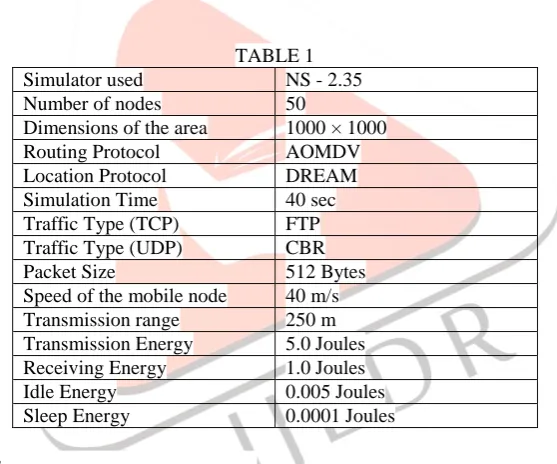
Simulation parameters used for case study are mentioned in TABLE 1. Results are analyzed for the same.
TABLE 1
Simulator used NS - 2.35
Number of nodes 50
Dimensions of the area 1000 × 1000
Routing Protocol AOMDV
Location Protocol DREAM
Simulation Time 40 sec
Traffic Type (TCP) FTP
Traffic Type (UDP) CBR
Packet Size 512 Bytes
Speed of the mobile node 40 m/s Transmission range 250 m Transmission Energy 5.0 Joules Receiving Energy 1.0 Joules
Idle Energy 0.005 Joules
Sleep Energy 0.0001 Joules
Average Energy Consumption
The average energy consumed by a node to transmit or receive the data. Consumed Energy = Initial Energy - Final Energy
Total Energy = Total Energy + Consumed Energy Average Energy = Total Energy / n
Overhead
The amount of information needed to describe the changes in the dynamic topology. Routing Overhead = total no. of routing packets received / total no. of data packets received
Packet Delivery Fraction (PDF)
IJEDR1502149
International Journal of Engineering Development and Research (www.ijedr.org)843
ThroughputThe number of bytes per second, and is measured in kbps.
Throughput = (Received size × 8) / ( (Stop time - Start time) × 1000)
Delay
The time delay between the sent and received packets. It is measured in ms (milli seconds) Delay = ∑ (End time- Start time)
Total Delay = Delay / count
Average Delay = Total Delay × 1000
VI.CONCLUSION
There are various routing algorithms to minimize energy efficiency, one of which is AOMDV. It is a energy efficient, and a robust routing protocol. With addition to this, DREAM protocol, which is a location-based protocol, helps to maintain the location information of each node, which in turn reduces the frequency of flood route discovery. Therefore, the energy is minimized using sleep scheduling effect algorithm, and the long lifetime of the nodes in the network is achieved, with reduced overhead and delay, and with an increased throughput and PDR (packet delivery ratio).
VII.ACKNOWLEDGEMENT
I am thankful to "Mr. H.B.Mahesh" for his imperative appeal and reinforce contacted me without which i couldn't have had the ability to complete the paper. I thank the baffling judges for their reviews that in a general sense improved the presentation of this paper. Words can't express our gratefulness for each one of those people who helped clearly or by suggestion in my attempt. I take this risk to express my honest to goodness due to all staff people from CS&E division of PESIT for the huge suggestion.
0 20 40 60 80 100
0 10 20 30 40 50
No. of nodes
PDR (TCP)
PDR (UDP)
0 50 100 150 200 250 300 350
0 10 25 50
No. of nodes
Throughput (TCP)
Throughput (UDP)
0 20 40 60 80 100 120 140
0 10 20 30 40 50
No. of nodes
Delay(TCP)
IJEDR1502149
International Journal of Engineering Development and Research (www.ijedr.org)844
VIII.REFERENCES[1] Nisarg A Patel, Manojkumar B Patel, and Ankit K Patel, "Energy Efficiency And Better Throughput In MANET Using Improved AOMDV", IJSRD - International Journal for Scientific Research & Development| Vol. 2, Issue 04, 2014.
[2] Mr. Sourabh Pandey and Mr. Rajender Singh Yadav, "Energy Efficient Location based Routing Using DREAM Algorithm for MANET", IOSR Journal of Engineering (IOSR-JEN) e-ISSN: 2250-3021, p-ISSN: 2278-8719 Vol. 3, Issue 8 (August. 2013). [3] Ruchi Gupta, Akhilesh A.Waoo, Sanjay Sharma and P. S Patheja, "A Research Paper on Comparison between Energy Efficient Routing Protocol with Energy and Location in MANET", IOSR Journal of Computer Engineering (IOSR-JCE) e-ISSN: 2278-0661, p- ISSN: 2278-8727Volume 9, Issue 4 (Mar. - Apr. 2013), PP 70-75.
[4] Hassanali Nasehi, Nastooh Taheri Javan, Amir Bagheri Aghababa and Yasna Ghanbari Birgani, "Improving Energy Efficiency In Manets By multi-Path Routing", International Journal of Wireless & Mobile Networks (IJWMN) Vol. 5, No. 1, February 2013. [5] Jagtar Singh and Natasha Dhiman, "A Review Paper on Introduction to Mobile Ad Hoc Networks", International Journal of Latest Trends in Engineering and Technology (IJLTET) ISSN: 2278-621X Vol. 2 Issue 4 July 2013.
[6] T.S.Asha and Dr.N.J.R.Muniraj, "Energy Efficient Topology Control Approach for Mobile Ad hoc Networks", IJCSI International Journal of Computer Science Issues, Vol. 10, Issue 4, No 1, July 2013 ISSN (Print): 1694-0814 | ISSN (Online): 1694-0784.
[7] May Cho Aye and Aye Moe Aung, "Energy Efficient Routing for MANETs using On-demand Multipath Routing Protocol", International Journal of Advanced Research in Computer Engineering & Technology (IJARCET) Volume 3 Issue 5, May 2014. [8] Ronit Nossenson and Adi Schwartz, "The Impact of Initial Network Topology on Performance of Routing Algorithms in MANETs", Proceedings of the World Congress on Engineering 2012 Vol II WCE 2012, July 4 - 6, 2012, London, U.K.
[9] Manveen Singh Chadha, Rambir Joon and Sandeep, "Simulation and Comparison of AODV, DSR and AOMDV Routing Protocols in MANETs", International Journal of Soft Computing and Engineering (IJSCE) ISSN: 2231-2307, Volume-2, Issue-3, July 2012.