-1-
Aryabhatta Journal of Mathematics & Informatics Vol. 7, No. 1, Jan-June, 2015 ISSN : 0975-7139 Scientific Journal Impact Factor SJIF (2014) : 4.1
Letter to Editor
ON THE FORMAL–LOGICAL ANALYSIS OF THE FOUNDATIONS
OF MATHEMATICS APPLIED TO PROBLEMS IN PHYSICS
Temur Z. Kalanov
Home of Physical Problems, Pisatelskaya 6a, 100200 Tashkent, Uzbekistan. [email protected], [email protected], [email protected]
ABSTRACT :
Results of the critical analysis of the standard foundations of mathematics applied to problems in physics are discussed. The unity of formal logic and of rational dialectics is methodological basis of the analysis. The main result is as follows: the concept of “mathematical quantity” – central concept of mathematics – is meaningless, erroneous, and inadmissible one because it represents the following formal-logical and dialectical-materialistic errors: negation of the existence of the essential sign of a concept (i.e., negation the existence of the essence of the concept) and negation of the existence of measure of material object. The obtained results lead to the conclusion that the generally accepted foundations of mathematics should be reconsidered.
Keywords: Mathematics, Number Theory, Mathematical Physics, Physics, Geometry, Engineering, Formal Logic, Philosophy Of Science
MSC: 00A05, 00A30, 00A30g, 00A35, 00A69, 00A79, 03A05, 03A10, 03B42, 03B44, 03B80, 33B10, 03F50, 97E20, 97E30, 97G60, 97G70, 97F60, 97M50, 51M15, 51N35, 51P05
1. As is well known, mathematical physics is the fundamental science of "the application of mathematics to
problems in physics and the development of mathematical methods suitable for such applications and for the
formulation of physical theories" (The Journal of Mathematical Physics). Mathematical physics arose from the
needs of science and practice and has a long history of development. The important significance of this field of science is determined by the contribution of prominent scientists of past and present times. However, it does not mean that the problem of validity of the achievements of mathematical physics is now completely solved, or that the foundations of mathematics and physics are not in need of analysis within the framework of the correct methodological basis: the unity of formal logic and of rational dialectics. In my opinion, standard mathematical and physical theories can not be considered as scientific truth if there is no formal-logical and dialectical substantiation of it in science.
2. The correct methodological basis represents theoretical generalization of practice and, therefore, is the
Temur Z. Kalanov
-2-
3. In my opinion, a thorough understanding of the foundations of mathematics is impossible without a critical
analysis of the concept of mathematical quantity – central concept of mathematics. A critical analysis of the concept of mathematical quantity leads to the following conclusion:
The concept of “mathematical quantity” is the result of the following mental operations: (i) abstraction of the “quantitative determinacy of physical quantity” from the “physical quantity” at that the “quantitative determinacy of physical quantity” is an independent object of thought; (ii) abstraction of the “amount (i.e., abstract number)” from the “quantitative determinacy of physical quantity” at that the “amount (i.e., abstract number)” is an independent object of thought. In this case, unnamed, abstract numbers are the only sign of the “mathematical quantity”. This sign is not an essential sign of the material objects. Therefore, the content of the concept of “mathematical quantity” is zero, and the volume of this concept is infinitely large.
Thus, the concept of mathematical quantity is meaningless, erroneous, and inadmissible concept in science because it represents the following formal-logical and dialectical-materialistic error: negation of the existence of the essential sign of the concept (i.e., negation the existence of the essence of the concept) and negation of the existence of measure of material object.
4. Mathematical theories can be applied to problems in physics if and only if the mathematical relationships are
interpreted geometrically or physically. The interpretation is that the mathematical quantities in the standard relationship y = f
( )
x are associated with geometric (metric) or physical quantitiesx
M andy
M characterizingthe material object M. Interpretation operation represents replacement x → xM, y → yM in the relationship
( )
x
f
y
=
. In fact, the interpretation is expressed by the identitiesx
=
x
M,y
=
y
M. In this case, the relationshipbetween the physical quantities has the form yM = f
( )
xM and can be tested in practice. This relationship meansthat the interpretation leads to the restoration of the measure of the material object (i.e., the restoration of the unity of qualitative and quantitative determinacy of the material object). Pure mathematics (i.e., mathematics without restored measure) is, according to Einstein, useless science. Therefore, the interpretation is a criterion of truth in pure mathematics.
5. In my published works, analysis of the foundations of mathematics applied to problems in physics was
proposed. It was first shown within the correct methodological basis that the foundations of differential and integral calculus, the foundations of vector calculus, the Pythagorean theorem, the foundations of trigonometry, and the foundations of the theory of negative numbers are not free from objection because these standard results contain the formal-logical and dialectical-materialistic errors. Removing these errors leads to the abolition of many standard theories. And the abolition of the standard theories turns science into helpless and barren knowledge.
-3-
Aryabhatta Journal of Mathematics & Informatics Vol. 7, No. 1, Jan-June, 2015 ISSN : 0975-7139 Scientific Journal Impact Factor SJIF (2014) : 4.1
CRITICAL ANALYSIS OF THE FOUNDATIONS
OF THE THEORY OF NEGATIVE NUMBERS
Temur Z. Kalanov
Home of Physical Problems, Pisatelskaya 6a, 100200 Tashkent, Uzbekistan. [email protected], [email protected], [email protected]
ABSTRACT :
Critical analysis of the foundations of the theory of negative numbers is proposed. The unity of formal logic and of rational dialectics is methodological basis of the analysis. It is shown that the foundations of the theory of negative numbers contradict practice and contain formal-logical errors. The main results are as follows: a) the concept “number sign” is inadmissible one because it represents a formal-logical error; b) all the numbers are neutral ones because the number “zero” is a neutral one; c) signs “plus” and “minus” are only symbols of mathematical operations. The obtained results are the sufficient reason for the following statement. The existence of logical errors in the theory of negative numbers determines the essence of the theory: the theory is a false one.
Keywords: Mathematics, Number Theory, Mathematical Physics, Physics, Geometry, Engineering, Formal Logic, Philosophy of Science
MSC: 00A05, 00A30, 00A30g, 00A35, 00A69, 00A79, 03A05, 03A10, 03B42, 03B44, 03B80, 33B10, 03F50, 97E20, 97E30, 97G60, 97G70, 97F60, 97M50, 51M15, 51N35, 51P05
INTRODUCTION
Recently, the progress of science, engineering, and technology has led to appearance of a new problem – the problem of rationalization of the fundamental sciences. Rationalization of sciences is impossible without rationalization of thinking and critical analysis of the foundations of sciences within the framework of the correct methodological basis: the unity of formal logic and of rational dialectics. Critical analysis of the sciences within the framework of the correct methodological basis shows [1-8] that the foundations of theoretical physics and of mathematics (for example, classical geometry, the Pythagorean theorem, differential and integral calculus, vector calculus, trigonometry) contain logical errors.
As is well known, the theory of negative numbers is an important part of mathematics [6-11] and of mathematical formalism of physics [12]. This theory is widely and successfully used in the natural sciences. The main result of this theory is the following statement: negative numbers and the concept “negative sign of number” have scientific
and practical meaning (for example,
1
−
2
=
0
−
1
=
−
1
). However, it does not mean that the problem of validityof the theory is now completely solved, or that the foundations of the theory are not in need of formal-logical and dialectical analysis. In my view, the theory of negative numbers cannot be considered as scientific truth if there is no formal-logical and dialectical substantiation of it in science.
Temur Z. Kalanov
-4-
1. GEOMETRICAL ANALYSIS OF THE CONCEPT “NEGATIVE NUMBER”
1. As is known, if the Cartesian coordinate system XOY on a plane is given, then the coordinate lines (scales)
X
andY
divide the plane into four quarters (I, II, III, IV), and the point of intersection of coordinate lines – pointO – determines the origin of coordinates (i.e., the number “zero”). The origin of coordinates – the number “zero”
– is on the coordinate scales and divides each scale into two parts: the scale of positive numbers and the scale of negative numbers. In this case, the number “zero” belongs to both the scale of positive numbers and the scale of negative numbers. The following formal-logical contradiction arises: the number “zero” is both the positive number and the negative number.
Standard mathematics asserts that: (a) zero belongs to the positive and negative scales; (b) zero is neither a positive number nor a negative number; (c) zero has no sign; zero is not characterized by a sign: zero is a “neutral number”. In this case, the formal-logical contradiction is conserved.
The contradiction between the qualitative determinacy of the positive number, the qualitative determinacy of the negative number, and the qualitative determinacy of the neutral number has the form of the law of identity:
(positive number) = (negative number); (positive number) = (neutral number); (negative number) = (neutral number).
Then the following questions arise: How does one can eliminate this contradiction? Are negative numbers admissible ones in science and practice? Are there negative and positive numbers in science and practice? The answer to these questions is as follows. The contradiction is eliminated if and only if the law of absence of contradictions,
(positive number) ≠ (negative number), (positive number) ≠ (neutral number), (negative number) ≠ (neutral number),
is not violated. The only correct assertion follows from the law of absence of contradictions: if there exists a neutral number (i.e. the number “zero”) on the numerical scale, then all the numbers on the numeric scale are neutral ones. Thus, neither positive numbers nor negative numbers do not exist on the numerical scale (i.e., they are not admissible numbers).
2. Let the material geometrical figure “square with identical sides ameter ” be in the quarter I of the coordinate
system XOY (in which all the numbers on scales have the dimension “
meter
”) (Figure 1).Critical Analysis of The Foundations of The Theory of Negative Numbers
-5-
If the figure “square with identical sides ameter” is situated in the quarters II and IV, then the sides “ameter”
and “−ameter” are not identical ones: a≠−a. In other words, the geometrical figure “square with identical
sides ameter” turns into the geometrical figure “square with non-identical sides ameter and −ameter” in the
quarters II and IV of the coordinate system XOY. In this case, the correct mathematical relationship a≠−a is
expressed by the formal-logical law of absence of contradictions:
(square with identical sides ameter ) ≠
(square with non-identical sides ameter and −ameter).
And the incorrect mathematical relationship
a
=
−
a
is expressed by the formal-logical law of identity:(square with identical sides ameter) =
(square with non-identical sides ameter and −ameter).
3. The material geometrical figure “square with identical sides ameter” has the area S= a × a = a2. The
calculation of the area of this geometrical figure in the quarters I and IV of the coordinate system XOY leads to
appearance of the concept “imaginary unit”. Really, if
S
I≠
S
IV, then2
a a a
SI = × = ;
S
I=
a
;2
a
a
a
S
IV=
−
×
=
−
;i a a
SIV = −1 = ;
i
≡
−
1
,where
S
I, SIV andS
I , SIV are areas and sides of the figure in the quarters I and IV, respectively;i
is imaginary unit. In this case, the following logical error appears:i a a
SIV = −1 = , because
a
SIV ≠ , SIV ≠−a.
In other words, these relationships signify that SIV represents the area of the square whose sides are equal to
i a a
SIV = −1 = . But SIV = ai contradicts the condition that the sides of this square are equal to a
and −a in the expression
S
IV=
−
a
×
a
=
−
a
2. Consequently, the concepts “negative number” and “imaginaryunit” represent a formal-logical error in the case of
S
I≠
S
IV .Also, a logical error appears if
S
I≡
S
IV. Really, ifS
I≡
S
IV, then1
≡
−
1
,1
≡
−
1
. In order to eliminatethe logical error
1
≡
−
1
, one should introduce the concept of modulus of number:1
=
−
1
≡
1
. (According tothe standard mathematics, modulus of number is a unsigned number. The algebraic quantity of the number always has a sign: plus or minus). The use of the modulus sign signifies the movement of the geometric figure from the
quarters II, III, and IV into the quarter I of the coordinate system XOY . In this case, the geometrical figure
represents the “square with identical sides ameter” in the quarter I.
Temur Z. Kalanov
-6-
2. LOGICAL ANALYSIS OF THE CONCEPT “NUMBER SIGN”
1. As is well known, practice is a criterion of truth. From practical point of view, operations such as
,
1
$
1
$
0
$
2
$
1
$
−
=
−
=
−
,
kilogram
1
kilogram
1
kilogram
0
kilograms
2
kilogram
1
−
=
−
=
−
,
meter
1
meter
1
meter
0
meters
2
meter
1
−
=
−
=
−
,
second
1
second
1
second
0
seconds
2
second
1
−
=
−
=
−
and the results of these operations are meaningless ones, wrong in essence. Interpretation of these operations does not represent a mathematical explanation, has no mathematical meaning. Really, the standard interpretation of
negative numbers is that the quantity −a is interpreted as modulus
−
a
, and then one add an explanation whichis not related to mathematics. In other words, the interpretation of negative numbers signifies a change of qualitative determinacy (meaning) of these numbers.
Since a≠−a,
a
=
−
a
(where a is some number), positive and negative numbers have identical quantitativedeterminacy (i.e.,
a
=
−
a
) but non-identical qualitative determinacy (i.e., a≠−a ). Non-identity ofqualitative determinacy is expressed by the formal-logical law of absence of contradiction:
(positive number) ≠ (negative number);
(positive number) ≠ (unsigned number);
(negative number) ≠ (unsigned number).
The following logical statements are true:
(a) positive numbers have identical quality (quantitative determinacy), and therefore they satisfy the formal-logical law of identity:
(positive number) = (positive numbers).
(If the number “zero” was a positive number, then the number “zero” would have to obey this law);
(b) negative numbers have identical quality (quantitative determinacy), and therefore they satisfy the formal-logical law of identity:
(negative numbers) = (negative numbers).
(If the number “zero” was a negative number, then the number “zero” would have to obey this law);
(c) the number “zero” is the unique (special, particular) number, and it satisfies the formal-logical law of identity:
(number “zero” not having a sign) =
(number “zero not having a sign).
(d) the number “zero” satisfies the formal-logical law of absence of contradiction:
(unsigned number) ≠ (signed number).
But the equations of a type such as
kilogram 1 kilogram 1 kilogram 0 kilograms 2 kilogram 1 − = − = −
Critical Analysis of The Foundations of The Theory of Negative Numbers
-7-
different qualitative determinacy. In other words, the left-hand side contains positive numbers and neutral number “zero”, and the right-hand side contains negative numbers:
(positive numbers and unsigned number “zero”) =
(negative numbers).
This signifies that the mathematical equations containing positive and negative numbers and zero are inadmissible ones in science and practice. It follows that all the numbers are neutral numbers: the numbers have no signs because the number “zero” have no sign. If the number “zero” had a sign, then there would be both the positive and negative numbers.
2. From practical point of view, the number (figure) is a symbol designating some amount or absence of
amount. Numbers can have dimensions (i.e., qualitative determinacy), but they can have no dimensions. The number “zero” is a symbol designating absence of amount. Mathematically, the essence of number “zero” is manifested in the following statements.
(a) The definition of zero is as follows:
a
a
≡
,a
−
a
≡
0
,a
=
a
+
0
,where a is a dimensional or dimensionless number. The definition of zero satisfies the formal-logical law of
identity:
(number not having a sign) = (number not having a sign). (b) The admissible operations on zero are as follows:
a
a
a
a
−
=
0
,
0
=
0
a
;(
)
0
a
a
a
a
a
−
=
,
a
0
=
0
. (c) The inadmissible operation on zero is as follows:0
0
0
0
0
=
−
=
−
a
a
a
a
,
because the number “zero” does not designate some amount, i.e. the number “zero” designates absence of amount. (d) Zero is a special (particular) number. Zero is not a part of any number a, zero is not divided into parts, zero is not composed of parts:
a
=
a
+
0
,0
a
=
0
;a
0
is not a part of a;0
0
is not a part of 0. Zero is neither integer number nor fractional number; zero has no sign.Therefore, firstly, the addition operation on zero and the subtraction operation on zero do not change amount:
0
0
0
±
=
; secondly, the multiplication operation on zero (i.e.,a
×
0
=
0
) and the division operation on zero bysome number (i.e.,
0
a
=
0
) do not lead to change of zero; thirdly, the operations0
−
a
anda
0
areinadmissible ones.
This signifies that zero is the beginning of amount counting out (i.e., the beginning of amount measuring). By definition, the concept “beginning of amount counting out” has the single sense: it is the designation of absence of
amount. Therefore, the subtraction of numbers from zero (i.e.,
0
−
a
) and division of numbers by zero (i.e.,a
0
)are inadmissible operations. The appearance of negative numbers in standard mathematics is stipulated by the following logical error: the assumption that the number “zero” is composed of two parts (i.e., zero is divided into two parts): a and −a, i.e.
a
a
=
−
−
0
,a
+
( )
−
a
=
0
.Temur Z. Kalanov
-8-
Thus, the formal-logical analysis of the concept “number sign” leads to the following conclusion: all the numbers are neutral ones; numbers have no signs; the concepts “positive number” and “negative number” represent a formal logical error.
3. DIALECTICAL ANALYSIS OF THE CONCEPT “SYMBOLS OF MATHEMATICAL
OPERATIONS”
1. Movement is change in general. Movement is a change of the qualitative and quantitative determinacy of the
object. If the qualitative determinacy of the object is not changed, then the movement of the object represents the process of transition of some states of the object into the other states of the object. The process of change is characterized by a direction. If one of the directions can be called a positive direction, then the opposite direction can be called a negative direction.
2. From practical point of view, mathematics is a science of calculations. In mathematics, the quantitative
determinacy of the object (i.e., the state of the object) is characterized by a number, and a change in the quantitative determinacy of the object (i.e., the process of transition of some states into other states on condition that the qualitative determinacy of the object is not changed) is described by means of symbols of operations on quantities (numbers). The concepts “quantitative determinacy of the object (i.e., the state)” and “change of the quantitative determinacy of the object (i.e., process)” are not identical ones. Therefore, the identification of the concepts “state; number” and “change of state; mathematical operation” represents a formal-logical error (i.e., violation of the law of absence of contradiction). Mathematical operations are carried out by people. Therefore, mathematical formalism contains only quantities (numbers) and symbols of operations on quantities (numbers), but mathematical formalism do not contain movement (action).
3. The basic mathematical (quantitative) operations on quantities and numbers are as follows: addition operation
(designated by the symbol “ + ”), subtraction operation (designated by the symbol “ – ”), multiplication operation
(designated by the symbol “ × ”), division operation (designated by the symbol “ : ” or “ / ”). The quantitative
relationship between quantities, symbols of operations on quantities, and result of operations is called mathematical equation. It is designated by the symbol “ = ”.
4. The addition operations and multiplication operations are actions which lead to an increase in the numerical
value of the result of operations; subtraction operations and division operations are actions which lead to a decrease in the numerical value of the result of operations. Operations of increase of the numerical value (i.e., increase of amount) and operations of decrease of the numerical value (i.e., decrease of amount) are mutually opposite operations. If the direction of the operation of increase of amount may be called positive direction, then the direction of the operation of decrease of amount should be called negative direction. If some operation is called direct one, then the operation of inversion of direct operation is called inverse operation. For example, if the operations
a
×
b
,b
×
a
,a
+
b
,b
+
a
are called direct ones, then the operationsa
:
b
(ora
b
),b
:
a
(or
b
a
),a
−
b
,b
−
a
are called inverse ones. Direct and inverse operations are called mutually oppositeCritical Analysis of The Foundations of The Theory of Negative Numbers
-9-
5. The solution to this problem is as follows.
a) The symbols of mathematical operations have practical meaning and can be practically used only in combination with numbers and the designations of the numbers in letters: for example,
c
b
a
+
=
,d
b
a
−
=
,a
>
b
,h
a
b
−
=
,b
>
a
,k
a
b
b
a
×
=
×
=
,l
b
a
=
,b
a
=
1
l
,where the letters designate numbers. In other words, the symbol of the operation relates two quantities (numbers). Therefore, the symbol of the operation of inversion of direction should contain a letter (number) and the symbol of the mathematical operation.
b) The definition of operational form of operations and correspondence between the standard form of operations
(left-hand side of relationships) and the operational form of operations (right-hand side of relationships) are as follows:
b
a
b
a
+
≡
+
,b
+
a
≡
b
+
a
;b
a
b
a
−
≡
−
,b
−
a
≡
b
−
a
;b
a
b
a
×
≡
×
,b
×
a
≡
b
×
a
;a
b
b
a
≡
,b
a
≡
a
b
;( ) ( )
a
b
×
b
a
≡
b
a
×
a
b
≡
1
;×
−
≡
−
1
1
,−
a
≡
−
1
×
a
,−
b
≡
−
1
×
b
;( ) ( )
2 21
1
a
a
a
a
×
−
≡
−
×
−
×
≡
−
;( ) ( )
2 21
1
b
b
b
b
×
−
≡
−
×
−
×
≡
−
;×
≡
×
−
×
−
1
1
1
,−
1
×
1
×
≡
−
1
×
;
b
−
a
≡
−
1
×
(
a
−
b
)
,a
−
b
≡
−
1
×
(
b
−
a
)
,where expression in angle brackets designates an operator,
−
1
×
is the operator of the inversion of directionof operation. Multiplication of operators represents successive fulfilment of operations: for example, the expression
×
≡
×
−
×
−
1
1
1
represents the inversion of the operation of inversion.c) The establishing of correspondence between the standard form of the operations and the operational form of the operations is a necessary condition for understanding of the qualitative distinction between a number sign and a symbol of operation. If the understanding is achieved, it is possible to use standard mathematical designation. However, it is not allowed to ascribe sign “plus” or “minus” to quantities (numbers).
Temur Z. Kalanov
-10-
4. DISCUSSION
1. As is well known, the concept of negative numbers appeared in ancient mathematics in the 7th century, and
finally formed in the 19th century. The great mathematicians of antiquity were wise men because they understood that practice is criterion of truth. Therefore, they called negative numbers by “false”, “dummy”, “absurd", and “imaginary” numbers. “By the beginning of the 19th century Caspar Wessel (1745-1818) and Jean Argand (1768-1822) had produced different mathematical representations of 'imaginary' numbers, and around the same time Augustus De Morgan (1806-1871), George Peacock (1791-1858), William Hamilton (1805-1865), and others began to work on the 'logic' of arithmetic and algebra and a clearer definition of negative numbers, imaginary quantities, and the nature of the operations on them began to emerge . Negative numbers and imaginaries are now built into the mathematical models of the physical world of science, engineering and the commercial world. There are many applications of negative numbers today in banking, commodity markets, electrical engineering, and anywhere we use a frame of reference as in coordinate geometry, or relativity theory” (Encyclopedia). However, the concept “methodological basis of science” is not contained in mathematics until now.
2. The standard theory of negative numbers, first worded in the article “Theory of Conjugate Functions, or
Algebraic Couples; with a Preliminary and Elementary Essay on Algebra as the Science of Pure Time” by William Rowan Hamilton, legalized the existence of negative numbers in mathematics and put an end to criticism of
negative numbers. The scientists called positive and negative numbers, and number 0 by rational numbers and
were satisfied that need for serious thinking about the true sense of negative numbers and of zero fell off. The stage of interpretation of negative numbers in science was begun. For example, the interpretation of some well-known negative numbers is as follows:
a) Number −273,15o C is the absolute zero of temperature, i.e. zero degrees Kelvin. Interpretation of this
negative number is as follows: number
−
273
,
15
represents the modulus−
273
,
15
; sign “minus” signifies thatnumber
−
273
,
15
is below zero; concepts “negative” and “below” are identical ones; the term “below” has nomathematical meaning.
b) Number 19 Cl
10 565 176 602 ,
1 × −
− is the electron charge. Interpretation of this negative number is as
follows: number −1,602176565×10⁻¹⁹ represents the modulus −602176565×10−19 ; number
19 10 565 176
602 × −
− is quantity of charge (i.e., quantitative determinacy); sign “minus” signifies qualitative
determinacy of the electron; concepts “minus sign” and “electron” are identical ones; the term “electron” has no mathematical meaning. Also, the term “proton” has no mathematical meaning if one identifies the concepts “plus sign” and “proton charge”.
c) Number
−
13
,
7
milliard
years
is the beginning of formation of the Universe. Interpretation of thisnegative number is as follows: number
−
13
,
7
represents the modulus−
13
,
7
; number−
13
,
7
is quantitativedeterminacy; “minus sign” signifies qualitative determinacy of number
−
13
,
7
; concepts “minus sign” and“beginning” are identical ones; the term “beginning” has no mathematical meaning.
Thus, qualitative determinacy of negative numbers is expressed by concepts which have no mathematical meaning:
(mathematical concept) = (non-mathematical concept).
Critical Analysis of The Foundations of The Theory of Negative Numbers
-11-
3. There is no logical definition of the concept “negative number” in science and practice. And definition such
as “negative number represents the number which is not a positive number” is inadmissible one in formal logic because such definition represents “contradictious (negative) definition”. The correct definition should be “confirmatory (positive) definition”.
Positive and negative numbers and the number “zero” have different qualitative determinacy (even if these numbers have the same dimension). This signifies that the scale of positive numbers and the scale of negative numbers
cannot have common point O (i.e., the number 0) in the Cartesian coordinate system XOY . Therefore, the
existence of the coordinate system XOY represents a formal-logical error.
From a practical point of view, all the numbers (having dimension or not) are always a result of measurement (or comparison). Negative numbers do not represent a measuring result or a consequence of the existence of positive numbers. This signifies that the set of negative numbers is not a supplement (expansion, extension) of the set of positive integers because positive and negative numbers have different qualitative determinacy. (In other words, if the existence of negative numbers would be cause of the existence of positive numbers, then one could be built negative numbers on the basis of positive numbers). Consequently, the existence of negative numbers is not consistent with practice and is not confirmed by practice.
Negative numbers are inadmissible ones: they should exist neither in science nor in practice. All the numbers obtained in measurements and having the same dimension are characterized by identical qualitative determinacy. Number “zero” is a neutral number. Consequently, all the numbers represent neutral numbers (i.e., the numbers which have no sign “plus’ or “minus”), and the concept “number sign” is inadmissible one. Sign “plus” and “minus” are only symbols of mathematical operations.
4. The theory of negative numbers is not unique erroneous theory in mathematics. As shown in the works
[6-28], differential and integral calculus, the Pythagorean theorem, vector calculus, and trigonometry are erroneous theories too. Therefore, today mathematics stands in front of the dilemma: either to recognize the existence of formal-logical errors or to continue movement on the wrong track.
CONCLUSION
Thus, the results of the critical analysis of the theory of negative numbers within the framework of correct methodological basis – the unity of formal logic and of rational dialectics – are as follows:
1. negative numbers are inadmissible ones in science because they represent a formal-logical error;
2. the concept “number sign” is inadmissible one because it represents a formal-logical error;
3. all the numbers are neutral ones because the number “zero” is a neutral one;
4. signs “plus” and “minus” are only symbols of mathematical operations;
5. the operational form of mathematical operations furnishes the clue to understanding of the operation of
inversion of operation.
Temur Z. Kalanov
-12-
REFERENCES
1. T.Z. Kalanov. “The critical analysis of the foundations of theoretical physics. Crisis in theoretical physics:
The problem of scientific truth”. Lambert Academic Publishing. ISBN 978-3-8433-6367-9. (2010).
2. T.Z. Kalanov. “Analysis of the problem of relation between geometry and natural sciences”. Prespacetime
Journal. Vol. 1, No 5, (2010), pp. 75-87.
3. T.Z. Kalanov. “Logical analysis of the foundations of differential and integral calculus”. Bulletin of Pure and
Applied Sciences. Vol. 30 E (Math.& Stat.), No. 2, (2011), pp. 327-334.
4. T.Z. Kalanov. “On rationalization of the foundations of differential calculus”. Bulletin of Pure and Applied
Sciences. Vol. 31E (Math.& Stat.), No. 1, (2012), pp. 1-7.
5. T.Z. Kalanov. “The critical analysis of the Pythagorean theorem and of the problem of irrational numbers”.
Bulletin of Pure and Applied Sciences. Vol. 32 (Math & Stat), No. 1, (2013), p. 1-12.
6. T.Z. Kalanov. “On the logical analysis of the foundations of vector calculus”. Aryabhatta Journal of Mathematics & Informatics. Vol. 5, No. 2, (2013), pp. 227-234.
7. T.Z. Kalanov. “Critical analysis of the mathematical formalism of theoretical physics. II. Foundations of
vector calculus”. Bulletin of Pure and Applied Sciences. Vol. 32 E (Math & Stat), No. 2, (2013), p.121-130.
8. T.Z. Kalanov. “On the system analysis of the foundations of trigonometry”. Bulletin of Pure and Applied
Sciences. Vol. 33E (Math & Stat), No. 1, (2014), pp. 1-27.
9. N. Bourbaki. Elements of the History of Mathematics. Berlin, Heidelberg, and New York: Springer-Verlag.
ISBN 3-540-64767-8. (1998).
10. G. Ifrah. The Universal History of Numbers. Harvill Press, London. (1998).
11. W.R. Hamilton. “Theory of conjugate functions, or algebraic couples; with a preliminary and elementary essay on algebra as the science of pure time”. (Transactions of the Royal Irish Academy, vol. 17, part 1 (1837), pp. 293-422).Edited by David R. Wilkins, 2000.
-13-
Aryabhatta Journal of Mathematics & Informatics Vol. 7, No. 1, Jan-June, 2015 ISSN : 0975-7139 Scientific Journal Impact Factor SJIF (2014) : 4.1
FORECASTING THE FREE CORTISOL LEVELS AFTER
AWAKENING BASED ON HIGH-ORDER FUZZY LOGICAL
RELATIONSHIP
Dr. P. Senthil Kumar*, B. Mohamed Harif ** & A. Nithya***
*Assistant professor of Mathematics, Rajah Serofji Government College, Thanjavur.(T.N), E-mail: [email protected] **Assistant professor of Mathematics, Rajah Serofji Government College, Thanjavur.(T.N), E-mail: [email protected] ***Research Scholar, Department of Mathematics, Rajah Serofji Government College, Thanjavur.(T.N), E-mail: [email protected]
ABSTRACT :
People usually use many methods to predict the weather, the temperature, the stock index, the enrollments, the earthquake, the economy, etc. A growing body of data suggests that a significantly enhanced salivary cortisol response to waking may indicate an enduring tendency to abnormal cortisol regulation. Based on these forecasting results, our objective was to apply the response test to a population already known to have long-term hypothalamo–pituitary–adrenocortical (HPA) axis dysregulation. We hypothesized that the free cortisol response to waking, believed to be genetically influenced, would be elevated in a significant percent age of cases, regard less of the afternoon Dexamethasone Suppression Test (DST) value based on high-order fuzzy logical relationships. First, the proposed method fuzzifies the historical data into fuzzy sets to form high-order fuzzy logical relationships. Then, it calculates the value of the variable between the subscripts of adjacent fuzzy sets appearing in the antecedents of high-order fuzzy logical relationships. Then, it lets the high-order fuzzy logical relationships with the same variable value form a order fuzzy logical relationship group. Finally, it chooses a high-order fuzzy logical relationships group to forecast the free cortisol response to walking and the short day time profile. Keywords: Fuzzy Time Series, Fuzzy Logical Relationship, Fuzzy Logical Relationship Groups, Mean Square Error, glucocorticoids, salivary cortisol, bipolar disorder, lithium, Dexamethasone Suppression Test, DST. 2000 Mathematics Subject Classification: Primary 90B22, Secondary 90B05; 60K30
1. INTRODUCTION
A growing body of literature points to hypothalamo–pituitary–adrenocortical (HPA) axis dysregulation as a critical factor in the development of mood disorders. Long-term enhanced cortisol secretion may have important health ramifications in addition to its contribution to mood syndromes. The free cortisol response to waking is a promising series of salivary tests that may provide a useful and non-invasive measure of HPA functioning in high-risk studies. The small sample size limits generalizability of our findings. Because interrupted sleep may interfere with the waking cortisol rise, we may have underestimated the proportion of our population with enhanced cortisol secretion. Highly cooperative participants are required[4].
Song and Chissom[2], [3], [5] proposed the time invariant fuzzy time series model and the time-variant fuzzy time series model to deal with the forecasting problems in which the historical data are represented by linguistic values. Because Song and Chissom’s method used the max-min operations to forecast the enrollments of the University of Alabama, they take a lot of computation time to deal with max-min composition operations. Chen[7], [11] presented a method to forecast the enrollments of the University of Alabama by using a simple fuzzy time series forecasting model.
Dr. P. Senthil Kumar, B. Mohamed Harif & A. Nithya
-14-
forecasting problems based on the intervals with different lengths. Recently Senthil & Harif [12] developed a fuzzy modelof extended Hausdroff distance to test the hypothesis that high job demands & low job control are associated with elevated free cortisol levels.
In this paper, we present a new method to forecast the A growing body of data suggests that a significantly enhanced salivary cortisol response to waking may indicate an enduring tendency to abnormal cortisol regulation. Based on these forecasting results, our objective was to apply the response test to a population already known to have long-term hypothalamo–pituitary–adrenocortical (HPA) axis dysregulation. We hypothesized that the free cortisol response to waking, believed to be genetically influenced, would be elevated in a significant percent age of cases, regard less of the afternoon Dexamethasone Suppression Test (DST) value based on high-order fuzzy logical relationships. First, the proposed method fuzzifies the historical data into fuzzy sets to form high-order fuzzy logical relationships. Then, it calculates the value of the variable between the subscripts of adjacent fuzzy sets appearing in the antecedents of high-order fuzzy logical relationships. Then, it lets the high-order fuzzy logical relationships with the same variable value form a high-order fuzzy logical relationship group.
2. PRELIMINARIES
The concepts of fuzzy time series are presented by Song and Chissom, where the values in a fuzzy time series are represented by fuzzy sets (Zadeh, 1965)[1]. Let D be the universe of discourse, where
D
=
{ }
d
i ni=1. A fuzzy seti
A in the universe of discourse D is defined as follows:
∑
=
= n
i i
i A i
d d f
A i
1 ) (
, Where
i A
f
is the membership function of the fuzzy set Ai,i A
f
: D→
[
0
,
1
]
,f
A(
d
j)
i is the
degree of membership of
d
j in the fuzzy set Ai,f
A(
d
j)
∈
[
0
,
1
]
i and 1≤ j ≤n.
Recently, interest has turned to more refined testing and the probability that HPA dysregulation may even predate the onset of clinical illness [9]. Preliminary data suggest that this dysregulation may be concentrated within the families of individuals with mood disorders [6], suggesting the hypothesis that early abnormalities in cortisol regulation may confer a risk for the future development of mood disorders. To understand the temporal relation between HPA dysregulation and the onset of bipolar disorder (BD), it is essential to have a reliable and non-invasive test that can be repeatedly administered prospectively and is acceptable to high-risk populations. Promising candidates for such a test include the salivary free cortisol response to waking and the short day time profile, a test that adds afternoon and evening measurements to the waking values[9].
Let Y(t)(t=....,0,1,2...) be the universe of discourse in which fuzzy sets fi(t)(i=1,2...) are defined in the universe of discourse Y(t). Assume that F(t) is a collection of fi(t)(i=1,2...), then F(t) is called a fuzzy time series of Y(t)(t=....,0,1,2...).
Assume that there is a fuzzy relationship R(t−1,t), such that F(t)=F(t−1)oR(t−1,t), where the symbol “
o
” represents the max-min composition operator, then F(t) is called caused by F(t−1).Let F(t−1) =Ai and let
F
(
t
)
=
A
j , where Ai andA
j are fuzzy sets, then the fuzzy logical relationship (FLR) between F(t−1) and F(t) can be denoted byA
i→
A
j , where Ai andA
j are called the left-hand side(LHS)and the right hand side (RHS) of the fuzzy logical relationship, respectively.
Forecasting the Free Cortisol Levels After Awakening Based on High-order Fuzzy Logical Relationship -15- , . . . , , , jm i jc i jb i ja i A A A A A A A A → → → →
Then these fuzzy logical relationships can be grouped into a fuzzy logical relationship group, shown as follows:
.
,...
,
,
jb jc jmja
i
A
A
A
A
A
→
Let F(t) be a fuzzy time series. If F(t) is caused by F(t−1),F(t−1),...,andF(t−n), then the fuzzy logical relationship between them can be represented by the “nth-order fuzzy logical relationship”, shown as follows:
) ( ) 1 ( ), 2 ( ),...,
(t n F t F t F t
F − − − → .
If
F
(
t
−
n
)
=
A
in,...,
F
(
t
−
2
)
=
A
i2,
F
(
t
−
1
)
=
A
i1and
F
(
t
)
=
A
j, whereA
in,...,
A
i2,
A
i1and
A
j are fuzzysets, then the nth-order fuzzy logical relationship can be represented by
A
in,...,
A
i2,
A
i1→
A
j,
Where Ain,...,Ai2,andAi1 are called the antecedent fuzzy sets of the nth-order fuzzy logical relationship;
" , ,...,
"Ain Ai2 Ai1 and
"
A
j"
are called the left hand-side and the right-hand side of the nth-order fuzzy logicalrelationship, respectively.
If there are the nth-order fuzzy logical relationships having the same left-hand side, shown as follows:
,
,
,...,
i2 i1 jain
A
A
A
A
→
,
,
,...,
i2 i1 jbin
A
A
A
A
→
,
,
,...,
i2 i1 jcin
A
A
A
A
→
. . .,
,
,...,
i2 i1 jmin
A
A
A
A
→
then these nth-order fuzzy logical relationships form a nth-order fuzzy logical relationships group, shown as follows:
A
in,...,
A
i2,
A
i1→
A
ja,
A
jb,
A
jc,...
A
jm.3. A NEW FORECASTING METHOD BASED ON HIGH-ORDER FUZZY LOGICAL
RELATIONSHIPS
In this section, we present a new forecasting method based on high-order fuzzy logical relationships. The proposed method is now presented as follows:
Step1: Define the universe of discourse D, D=
[
Bmin −B1,Bmax +B2]
into intervals of equal length, wheremin
B
and Bmax are the minimum value and the maximum value of the historical data, respectively, andB
1 andB
2are two proper positive real values to divide the universe of discourse D into n intervals d1,d2,...,dn of equal
length.
Dr. P. Senthil Kumar, B. Mohamed Harif & A. Nithya -16-
,
0
0
0
...
0
0
5
.
0
1
1 2 4 3 2 1 1 n nn
d
d
d
d
d
d
d
A
=
+
+
+
+
+
+
+
− −
,
0
0
0
...
0
5
.
0
1
5
.
0
1 2 4 3 2 1 2 n nn
d
d
d
d
d
d
d
A
=
+
+
+
+
+
+
+
− −
,
0
0
0
...
5
.
0
1
5
.
0
0
1 2 4 3 2 1 3 n nn
d
d
d
d
d
d
d
A
=
+
+
+
+
+
+
+
− −
,
5
.
0
1
5
.
0
...
0
0
0
0
1 2 4 3 2 1 1 n n nn
d
d
d
d
d
d
d
A
=
+
+
+
+
+
+
+
− − −
,
1
5
.
0
0
...
0
0
0
0
1 2 4 3 21 n n n
n
d
d
d
d
d
d
d
A
=
+
+
+
+
+
+
+
− −
Where A1,A2,...andAn are linguistic terms represented by fuzzy sets.
Step3: Fuzzify each historical datum into a fuzzy set defined in Step2. If the historical datum belongs to di and
the maximum membership value of Ai occurs at di , then the historical datum is fuzzified into Ai, where
n
i
≤
≤
1
.Step4: Construct the nth-order fuzzy logical relationships from the fuzzified historical datum of the training data set.
Step5: Transform each nth-order fuzzy logical relationship
"
,
2,
3,...,
,...,
"
1 X X Xj X Xr
X
A
A
A
A
A
A
n
→
intothe following form:
) ( .. ... ) ( ... ) 2 ( ) 1 ( 1 .. ... ) ( ... ) 2 ( ) 1 ( 1 ) 2 ( ) 1 ( 1 ) 1 ( 1
1, X V X , X VX V X ,... X V X V X V Xi , X V X V X V Xi V Xm
X A A A A
A + + + + + + + + + + + + + +
) ( ) ( .. ... ) ( ... ) 2 ( ) 1 (
1 V X V X V Xi V Xm V Xn
X
A
+ + + + + + +→
, where V(X1),V(X2),...,andV(Xn) are integers.Step6: Let the transformed nth-order fuzzy logical relationships obtained in Step5 having the same left-hand side form a nth-order fuzzy logical relationship group. For example, let us consider the following transformed third-order fuzzy logical relationships:
) 3 ( ) 2 ( ) 1 ( 1 ) 2 ( ) 1 ( 1 ) 1 ( 1
1, a Va , a Va Va a Va Va Va
a A A A
A + + + → + + + ,
, ) 3 ( ) 2 ( ) 1 ( 1 ) 2 ( ) 1 ( 1 ) 1 ( 1
1, b Vb , b Vb Vb b Vb Vb Vb
b A A A
A + + + → + + +
. . . ) 3 ( ) 2 ( ) 1 ( 1 ) 2 ( ) 1 ( 1 ) 1 ( 1
1, k Vk , k Vk Vk k Vk Vk Vk
k A A A
A + + + → + + + ,
Where
V
(
a
1)
=
V
(
b
1)
=
...
=
V
(
k
1)
andV
(
a
2)
=
V
(
b
2)
=
...
=
V
(
k
2)
, then these third- order fuzzy logical relationships can be grouped into a transformed third-order fuzzy logical relationships group, shown as follows:) 3 ( ) 2 ( ) 1 ( ) 3 ( ) 2 ( ) 1 ( ) 3 ( ) 2 ( ) 1 ( ) 2 ( ) 1 ( 1 ) 1 ( , ,..., , , k V Y V Y V b V Y V Y V a V Y V Y V Y V Y V Y
V X X X X
X
X A A A A A
A + + + → + + + + + + + + + , where
X
=
a
1,
b
1,...
k
1 ,)
(
...
)
(
)
(
)
(
Y
1V
a
1V
b
1V
k
1V
=
=
=
=
andV
(
Y
2)
=
V
(
a
2)
=
V
(
b
2)
=
...
=
V
(
k
2)
.Step7: Choose a transformed nth-order fuzzy logical relationship group for prediction. Assume that
1 2
) 1
(
,...
(
2
)
,
(
1
)
))
1
(
(
,
)
(
t
n
A
inF
t
n
A
inF
t
A
iand
F
t
A
iF
−
=
−
−
=
−−
=
−
=
, and assume that we want to predict) (t
F , where Ai1,Ai2,...,and Ain are fuzzy sets. Based on the transformed nth-order fuzzy logical relationship
groups obtained in Step6, choose the corresponding transformed nth-order fuzzy logical relationship group for
Forecasting the Free Cortisol Levels After Awakening Based on High-order Fuzzy Logical Relationship -17- ) ( ) 1 ( ... ) 2 ( ) 1 ( ) ( ) 1 ( . ... ) 1 ( ) ( ) 1 ( ... ... ) 1 ( ) 1 ( .. ... ) 2 ( ) 1 ( 1 ) 1 ( ,..., ,..., , , n k V n Y V Y V Y V n b V n Y V Y V n a V n Y V Y V n Y V Y V Y V Y
V X X X X
X
X A A A A A
A + − + + + + + − + + + + − + + + − + + + + + →
where ( 1) ( ) 1 ( ) ( ) ... ( )
1 2 1 1
,...,
,
−=
+=
+ + + + −=
n Y V Y V Y V X i Y V X n i Xin
A
A
A
A
A
A
, then replace X by the subscript in of thefuzzy set Ain to get the derived fuzzy sets
) ( ) 1 ( ( ... ) 1 ( ) 1 ( 1 ) 1 (
1) ... ( ) ( ) ( ) ... ( ) ( ),...,
( , n k V n Y V Y V in n n n
n V a in V Y V Y V b andA
Y V Y V in A A + − + + + − − + + + + + + +
+ for prediction. Let
) ( ) ( ... ) (
1 in V Y1 V Yn1 V an
j
A
A
=
+ + + − + , letA
j2=
A
in+V(Y1)+...+V(Yn−1)+V(bn)..., and letA
jk=
A
in+V(Y1)+...+V(Yn−1)+V(kn) .Then, the forecasted variable
FVar
is calculated as follows:. 1 1 i k i ji m k m FVar= −
∑
= (1)
Where the maximum membership values of
A
i1,
A
j1,
A
j2,...,
andA
jk occur at the intervalsjk j
j
i
d
d
and
d
d
1,
1,
2,...,
, respectively, andm
i1,
m
j1,
m
j2,...,
andm
jk are the midpoints of the intervalsjk j
j
i
d
d
and
d
d
1,
1,
2,...,
, respectively. The forecasted valueFV
is calculated as follows:FVar t
RV
FV= ( −1)+ (2)
Where RV(t−1) is the real value on trading day t-1.
4. EXAMPLE
Figure 1: The Longitudinal Dexamethasone Suppression Test (DST) data on a fully remitted lithium
responder for past 5 years who was asymptomatic and treated with lithium throughout
We apply the proposed method to forecast the Longitudinal Dexamethasone Suppression Test (DST)[10] data on a
fully remitted lithium responder for past 5 years who was asymptomatic and treated with lithium throughout based on high order fuzzy logical relationships.
A1 = [50, 100], A2 = [100, 150], A3 = [150, 200], A4 = [200, 250], A5 = [250, 300], A6 = [300, 350], A7 = [350,
Dr. P. Senthil Kumar, B. Mohamed Harif & A. Nithya
-18-
Forecasting the Free Cortisol Levels After Awakening Based on High-order Fuzzy Logical Relationship
-19-
Table 2: Transformed second order fuzzy logical relationship groups
5. EXPERIMENTAL RESULTS
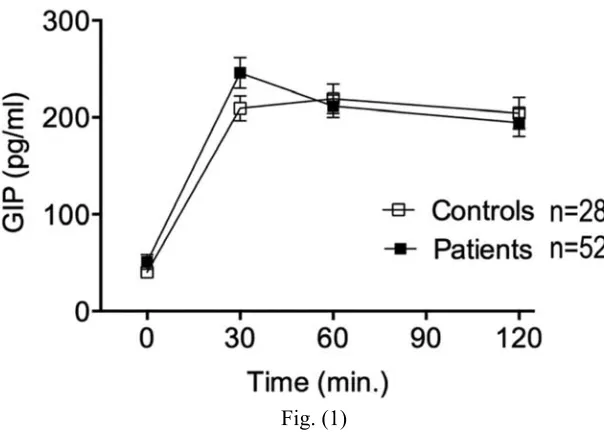
There was a significant difference between BD patients and our control subjects in the maximum percentage rise of salivary cortisol response to awakening. Those showing a waking response also had significantly higher mean cortisol values at 30 minutes after waking, compared with 509 normal subjects described in Wust’s and others study [4]. Base line values at time zero, immediately upon waking, did not differ significantly between our sample and Wust’s control subjects [4]. Patients and our 5 control subjects did not differ significantly in the percent age decline from the peak morning value to the evening values.
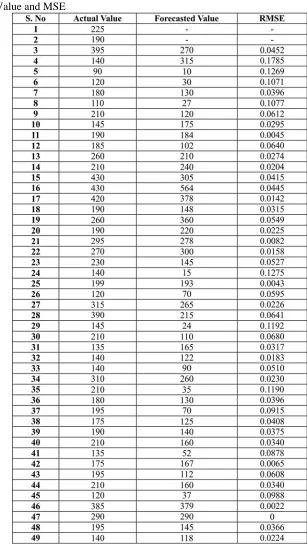
In this section we apply the proposed for forecasting the Longitudinal Dexamethasone Suppression Test (DST)
data on a fully remitted lithium responder for past 5 years who was asymptomatic and treated with lithium throughout. We evaluate the performance of the proposed method using the root mean square error (RMSE), which is defined as follows:
i
2 i
value forecasted
| value
forecasted |
RMSE
⎟ ⎟ ⎠ ⎞ ⎜
⎜ ⎝
⎛ −
= n
value acutual i
Where
n
denotes the number of dates needed to be forecasted,forecasted
value
i denotes the forecasted value on trading day i, acutualvaluei denotes the actual value on trading day i and1
≤
i
≤
n
.Dr. P. Senthil Kumar, B. Mohamed Harif & A. Nithya
-20-
Table 3: Forecasted Value and MSE
It means that the proposed method gets a higher average forecasting accuracy rate than other existing methods to
forecast the maximum percentage rise of salivary cortisol response to awakening. we can see that the proposed
Forecasting the Free Cortisol Levels After Awakening Based on High-order Fuzzy Logical Relationship
-21-
Figure 2: Actual value and Forecasted value for the Longitudinal Dexamethasone Suppression Test (DST)[10] data on a fully remitted lithium responder for past 5 years who was asymptomatic and treated with lithium throughout
CONCLUSION
In this paper, Our dysregulation, even when lithium-responsive BD patients are clinically well and their DSTs are
observations support the hypothesis that the free cortisol response to waking can reflect relatively enduring HPA normal. Because the test is easy to administer, the free cortisol response to waking may hold promise as a marker in studies of high-risk families predisposed to, or at risk for, mood disorders, we have presented a new method for
forecasting the Longitudinal Dexamethasone Suppression Test (DST) data on a fully remitted lithium responder for
past 5 years who was asymptomatic and treated with lithium throughout based on high-order fuzzy logical relationships. The proposed method gets a higher forecasting rate than the existing methods.
REFERENCES
1. Zadeh, L.A.(1965). Fuzzy sets. Information and control, 8, 338-353.
2. Song, Q,& Chissom, B.S. (1993a). Fuzzy time series and its model. Fuzzy sets and systems,54(3), 269-277.
3. Song, Q,& Chissom, B.S. (1993b). Forecasting enrollments with fuzzy time series- Part I. Fuzzy sets and
systems, 54(1),1-9.
4. Kirschbaum C, Hellhammer DH.( 1994) Salivary cortisol in psychoneuroendocrine research: recent developments and applications. Psychoneuroendocrinolog, (19), 313–33.
5. Song, Q,& Chissom, B.S. (1994). Forecasting enrollments with fuzzy time series-Part II. Fuzzy sets and
Systems, 62(1), 1-8.

![Figure 2: Actual value and Forecasted value for the Longitudinal Dexamethasone Suppression Test (DST)[10] data on a fully remitted lithium responder for past 5 years who was asymptomatic and treated with lithium throughout](https://thumb-us.123doks.com/thumbv2/123dok_us/8608487.1398195/21.612.55.564.81.287/figure-forecasted-longitudinal-dexamethasone-suppression-remitted-responder-asymptomatic.webp)