Partially balanced incomplete block designs having three associate classes by using symmetric differences
Gurinder Pal Singh
Assistant Professor, University School of Business Chandigarh University, Mohali (PB)
Davinder Kumar Garg
Professor & Head, Department of Statistics, Punjabi University, Patiala – 147002(Pb), India
Abstract
A new series of Partially Balanced Incomplete Block (PBIB) designs having three associate classes along with their association scheme are introduced in this paper. New series is constructed by using method of differences with introducing initial blocks using different classes of a treatment. PBIB designs of new series are constructed in such a way that there is no fixation apply on v, b, r, k with one particular restriction on‘s’ (s ≥ 4).Three kinds of existing efficiencies and the average efficiency factor (A.E.F) of the newly constructed PBIB designs to compare with already existing designs, illustration for a particular parametric combination for practical understanding and conclusion of research work are also discussed in this paper.
Keywords & phrases: Partially balanced incomplete block designs, association matrices, initial block, pure difference, mixed difference
Mathematical subject code: Primary 62K10, Secondary 62K99
1. Introduction
A new series of higher associate class Partially Balanced Incomplete Block (PBIB) designs along with their association scheme are presented in this paper. New series is constructed by using method of differences and by introducing initial blocks using different classes of a treatment. Similar type of work available in literature is due to Bose et al (1953) in which they introduced the method of differences in the construction of two associate class PBIB designs. Stanton and Sprott (1958) introduced a cyclic difference set defined as a set of k distinct residues d1, d2 , d3 ,…, dk ( module v) with the property that all
non- zero residues modulo v occurs exactly λ times among the difference di = dj ( i ≠ j). Raghavarao and
Aggarwal (1974) introduced rectangular designs with parameters v = mn, b = tm, r,k, n1= m-1, n2 = m-1,
n3 = (n-1)(m-1) with λ1 ,λ2, λ3 by developing tm blocks from t – initial blocks, each contain k treatments
by considering tk(k – 1) differences. The method of differences used to construct rectangular designs by Nair (1980) and Aggarwal (1983). Similarly, Yi – Suen (1989) also constructed rectangular designs with parameters v = (st+1)s, b = s(st+1), r= st = k, n1= s-1, n2 = st, n3 = (s-1)st, λ1 = 0,λ2 = t-1, λ3 = t by using s –
initial blocks.
In this way, we are able to construct a new series of three associate class PBIB designs for v ≤ 20 and k ≤ 10. In this series, three associate class PBIB designs with variable replicates for (s ≥ 4) for suitable values of v, b, r, k, λi’s and ni’ s have been constructed. For complete description and understanding of
method of differences, we refer to Raghavarao (1971)and Hinkelmann and Kempthorne (2005) .
2. Series of three associate class PBIB designs
We introduced a series of three associate class PBIB designs by using method of symmetric repeated differences having parameters
v= 2s, b=2( s + 1), r= s + 1, k= s, λ1 = s -1, λ2= 2, λ3 =0, n1 = s-1 = n2 and n3 = 1 for s≥4
The construction method of blocks, association scheme along with P – matrices of association scheme of the new series of PBIB designs are discussed in the following sections.
3. Construction methodology
In this design, all basic requirements depend merely upon one parameter say ‘s’. Consider module (under addition) 2 and for each element of mod(2), let there correspond to ‘s’( s≥ 4) elements. It mean treatments can be 0 or 1 only and each treatment has‘s’ different classes. Consider the following set of blocks containing ‘s’ elements each as initial blocks. Let these initial blocks be expressed as
[01, 02, 03, …,0s] and [0i, 1i+1, 1i+2, …,1i+j ] for i = 1,2,….s under the condition that
i + j = 𝑠𝑢𝑚 𝑜𝑓 𝑖 𝑎𝑛𝑑 𝑗 , 𝑖𝑓 𝑖 + 𝑗 ≤ 𝑠𝑚𝑜𝑑 𝑠 , 𝑖𝑓 𝑖 + 𝑗 > 𝑠 , where j ∈ N with j < s.
In this way, we have ‘s + 1’ initial blocks and all the remaining ‘s+1’ blocks are arising from these blocks by adding ‘1’ to each element under mod(2).
Using the above procedure, we get a new series of three associate class PBIB designs with parameters v= 2s, b=2( s + 1), r= s + 1, k= s, t= s +1 (initial blocks), n=s (classes) λ1 = s -1, λ2= 2, λ3 =0 with n1 = s-1 =
n2 and n3 = 1 for s ≥ 4 following an association scheme as given below.
4. Association scheme
The total number of blocks in the above constructed design are 2(s+1) and every treatment repeats itself ‘s+1’ times. In these blocks zero mixed differences and mixed differences symmetrically repeated. Let us take a particular treatment say ‘θ’.
Treatment pairs of type (θ, θi) occurs ‘s-1’ times in these blocks, where i =1,2,…,s-1 are 1st associate
of ‘θ’ and n1 = s-1. Treatment pairs of type (θ, θj ) occurs exactly two times in these blocks , where j=
1,2,…,s-1 are 2nd associate of ‘θ’ and n2 =s - 1.
One remaining treatment say ‘φ’ which does not occur with ‘θ’ in any block or in other words treatment pair type (θ, φ ) does not occur in these blocks are 3rd associates of ‘θ’ and n3 = 1.
5. P – matrices
P1 =
P2 =
0 𝑠 − 2 1 𝑠 − 2 0 0
1 0 0
P3 =
0 𝑠 − 1 0 𝑠 − 1 0 0 0 0 0
6. Illustration of construction
For s= 6 , it is clear that v = 12 , b = 14, r = 7, k = 6, t = 7( initial blocks) , n = 6 (classes) under mod(2) represent two treatments and each treatment has six different classes. Let treatments be 0 and 1 and let six different classes for each treatment be 1,2,3,4,5,6 with seven initial blocks for i = 1, 2, 3, 4, 5 and 6 under the condition defined in section - 3 are
[01, 02, 03, 04, 05, 06] [01, 12, 13, 14, 15, 16] [02, 13, 14, 15, 16 , 11] [03, 14, 15, 16, 11,12]
[04, 15, 16, 11, 12,13] [05, 16, 11, 12, 13 , 14] [06, 11, 12, 13, 14 , 15]
For more clarification, we represent the treatments as 01 02 03 04 05 06 11 12 13 14 15 16
1 2 3 4 5 6 7 8 9 10 11 12
By using the above initial blocks, the developed blocks under module (2) are as
[01, 02, 03, 04, 05, 06] [11, 12, 13, 14, 15, 16] [01, 12, 13, 14, 15, 16] [11, 02, 03, 04, 05, 06]
[02, 13, 14, 15, 16 , 11] [12, 03, 04, 05, 06 , 01] [03, 14, 15, 16, 11,12] [13, 04, 05, 06, 01,02]
[04, 15, 16, 11, 12,13] [14, 05, 06, 01, 02,03] [05, 16, 11, 12, 13 , 14] [15, 06, 01, 02, 03 , 04]
[06, 11, 12, 13, 14 , 15] [16, 01, 02, 03, 04 , 05]
The complete solution in general form from the above initial and developed blocks is
{1,2,3,4,5,6 } {7,8,9,10,11,12} {1,8,9,10,11,12} {7,2,3,4,5,6}
{ 2,9,10,11,12,7} {8,3,4,5,6,1} {3,10,11,12,7,8} {9,4,5,6,1,2}
{4, 11, 12, 7, 8, 9} {10,5,6,1,2,3} {5,12,7,8,9,10} {11,6,1,2,3,4}
{6,7,8,9,10,11} { 12,1,2,3,4,5}
In this way, we get a three associate class PBIB design with parameter v = 12 , b = 14, r = 7, k = 6 ,λ1 = 5, λ2= 2, λ3 =0, n1 = 5= n2 , n3 = 1.
follows an association scheme given below.
Association scheme
Treatment pairs of type (θ, θi ) which are (1,2), (1,3), (1,4), (1,5), (1,6) occurs five times in blocks of
PBIB design. Therefore, treatments 2,3,4,5 and 6 are 1st associate of ‘1’ and n1 = 5.
Treatment pairs of type (θ, θj ) which are (1,8), (1,9), (1,10), (1,11), (1,12) occurs exactly two times in
these blocks. So, treatments 8, 9, 10, 11 and 12 are 2nd associate of ‘θ’ and n2 = 5.
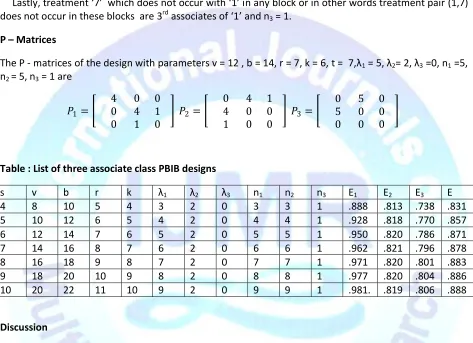
Lastly, treatment ‘7’ which does not occur with ‘1’ in any block or in other words treatment pair (1,7) does not occur in these blocks are 3rd associates of ‘1’ and n3 = 1.
P – Matrices
The P - matrices of the design with parameters v = 12 , b = 14, r = 7, k = 6, t = 7,λ1 = 5, λ2= 2, λ3 =0, n1 =5,
n2 = 5, n3 = 1 are
𝑃1=
4 0 0 0 4 1 0 1 0
𝑃2=
0 4 1 4 0 0 1 0 0
𝑃3=
0 5 0 5 0 0 0 0 0
Table : List of three associate class PBIB designs
s v b r k λ1 λ2 λ3 n1 n2 n3 E1 E2 E3 E
4 8 10 5 4 3 2 0 3 3 1 .888 .813 .738 .831
5 10 12 6 5 4 2 0 4 4 1 .928 .818 .770 .857
6 12 14 7 6 5 2 0 5 5 1 .950 .820 .786 .871
7 14 16 8 7 6 2 0 6 6 1 .962 .821 .796 .878
8 16 18 9 8 7 2 0 7 7 1 .971 .820 .801 .883
9 18 20 10 9 8 2 0 8 8 1 .977 .820 .804 .886
10 20 22 11 10 9 2 0 9 9 1 .981. .819 .806 .888
Discussion
In this paper, we develop a new series of PBIB designs by using method of differences and expressing blocks in general form to get three associate class PBIB designs for a particular parametric combination without any restriction on parameters of PBIB designs. We have kept fixed mod (2) and vary the classes of treatments only, the efficiency factors of first and third kinds as well as A.E.F of PBIB design of series monotonically increases which is a significant result of our research work.
References
Aggarwal, K.R. (1983). A new class of a symmetrical factorial designs of type q × (2q +1) m .Utilitas Math. 24, 19-21.
Bose, R.C., Shrikhande, S.S. and Bhattacharya, K.N. (1953). On the construction of G-D incomplete block designs . Ann. Math. Stat. 24,167-195.
Garg, D.K.(2010). Pseudo New Modified Latin Square (NMLm(m)) Type PBIB Designs. Communications
in Statistics-Theory and Methods, 39, 3485-3491.
Garg, D.K. and Farooq, A. (2014). Construction of PBIB designs through chosen lines and triangles of graphs. International Journal of Mathematics Trends and Technology, 8(1), 25 – 32.
Garg, D.K. and Singh, G.P. (2012). Construction of two series of higher associate class using symmetric differences. Far East .J.theor.Stat. 38 (2), 87 – 99.
Hinkelmann, K. and Kempthorne, O.(2005). Design and Analysis of Experiments .Vol. 2, Wiley ,New York..
Kageyama, S. and Sinha, A. K. (2003). Some patterned construction of rectangular designs. J. Japan Statist. Soc. 33(1), 137-144.
Kaur, P. and Garg, D.K.( 2016). Construction of some higher associate class PBIB designs using symmetrically repeated differences. Aryabhatta Journal of Mathematics and Informatics,8(2) ,65-78.
Nair, C.R. (1980). Construction of PBIB designs from families of difference sets. J. Indian Soc. Agril. Statist. 32, 33-40.
Raghavarao, D. (1971).Constructions and combinatorial problems in design of Experiments. Wiley, New York.
Ragahavarao, D. and Aggarawal, K.R. (1974). Some new series of PBIB designs and their application. Ann.Inst.Statist Math. 26, 153-161.
Sinha, K., Singh, M.K., Kageyama, S. and Singh, R.S. (2002b). Some series of rectangular designs. Jour.Statist. Planning & Inference. 21, 273- 276.
Stanton, R.G. and Sprott, D.A. (1958). A family of difference sets. Canad. J. Math.10, 73- 77.