IJEDR1503132
International Journal of Engineering Development and Research (www.ijedr.org)1
Real Time Multiple Object Tracking from Video
Based On Background Subtraction Algorithm
1Neha Goyal, 2Bhavneet kaur Chandigarh engineering college, Jhanjheri
________________________________________________________________________________________________________
Abstract--Visual reconnaissance in element scenes, particularly for people and vehicles, is at present a standout amongst the most dynamic exploration points in PC vision. It has a wide range of promising applications, incorporating access control in extraordinary ranges, human identification at a distance, group flux measurements and blockage investigation, identification of odd practices, and intelligent reconnaissance utilizing numerous cameras, and so forth. As a rule, the handling system of visual observation in element scenes incorporates the taking after stages: displaying of situations, identification of movement, and characterization of moving items, following, comprehension and depiction of practices, human identification proof, and combination of information from different cameras. We survey late improvements and general systems of every one of these stages. At last, we investigate conceivable research headings, e.g., impediment taking care of, a mix of two and three-dimensional following, a blend of movement examination what's more, biometrics, abnormality recognition and conduct forecast, substance based recovery of reconnaissance features, conduct understanding what's more, common dialect portrayal, combination of data from various sensors, and remote reconnaissance.
Keywords- Object tracking, SLAM, DATMO, Bayesian framework
________________________________________________________________________________________________________
I. INTRODUCTION
In this paper we consider the tracking of multiple objects in video based algorithms.In video Sequence an object is said to be in movement, if the position of the object is changed concerning its surrounding. So video tracking is really the procedure of keeping the track of that moving protest in feature succession. Notwithstanding the way that truly extraordinary game plans have been proposed in the keeping in touch with track a bit number of disengaged articles, track a little number of confined items, following stays testing when the objective components.
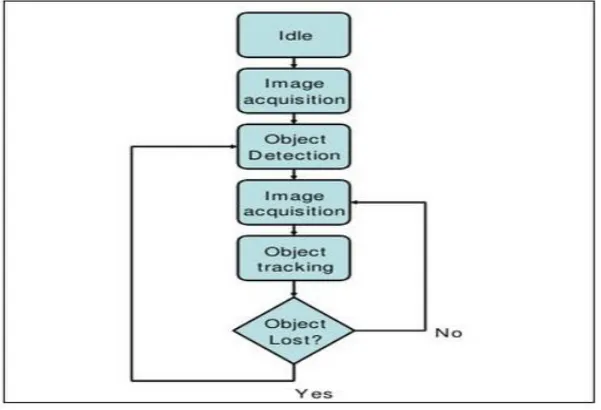
Fig. 1 Object Tracking. Steps to Track the Objects:
IJEDR1503132
International Journal of Engineering Development and Research (www.ijedr.org)2
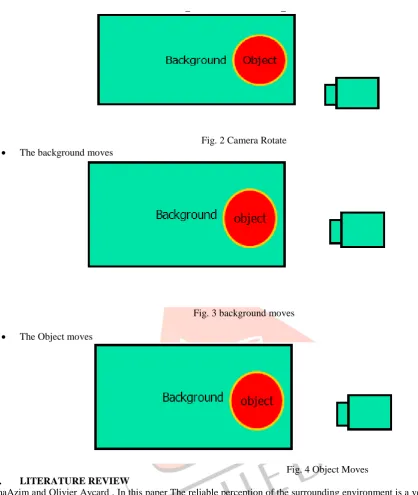
Fig. 2 Camera Rotate The background moves
Fig. 3 background moves
The Object moves
Fig. 4 Object Moves II. LITERATURE REVIEW
AsmaAzim and Olivier Aycard , In this paper The reliable perception of the surrounding environment is a very important step for an intelligent vehicle. It is usually divided into two subtasks: simultaneous localization and mapping (SLAM) and detection and tracking of moving objects (DATMO). The purpose of SLAM is to provide the vehicle with a map consisting of static entities of the environment while DATMO uses that map to detect and track dynamic entities.We have presented an approach capable of performing detection, classification and tracking of moving objects from 3D range data. Experimental results have shown that our system can successfully perform the moving object tracking from a vehicle in different dynamic outdoor scenarios. The proposed approach uses an octree based occupancy grid map- ping of the environment in 3D [1].
Weiming Hu, Tieniu Tan, Liang Wang, and Steve Maybank, in this paper author compare the Visual surveillance in dynamic scenes, especially for humans and vehicles, is currently one of the most active research topics in computer vision. It has a wide spectrum of promising applications, including access control in special areas, human identification at a distance, crowd flux statistics and congestion analysis, detection of anomalous behaviors, and interactive surveillance using multiple cameras etc. In general the processing framework of visual surveillance in dynamic scenes includes the following stages: modeling of environments, detection of motion, classification of moving objects, tracking, understanding and description of behaviors, human identification, and fusion of data from multiple cameras. Visual surveillance in dynamic scenes is an active and important research area, strongly driven by many potential and promising applications, such as access control in special areas, person-specific identification in certain scenes, crowd flux statistics and congestion analysis, and anomaly detection and alarming, etc [2].
IJEDR1503132
International Journal of Engineering Development and Research (www.ijedr.org)3
multiple target problem, the linking step results in a difficult optimization problem in the space of all possible families of trajectories.Combining frame-by-frame detections to estimate the most like trajectories of unknown number of targets, [3]. Philip Lenz, Julius Ziegler, Andreas Geiger and Martin Roser, in this papermodern driver assistance systems such as collision avoidance or intersection assistance need reliable information on the current environment. Extracting such information from camera-based systems is a complex and challenging task for inner city traffic scenarios. This paper presents an approach for object detection utilizing sparse scene flow. For consecutive stereo images taken from a moving vehicle, corresponding interest points are extracted.We presented a novel approach for class-independent object detection for inner-city traffic scenarios. The pro- posed algorithm uses computationally efficient sparse interest points in consecutive stereo images to compute the scene flow.[4].Boris Kluge Christian Kohler Erwin Prasslerin this paper we focus on the task of tracking multiple moving objects in rapidly changing, dynamic environments. Objects are extracted from laser range finder images and correspondences between successive images are established by network optimization techniques. The approach is implemented on a robotic wheelchair, used in two applications and evaluated experimentally.In this paper we presented an object tracking sys- tem based on a laser range finder as its sensor and on graph algorithms for data processing. The basic idea is to represent the motion of object shapes in successive scan images as flows in bipartite graphs. By optimization (maximum flow, minimum cost, maxi- mum weighted matching) we get plausible assignments of objects from successive scans. In our experiments the system proved to perform considerably more ro- bust than its predecessor [PS9S98] which is based on a greedy nearest neighbor search among the objects’ cen- ters of gravity. However the presented system still has to be improved for real long-term tracking as shown in the discussion. [5].
Andreas Ess · Konrad Schindler · Bastian Leibe · Luc Van Gool, in this paper, we address the problem of vision-based navigation in busy inner-city locations, using a stereo rig mounted on a mobile platform. In this scenario semantic information becomes important: rather than modeling moving objects as arbitrary obstacles, they should be categorized and tracked in order to predict their future behavior. To this end, we combine classical geometric world mapping with object category detection and tracking. Object-category specific detectors serve to find instances of the most important object classes (in our case pedestrians and cars). Based on these detections, multi-object tracking recovers the objects’ trajectories, thereby making it possible to predict their future locations, and to employ dynamic path planning. The approach is evaluated on challenging, realistic video sequences recorded at busy inner-city locations. [6].
Tao Zhao and Ram Nevatia in this paper tracking of humans in dynamic scenes has been an important topic of research. Most techniques, however, are limited to situations where humans appear isolated and occlusion is small. Typical methods rely on appearance models that must be acquired when the humans enter the scene and are not occluded. We present a method that can track humans in crowded environments, with significant and persistent occlusion by making use of human shape models in addition to camera models, the assumption that humans walk on a plane and acquired appearance models. Experimental results and a quantitative evaluation are included. We have presented a principle approach to simultaneously detect and track humans in a crowded scene acquired from a stationary camera. Our contribution in this work is: 1) a Bayesian framework of the multi-object tracking problem, including a color-based joint likelihood which enables simultaneously detection and tracking; 2) an efficient MCMC-based approach to compute the optimal solution: the design of reversible dynamics to explore the solution space and the use of informed proposal probabilities from image features for faster convergence.[7].
III. BACKGROUND SUBSTRACTION ALGORITHM
Background subtraction is a typical and generally utilized method for producing a frontal area veil by utilizing static cameras..However, identifying movement through Background subtraction is not generally as simple as it may first show up. Undoubtedly, a few features with poor sign to-clamor proportion brought about by a low quality camera, pressure antiquities or a loud domain, are liable to create various false positive. False positives can likewise be impelled by brightening changes (continuous or sudden), an animated background (waves on the water, trees shaken by the wind), or camera jitter to give some examples. Then again, false negatives can likewise happen when a moving article is made of hues like the ones out of sight (the alleged camouflage effect). With such situations, a basic inter frame concession with worldwide limit uncovers itself as a frail arrange. The objective of this study is triple:
• evaluate how better complex routines are contrasted with straightforward foundation sub-footing systems; • compare the handling force and the measure of memory needed by every strategy at runtime;
• determine to which sort of feature every strategy suits best.
As foundation subtraction is broadly utilized as a part of PC vision, various studies and similar studies have been distributed throughout the years Purpose of Background Subtraction Algorithm
Decrease issue set for further preparing
Segment the image into foreground and background
Just process piece of picture that contains the applicable data
IV BACKGROUND SUBTRACTION TECHNIQUE
IJEDR1503132
International Journal of Engineering Development and Research (www.ijedr.org)4
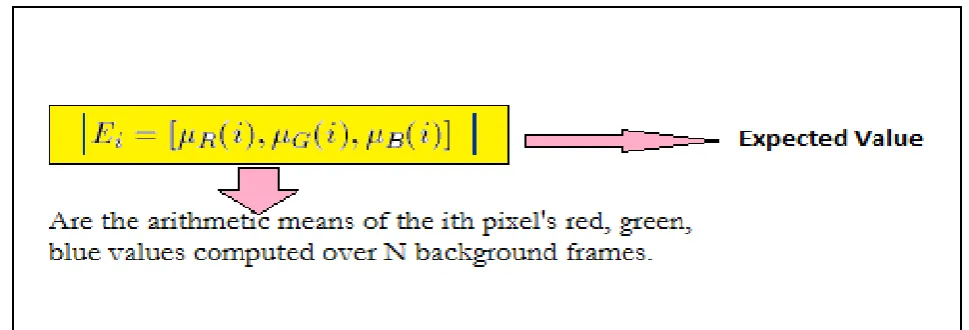
Background modeling -A reference background image computed over a number of static background frames.Threshold selection- Decides proper edge qualities utilized as a part of the subtraction operation to get a craved location rate. Pixel classification- Classifies the kind of a given pixel, i.e., the pixel is the part of background(counting common foundation and shaded foundation), or it is a moving item.
Fig. 5 Background modeling
IV. CONCLUSIONS
We have exhibited a review of late advancements in visual reconnaissance inside of a general handling structure for visual observation frameworks. The best in class of existing strategies in every key issue is depicted with the attention on the taking after assignments: location, following, comprehension and depiction of practices, individual ID for visual reconnaissance, also, intuitive reconnaissance utilizing different cameras. With respect to the recognition of moving articles, it includes ecological demonstrating, movement division and article characterization. Three methods for movement division are tended to: foundation subtraction, fleeting differencing, and optical stream. We have talked about four seriously examined methodologies to following: locale based, dynamic shape based, component based, furthermore, model based. We have looked into the best in class of conduct depiction. As to individual ID at a distance. As to combination of information from different cameras, we have surveyed establishment, item coordinating, exchanging, and information combination.
V. ACKNOWLEDGMENT
Working on this thesis of Real time multiple object tracking from video based on background subtraction
algorithm provided a unique experience and analysis, I feel great pleasure and privilege in working over this research. I am deeply indebted to “Chandigarh group of college jhanjeri” for the invaluable guidance, support and motivation for the many other aids without which it would have been impossible to complete this project.
I have no words to express my deep sense of gratitude for (Mentor) for her/his enlightening guidance, directive encouragement, suggestions and constructive criticism for always listening to our problems and helping us out with their full cooperation.
Last but not the least, Father NAME Ahmad Dar Mother NAME who have given me that much strength to keep moving on forward every time, we are greatly thankful to them and have no words to express my gratitude to them.
VI. REFERENCES
[1] H. Jiang, S. Fels, and J. Little, “A Linear Programming Approach for Multiple Object Tracking,” in Conference on Computer Vision and Pattern Recognition, 2007, pp. 744–750.
[2] G. B. Dantzig, Linear Programming and Extensions. Princeton University Press, 1963. [3] J. W. Suurballe, “Disjoint Paths in a Network,” Networks, vol. 4, pp. 125–145, 1974.
[4] J. Black, T. Ellis, and P. Rosin, “Multi-View Image Surveillance and Tracking,” in IEEE Workshop on Motion and Video Computing, 2002.
[5] A. Mittal and L. Davis, “M2tracker: a Multi-View Approach to Segmenting and Tracking People in a Cluttered Scene,” Computer Vision and Image Understanding, vol. 51(3), pp. 189–203, 2003.
[6] S. Iwase and H. Saito, “Parallel Tracking of All Soccer Players by Integrating Detected Positions in Multiple View Images,” in International Conference on Pattern Recognition, August 2004, pp. 751–754.
[7] C. Stauffer and W. Grimson, “Adaptive background mixture models for real-time tracking,” in Proc. IEEE Conf. Computer Vision and Pattern Recognition, vol. 2, 1999, pp. 246–252.
[8] D. Meyer, J. Denzler, and H. Niemann, “Model based extraction of ar- ticulated objects in image sequences for gait analysis,” in Proc. IEEE Int. Conf. Image Processing, 1998, pp. 78–81.
[9] J. Barron, D. Fleet, and S. Beauchemin, “Performance of optical flow techniques,” Int. J. Comput.Vis., vol. 12, no. 1, pp. 42– 77, 1994.