International Journal of Advanced Research in Computer Science
RESERCH PAPER
Available Online at www.ijarcs.info
CONFERENCE PAPER
Noise Reduction in Compressed Images Using Improved Fuzzy Transform Technique
Gaganpreet Kaur
Department of Computer Engineering, University College of Engineering,
Punjabi University, Patiala,India [email protected]
Priyanka Jarial
Department of Computer Engineering, University College of Engineering,
Punjabi University, Patiala,India
Abstract-In the area of digital image compression, computer algorithms are used to perform processing of images and compression. It deals with developing a digital system that perform operations on digital image. It has many advantages using in digital camera, film, Satellite, X-ray and many more applications. Image compression is a technique used to save the storage space normally used to compress images and videos. Number of compression algorithms are used like run length encoding, huffman coding, discrete cosine transform, vector quantization, fuzzy transform. This gives a brief idea on improved fuzzy technique to reduce noise in compressing image. There are so many techniques for compression but in this only present the techniques of improved fuzzy method to reduce noise and compressed the image by using edge detection. The main idea behind applying this is we have to preserve the well significant edges as Jpeg is the popular standard but at low bit rate Jpeg exhibits blocking artifacts means noisy effects that affect the visual image quality so to produce high visual quality image at low bit rate ,the algorithm is efficient and simple. The proposed algorithm consists of three steps. First, image is preprocessed using competitive fuzzy edge detection. Second, based on edge information image is compressed and decompressed using improved fuzzy transform. Third, reconstructed image is post processed using hybrid median filter for artifact reduction. Analysis proves the superiority of proposed algorithm. The results of different number of coefficients are compared with the value of PSNR, MSE of algorithm. After comparison of techniques it is found to be efficient for visualization.
INTRODUCTION
Compression is very important for data storage and transmission. Incase of general data compression, it has to be a lossless one. It means, we have ability to recover the original data 1:1 from the compressed file. In this area, we can use something which is called a lossy compression. Our main aim is not to recover data 1:1, but keeping them visually similar.
Fuzzy is the method of real value functions. It is human ability based.
Using fuzzy transform in which improved fuzzy is used consists of three steps-
1. Preprocessing using competitive fuzzy edge detection. 2. Compression and decompression using improved fuzzy
transform.
3. Postprocessing (noise/artifact reduction using hybrid median filter)
Its contribution is well known that for image blocks with many edge pixels have more information and they should be less compressed and the blocks with smooth regions should be more compressed.
Fuzzy transform compress each image block into the same level without taking the edge information.
The algorithm we further used which compresses block by taking into account the edge information contained in the block. The algorithm gives better quality of compressed images with well preserved edges and reduced artifacts. The algorithm provides improvement in visual quality and quantitative results should be calculated. In fuzzy transform, first an image is preprocessed using fuzzy edge detection which detect the edge pixels in the image. Second on the basis of edge information, image is compressed and decompressed using improved fuzzy transform. Third, reconstruction is postprocessed using hybrid median filter for artifact reduction. The analysis proves the superiority of proposed algorithm. Transformations use fuzzy logic functions of local areas by their membership values which use basic functions for generalized functions and this technique can be successfully applied for comparing the approximate derivatives of the initial function as well as comparing the definite integrals.
Fuzzy transform(F-transform):-
Gaganpreet Kaur et al, International Journal of Advanced Research in Computer Science, 7 (6) (Special Issue) November 2016,101-104
978-93-85670-72-5 © 2016 (RTCSIT)
CONFERENCE PAPER
International Conference on 102Recent Trends in Computer Science & Information Technology (RTCSIT-2016) 21st August 2016
Guru Nanak College Budhlada, Punjab India
complex computations can use the inversion formula instead of representation of the original function. Fuzzy is easy to understand based on natural language. Flexible and tolerance of imprecise data. It is human logic ability based and its efficiency is veryhigh and is very easy to use .Fuzzy logic is used in fuzzy set theory their success is for closeness to human ability as well as simplicity. It provides high knowledge base that is easy to understand and maintain.
Image compression is used in applications like televideo-conferencing, remote sensing and documents. Its main aim is to reduce redundancy of images for storing and transmitting data in an efficient manner. Uncompressed image/data require more space and time. Two types-Lossy and lossless. In lossless techniques, original image does not loss any data. In lossy technique some unnecessary information can be lost and original image cannot be recovered. There are many techniques in lossless compression like run length encoding, huffman, arithmetic and LZW coding .In lossy, transformations used are DCT,DWT,FFT etc in transformation domain..The increasing demand for multimedia content like digital images and video has led to take interest in research on compression techniques like medical imaging, fax transmission .Fuzzy is also efficient and reliable technique used for compression. Motivation Jpeg image based on Dct is populary used standard. A low bit rate Jpeg based compression exhibit blocking artifacts that affect the visual image quality. Fuzzy is simple and more efficient for this. Its main objective is to reduce redundancy in images for storing and transmitting the data. Uncompressed data like uncompressed video and audio, the data takes space and time. Digital image requires large space for storage and greater bandwidth for transmission. The main aim is to reduce the memory space of data so that transmission times are reduced.
Fuzzy transformation is our proposed work to compress the images because
1 Its efficiency is very high as compared to efficient result in Dct,Dwt etc.
2 This transformation is very easy not too much calculations so give accurate result.
3 Its main advantage is that it is human ability based or human logical reasoning based.
4 Its understanding is very easy.
5 There is less work done on fuzzy transform beacause it is a new logical based transform used for the accurate results.
The focus of study is to reduce the noise effect in compressed images using this transform. During compression of images, edges should be well preserved for human perception. So there are many standards such as Jpeg is most popular standard to compress images. Jpeg exhibits blocking artifacts that affect the visual quality of images. Improved fuzzy is simple and more efficient for reducing artifacts. It consists of three steps-
1. Image is preprocessed based on edge detecting method called competitive fuzzy edge detection.
2. Second,based on the edge detection image should be compressed and decompressed.
3. Last used hybrid median filter for artifact reduction .
This give improvement in quality of image used for compression at a low bit rate. Fuzzy has an advantage of producing a unique representation of an original function that makes complex equations easier. It is to compress image at a very low bit rate.
Proposed work
Preprocessing based on edge detecting method called competitive fuzzy e dge detection(CFED)
In this, CFED assigns each pixel to one of the six classes depending on its neighbourhood. Classes are then classified into Low (LV), Median(MV) and High(HV) variation blocks depending on the number of edge pixels. CFED detect edge pixels by using different fuzzy membership functions based on neighbourhood situation in different directions and used for segmenting the blocks. CFED accept input in form of vectors. Each input is assigned a class depending on max/min fuzzy membership functions.
4D Feature Vector
-Computing for each pixel in input imageby adding the gray level magnitude difference of pixels in four directions.
Improved fuzzy transform Fuzzy switched
median +hybridmedian filter
based artifact Reconstruct
CONFERENCE PAPER
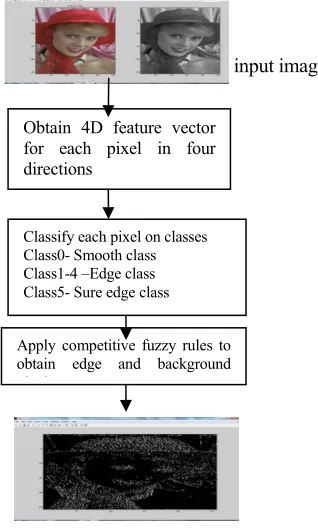
Class 1 is assigned to pixel which has low magnitude intensity difference along diagonal direction D2 and high magnitude intensity difference along rest of directions. Second ,Class2 is assigned that has low magnitude difference along vertical direction V and high on rest of directions.Class3 is assigned that has low along diagonal D1 and high along remaining directions.Class4 is assigned that has low along horizontal H and high along remaining directions. Then classes assigned to it and competitive rules are applied according to class assigned. Only the pixels classified as edge pixels and sure edge pixels are assigned the value high(white) in output and all other are assigned low(black) in output image. This results in white edges on black background.
Fuzzy rule firing
- Before classifying edge pixel to eitherblack or white, it is compared with neighbourhood edge pixel. Rule 1- If x belongs to smoothly class(class 0) then change color of pixel to black.
Rule 2- If x belongs to edge class 1, compare v1 with its neighbouring pixels along diagonal D2.If v1 is large then change pixel value to white else black.
Rule 3- If x belongs to edge class 2, compare v4 with neighboring on vertical V. If a large then change pixel to white else black. Rule 4-If x belongs to edge class 3, compare v2 with neighboring pixels along diagonal D1. If it is large then change to white else black. Rule 5-If x belongs to edge class 4,compare v3 with neighboring pixel along horizontal H.If it is large then change pixel to white else black.
Rule 6-If x belongs to sure edge class (class 5), then change pixel to white.
CFED can detect edges in image block. These blocks then classified into LV,MV and HV blocks depending on no of edge pixels.
Experimenting CFED on different images,it is concluded that treating blocks with less than 20 % of edge pixels as LV block, between 20 and 70 % as MV block and rest as HV block.It yields an optimum quality of compressed image at low rate.
yields an optimum quality of compressed image at low rate.
input image
Edge image Figure 3 CFED
Compression and decompression using
improved fuzzy transform-
Fuzzy transform gives better results than FEQ(fuzzy relation equations) .The value obtained using fuzzy tranform are similar or slightly less as compared to Jpeg based compression result.So to provide an algorithm that perform better than JPEG and fuzzy transform.The improved fuzzy is the technique which takes each of the LV,MV and HV blocks differntly to use for compression.These blocks are compressed to different size blocks so that maintaining an average value of compression rate and performing better than JPEG standard used for compressing images at similar compression rates.
Obtain 4D feature vector for each pixel in four directions
Classify each pixel on classes Class0- Smooth class Class1-4 –Edge class Class5- Sure edge class
Apply competitive fuzzy rules to obtain edge and background
Gaganpreet Kaur et al, International Journal of Advanced Research in Computer Science, 7 (6) (Special Issue) November 2016,101-104
978-93-85670-72-5 © 2016 (RTCSIT)
CONFERENCE PAPER
International Conference on 104Recent Trends in Computer Science & Information Technology (RTCSIT-2016) 21st August 2016
Guru Nanak College Budhlada, Punjab India
Edge image
Figure 4 Improved fuzzy transform compression
Then after compressing we apply inverse transform and obtain the original image.Decompressed image is achieved then using fuzzy switched median filter to reduce artifacts in decompressed image . After that we use another filter is hybrid median filter to obtain much more better result and reducing artifacts more.PSNR and MSE calculated after proposed work gives better results.
Fuzzy switched median filter
:- Artifacts reduced by using asquare filtering window W(2M+1)x(2M+1) where M is even integer
and (2M+1) rows , (2M+1) columns centered at pixel x(i,j) positioned at i,j.When window is placed on the right (left) boundary of image,then neighbouring pixels on left (right) considered to be free from artifact.The value of pixel calculated based on median value.
Med(i,j)=Median{x(i+k,j+l) For k,l= -M to + M
After this calculate D(i,j) that provides local information of window.
1 Pixels with value of D(i,j) between 0 and TH1 are non-edge pixels and assign zero membership value.
2 Pixels with value of D(i,j) between TH1 and TH2 are edge pixels with membership value between 0 and 1 and calculated by mD(i,j)+c
where m= 1 c=(-TH1) TH2-TH1 (TH2-TH1)
3 Pixels with value greater than TH2 are sure edge pixels and assign value 1.
These values are denoted by u(i,j)
Finally artifact calculated by
Y(i,j)=[(1- u(i,j))] x(i,j)+u(i,j)Med(i,j)] This is base work filter.
Proposed work filter:-
Hybrid median filter :-In median filter, the neighbourhood
pixels should give rank according to brightness or intensity and
median value becomes new value for central pixel.Median
filters are best to reduce “shot” noise or impulsive noise in which some individual pixels has extreme values.It can erase lines narrower than half width of neighbourhood.They can be of roundoff corners.The hybrid median filter is a three step ranking process and preserve edges better than square kernel median filter.Three median values are calculated so called hybrid median. MR is median of horizontal and vertical R pixels,MD is the median of diagonal pixels D and centered pixel C.So filter is the median of two median values and center pixel C: Median([MR,MD,C]). For example n=5
D * R * D * D R D * R R DCR R R * D * D * D * R * D
In this way by using hybrid median filter we can calculate the median of got medain values ie median of median values so this gives better result by preserving edges in image and result calculated for different images whereas, CFED in which detector takes low=0, high=20 and width (w)=256 and results show high PSNR and low MSE value.
Results and discussions
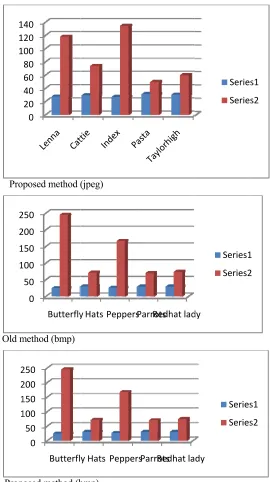
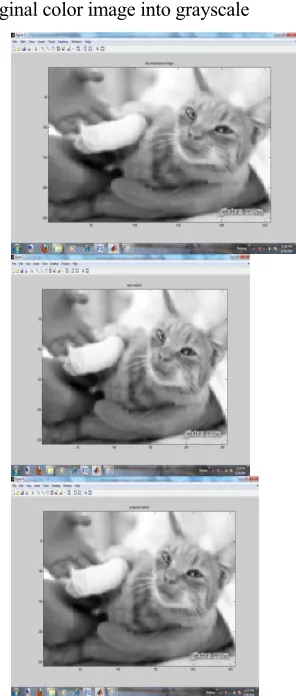
:-To evaluate the performance we have taken the images of size 256x256 of Jpeg and Bitmap type of images and experiment is performed.For compression,images are divided into blocks of LV,MV and HV(low,medium andhigh).The total number of 8x8 size blocks for 256x256 size image is (256x256) /(8x8)=1024.Experiment has been found that block containing less than 20% of edge pixels treated as LV block,between 20 and 70 % of edge pixels as MV block and rest are HV block.Hybrid median filter is used to reduce noise in compressed images.The proposed algorithm is analyzed and results obtained are compared with previous used filter.The figures first show the original color image we convert it into grayscale then achieved Select a block from input image
based on Fuzzy detected edge image
Compute fuzzy components for each block using:
m n
Fk,l=ΣΣ f(xi,yj) Ak(xi) Bl(yj) j=1 i=1
m n
ΣΣ Ak(xi) Bl(yj)
j=1 i=1
edge ler than from Jp more less artifac al quality. Hyb y removes imp has better corn nd filter is for an technique s d which had use sed method im cts which is ou brid median f pulse noise w ner preserving r any element everal times a We used the pa e given in table
chnique then od achieves th ed fuzzy switch mage that used m artifacts im ed by using this ut suffer from and then take t arameters for o gnal to noise ra
E] where E is defined as X N is total no N l pixel values
978-93-8
5670-72-5 © 2016 (RTC
posed method (
Recent Trends in Co
G ween PSNR an
sParrotsRedhat lad
rsParrotsRedhat la
al of Advanced Re
CONFERE
Original Colo Edge ima
CONFERENCE PAPER
Original color image into grayscale Edge image
Decompressed image Base method Proposed method
Figure 7 Bmp Butterfly
Original color image to grayscale Edge image
Gaganpreet Kaur et al, International Journal of Advanced Research in Computer Science, 7 (6) (Special Issue) November 2016,101-104
978-93-85670-72-5 © 2016 (RTCSIT)
CONFERENCE PAPER
International Conference on 108Recent Trends in Computer Science & Information Technology (RTCSIT-2016) 21st August 2016
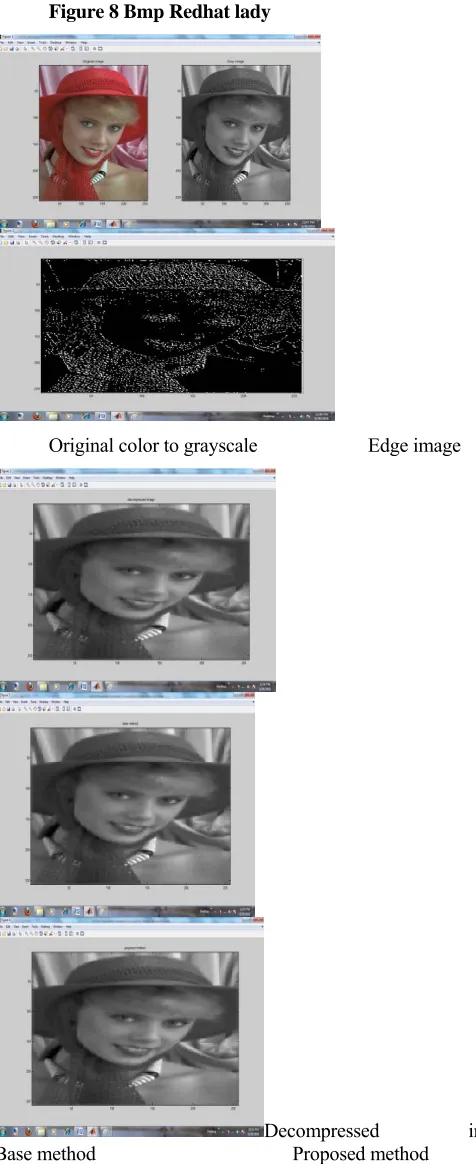
Guru Nanak College Budhlada, Punjab India Figure 8 Bmp Redhat lady
Original color to grayscale Edge image
Decompressed image Base method Proposed method
The image finally achieved is free from artifacts image with high PSNR and low MSE.
Conclusion
This paper proposes a method to reduce noise in compressed images named Noise reduction in compressed images using
improved fuzzy transform technique.The proposed method preprocesses an image using CFED(competitive fuzzy edge detector) that results that each image block classifies as either low variation( LV),medium variation(MV) and high variation (HV).These blocks are then compressed and decompressed using improved fuzzy.The reconstructed image contain blocking artifacts or noise that are reduced using hybrid median filter.The proposed method is subjectively and objectively analysis and compared with previous method and found better in terms of quality and artifact reduction as compared to fuzzy and jpeg.This method achieves better improvement in terms of quality but still it requires more improvement.In future, it has the advantage that the neural network with fuzzy transform technique can be used to develop image compression algorithm at low bit rate.
References
[1] K.Meenakshi;G.N Beena(2014) “ Design and simulation of constant bit rate compressor using fuzzy logic,” ,IEEE 978-1-4799-3486-7/14.
[2] Deepak gambir;Navin rajpal (2015) “Improved fuzzy transform based image compression using pair fuzzy,”,Springer Int. J. Mach. Learn. & Cyber. 6:935–952 DOI 10.1007/s13042-015-0374-1.
[3] Maneesha gupta;Dr. Amit Kumar garg (2015) “Analysis of Image Compression algorithm Using Dct,” by gupta.
[4] “ Efficient image compression using all the coefficients of 16x16 Dct image subblock,”(2015).
[5] “An Image compression technique based on fuzzy transform ,”(2014).
[6] “ Design and simulation of constant bit rate compressor using fuzzy logic,” (IEEE 2014).
[7] Arun Kumar PS ,Dept. of ECE, NIT Rourkela(2007-2009)
“Implementation of Image Compression Algorithm using Verilog with Area, Power and Timing Constraints,”by kumar .[8] Ning Xu, Embedded Networks Laboratory, Computer Science Dept. USC. Los Angeles . “ Implementation of Data Compression and FFT” .
[9] M. Klimesh,1 V. Stanton,1 and D. Watola1 (2001) “Hardware Implementation of a Lossless Image Compression Algorithm Using a Field Programmable Gate Array .”
[10]Sadashivappan Mahesh Jayakar;K.V.S AnandBabu;Dr.Srinivas K (2011) “Color Image Compression
Using SPIHTAlgorithm International Journal of Computer Applications,”Volume 16– No.7, pp 34-42.
[11]David F. Walnut(2003) “An Introduction To Wavelet Analysis,American Mathematical Society” Volume 40, Number 3,Birkhauser, Isbn-0-8176-3962-4.Pp. 421-427.
[12] M. I. Khali (2010) “Image Compression Using New Entropy Coder, International Journal of Computer Theory and Engineering,” Vol. 2, No. 1 1793-8201.
[13] Andrew B. Watson(1994)” Image Compression Using the Discrete Cosine Transform ,” NASA Ames Research Center . [14] Rupinder Kaur, Nisha Kaushal (NITTTR, Chd.) (2007) “Comparative Analysis of Various Compression Methods for Medical Images .”
CONFERENCE PAPER
[16] De A, Guo C (2014) “An image segmentation method based on the fusion of vector quantization and edge detection with applications to medical image processing. Int J Mach learn 5(4):543-551
[17]Gambhir D,Rajpal N(in Press) Image Coding using fuzzy edge classifier and fuzzy f- transform: dualfuzzy,Int J fuzzy Comput model ISSN online:2052-3548.
[18] Rahul Shukla and Narender Kumar Gupta “Image compression through Dct and Huffman Coding Technique” IJCET inpressco(2015).
[19] Er abhishek Kaushik,Deepti nain “Image compression Algorithms using dct” IJERA vol4 issue 4 (April 2014).
[20] Priyanka Dixit,Mayank Dixit “ Study of jpeg Image compression technique using Dct” IJIRI vol1 issue (1 oct-dec 2013).
[21] Abhishek sahu,Praveen yadav “ Development of constant bit rate jpeg image compression using fuzzy logic” IJSR (2015). [22] A.M. Raid,W.M Khedr M.A. El-dosuky and Wesam Ahmed “Jpeg Image compression using discrete cosine transform In IJCSES vol-5 no2,(April 2014).