2254
Minimizing Makespan in Flow Shop under Continuous
Machine Operation
Kewal Krishan Nailwal1, Deepak Gupta2, Kawal Jeet3
Department of Mathematics, Apeejay College of Fine Arts, Jalandhar, Punjab,India1 Department of Mathematics and Humanities, M.M. University Mullana, Ambala, Haryana, India2
Department of Computer Science, D.A.V. College, Jalandhar, Punjab, India3 [email protected], [email protected], [email protected]
Abstract- The role of production scheduling is indispensible in the environment of manufacturing and service industries. Continuous machine operation or No-idle time on machines refers to the environment of production scheduling in which the machines once started work continuously to process all the jobs from first to last. The classical problem in flow shop scheduling is the minimization of makespan under different environments. The problem of makespan minimization in flow shop scheduling under continuous machine operation or no-idle situation is NP-hard. The heuristic proposed in this paper works on the principle of basic insertion to solve the flow shop problem for processing n-jobs on m-machines with continuous machine operation. The proposed constructive heuristic is compared with important heuristics solving no-idle problem that exists in flow shop literature. The computational result on Taillard‟s benchmark problems shows the superiority of the heuristic proposed over other heuristics.
Keywords
-
Flow shop; scheduling; constructive heuristic; no-idle.1. INTRODUCTION
Production scheduling plays a vital role in manufacturing and service industries. For improving the production efficiency of the system, one must use effective and efficient solutions for manufacturing and scheduling technologies for the rapidly changing market demands having great competitive environment. According to the different industrial setups in flow shop, there prevail different constraints either on the jobs or on the machines to complete the task. The two important constraints in flow shop scheduling problem are No-wait of jobs and No-idle or Zero-idle time on machines. The No-wait flow shop scheduling problem (NWFSP) is an important branch of scheduling problems which related to „zero buffer‟. It arises due to the characteristics of jobs processing producing certain products, where the processing of jobs demands the processing to be continuous. The continuous flow shop originates in the scheduling theory because of the production environment in industry. In many flow shops, the production environment is such that the delay in job processing between the subsequent machines is not allowed i.e. the assumption of infinite storage capacity between the machines in flow shop is no longer valid. For maintaining the continuous flow of job, the processing of jobs is delayed on the first machine so that the jobs do not wait in the subsequent processing on machines. Various applications can be found in the industry related to this type of flow shop. For example, the
2255 of integrated circuits by means of photolithography.
Other examples come from sectors where less expensive machinery is used but where machines cannot be easily stopped and restarted. Ceramic roller kilns, for example, consume a large quantity of natural gas when in operation. Idling is not an option because it takes several days to stop and to restart. Other such example includes the production of glass fiber. The temperature inside the furnace for molten made from glass is maintained at high temperature, the furnace once stopped halts the production as it takes time in days to retain that temperature [7].
Adiri and Pohoryles [1] was first to study the m -machine no-idle situation in flow shop and showed that the problem F2/ prmu C/ maxcan be referred as the problemF2/prmu no idle C, / maxi.e. these two problems are equivalent. The solution of this can be obtained by applying Johnson [6] algorithm. For details relating to permutation (prmu) flow shop, one may refer to Pinedo [17]. Narain and Bagga [12] also developed an algorithm based on branch and bound method for two stage flow shop scheduling problem with objective as total flow time under no-idle condition. The problem related to
3/ , / max
F prmu no idle C have been studied extensively some researchers. Baptiste and Hguny [3] gave a integer linear programming model for solving
max
/ , /
m
F prmu no idle C , and a corresponding branch and bound algorithm; also see Saadani et al. [21]. Saadani et al. [19] explains the environment of no-idle in a three-stage production of engine blocks in a foundry which includes the casting of sand moulds and sand cores. Narain and Bagga [2] formulated the three stage flow shop problem minimizing the total elapsed time with zero idle time on machines. He illustrated that it is not necessary that the sequence having minimum total elapsed time also possesses the same under no-idle constraint. They discussed the concept of sequencing in rental situations under specific rental policy. The idle time on the first machine is always zero as first machine is required only for the time equal to the sum of the processing time of all the jobs on it. Under the circumstances of scarcity of funds, the machines have to be taken on rent or hired in order to complete the assignments. Hiring of machines enable saving working capital, give option for having the equipment, and allow the up-gradation to new technology. Minimization of the total hiring cost of machines would be the criterion in these types of situations. In this direction, they did
some work and explored the area for solving this problem [14].
Kamburowski [9] identified the simple network representation of total elapsed time which efficiently solves the three machine flow shop problem under no-idle situation. Besides this, the results of three machine problem are extended to m-machine no-idle flow shop problem. Woollam [24] studied the problem of no-idle time of machines using various benchmark heuristics like NEH heuristic [15] when modified to no-idle problem and other heuristics known for makespan problems. Narain and Bagga [13] gave four algorithms using branch and bound technique to solve
n-job, m-machine flow shop problem under no-idle situation with objective of minimizing total elapsed time in which processing time of jobs follow certain relationship. Corresponding to these algorithms, theorems have been proved to show when one should hire the machine on rent to minimize total rental cost of machines. Saadani et al. [20] presented the model of Fm/prmu C/ max problem with travelling salesman approach by using the nearest insertion technique and implemented with the help of the solver. Kalczynski and Kamburowski [7] proposed a improved heuristic based on the Johnson algorithm which outperforms the heuristic of Saadani et al. [21] and the modified NEH for no-idle constraint. Apart from this heuristic, Kalczynski and Kamburowski [8] have discussed no-wait and no-idle flow shops scheduling with makespan criterion and found that makepan with no-idle constraint is not the increasing function of processing times of jobs. Goncharov and Sevastyanov [5] have given review and approximation on the flow shop problem with no-idle constraints. Ruiz et al. [18] studied the variant of the classical permutation flow shop problem with makespan criterion with no-idle constraint. Baraz and Mosheiov [4] proposed the improved greedy (IG) heuristic with an improvement step involving pairwise exchange of jobs. Makuchowski [11] shows the significant correlation between the two variants of NEH algorithm for makespan with no-idle and without no-idle constraint i.e. the algorithm used for solving problem without no-idle can be effectively used for no-no-idle problems. Recently, Xiaoxia, and Yunhong [25] proposed a probability based model for solving mixed no-idle permutation flowshop scheduling problem.
Since, with advent of time the problem
max
/ , /
m
2256 papers such as Pan and Wang [16], Seido Nagano and
Januário, [22], Zhou and Chen [27], Li et al. [10] and Yazdani and Naderi [26] used metaheuristics for solvingFm/prmu no idle C, / max. This describes the significance of proposing improved constructive heuristic algorithm for providing the good initial solution to various metaheuristics. This is in turn implies that results of the metaheuristics can be improve further by the proposed constructive heuristic. In this work, a constructive heuristic is proposed and is compared with two important heuristics namely the improved greedy (IG) and Kalczynski-Kamburowski (KK) heuristic on various Taillard [23] instances. The computational result on Taillard‟s instances shows the superiority of the proposed heuristic (PH) over both the heuristics. The rest of paper is organized as follows: the section two deals with problem formulation. Section three explains the proposed heuristic algorithm. In section four, the working of the proposed heuristic algorithm is explained. Section five reports the results along with analysis of the results obtained. At the end, we conclude the paper in section six followed by references.
2. PROBLEM FORMULATION
Let some job i(1 i n) is to be scheduled on machine j(1 j m) in the same technological order with criteria to be optimized as minimization of makespan under no-idle constraint i.e.Cmax. The general assumptions under which the n-jobs are processed through m-machines are: Pre-emption of jobs is not permitted. All jobs and machines are available at the beginning of processing. The machines are available throughout the processing and never breakdown. Each job is processed through each of the machine once and only once. Each machine can perform only one task at a time. The setup times of jobs on machines are negligibly small and hence can be ignored or are included in the processing time of jobs.
Let ti j, be the time of processing of the job i
on the machine j, , 1
m i i j
j
T t
be the sum total of processing times corresponding to job i on m
machines. For calculating the makespan of a schedule of n-jobs in a no-idle situation concerning flow shop, we have to first find the time of initiation of machines so that the machines start processing jobs without any idle time on them. Following this, we denote this initiation of machines by Lj, j = {1,2,3,…..,m}.
Clearly, L1 = 0. We calculate the initiation of machines
denoted by Lj as follows: 1
1 1 ,( 1) ,
1 1
max , {2,3,...., }
k k
j j k n i j i j
i i
L L t t j m
After the calculation of values of Lj , the makespan
max
C can obtained from the following equation as:
max ,
1
n
m i m i
C L t
.3. PROPOSED ALGORITHM
The steps formulated for algorithm concerning flow shop scheduling problem, processing
n-jobs through m-machines with objective of minimizing makespan under no-idle constraint (Cmax) are given below.
Step1. Find the sum total of the processing time Ti of
every job i (i=1,2,3,…,n) on the given m-machines by the expression: ,
1
m i i j
j
T t
.
Step2. Exhibit the job list according to the decreasing values of Ti so obtained in step 1.
Step3. Take the first two jobs from the job list. Find the two-job partial sequence with minimum Cmaxout of the possible two job sequences. Select it as the current partial sequence. If there is a tie for Cmax, select that two job sequence for further construction of jobs in which the first job is with lower index to break the tie.
Step4. Take the next job from the job list and insert in all possible positions of the partial sequence obtained in step 3. Find the partial sequence with minimum
max
C . This is the current sequence for further construction of final sequence of jobs. Break the tie if any as per step 3.
Step5. Check if there is more than one job in the job list. If so, consider the next two jobs else go to step 4. Find the possible two-job partial schedule from these. Select the two-job partial sequence with minimum
max
C . Generate all the sequences by inserting the two-job partial sequence at all possible locations of the partial sequence so obtained in step 4. Select the sequence with minimum Cmax as the current sequence. Next the first job of the latest pair of jobs is inserted in the all the possible locations of the current sequence to generate the possible sequences. If the any of these sequences have better result, then record that sequence as the current sequence. Break the tie if any as per step 3.
2257 so obtained is the final best sequence with minimum
max
C .
4. NUMERICAL ILLUSTRATION
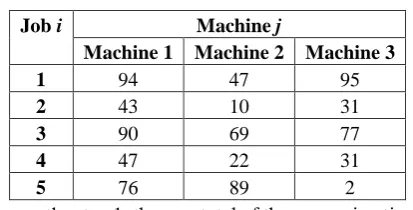
[image:4.595.78.285.205.310.2]Consider the following flow shop instance with number of jobs, n = 5:
Table 1. Flow shop instance
Job i Machine j
Machine 1 Machine 2 Machine 3
1 94 47 95
2 43 10 31
3 90 69 77
4 47 22 31
5 76 89 2
As per the step 1, the sum total of the processing times for every job on the three machines is T1 = 236, T2 =
84, T3 = 236, T4 = 100, T5 = 167. Following step 1,
arrange all the 5 jobs in the order of decreasing values of Ti in the job list resulting in {1, 3, 5, 4, 2}.
According to step 3, pick the first two jobs from the job list namely {1, 3}. The possible two job sequences resulting from {1, 3} are 1-3 and 3-1 with respective
max
C = 356 and 356. Since, there is a tie for the selection of two job sequence for further construction of jobs. Therefore, picking the sequence 1-3 as per the step proposed to break the tie. This is the best current sequence. Now picking the next job 5 using step 4 and inserting it at all the possible locations of the current sequence generating the sequences 5-1-3, 1-5-3 and 1-3-5 having Cmax = 432, 406 and 365 respectively.
The best current sequence of jobs having minimum
max
C = 365 is 1-3-5. Now, pick next two unscheduled jobs {4, 2} from the job list. Find the minimum Cmax
for the possible arrangement of {4, 2}. The Cmax= 152
for the partial sequences 4-2 and 2-4. Therefore, inserting the partial two job sequence 4-2 as block in the current best partial sequence so obtained in the last step generating the sequences 4-2-3-5, 4-2-3-5, 1-3-4-2-5, 1-3-5-4-2 with Cmax= 460, 485, 485, 433 respectively. The sequence 1-3-5-4-2 becomes the current best sequence with minimum makespan. Now, insert the first job {4} of the last job-block in the last best sequence to generate 4-1-3-5-2, 1-4-3-5-2, 1-3-4-5-2, 1-3-5-4-2 and 1-3-5-2-4 with Cmax= 443, 452,
452, 433, 427. The job sequence 1-3-5-4-2 retain as the best sequence. Further the second job 2 of the last pair is selected for inserting at all the possible locations of the current sequence generating the sequences 2-1-3-5-4, 1-2-3-5-4, 1-3-2-5-4, 1-3-5-2-4
and 1-3-5-4-2 with Cmax= 445, 460, 460, 427 and 433 respectively. The sequence 1-3-5-2-4 is the final best sequence with minimum Cmax = 427.
5. COMPUTATIONAL RESULTS
IG (improved greedy) is a heuristic method put forward by Baraz and Mosheiov [4] for solving NFSP. Their numerical tests showed that the IG heuristic method performed better. KK is a heuristic developed by Kalczynski and Kamburowski [7] showed that the KK heuristic performed better than NEH when modified to no-idle (NEHM) problem. For the performance evaluation, the proposed heuristic (PH) is tested against the IG, KK heuristic and the results are compared to the solution produced by modified NEH for no-idle (NEHM) on 100-Taillard instances. These 100-Taillard‟s instances contain 10-subsets having 10-problems each.
Table 2. Makespan values for 20, 50-job Taillard instances
Probl em Insta nces
Makespan Proble
m Instan
ces
Makespan
20x5 NEHM PH 50x5 NEHM PH
Ta001 1413 1408 Ta031 3028 3038 Ta002 1456 1432 Ta032 3172 3160
Ta003 1278 1294 Ta033 2876 2841
Ta004 1396 1402 Ta034 3107 3057
Ta005 1454 1463 Ta035 3158 3174 Ta006 1463 1469 Ta036 3061 3047
Ta007 1270 1295 Ta037 3120 3051
Ta008 1341 1301 Ta038 3040 3030
Ta009 1467 1417 Ta039 2700 2701 Ta010 1262 1230 Ta040 2885 2884
Avg 1380 1371
.1 Avg 3014.7 2998.3
20x10 50x10
Ta011 2266 2247 Ta041 3652 3528
Ta012 2198 2170 Ta042 3643 3639
Ta013 2007 2029 Ta043 3676 3556
Ta014 2048 1929 Ta044 3640 3755 Ta015 1799 1867 Ta045 3507 3507
Ta016 1835 1915 Ta046 4021 4023 Ta017 1988 1881 Ta047 3753 3702
Ta018 1931 1883 Ta048 4092 4082
Ta019 2054 2022 Ta049 3640 3585
Ta020 2011 1956 Ta050 3901 3867
2258
.9
20x20 50x20
Ta021 3482 3599 Ta051 5774 5898 Ta022 3329 3234 Ta052 6367 6378 Ta023 3578 3589 Ta053 5676 5671
Ta024 3227 3313 Ta054 5968 5995 Ta025 3433 3531 Ta055 5477 5503 Ta026 3677 3615 Ta056 6300 6146
Ta027 3584 3476 Ta057 5979 5969
Ta028 3372 3335 Ta058 5785 5766
Ta029 3480 3510 Ta059 5639 5628
Ta030 3855 3943 Ta060 5800 5859
Avg 3501.7 3514
.5 Avg 5876.5 5881.3
Table 3. Makespan values for 100, 200-job Taillard instances
Proble m Instan
ces
Makespan Proble
m Instan
ces
Makespan
100x5 NEHM PH 100x20 NEHM PH
Ta061 5848 5893 Ta081 9694 9680
Ta062 5418 5418 Ta082 8820 8744
Ta063 5355 5403 Ta083 9308 9237
Ta064 5321 5333 Ta084 9619 9664 Ta065 5836 5836 Ta085 9869 9777
Ta066 5399 5383 Ta086 9049 9219 Ta067 5735 5743 Ta087 9111 9007
Ta068 5195 5204 Ta088 9005 9027 Ta069 5588 5621 Ta089 9498 9455
Ta070 5511 5477 Ta090 8825 8810
Avg 5520.6
5531
.1 Avg 9279.8 9262
100x10 200x10
Ta071 6853 6849 Ta091 11840 11860 Ta072 6258 6189 Ta092 12560 12641 Ta073 6817 6756 Ta093 13341 13386 Ta074 6783 6629 Ta094 11844 11813
Ta075 6484 6527 Ta095 12197 12154
Ta076 6644 6658 Ta096 12015 12019 Ta077 6942 6956 Ta097 11735 11664
Ta078 7172 7176 Ta098 12397 12419 Ta079 7371 7232 Ta099 11191 11044
Ta080 7393 7429 Ta100 12624 12649
Avg 6871.7
6840 .1
Avg 12174. 4
12164 .9 Both proposed heuristic and modified NEH for no-idle (NEHM) are implemented in MATLAB-R2008a. The average relative percent deviation
(ARPD) of the proposed heuristic (PH), IG and KK heuristic is calculated as the statistics for the performance measures.
Relative Percentage Deviation calculated as: Relative Percentage Deviation (RPD) =
100
heuristic NEH
NEH Makespan Makespan
Makespan
,
Where,Makespanheuristicis the value of the makespan obtained by the heuristic for a particular set of problems and MakespanNEHis the value of the makespan obtained from modified NEH for no-idle(NEHM).
The ARPD results of proposed heuristic, IG [4] and KK heuristic [7] are compared and are shown in table 4. It can be observed that the proposed heuristic (PH) outperforms IG heuristic in all the 100-Taillard‟s instances considered. The proposed heuristic (PH) performs well than KK heuristic for job instances from 20x5 to 50x5 and for size 100x10 but KK features well for Taillard [23] problem instances of size 50x10 and larger except 100x10. For the overall average, it can be seen from table 4 that ARPD obtained by proposed heuristic (PH) algorithm is better than both IG and KK. That means that the makespan obtained by proposed heuristic (PH) algorithm is smaller than those by IG and KK.
Table 4.Comparison of IG, KK and Proposed Heuristic (PH)
Taillard problem instances
Average Relative Percentage Deviation
IG KK PH
20X5 9.19 0.87 -0.63
20X10 8.37 2 -1.18
20X20 5.4 1.29 0.37
50X5 11.53 -0.03 -0.54
50X10 12.34 -1.79 -0.75 50X20 12.44 -0.55 0.1 100X5 16.4 -0.24 0.19 100X10 13.98 0.08 -0.46
100X20 14.78 -2.57 -0.19 200X10 17.18 -0.55 -0.1 Overall Avg 12.16 -0.15 -0.32
6. CONCLUSION
2259 are equivalent under the no-idle constraint. The
operational cost of the machines is also minimized as the machines are delayed in their operation and also they work continuously without waiting for any job. The proposed heuristic (PH) algorithm outperforms the two well known IG and KK heuristics existing in the literature on the 100-Taillard problem instances. The ARPD of the proposed heuristic (PH) is -0.32 as compared to the IG and KK heuristic with 12.16 and -0.15 respectively. The proposed heuristic (PH) algorithm therefore can be the taken as the good initial solution to the various metaheuristics, thereby improving upon the solutions. The main aim is to provide a good initial solution to various algorithms based on the metaheuristics so that the results of these metaheuristics can be improved further.
REFERENCES
[1] Adiri, I. and Pohoryles, D. “Flowshop/no-idle or no-wait scheduling to minimize the sum of completion times”. Naval Research Logistics Quarterly, 29(3), 495-504, 1982.
[2] Bagga, P.C. “Minimizing total elapsed time subject to zero total idle time of machines in n X 3 flowshop problem”. Indian J. pure appl. Math, 34(2), 219-228, 2003.
[3] Baptiste, P. and Hguny, L. K. A branch and bound algorithm for the F/no− idle/Cmax. In Proceedings of the international conference on industrial engineering and production management, pages, 429-438. 1997.
[4] Baraz, D. and Mosheiov, G. “A note on a greedy heuristic for flow-shop makespan minimization with no machine idle-time”. European Journal of Operational Research, 184(2), 810-813, (2008). [5] Goncharov, Y. and Sevastyanov, S. “The flow
shop problem with no-idle constraints: A review and approximation”. European Journal of Operational Research, 196(2), 450-456, 2009. [6] Johnson, S.M. “Optimal two-and three-stage
production schedules with setup times included”. Naval research logistics quarterly, 1(1), 61-68, 1954.
[7] Kalczynski, P.J. and Kamburowski, J. “A heuristic for minimizing the makespan in no-idle permutation flow shops”. Computers & Industrial Engineering, 49(1), 146-154, 2005.
[8] Kalczynski, P.J. and Kamburowski, J. “On no-wait and no-idle flow shops with makespan criterion”. European journal of Operational research, 178(3), 677-685, 2007.
[9] Kamburowski, J. “More on three-machine no-idle flow shops”. Computers & Industrial Engineering, 46(3), 461-466, 2004.
[10]Li, L., Wu, X. and Wang, Z. “Research of no-idle flow shop scheduling based on improved bacteria
foraging optimization algorithm”. Computer Engineering and Applications, 17, 48, 2015. [11]Makuchowski, M. “Permutation, no-wait, no-idle
flow shop problems”. Archives of Control Sciences, 25(2), 189-199, 2015.
[12]Narain, L. and Bagga, P.C. “Flowshop/no-idle scheduling to minimise the mean flowtime”. The ANZIAM Journal, 47(2), 265-275, 2005.
[13]Narain, L. and Bagga, P.C. “Flowshop/no-idle scheduling to minimize total elapsed time”. Journal of Global Optimization, 33(3), 349-367, 2005.
[14]Narian, L. and Bagga, P.C. “Scheduling problems in rental situation”. Bulletin of Pure and Applied Sciences: Section E, 24, 2005.
[15]Nawaz, M., Enscore Jr, E.E. and Ham, I. “A heuristic algorithm for the m-machine, n-job flow-shop sequencing problem”. Omega, 11(1), 91-95, 1983.
[16]Pan, Q.K. and Wang, L. “ No-idle permutation flow shop scheduling based on a hybrid discrete particle swarm optimization algorithm”. The International Journal of Advanced Manufacturing Technology, 39(7-8), 796-807, 2008.
[17]Pinedo, M.L. “Scheduling: theory, algorithms, and systems”. Springer, 2016.
[18]Ruiz, R., Vallada, E. and Fernández-Martínez, C. “Scheduling in flowshops with no-idle machines. In Computational intelligence in flow shop and job shop scheduling” pages 21-51, Springer, Berlin, Heidelberg, 2009.
[19]Saadani, N.E.H. , Guinet, A. and Moalla, M. “Three stage no-idle flow-shops”. Computers & industrial engineering, 44(3), 425-434, 2003. [20]Saadani, N.E.H., Guinet, A. and Moalla, M. “A
travelling salesman approach to solve the F/no-idle/Cmax problem”. European Journal of Operational Research, 161(1), 11-20, 2005. [21]Saadani, N.E.H., Baptiste, P. and Moalla, M.
“The simple F2//C max with forbidden tasks in first or last position: A problem more complex that it seems”. European journal of operational research, 161(1), 21-31, 2005.
[22]Seido Nagano, M. and Soriano Sampaio Januário, J.C. “Evolutionary heuristic for makespan minimization in no-idle flow shop production systems”. Acta Scientiarum. Technology, 35(2), 271-278, 2013.
[23]Taillard, E. “Benchmarks for basic scheduling problems”. European Journal of Operational Research, 64(2), 278-285, 1993.
[24]Woollam, C.R. “Flowshop with no idle machine time allowed”. Computers & industrial engineering, 10(1), 69-76, 1986.
2260 [26]Yazdani, M. and Naderi, B. “Modeling and
scheduling no-idle hybrid flow shop problems”. Journal of Optimization in Industrial Engineering, 10(21), 59-66, 2016.
[27]Zhou, Y., Chen, H. and Zhou, G. “Invasive weed optimization algorithm for optimization no-idle
flow shop scheduling