Pruning the Search Space of a Hand-Crafted Parsing System with a
Probabilistic Parser
Aoife Cahill
Dublin City University [email protected]
Tracy Holloway King
PARC
John T. Maxwell III
PARC
Abstract
The demand for deep linguistic analysis for huge volumes of data means that it is increasingly important that the time taken to parse such data is minimized. In the XLE parsing model which is a hand-crafted, unification-based parsing system, most of the time is spent on unification, searching for valid f-structures (dependency attribute-value matrices) within the space of the many valid c-structures (phrase structure trees). We carried out an experiment to determine whether pruning the search space at an ear-lier stage of the parsing process results in an improvement in the overall time taken to parse, while maintaining the quality of the f-structures produced. We retrained a state-of-the-art probabilistic parser and used it to pre-bracket input to the XLE, constraining the valid c-structure space for each sentence. We evaluated against the PARC 700 Depen-dency Bank and show that it is possible to decrease the time taken to parse by ∼18%
while maintaining accuracy.
1 Introduction
When deep linguistic analysis of massive data is re-quired (e.g. processing Wikipedia), it is crucial that the parsing time be minimized. The XLE English parsing system is a large-scale, hand-crafted, deep, unification-based system that processes raw text and produces both constituent-structures (phrase structure trees) and feature-structures (dependency
attribute-value matrices). A typical breakdown of parsing time of XLE components is Morphology (1.6%), Chart (5.8%) and Unifier (92.6%).
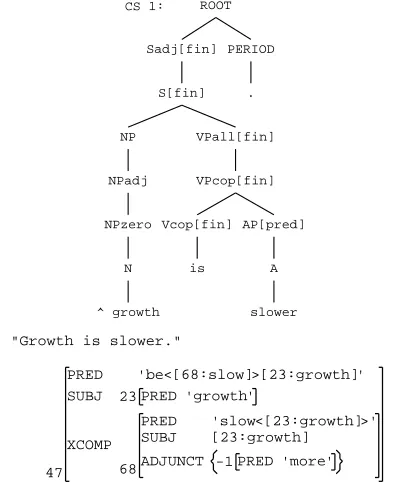
The unification process is the bottleneck in the XLE parsing system. The grammar generates many valid c-structure trees for a particular sentence: the Unifier then processes all of these trees (as packed structures), and a log-linear disambiguation module can choose the most probable f-structure from the resulting valid f-structures. For example, the sen-tence “Growth is slower.” has 84 valid c-structure trees according to the current English grammar;1 however once the Unifier has processed all of these trees (in a packed form), only one c-structure and f-structure pair is valid (see Figure 1). In this in-stance, the log-linear disambiguation does not need to choose the most probable result.
The research question we pose is whether the search space can be pruned earlier before unifi-cation takes place. Bangalore and Joshi (1999), Clark and Curran (2004) and Matsuzaki et al. (2007) show that by using a super tagger before (CCG and HPSG) parsing, the space required for discrimini-tive training is drastically reduced. Supertagging is not widely used within the LFG framework, al-though there has been some work on using hypertags (Kinyon, 2000). Ninomiya et al. (2006) propose a method for faster HPSG parsing while maintaining accuracy by only using the probabilities of lexical entry selections (i.e. the supertags) in their discrim-initive model. In the work presented here, we
con-1For example, is can be a copula, a progressive auxiliary or
a passive auxiliary, while slower can either be an adjective or an adverb.
centrate on reducing the number of c-structure trees that the Unifier has to process, ideally to one tree. The hope was that this would speed up the parsing process, but how would it affect the quality of the f-structures? This is similar to the approach taken by Cahill et al. (2005) who do not use a hand-crafted complete unification system (rather an automatically acquired probabilistic approximation). They parse raw text into LFG f-structures by first parsing with a probabilistic CFG parser to choose the most proba-ble c-structure. This is then passed to an automatic f-structure annotation algorithm which deterministi-cally generates one f-structure for that tree.
The most compact way of doing this would be to integrate a statistical component to the parser that could rank the c-structure trees and only pass the most likely forward to the unification process. How-ever, this would require a large rewrite of the sys-tem. So, we first wanted to investigate a “cheaper” alternative to determine the viability of the pruning strategy; this is the experiment reported in this pa-per. This is implemented by stipulating constituent boundaries in the input string, so that any c-structure that is incompatible with these constraints is invalid and will not be processed by the Unifier. This was done to some extent in Riezler et al. (2002) to au-tomatically generate training data for the log-linear disambiguation component of XLE. Previous work obtained the constituent constraints (i.e. brackets) from the gold-standard trees in the Penn-II Tree-bank. However, to parse novel text, gold-standard trees are unavailable.
We used a state-of-the-art probabilistic parser to provide the bracketing constraints to XLE. These parsers are accurate (achieving accuracy of over 90% on Section 23 WSJ text), fast, and robust. The idea is that pre-parsing of the input text by a fast and accurate parser can prune the c-structure search space, reducing the amount of work done by the Unifier, speed up parsing and maintain the high quality of the f-structures produced.
The structure of this paper is as follows: Section 2 introduces the XLE parsing system. Section 3 de-scribes a baseline experiment and based on the re-sults suggests retraining the Bikel parser to improve results (Section 4). Section 5 describes experiments on the development set, from which we evaluate the most successful system against the PARC 700 test
CS 1: ROOT
Figure 1: C- and F-Structure for “Growth is slower.”
set (Section 6). Finally, Section 7 concludes.
2 Background
In this section we introduce Lexical Functional Grammar, the grammar formalism underlying the XLE, and briefly describe the XLE parsing system.
2.1 Lexical Functional Grammar
Parser Output:(S1 (S (NP (NN Growth)) (VP (AUX is) (ADJP (JJR slower))) (. .)))
Labeled:\[S1 \[S Growth \[VP is \[ADJP slower\] \].\] \]
Unlabeled:\[ \[ Growth \[ is \[ slower\] \].\] \]
Figure 2: Example of retained brackets from parser output to constrain the XLE parser
2.2 The XLE Parsing System
The XLE parsing system is a deep-grammar-based parsing system. The experiments reported in this paper use the English LFG grammar constructed as part of the ParGram project (Butt et al., 2002). This system incorporates sophisticated ambiguity-management technology so that all possible syn-tactic analyses of a sentence are computed in an efficient, packed representation (Maxwell and Kaplan, 1993). In accordance with LFG the-ory, the output includes not only standard context-free phrase-structure trees (c-structures) but also attribute-value matrices (f-structures) that explic-itly encode predicate-argument relations and other meaningful properties. The f-structures can be de-terministically mapped to dependency triples with-out any loss of information, using the built-in or-dered rewrite system (Crouch et al., 2002). XLE se-lects the most probable analysis from the potentially large candidate set by means of a stochastic disam-biguation component based on a log-linear proba-bility model (Riezler et al., 2002) that works on the packed representations. The underlying parsing sys-tem also has built-in robustness mechanisms that al-low it to parse strings that are outside the scope of the grammar as a list of fewest well-formed “frag-ments”. Furthermore, performance parameters that bound parsing and disambiguation can be tuned for efficient but accurate operation. These parameters include at which point to timeout and return an error, the amount of stack memory to allocate, the num-ber of new edges to add to the chart and at which point to start skimming (a process that guarantees XLE will finish processing a sentence in polynomial time by only carrying out a bounded amount of work on each remaining constituent after a time threshold has passed). For the experiments reported here, we did not fine-tune these parameters due to time con-straints; so default values were arbitrarily set and the same values used for all parsing experiments.
3 Baseline experiments
We carried out a baseline experiment with two state-of-the-art parsers to establish what effect pre-bracketing the input to the XLE system has on the quality and number of the solutions produced. We used the Bikel () multi-threaded, head-driven chart-parsing engine developed at the University of Penn-sylvania. The second parser is that described in Charniak and Johnson (2005). This parser uses a discriminative reranker that selects the most proba-ble parse from the 50-best parses returned by a gen-erative parser based on Charniak (2000).
We evaluated against the PARC 700 Dependency Bank (King et al., 2003) which provides gold-standard analyses for 700 sentences chosen at ran-dom from Section 23 of the Penn-II Treebank. The Dependency Bank was bootstrapped by parsing the 700 sentences with the XLE English grammar, and then manually correcting the output. The data is di-vided into two sets, a 140-sentence development set and a test set of 560 sentences (Kaplan et al., 2004). We took the raw strings from the 140-sentence development set and parsed them with each of the state-of-the-art probabilistic parsers. As an upper bound for the baseline experiment, we use the brack-ets in the original Penn-II treebank trees for the 140 development set.
Non-Fragment Fragment Penn-XLE Penn-XLE Penn-XLE Penn-XLE
(lab.) (unlab.) (lab.) (unlab.) Total XLE parses (/140) 0 89 140 140 F-Score of subset 0 84.11 53.92 74.87 Overall F-Score 0 58.91 53.92 74.87
Table 1: Upper-bound results for original Penn-II trees
Non-Fragment Fragment
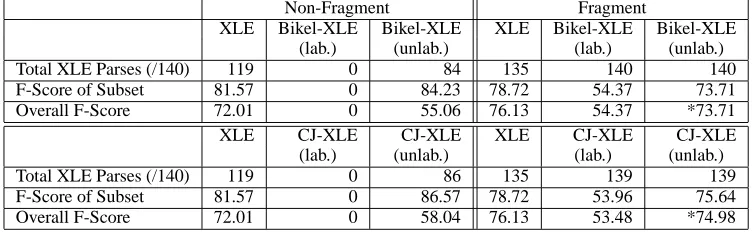
XLE Bikel-XLE Bikel-XLE XLE Bikel-XLE Bikel-XLE (lab.) (unlab.) (lab.) (unlab.) Total XLE Parses (/140) 119 0 84 135 140 140 F-Score of Subset 81.57 0 84.23 78.72 54.37 73.71 Overall F-Score 72.01 0 55.06 76.13 54.37 *73.71 XLE CJ-XLE CJ-XLE XLE CJ-XLE CJ-XLE (lab.) (unlab.) (lab.) (unlab.) Total XLE Parses (/140) 119 0 86 135 139 139 F-Score of Subset 81.57 0 86.57 78.72 53.96 75.64 Overall F-Score 72.01 0 58.04 76.13 53.48 *74.98
Table 2: Bikel (2002) and Charniak and Johnson (2005) out-of-the-box baseline results
the PARC 700 Dependency Bank.
The results of the baseline experiments are given in Tables 1 and 2. Table 1 gives the upper bound results if we use the gold standard Penn treebank to bracket the input to XLE. Table 2 compares the XLE (fragment and non-fragment) grammar to the system where the input is pre-parsed by each parser. XLE fragment grammars provide a back-off when parsing fails: the grammar is relaxed and the parser builds a fragment parse of the well-formed chunks. We compare the parsers in terms of total number of parses (out of 140) and the f-score of the sub-set of sentences successfully parsed. We also com-bine these scores to give an overall f-score, where the system scores 0 for each sentence it could not parse. When testing for statistical significance be-tween systems, we compare the overall f-score val-ues. Figures marked with an asterisk are not statisti-cally significantly different at the 95% level.2
The results show that using unlabeled brackets achieves reasonable f-scores with the non-fragment grammar. Using the labeled bracketing from the out-put of both parsers causes XLE to always fail when parsing. This is because the labels in the output of parsers trained on the Penn-II treebank differ con-siderably from the labels on c-structure trees
pro-2We use the approximate randomization test (Noreen, 1989)
to test for significance.
duced by XLE. Interestingly, the f-scores for both the CJ-XLE and Bikel-XLE systems are very sim-ilar to the upper bounds. The gold standard upper bound is not as high as expected because the Penn trees used to produce the gold bracketed input are not always compatible with the XLE-style trees. As a simple example, the tree in Figure 1 differs from the parse tree for the same sentence in the Penn Treebank (Figure 3). The most obvious difference is the labels on the nodes. However, even in this small example, there are structural differences, e.g. the position of the period. In general, the larger the tree, the greater the difference in both labeling and structure between the Penn trees and the XLE-style trees. Therefore, the next step was to retrain a parser to produce trees with structures the same as XLE-style trees and with XLE English grammar labels on the nodes. For this experiment we use the Bikel () parser, as it is more suited to being retrained on a new treebank annotation scheme.
4 Retraining the Bikel parser
We retrained the Bikel parser so that it produces trees like those outputted by the XLE parsing sys-tem (e.g. Figure 1). To do this, we first created a training corpus, and then modified the parser to deal with this new data.
S
NP
NN
Growth
VP
VBZ
is
ADJP-PRD
JJR
slower
· ·
Figure 3: Penn Treebank tree for “Growth is slower.”
XLE-style trees, we created one automatically from sections 02-21 of the Penn-II Treebank. We took the raw strings from those sections and marked up NP
and SBAR constituents using the brackets from the gold standard Penn treebank. The NP constituents
are labeled, and the SBARunlabeled (i.e. the SBAR
constituents are forced to exist in the XLE parse, but the label on them is not constrained to be SBAR).
We also tagged verbs, adjectives and nouns, based on the gold standard POS tags.
We parsed the 39,832 marked-up sentences in the standard training corpus and used the XLE disam-biguation module to choose the most probable c-and f-structure pair for each sentence. Ideally we would have had an expert choose these. We au-tomatically extracted the c-structure trees produced by the XLE and performed some automatic post-processing.3 This resulted in an automatically cre-ated training corpus of 27,873 XLE-style trees. The 11,959 missing trees were mainly due to the XLE parses not being compatible with the bracketed in-put, but sometimes due to time and memory con-straints.
Using the automatically-created training corpus of XLE-style trees, we retrained the Bikel parser on this data. This required adding a new language mod-ule (“XLE-English”) to the Bikel parser, and regen-erating head-finding rules for the XLE-style trees.
5 Experiments
Once we had a retrained version of the Bikel parser that parses novel text into XLE-style trees, we car-ried out a number of experiments on our develop-ment set in order to establish the optimum settings
3The postprocessing included removing morphological
in-formation and the brackets from the original markup.
All Sentences XLE Bikel-XLE
Non-fragment grammar Labeled brackets
Total Parsing Time 964 336 Total XLE Parses (/140) 119 77 F-Score of Subset 81.57 86.11 Overall F-Score 72.01 52.84
Non-fragment grammar Unlabeled brackets
Total Parsing Time 964 380 Total XLE Parses (/140) 119 89 F-Score of Subset 81.57 85.62 Overall F-Score 72.01 59.34
Fragment grammar Labeled brackets
Total Parsing Time 1143 390 Total XLE Parses (/140) 135 140 F-Score of Subset 78.72 71.86 Overall F-Score 76.13 71.86
Fragment grammar Unlabeled brackets
Total Parsing Time 1143 423 Total XLE Parses (/140) 135 140 F-Score of Subset 78.72 74.51 Overall F-Score 76.13 *74.51
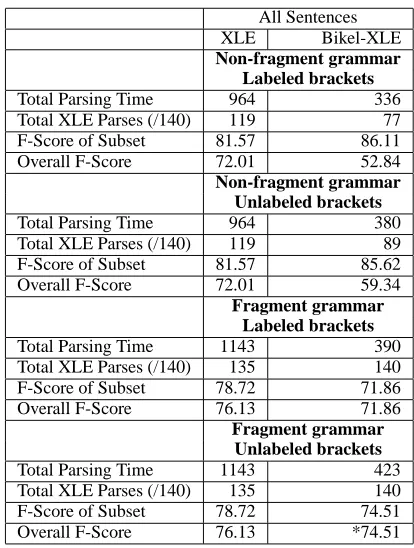
Table 3: Bikel-XLE Initial Experiments
for the evaluation against the PARC 700 test set.
5.1 Pre-bracketing
We automatically pre-processed the raw strings from the 140-sentence development set. This made sys-tematic changes to the tokens so that the retrained Bikel parser can parse them. The changes included removing quotes, converting a and an to a, con-verting n’t to not, etc. We parsed the pre-processed strings with the new Bikel parser.
We carried out four initial experiments, experi-menting with both labeled and unlabeled brackets and XLE fragment and non-fragment grammars. Ta-ble 3 gives the results for these experiments. We compare the parsers in terms of time, total number of parses (out of 140), the f-score of the subset of sentences successfully parsed and the overall f-score if the system achieves a score of 0 for all sentences it does not parse. The time taken for the Bikel-XLE system includes the time taken for the Bikel parser to parse the sentences, as well as the time taken for XLE to process the bracketed input.
subset of sentences parsed than XLE system alone, though the results are not statistically significantly better overall, since the coverage is much lower. The number of bracketed sentences that can be parsed by XLE increases if the brackets are unlabeled. The table also shows that the XLE system performs much better than Bikel-XLE when using the frag-ment grammars. Although the Bikel-XLE system is quite a bit faster, there is a drop in f-score; however this is not statistically significant when the brackets are unlabeled.
5.2 Pre-tagging
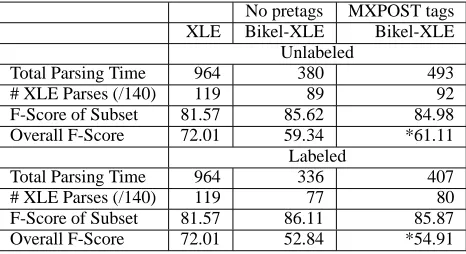
We performed some error analysis on the output of the Bikel-XLE system and noticed that a consider-able number of errors were due to mis-tagging. So, we pre-tagged the input to the Bikel parser using the MXPOST tagger (Ratnaparkhi, 1996). The results for the non-fragment grammars are presented in Ta-ble 4. Pre-tagging with MXPOST, however, does not result in a statistically significantly higher re-sult than parsing untagged input, although more sen-tences can be parsed by both systems. Pre-tagging also adds an extra time overhead cost.
No pretags MXPOST tags XLE Bikel-XLE Bikel-XLE
Unlabeled
Total Parsing Time 964 380 493 # XLE Parses (/140) 119 89 92 F-Score of Subset 81.57 85.62 84.98 Overall F-Score 72.01 59.34 *61.11
Labeled
Total Parsing Time 964 336 407 # XLE Parses (/140) 119 77 80 F-Score of Subset 81.57 86.11 85.87 Overall F-Score 72.01 52.84 *54.91
Table 4: MXPOST pre-tagged, Non-fragment gram-mar
5.3 Pruning
The Bikel parser can be customized to allow differ-ent levels of pruning. The above experimdiffer-ents were carried out using the default level. We carried out experiments with three levels of pruning.4 The
re-4
The default level of pruning starts at 3.5, has a maximum of 4 and relaxes constraints when parsing fails. Level 1 pruning is the same as the default except the constraints are never relaxed. Level 2 pruning has a start value of 3.5 and a maximum value of 3.5. Level 3 pruning has a start and maximum value of 3.
sults are given in Table 5 for the experiment with labeled brackets and the non-fragment XLE gram-mar. More pruning generally results in fewer and lower-quality parses. The biggest gain is with prun-ing level 1, where the number and quality of brack-eted sentences that can be parsed with XLE remains the same as with the default level. This is because Bikel with pruning level 1 does not relax the con-straints when parsing fails and does not waste time parsing sentences that cannot be parsed in bracketed form by XLE.
Default L1 L2 L3 Total Parsing Time 336 137 137 106 # XLE Parses (/140) 77 77 76 75 F-Score of Subset 86.11 86.11 86.04 85.87 Overall F-Score 52.84 *52.84 *52.43 *52.36
Table 5: Pruning with Non-fragment grammar, La-beled brackets, Levels default-3
5.4 Hybrid systems
Although pre-parsing with Bikel results in faster XLE parsing time and high-quality f-structures (when examining only the quality of the sentences that can be parsed by the Bikel-XLE system), the coverage of this system remains poor, therefore the overall f-score remains poor. One solution is to build a hybrid two-pass system. During the first pass all sentences are pre-parsed by Bikel and the bracketed output is parsed by the XLE non-fragment gram-mar. In the second pass, the sentences that were not parsed during the first pass are parsed with the XLE fragment grammar. We carried out a number of experiments with hybrid systems and the results are given in Table 6.
The results show that again labeled brackets re-sult in a statistically significant increase in f-score, although the time taken is almost the same as the XLE fragment grammar alone. Coverage increases by 1 sentence. Using unlabeled brackets results in 3 additional sentences receiving parses, and parsing time is improved by∼12%; however the increase in
f-score is not statistically significant.
deteri-XLE Bikel-XLE hybrid Bikel-XLE hybrid (frag) (labeled) (unlabeled) Total Parsing Time 1143 1121 1001 Total XLE Parses (/140) 135 136 138 F-Score of Subset 78.72 79.85 79.51 Overall F-Score 76.13 77.61 *78.28
Table 6: Hybrid systems compared to the XLE fragment grammar alone
XLE Bikel-XLE hybrid Bikel-XLE hybrid Bikel-XLE hybrid (frag) (level 1) (level 2) (level 3)
Total Parsing Time 1143 918 920 885
Total XLE Parses (/140) 135 136 136 136 F-Score of Subset 78.72 79.85 79.79 79.76 Overall F-Score 76.13 77.61 77.55 77.53
Table 7: Hybrid systems with pruning compared to the XLE fragment grammar alone
orate. The best system is the Bikel-XLE hybrid sys-tem with labeled brackets and pruning level 1. This system achieves a statistically significant increase in f-score over the XLE fragment grammar alone, de-creases the time taken to parse by almost 20% and increases coverage by 1 sentence. Therefore, we chose this system to perform our final evaluation against the PARC 700 Dependency Bank.
6 Evaluation against the PARC 700
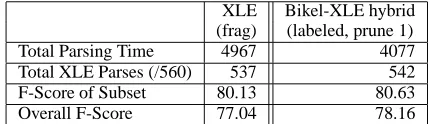
We evaluated the system that performs best on the development set against the 560-sentence test set of the PARC 700 Dependency Bank. The results are given in Table 8. The hybrid system achieves an 18% decrease in parsing time, a slight improvement in coverage of 0.9%, and a 1.12% improvement in overall f-structure quality.
XLE Bikel-XLE hybrid (frag) (labeled, prune 1) Total Parsing Time 4967 4077 Total XLE Parses (/560) 537 542 F-Score of Subset 80.13 80.63 Overall F-Score 77.04 78.16
Table 8: PARC 700 evaluation of the Hybrid system compared to the XLE fragment grammar alone
7 Conclusions
We successfully used a state-of-the-art probabilistic parser in combination with a hand-crafted system to improve parsing time while maintaining the quality of the output produced. Our hybrid system consists
of two phases. During phase one, pre-processed, to-kenized text is parsed with a retrained Bikel parser. We use the labeled brackets in the output to constrain the c-structures generated by the XLE parsing sys-tem. In the second phase, we use the XLE fragment grammar to parse any remaining sentences that have not received a parse in the first phase.
Given the slight increase in overall f-score per-formance, the speed up in parsing time (∼18%) can
justify more complicated processing architecture for some applications.5 The main disadvantage of the current system is that the input to the Bikel parser needs to be tokenized, whereas XLE processes raw text. One solution to this is to use a state-of-the-art probabilistic parser that accepts untokenized input (such as Charniak and Johnson, 2005) and retrain it as described in Section 4.
Kaplan et al. (2004) compared time and accuracy of a version of the Collins parser tuned to maximize speed and accuracy to an earlier version of the XLE parser. Although the XLE parser was more accu-rate, the parsing time was a factor of 1.49 slower (time converting Collins trees to dependencies was not counted in the parse time; time to produce f-structures from c-f-structures was counted in the XLE parse time). The hybrid system here narrows the speed gap while maintaining greater accuracy.
The original hope behind using the brackets to constrain the XLE c-structure generation was that
5For example, in massive data applications, if the parsing
the brackets would force the XLE to choose only one tree. However, the brackets were sometimes ambiguous, and sometimes more than one valid tree was found. In the final evaluation against the PARC 700 test set, the average number of optimal solutions was 4.05; so the log-linear disambiguation mod-ule still had to chose the most probable f-structure. However, this is considerably less to choose from than the average of 341 optimal solutions produced by the XLE fragment grammar for the same sen-tences when unbracketed.
Based on the results of this experiment we have integrated a statistical component into the XLE parser itself. With this architecture the packed c-structure trees are pruned before unification with-out needing to preprocess the input text. The XLE c-structure pruning results in a ∼30% reduction in
parse time on the Wikipedia with little loss in preci-sion. We hope to report on this in the near future.
Acknowledgments
The research in this paper was partly funded by Sci-ence Foundation Ireland grant 04/BR/CS0370.
References
Srinivas Bangalore and Aravind K. Joshi. 1999. Su-pertagging: An approach to alsmost parsing.
Com-putational Linguistics, 25(2):237–265.
Dan Bikel. Design of a Multi-lingual, Parallel-processing Statistical Parsing Engine. In Proceedings of HLT,
YEAR = 2002, pages = 24–27, address = San Diego, CA,.
Miriam Butt, Helge Dyvik, Tracy Holloway King, Hi-roshi Masuichi, and Christian Rohrer. 2002. The Par-allel Grammar Project. In Proceedings of Workshop
on Grammar Engineering and Evaluation, pages 1–7,
Taiwan.
Aoife Cahill, Martin Forst, Michael Burke, Mairead Mc-Carthy, Ruth O’Donovan, Christian Rohrer, Josef van Genabith, and Andy Way. 2005. Treebank-based acquisition of multilingual unification grammar re-sources. Journal of Research on Language and
Com-putation, pages 247–279.
Eugene Charniak and Mark Johnson. 2005. Coarse-to-Fine n-Best Parsing and MaxEnt Discriminative Reranking. In Proceedings of ACL, pages 173–180, Ann Arbor, Michigan.
Eugene Charniak. 2000. A maximum entropy inspired parser. In Proceedings of NAACL, pages 132–139, Seattle, WA.
Stephen Clark and James R. Curran. 2004. The Impor-tance of Supertagging for Wide-Coverage CCG Pars-ing . In Proceedings of COLING, pages 282–288, Geneva, Switzerland, Aug 23–Aug 27. COLING.
Richard Crouch, Ron Kaplan, Tracy Holloway King, and Stefan Riezler. 2002. A comparison of evaluation metrics for a broad coverage parser. In Proceedings of
the LREC Workshop: Beyond PARSEVAL, pages 67–
74, Las Palmas, Canary Islands, Spain.
Ron Kaplan and Joan Bresnan. 1982. Lexical Functional Grammar, a Formal System for Grammatical sentation. In Joan Bresnan, editor, The Mental
Repre-sentation of Grammatical Relations, pages 173–281.
MIT Press, Cambridge, MA.
Ron Kaplan, Stefan Riezler, Tracy Holloway King, John T. Maxwell, Alexander Vasserman, and Richard Crouch. 2004. Speed and Accuracy in Shallow and Deep Stochastic Parsing. In Proceedings of
HLT-NAACL, pages 97–104, Boston, MA.
Tracy Holloway King, Richard Crouch, Stefan Riezler, Mary Dalrymple, and Ron Kaplan. 2003. The PARC 700 dependency bank. In Proceedings of LINC, pages 1–8, Budapest, Hungary.
Alexandra Kinyon. 2000. Hypertags. In Proceedings of
COLING, pages 446–452, Saarbr¨ucken.
Takuya Matsuzaki, Yusuke Miyao, and Jun’ichi Tsujii. 2007. Efficient HPSG Parsing with Supertagging and CFG-filtering. In Proceedings of IJCAI, pages 1671– 1676, India.
John T. Maxwell and Ronald M. Kaplan. 1993. The interface between phrasal and functional constraints.
Computational Linguistics, 19(4):571–590.
Takashi Ninomiya, Takuya Matsuzaki, Yoshimasa Tsu-ruoka, Yusuke Miyao, and Jun’ichi Tsujii. 2006. Extremely Lexicalized Models for Accurate and Fast HPSG Parsing. In Proceedings of EMNLP, pages 155–163, Australia.
Eric W. Noreen. 1989. Computer Intensive Methods for Testing Hypotheses: An Introduction. Wiley, New
York.
Adwait Ratnaparkhi. 1996. A Maximum Entropy Part-Of-Speech Tagger. In Proceedings of EMNLP, pages 133–142, Philadelphia, PA.