S. Werner (ed.),Proceedings of the 15th NODALIDA conference, Joensuu 2005, Ling@JoY 1, 2006, pp. 173–179
The impact of phrases in document clustering for Swedish
Magnus Rosell
and
Sumithra Velupillai
KTH Nada
100 44 Stockholm
Sweden
{rosell, sumithra}@nada.kth.se
Abstract
We have investigated the impact of using phrases in the vector space model for clustering documents in Swedish in different ways. The in-vestigation is carried out on two text sets from different domains: one set of newspaper articles and one set of medical papers.
The use of phrases do not im-prove results relative the ordinary
use of words. The results
dif-fer significantly between the text
types. This indicates that one
could benefit from different text representations for different do-mains although a fundamentally different approach probably would be needed.
1
Introduction
For document clustering one normally uses the vector space model to represent texts. It is based on the distribution of
sin-gle words over the texts in a set. We
have investigated the impact of introducing phrases in this representation for Swedish in different ways and in different domains. Our hypothesis was that phrases would im-prove results and that the imim-provement would be greater for the medical papers than for the newspaper articles as we be-lieve that phrases carry more significance in the medical domain.
To calculate similarity between docu-ments with respect to their phrases we use a word trie (in one set of experiments). This approach has a lot in common with the method presented in (Hammouda and
Kamel, 2004). They show improvements
in clustering results on web pages using phrases combined with single words, using other algorithms than we. Another related method is the Phrase-Intersection Cluster-ing method which has been proven efficient on web pages (Zamir and Etzioni, 1998). It is based on word-n-grams rather than phrases.
2
Text sets
We have used a set of 2500 newspaper ar-ticles from KTH News Corpus (AB) (Has-sel, 2001) and a set of 2422 medical
pa-pers from Läkartidningen1 (Med). In Table
1 some statistics for the sets are given. We need categorizations of the text sets for the evaluation. The newspaper articles have been categorized by the paper into five sections such as Economy and Sports etc.
The medical papers are categorized
with The Medical Subject Headings
(MeSH) thesaurus2. This thesaurus is
(poly)hierarchical with a term and a unique code at each place in it. The terms are not unique and may occur at several places in
the hierarchy. There are 15broad headings
at the top level.
1http://www.lakartidningen.se/
Text Set Categories Documents Words Unique Words
AB 5 2500 119401 5896
Med 15, 814 2422 4383169 26102
Table 1: Text Sets
Each paper has one or more terms from
the thesaurus assigned to it. This
cate-gorization is very extensive, but also very hard to handle for clustering evaluation. Hence we have made four attempts to flat-ten and disambiguate it so that each paper belongs to only one of a set of non overlap-ping categories.
We have made three categorizations where we try to put each document into one of 15 categories corresponding to the
15 broad headings. The first, which we
call General, is constructed by choosing the broad heading to which most of the MeSH-terms assigned to the paper belongs.
By choosing the broad heading under which the most specific term (the term deepest into the hierarchy) is found for each paper we have constructed the second categorization, which we call Specific.
Many of the papers have as one of the terms assigned to it one or several broad headings. In the third categorization we have chosen this (always one) as the cat-egorization of those papers. The other pa-pers are categorized using the same system as for our categorization Specific. We call this categorization Combined.
We have made a fourth categorization which we call Term. In this every paper is assigned the MeSH-term that has the high-est frequency among the terms assigned to it. This leads to a categorization with 817 categories.
The categorizations General and Com-bined are those that seem most
trustwor-thy. A paper may probably have a very
specific term assigned without having its broad heading as the general focus (see Specific). Terms at different levels of the
MeSH-hierarchy probably make up an un-equal categorization (see Term).
3
Linguistics
We used the grammar checking program
Granska3 to extract nominal phrases from
the texts and a stemmer (Carlberger et al., 2001) to stem all words. To prevent very similar but not identical phrases to be deemed unsimilar we removed stopwords within the phrases as well as from the sin-gle words.
Swedish solid compounds often corre-spond to phrases (or compounds) in other languages. We use the spell checking pro-gram Stava (Kann et al., 2001) to split them. An earlier study (Rosell, 2003) has proven this to improve clustering results for newspaper articles. We also try to rep-resent the split compounds as phrases and try to split compounds within phrases (see Section 5).
4
Similarity
When calculating the similarity between two documents using phrases two
natu-ral alternatives are at hand. Either one
chooses to deem phrases similar only if they are identical or one looks at the over-lap of words between them. We have tried both. In the first case we have calculated the weight for each phrase in a document as the frequency of its appearance in that document multiplied by the sum of the idf-weight for the single words in it.
To find the overlaps of phrases in docu-ments we have built a trie based on words for each document from the phrases ap-pearing in them. Each phrase is put into
the trie in its entire and with all but the first word, with all but the first two words, etc. In each node of the trie we save the number of times it has been reached. To calculate the overlap of phrases between two docu-ments we follow all common paths in the tries and multiply relative appearances in each node weighted by the sum of the
idf-weights for the words along the path.4
5
Representations
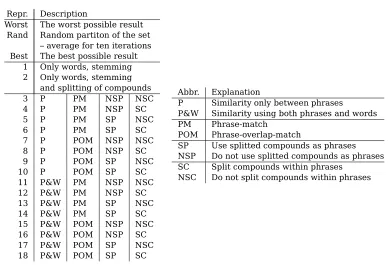
From the phrases and single words we built several different representations. Refer to Table 2 through this section.
Combining all the described possibilities (full phrases or overlap, using split pounds as phrases or not, and split com-pounds within phrases or not) we get eight different representations based on phrases.
By combining5 these with the ordinary
sin-gle word representation with split com-pounds we get eight more. This gives 16 representations (representations 3 through 18 in Table 2). We also made the reference representation (only words, 1) and the rep-resentation where solid compounds have been split (2), giving in total 18 different representations.
Finally, for comparison we also try a ran-dom “clustering” (Rand) and in the eval-uation we present the theoretical worst (Worst) and best (Best) possible results (see Sections 7 and 8).
6
Clustering algorithm
The clusterings have been made using the divisive algorithm Bisecting K-Means (Steinbach et al., 2000) which splits the worst cluster (i.e. largest) in two, using K-Means, until the desired number of clusters are reached. We have let the K-Means
algo-4Compare with Phrase-Intersection Clustering in (Zamir and Etzioni, 1998).
5We use equal weight on the two different repre-sentations. In (Hammouda and Kamel, 2004) they try different weightings.
rithm iterate ten times and for each split we ran it five times and picked the best split (evaluated using the similarity mea-sure). Average results are calculated over ten runs to ten clusters for each represen-tation.
7
Evaluation
As we compare different representations we use extrinsic evaluation measures that requires a categorization of the the same text set to compare with. Among the ex-trinsic evaluation measures that have been
used for text clustering are the purity and
the entropy. These measures are well
suited for evaluation of single clusters, but
for evaluation of whole clusteringsthe
mu-tual information is better. (Strehl et al., 2000)
Consider a text set
N
withn
texts. LetC
be a clustering with
γ
clusters,c
1 throughc
γ. Byn
i we mean the number of texts incluster
c
i (Pγi=1n
i=
n
). Similarly, letK
be a categorization with
κ
categories,k
(1)through
k
(κ)and letn
(j)denote the numberof texts in category
k
(j).The
γ
byκ
matrixM
describes thedistri-bution of the texts over both
C
andK
; thatis
m
(ij)is the number of texts that belong toc
i andk
(j).The mutual information of clustering
C
and categorization
K
is:M I(C, K) =
γX
i=1
κ
X
j=1
m
(ij)n
log(
m
(ij)n
n
in
(j))
(1)A theoretical tight upper bound is
M I
max(C, K) = log(κγ)/2
, the mean ofthe theoretical maximal entropy of the
clustering and the categorization. By
dividing the mutual information by this we get a normalized measure. (Strehl, 2002)
This normalization is theoretical and par-ticular for each
clustering-categorization-setting. We want to compare results on
Repr. Description
Worst The worst possible result Rand Random partiton of the set
– average for ten iterations Best The best possible result
1 Only words, stemming 2 Only words, stemming
and splitting of compounds 3 P PM NSP NSC 4 P PM NSP SC 5 P PM SP NSC
6 P PM SP SC
7 P POM NSP NSC 8 P POM NSP SC 9 P POM SP NSC 10 P POM SP SC 11 P&W PM NSP NSC 12 P&W PM NSP SC 13 P&W PM SP NSC 14 P&W PM SP SC 15 P&W POM NSP NSC 16 P&W POM NSP SC 17 P&W POM SP NSC 18 P&W POM SP SC
Abbr. Explanation
P Similarity only between phrases
P&W Similarity using both phrases and words PM Phrase-match
POM Phrase-overlap-match
SP Use splitted compounds as phrases NSP Do not use splitted compounds as phrases SC Split compounds within phrases
[image:4.595.104.493.70.335.2]NSC Do not split compounds within phrases
Table 2: Representations
sets, having varying clustering complex-ity/difficulty. Therefore we need to normal-ize with regard to something else.
Since we want to know how much intro-ducing phrases improve results we use the result from a clustering using only words as a reference. By comparing the results with this reference we take the complexity of the different text sets into account.
There are two simple and reasonable ways of normalizing the result using the
word clustering result,
M I(C
word, K)
. Wecan divide the result by it:
M I
word(C, K) =
M I
(C, K)
M I(C
word, K
)
,
(2)or we can divide the improvement by the maximum possible improvement from the word clustering result:
M I
imp(C, K
) =
M I
(C, K)
−
M I
(C
word, K)
M I
max(C, K)
−
M I(C
word, K)
(3)
The first normalization is suitable when we have a decrease in performance. It puts
the decrease in relation to the greatest pos-sible decrease. The second normalization is suitable when we have an increase in per-formance.
8
Results
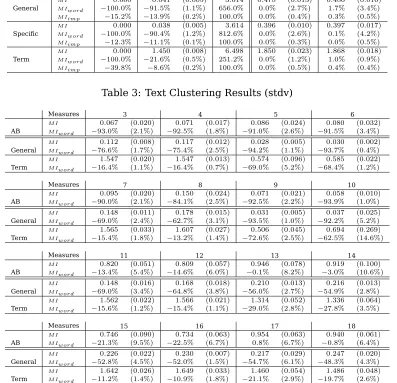
We present the results of our investigation in Tables 3 and 4. All values are average results over ten clusterings with standard deviation within parenthesis.
The first row of each part of these tables gives the results for the newspaper articles and the following the results on the med-ical papers compared to the different cat-egorizations. In Table 4 we only give re-sults for representations Term and General as the results for Combined, General and Specific are very similar.
Measures Worst Rand Best 1 2
M I 0.000 0.009 (0.003) 2.822 0.947 (0.043) 1.093 (0.084) AB M Iword −100.0% −99.0% (0.3%) 198.0% 0.0% (4.6%) 15.4% (8.9%)
M Iimp −50.5% −50.0% (0.2%) 100.0% 0.0% (2.3%) 7.8% (4.5%)
M I 0.000 0.038 (0.006) 3.614 0.407 (0.016) 0.415 (0.010) Combined M Iword −100.0% −90.6% (1.4%) 787.9% 0.0% (4.0%) 2.0% (2.4%)
M Iimp −12.7% −11.5% (0.2%) 100.0% 0.0% (0.5%) 0.3% (0.3%)
M I 0.000 0.041 (0.005) 3.614 0.478 (0.013) 0.486 (0.016) General M Iword −100.0% −91.5% (1.1%) 656.0% 0.0% (2.7%) 1.7% (3.4%)
M Iimp −15.2% −13.9% (0.2%) 100.0% 0.0% (0.4%) 0.3% (0.5%)
M I 0.000 0.038 (0.005) 3.614 0.396 (0.010) 0.397 (0.017) Specific M Iword −100.0% −90.4% (1.2%) 812.6% 0.0% (2.6%) 0.1% (4.2%)
M Iimp −12.3% −11.1% (0.1%) 100.0% 0.0% (0.3%) 0.0% (0.5%)
M I 0.000 1.450 (0.008) 6.498 1.850 (0.023) 1.868 (0.018) Term M Iword −100.0% −21.6% (0.5%) 251.2% 0.0% (1.2%) 1.0% (0.9%)
[image:5.595.101.498.145.528.2]M Iimp −39.8% −8.6% (0.2%) 100.0% 0.0% (0.5%) 0.4% (0.4%)
Table 3: Text Clustering Results (stdv)
Measures 3 4 5 6
M I 0.067 (0.020) 0.071 (0.017) 0.086 (0.024) 0.080 (0.032) AB M Iword −93.0% (2.1%) −92.5% (1.8%) −91.0% (2.6%) −91.5% (3.4%)
M I 0.112 (0.008) 0.117 (0.012) 0.028 (0.005) 0.030 (0.002) General M Iword −76.6% (1.7%) −75.4% (2.5%) −94.2% (1.1%) −93.7% (0.4%)
M I 1.547 (0.020) 1.547 (0.013) 0.574 (0.096) 0.585 (0.022) Term M Iword −16.4% (1.1%) −16.4% (0.7%) −69.0% (5.2%) −68.4% (1.2%)
Measures 7 8 9 10
M I 0.095 (0.020) 0.150 (0.024) 0.071 (0.021) 0.058 (0.010) AB M Iword −90.0% (2.1%) −84.1% (2.5%) −92.5% (2.2%) −93.9% (1.0%)
M I 0.148 (0.011) 0.178 (0.015) 0.031 (0.005) 0.037 (0.025) General M Iword −69.0% (2.4%) −62.7% (3.1%) −93.5% (1.0%) −92.2% (5.2%)
M I 1.565 (0.033) 1.607 (0.027) 0.506 (0.045) 0.694 (0.269) Term M Iword −15.4% (1.8%) −13.2% (1.4%) −72.6% (2.5%) −62.5% (14.6%)
Measures 11 12 13 14
M I 0.820 (0.051) 0.809 (0.057) 0.946 (0.078) 0.919 (0.100) AB M Iword −13.4% (5.4%) −14.6% (6.0%) −0.1% (8.2%) −3.0% (10.6%)
M I 0.148 (0.016) 0.168 (0.018) 0.210 (0.013) 0.216 (0.013) General M Iword −69.0% (3.4%) −64.8% (3.8%) −56.0% (2.7%) −54.9% (2.8%)
M I 1.562 (0.022) 1.566 (0.021) 1.314 (0.052) 1.336 (0.064) Term M Iword −15.6% (1.2%) −15.4% (1.1%) −29.0% (2.8%) −27.8% (3.5%)
Measures 15 16 17 18
M I 0.746 (0.090) 0.734 (0.063) 0.954 (0.063) 0.940 (0.061) AB M Iword −21.3% (9.5%) −22.5% (6.7%) 0.8% (6.7%) −0.8% (6.4%)
M I 0.226 (0.022) 0.230 (0.007) 0.217 (0.029) 0.247 (0.020) General M Iword −52.8% (4.5%) −52.0% (1.5%) −54.7% (6.1%) −48.3% (4.3%)
M I 1.642 (0.026) 1.649 (0.033) 1.460 (0.054) 1.486 (0.048) Term M Iword −11.2% (1.4%) −10.9% (1.8%) −21.1% (2.9%) −19.7% (2.6%)
Table 4: Results for Text Clustering with Phrases (stdv)
9
Discussion
When, in the following discussion, we re-fer to the results on the medical papers we consider the results on the categorization General (which is very similar to results on Combined and Specific). The results with respect to the categorization Term of the medical papers are a bit different than for the others. As we believe the other catego-rizations to be better we do not discuss this further.
To splitcompounds in the representation
com-pounds here would perhaps improve re-sults.
All variations of clustering usingphrases
performs worse than clustering using only
words. Clustering performs worse when
using only phrases (representations 3-10) than when using the combination of words and phrases (representations 11-18). Since clustering using words is superior the im-pact of phrases is diminished in the com-bined representations (11-18).
Looking at the representations based
only on phrases (3-10) we see that results on newspaper articles are almost as bad as random clustering for all of them. The performance on the medical papers, on the other hand, is better than random cluster-ing as long as we do not use split com-pounds as phrases. It is also better here to use the word trie representation (POM) rather than the simple phrase match (PM). In all this is an indication that phrases con-tain more information in the medical pa-pers than in the newspaper articles.
For the combined representations
(11-18) the results are much harder to analyze as the word representation is so much bet-ter than the phrase representation. The re-sults on the newspaper articles are much better than on the medical papers here. This could be since the phrase represen-tations do not contain as much informa-tion for the newspaper articles as for the medical papers and they thereby obscure the clustering to a lesser extent. Concern-ing the medical papers, all what is stated for the representations using only phrases holds, except that here it is not negative to use the split compounds as phrases (SP). For the newspaper articles there is even a great increase in performance when us-ing the split compounds as phrases. This could be explained if the phrase represen-tations using split compounds gives no in-formation, which the results for
represen-tations 3-10 indicates. There is no
reli-able difference between the use of simple
phrase match and the word trie representa-tions for the newspaper articles as the stan-dard deviation is very high.
No cases show any change in perfor-mance when splitting compounds within phrases (SC) or not. The reason for this could be beacuse the amount of compounds within phrases is small.
It is important to bear the great
differ-ences of the two text sets in mind. The differences in results between them show that clustering works differently on corpora with different contents (i.e. medical text vs. newspaper text). However, this difference might as well to a great extent be explained by other things, such as the structure and size of the texts and the difference of the
categorizations. The medical papers are
much longer than the newspaper articles. This could in fact explain all of the differ-ences between them regarding information found in the phrases and the compounds. The categorization of the newspaper arti-cles is probably much better than our cate-gorizations of the medical articles.
10
Conclusions and further work
Phrases do not improve clustering in
Swedish. At least with the
representa-tions tried here. The impact of phrases is more obvious on the medical papers. Over-lap match between phrases performs bet-ter than simple match. It seems to be bad to consider split compounds as phrases and it does not matter whether one splits com-pounds within phrases or not.
per-haps be exploited using some other repre-sentation. But the same information might also be found in the ordinary representa-tion using only words.
Our results are different from those pre-sented in (Hammouda and Kamel, 2004). This is presumably, at least partially, be-cause of differences between Swedish and English. Swedish solid compounds often correspond to phrases in English.
It could be interesting to try other varia-tions of the representavaria-tions using phrases presented here, but to really use the in-formation that phrases contain relative to mere words a fundamentally different ap-proach is probably needed. One interesting obvious extension of the present work is, however, to look at word-n-grams instead of phrases as these has proven useful in other works.
Acknowledgements
Our thanks go to professor Viggo Kann for supervision, to VR (Vetenskapsrådet – the Swedish Research Council) for funding and to all participants in the project “Info-mat” from KTH Nada (department of Com-puter Science and Numerical Analysis at the Royal Institute of Technology) and the department of Medical Epidemiology and Biostatistics (MEB) at Karolinska Institutet, both in Stockholm, Sweden.
References
J. Carlberger, H. Dalianis, M. Hassel, and O. Knutsson. 2001. Improving precision in information retrieval for Swedish using stem-ming. In Proc. 13th Nordic Conf. on Comp. Ling. – NODALIDA ’01.
K. M. Hammouda and M. S. Kamel. 2004.
Efficient phrase-based document indexing for web document clustering. IEEE Trans-actions on Knowledge and Data
Engineer-ing, 16(10):1279–1296. Student
Khaled M. Hammouda and Senior Member-Mohamed S. Kamel.
M. Hassel. 2001. Automatic construction of a Swedish news corpus. In Proc. 13th Nordic Conf. on Comp. Ling. – NODALIDA ’01.
V. Kann, R. Domeij, J. Hollman, and M. Tillenius, 2001. Text as a Linguistic Paradigm: Levels, Constituents, Constructs. Festschrift in hon-our of Ludek Hrebicek, volume 60, chapter Implementation aspects and applications of a spelling correction algorithm.
M. Rosell. 2003. Improving clustering of
swedish newspaper articles using stemming and compound splitting. InProc. 14th Nordic Conf. on Comp. Ling. – NODALIDA ’03.
M. Steinbach, G. Karypis, and V. Kumar. 2000. A comparison of document clustering tech-niques. In Proc. Workshop on Text Mining, 6th ACM SIGKDD Int. Conf. on Knowledge Discovery and Data Mining.
A. Strehl, J. Ghosh, and R. Mooney. 2000. Im-pact of similarity measures on web-page clus-tering. In Proc. AAAI Workshop on AI for Web Search (AAAI 2000), Austin, pages 58– 64. AAAI/MIT Press, July.
A. Strehl. 2002. Relationship-based Clustering and Cluster Ensembles for High-dimensional Data Mining. Ph.D. thesis, The University of Texas at Austin.
O. Zamir and O. Etzioni. 1998. Web