The Third PASCAL Recognizing Textual Entailment Challenge
Danilo Giampiccolo CELCT Via alla Cascata 56/c
38100 POVO TN
Bernardo Magnini FBK-ITC Via Sommarive 18,
38100 Povo TN
Ido Dagan
Computer Science Department Bar-Ilan University Ramat Gan 52900, Israel
Bill Dolan Microsoft Research Redmond, WA, 98052, USA [email protected]
Abstract
This paper presents the Third PASCAL Recognising Textual Entailment Chal-lenge (RTE-3), providing an overview of the dataset creating methodology and the submitted systems. In creating this year’s dataset, a number of longer texts were introduced to make the challenge more oriented to realistic scenarios. Ad-ditionally, a pool of resources was of-fered so that the participants could share common tools. A pilot task was also set up, aimed at differentiating unknown en-tailments from identified contradictions and providing justifications for overall system decisions. 26 participants submit-ted 44 runs, using different approaches and generally presenting new entailment models and achieving higher scores than in the previous challenges.
1.1 The RTE challenges
The goal of the RTE challenges has been to cre-ate a benchmark task dediccre-ated to textual en-tailment – recognizing that the meaning of one
text is entailed, i.e. can be inferred, by another1. In the recent years, this task has raised great in-terest since applied semantic inference concerns many practical Natural Language Processing (NLP) applications, such as Question Answering (QA), Information Extraction (IE), Summariza-tion, Machine Translation and Paraphrasing, and certain types of queries in Information Retrieval (IR). More specifically, the RTE challenges have aimed to focus research and evaluation on this common underlying semantic inference task and separate it from other problems that differ-ent NLP applications need to handle. For exam-ple, in addition to textual entailment, QA sys-tems need to handle issues such as answer re-trieval and question type recognition.
By separating out the general problem of tex-tual entailment from these task-specific prob-lems, progress on semantic inference for many application areas can be promoted. Hopefully, research on textual entailment will finally lead to the development of entailment “engines”, which can be used as a standard module in many appli-cations (similar to the role of part-of-speech tag-gers and syntactic parsers in current NLP appli-cations).
In the following sections, a detailed descrip-tion of RTE-3 is presented. After a quick review
1
The task was first defined by Dagan and Glickman (2004).
of the previous challenges (1.2), section 2 de-scribes the preparation of the dataset. In section 3 the evaluation process and the results are pre-sented, together with an analysis of the perform-ance of the participating systems.
1.2 The First and Second RTE Challenges
The first RTE challenge2 aimed to provide the NLP community with a new benchmark to test progress in recognizing textual entailment, and to compare the achievements of different groups. This goal proved to be of great interest, and the community's response encouraged the gradual expansion of the scope of the original task.
The Second RTE challenge3 built on the suc-cess of the first, with 23 groups from around the world (as compared to 17 for the first challenge) submitting the results of their systems. Repre-sentatives of participating groups presented their work at the PASCAL Challenges Workshop in April 2006 in Venice, Italy. The event was suc-cessful and the number of participants and their contributions to the discussion demonstrated that Textual Entailment is a quickly growing field of NLP research. In addition, the workshops spawned an impressive number of publications in major conferences, with more work in pro-gress. Another encouraging sign of the growing interest in the RTE challenge was represented by the increase in the number of downloads of the challenge datasets, with about 150 registered downloads for the RTE-2 development set.
1.3 The Third Challenge
RTE-3 followed the same basic structure of the previous campaigns, in order to facilitate the participation of newcomers and to allow "veter-ans" to assess the improvements of their systems in a comparable test exercise. Nevertheless, some innovations were introduced, on the one hand to make the challenge more stimulating and, on the other, to encourage collaboration between system developers. In particular, a lim-ited number of longer texts, i.e. up to a para-graph in length, were incorporated in order to move toward more comprehensive scenarios,
2
http://www.pascal-network.org/Challenges/RTE/.
3
http://www.pascal-network.org/Challenges/RTE2./
which incorporate the need for discourse analy-sis. However, the majority of examples re-mained similar to those in the previous chal-lenges, providing pairs with relatively short texts.
Another innovation was represented by a re-source pool4, where contributors had the possi-bility to share the resources they used. In fact, one of the key conclusions at the second RTE Challenge Workshop was that entailment model-ing requires vast knowledge resources that cor-respond to different types of entailment reason-ing. Moreover, entailment systems also utilize general NLP tools such as POS taggers, parsers and named-entity recognizers, sometimes posing specialized requirements to such tools. In re-sponse to these demands, the RTE Resource Pool was built, which may serve as a portal and forum for publicizing and tracking resources, and reporting on their use.
In addition, an optional pilot task, called "Ex-tending the Evaluation of Inferences from Texts" was set up by the US National Institute of Stan-dards and Technology (NIST), in order to ex-plore two other sub-tasks closely related to tex-tual entailment: differentiating unknown entail-ments from identified contradictions and provid-ing justifications for system decisions. In the first sub-task, the idea was to drive systems to make more precise informational distinctions, taking a three-way decision between "YES", "NO" and "UNKNOWN”, so that a hypothesis being unknown on the basis of a text would be distinguished from a hypothesis being shown false/contradicted by a text. As for the other sub-task, the goal for providing justifications for de-cisions was to explore how eventual users of tools incorporating entailment can be made to understand how decisions were reached by a system, as users are unlikely to trust a system that gives no explanation for its decisions. The pilot task exploited the existing RTE-3 Chal-lenge infrastructure and evaluation process by using the same test set, while utilizing human assessments for the new sub-tasks.
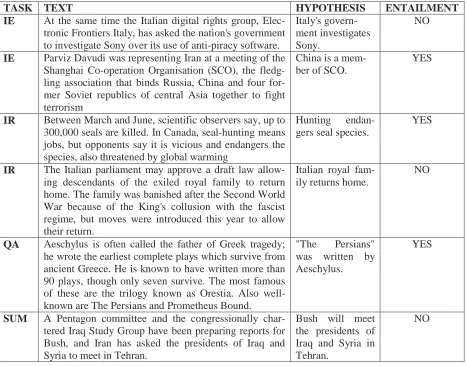
Table 1: Some examples taken from the Development Set.
2 The RTE-3 Dataset
2.1 Overview
The textual entailment recognition task required the participating systems to decide, given two text snippets t and h, whether t entails h. Textual en-tailment is defined as a directional relation between two text fragments, called text (t, the entailing text), and hypothesis (h, the entailed text), so that a human being, with common understanding of lan-guage and common background knowledge, can infer that h is most likely true on the basis of the content of t.
As in the previous challenges, the RTE-3 dataset consisted of 1600 text-hypothesis pairs, equally divided into a development set and a test set. While
the length of the hypotheses (h) was the same as in the past datasets, a certain number of texts (t) were longer than in previous datasets, up to a paragraph. The longer texts were marked as L, after being se-lected automatically when exceeding 270 bytes. In the test set they were about 17% of the total.
As in RTE-2, four applications – namely IE, IR, QA and SUM – were considered as settings or con-texts for the pairs generation (see 2.2 for a detailed description). 200 pairs were selected for each ap-plication in each dataset. Although the datasets were supposed to be perfectly balanced, the num-ber of negative examples were slightly higher in both development and test sets (51.50% and 51.25% respectively; this was unintentional). Posi-tive entailment examples, where t entailed h, were annotated YES; the negative ones, where entailment did not hold, NO. Each pair was annotated with its
TASK TEXT HYPOTHESIS ENTAILMENT
IE At the same time the Italian digital rights group, Elec-tronic Frontiers Italy, has asked the nation's government to investigate Sony over its use of anti-piracy software.
Italy's govern-ment investigates Sony.
NO
IE Parviz Davudi was representing Iran at a meeting of the Shanghai Co-operation Organisation (SCO), the fledg-ling association that binds Russia, China and four for-mer Soviet republics of central Asia together to fight terrorism
China is a mem-ber of SCO.
YES
IR Between March and June, scientific observers say, up to 300,000 seals are killed. In Canada, seal-hunting means jobs, but opponents say it is vicious and endangers the species, also threatened by global warming
Hunting endan-gers seal species.
YES
IR The Italian parliament may approve a draft law allow-ing descendants of the exiled royal family to return home. The family was banished after the Second World War because of the King's collusion with the fascist regime, but moves were introduced this year to allow their return.
Italian royal fam-ily returns home.
NO
QA Aeschylus is often called the father of Greek tragedy; he wrote the earliest complete plays which survive from ancient Greece. He is known to have written more than 90 plays, though only seven survive. The most famous of these are the trilogy known as Orestia. Also well-known are The Persians and Prometheus Bound.
"The Persians" was written by Aeschylus.
YES
SUM A Pentagon committee and the congressionally char-tered Iraq Study Group have been preparing reports for Bush, and Iran has asked the presidents of Iraq and Syria to meet in Tehran.
Bush will meet the presidents of Iraq and Syria in Tehran.
related task (IE/IR/QA/SUM) and entailment judgment (YES/NO, obviously released only in the development set). Table 1 shows some examples taken from the development set.
The examples in the dataset were based mostly on outputs (both correct and incorrect) of Web-based systems. In order to avoid copyright prob-lems, input data was limited to either what had al-ready been publicly released by official competi-tions or else was drawn from freely available sources such as WikiNews and Wikipedia.
In choosing the pairs, the following judgment criteria and guidelines were considered:
§ As entailment is a directional relation, the hypothesis must be entailed by the given text, but the text need not be entailed by the hypothesis.
§ The hypothesis must be fully entailed by the text. Judgment must be NO if the hy-pothesis includes parts that cannot be in-ferred from the text.
§ Cases in which inference is very probable (but not completely certain) were judged as YES.
§ Common world knowledge was assumed, e.g. the capital of a country is situated in that country, the prime minister of a state is also a citizen of that state, and so on.
2.2 Pair Collection
As in RTE-2, human annotators generated t-h pairs within 4 application settings.
The IE task was inspired by the Information Ex-traction (and Relation ExEx-traction) application, where texts and structured templates were replaced by t-h pairs. As in the 2006 campaign, the pairs were generated using four different approaches:
1) Hypotheses were taken from the relations tested in the ACE-2004 RDR task, while texts were extracted from the outputs of ac-tual IE systems, which were provided with relevant news articles. Correctly extracted instances were used to generate positive examples and incorrect instances to gener-ate negative examples.
2) The same procedure was followed using output of IE systems on the dataset of the
MUC-4 TST3 task, in which the events are acts of terrorism.
3) The annotated MUC-4 dataset and the news articles were also used to manually generate entailment pairs based on ACE re-lations.
4) Hypotheses corresponding to relations not found in the ACE and MUC datasets were used both to be given to IE systems and to manually generate t-h pairs from collected news articles. Examples of these relations, taken from various semantic fields, were “X beat Y”, “X invented Y”, “X steal Y” etc.
The common aim of all these processes was to simulate the need of IE systems to recognize that the given text indeed entails the semantic relation that is expected to hold between the candidate tem-plate slot fillers.
In the IR (Information Retrieval) application set-ting, the hypotheses were propositional IR queries, which specify some statement, e.g. “robots are used to find avalanche victims”. The hypotheses were adapted and simplified from standard IR evaluation datasets (TREC and CLEF). Texts (t) that did or did not entail the hypotheses were se-lected from documents retrieved by different search engines (e.g. Google, Yahoo and MSN) for each hypothesis. In this application setting it was as-sumed that relevant documents (from an IR per-spective) should entail the given propositional hy-pothesis.
For the QA (Question Answering) task, annotators used questions taken from the datasets of official QA competitions, such as TREC QA and QA@CLEF datasets, and the corresponding an-swers extracted from the Web by actual QA sys-tems. Then they transformed the question-answer pairs into t-h pairs as follows:
§ An answer term of the expected answer type was picked from the answer passage -either a correct or an incorrect one.
§ The question was turned into an affirma-tive sentence plugging in the answer term.
For example, given the question “How high is Mount Everest?” and a text (t) “The above men-tioned expedition team comprising of 10 members was permitted to climb 8848m. high Mt. Everest from Normal Route for the period of 75 days from 15 April, 2007 under the leadership of Mr. Wolf Herbert of Austria”, the annotator, extracting the piece of information “8848m.” from the text, would turn the question into an the affirmative sen-tence “Mount Everest is 8848m high”, generating a positive entailment pair. This process simulated the need of a QA system to verify that the retrieved passage text actually entailed the provided answer.
In the SUM (Summarization) setting, the entailment pairs were generated using two proce-dures.
In the first one, t’s and h’s were sentences taken from a news document cluster, a collection of news articles that describe the same news item. Annota-tors were given the output of multi-document summarization systems -including the document clusters and the summary generated for each clus-ter. Then they picked sentence pairs with high lexi-cal overlap, preferably where at least one of the sentences was taken from the summary (this sen-tence usually played the role of t). For positive ex-amples, the hypothesis was simplified by removing sentence parts, until it was fully entailed by t. Negative examples were simplified in a similar manner. In alternative, “pyramids” produced for the experimental evaluation mehod in DUC 2005 (Passonneau et al. 2005) were exploited. In this new evaluation method, humans select sub-sentential content units (SCUs) in several manually produced summaries on a subject, and collocate them in a “pyramid”, which has at the top the SCUs with the higher frequency, i.e. those which are present in most summaries. Each SCU is identi-fied by a label, a sentence in natural language which expresses the content. Afterwards, the anno-tators individuate the SCUs present in summaries generated automatically (called peers), and link them to the ones present in the pyramid, in order to assign each peer a weight. In this way, the SCUs in the automatic summaries linked to the SCUs in the higher tiers of the pyramid are assigned a heavier weight than those at the bottom. For the SUM set-ting, the RTE-3 annotators selected relevant pas-sages from the peers and used them as T’s, mean-while the labels of the corresponding SCUs were
used as H’s. Small adjustments were allowed, whenever the texts were not grammatically accept-able. This process simulated the need of a summa-rization system to identify information redundancy, which should be avoided in the summary.
2.3 Final dataset
Each pair of the dataset was judged by three anno-tators. As in previous challenges, pairs on which the annotators disagreed were filtered-out.
On the test set, the average agreement between each pair of annotators who shared at least 100 ex-amples was 87.8%, with an average Kappa level of 0.75, regarded as substantial agreement according to Landis and Koch (1997).
19.2 % of the pairs in the dataset were removed from the test set due to disagreement. The dis-agreement was generally due to the fact that the h was more specific than thet, for example because it contained more information, or made an absolute assertion where t proposed only a personal opinion. In addition, 9.4 % of the remaining pairs were dis-carded, as they seemed controversial, too difficult, or too similar when compared to other pairs.
As far as the texts extracted from the web are concerned, spelling and punctuation errors were sometimes fixed by the annotators, but no major change was allowed, so that the language could be grammatically and stylistically imperfect. The hy-potheses were finally double-checked by a native English speaker.
3 The RTE-3 Challenge
3.1 Evaluation measures
The evaluation of all runs submitted in RTE-3 was automatic. The judgments (classifications) returned by the system were compared to the Gold Standard compiled by the human assessors. The main evaluation measure was accuracy, i.e. the percent-age of matching judgments.
average of the system's precision values at all points in the ranked list in which recall increases, that is at all points in the ranked list for which the gold standard annotation is YES, or, more for-mally:
∑
=
×
n
i i
i UpToPair Entailment
i E
R 1
) ( #
) ( 1
(1)
where n is the number of the pairs in the test set, R is the total number of positive pairs in the test set, E(i) is 1 if the i-th pair is positive and 0 otherwise, and i ranges over the pairs, ordered by their rank-ing.
In other words, the more the system was confi-dent that t entails h, the higher was the ranking of the pair. A perfect ranking would have placed all the positive pairs (for which the entailment holds) before all the negative ones, yielding an average precision value of 1.
3.2 Submitted systems
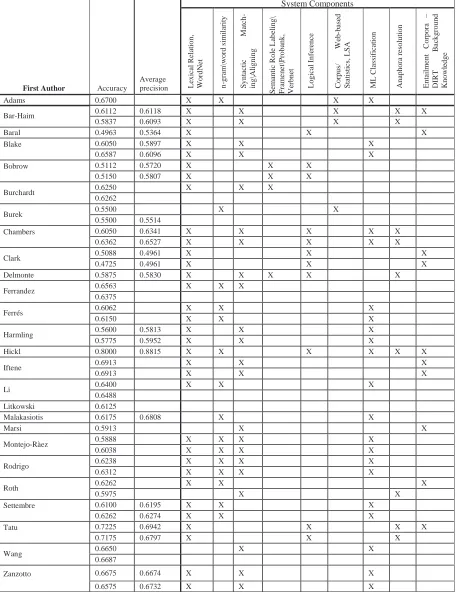
Twenty-six teams participated in the third chal-lenge, three more than in previous year. Table 2 presents the list of the results of each submitted runs and the components used by the systems. Overall, we noticed a move toward deep proaches, with a general consolidation of ap-proaches based on the syntactic structure of Text and Hypothesis. There is an evident increase of systems using some form of logical inferences (at least seven systems). However, these approaches, with few notably exceptions, do not seem to be consolidated enough, as several systems show re-sults not still at the state of art (e.g. Natural Logic introduced by Chambers et al.). For many systems an open issue is the availability and integration of different and complex semantic resources-
A more extensive and fine grained use of spe-cific semantic phenomena is also emerging. As an example, Tatu and Moldovan carry on a sophisti-cated analysis of named entities, in particular Per-son names, distinguishing first names from last names. Some form of relation extraction, either through manually built patterns (Chambers et al.) or through the use of an information extraction sys-tem (Hickl and Bensley) have been introduced this
year, even if still on a small scale (i.e. few rela-tions).
On the other hand, RTE-3 confirmed that both machine learning using lexical-syntactic features and transformation-based approaches on depend-ency representations are well consolidated tech-niques to address textual entailment. The extension of transformation-based approaches toward prob-abilistic settings is an interesting direction investi-gated by some systems (e.g. Harmeling). On the side of “light” approaches to textual entailment, Malakasiotis and Androutpoulos provide a useful baseline for the task (0.61%) using only POS tag-ging and then applying string-based measures to estimate the similarity between Text and Hypothe-sis.
As far as resources are concerned, lexical data-bases (mostly WordNet and DIRT) are still widely used. Extended WordNet is also a common re-source (for instance in Iftene and Balahur-Dobrescu) and the Extended Wordnet Knowledge Base has been successfully used in (Tatu and Moldovan). Verb-oriented resources are also largely present in several systems, including Fra-menet (e.g. Burchardt et al.), Verbnet (Bobrow et al.) and Propbank (e.g. Adams et al.). It seems that the use of the Web as a resource is more limited when compared to the previous RTE workshop. However, as in RTE-2, the use of large semantic resources is still a crucial factor affecting the per-formance of systems (see, for instance, the use of a large corpus of entailment examples in Hickl and Bensley).
Finally, an interesting aspect is that, stimulated by the percentage of longer texts included this year, a number of participating systems addressed anaph-ora resolution (e.g. Delmonte, Bar-Haim et al., Iftene and Balahur-Dobrescu).
3.3 Results
Table 2: Submission results and components of the systems. .
System Components
First Author Accuracy
Average precision Lex
ic al R el at io n , W o rd N et n -g ra m \w o rd s im il ar it y S y n ta ct ic M at ch -in g \A li g n in g S em an ti c R o le L ab el in g \ F ra m e n et \P ro b an k , V er b n et L o g ic al I n fe re n ce C o rp u s/ W eb -b as ed S ta ti st ic s, L S A M L C la ss if ic at io n A n ap h o ra r es o lu ti o n E n ta il m e n t C o rp o ra – D IR T B a ck g ro u n d K n o w le d g e
Adams 0.6700 X X X X
0.6112 0.6118 X X X X X
Bar-Haim
0.5837 0.6093 X X X X
Baral 0.4963 0.5364 X X X
0.6050 0.5897 X X X
Blake
0.6587 0.6096 X X X
0.5112 0.5720 X X X
Bobrow
0.5150 0.5807 X X X
0.6250 X X X
Burchardt
0.6262
0.5500 X X
Burek
0.5500 0.5514
0.6050 0.6341 X X X X X
Chambers
0.6362 0.6527 X X X X X
0.5088 0.4961 X X X
Clark
0.4725 0.4961 X X X
Delmonte 0.5875 0.5830 X X X X X
0.6563 X X X
Ferrandez
0.6375
0.6062 X X X
Ferrés
0.6150 X X X
0.5600 0.5813 X X X
Harmling
0.5775 0.5952 X X X
Hickl 0.8000 0.8815 X X X X X X
0.6913 X X X
Iftene
0.6913 X X X
0.6400 X X X
Li
0.6488
Litkowski 0.6125
Malakasiotis 0.6175 0.6808 X X
Marsi 0.5913 X X
0.5888 X X X X
Montejo-Ràez
0.6038 X X X X
0.6238 X X X X
Rodrigo
0.6312 X X X X
0.6262 X X X
Roth
0.5975 X X
0.6100 0.6195 X X X
Settembre
0.6262 0.6274 X X X
0.7225 0.6942 X X X X
Tatu
0.7175 0.6797 X X X
0.6650 X X
Wang
0.6687
0.6675 0.6674 X X X
Zanzotto
As far as the per-task results are concerned, the trend registered in RTE-2 was confirmed, in that there was a marked difference in the performances obtained in different task settings.
In fact, the average accuracy achieved in the QA setting (0.71) was 20 points higher than that achieved in the IE setting (0.52); the average accu-racy in the IR and Sum settings was 0.66 and 0.58 respectively. In RTE-2 the best results were achieved in SUM, while the lower score was al-ways recorded in IE. As already pointed out by Bar-Haim (2006), these differences should be fur-ther investigated, as they could lead to a sensible improvement of the performance.
As for the LONG pairs, which represented a new element of this year’s challenge, no substan-tial difference was noted in the systems’ perform-ances: the average accuracy over the long pairs was 58.72%, compared to 61.93% over the short ones.
4 Conclusions and future work
At its third round, the Recognizing Textual En-tailment task has reached a noticeable level of ma-turity, as the very high interest in the NLP commu-nity and the continuously increasing number of participants in the challenges demonstrate. The relevance of Textual Entailment Recognition to different applications, such as the AVE5 track at QA at CLEF6, has also been acknowledged. Fur-thermore, the debates and the numerous publica-tions about the Textual Entailment have contrib-uted to the better understanding the task and its nature.
To keep a good balance between the consoli-dated main task and the need for moving forward, longer texts were introduced in the dataset, in order to make the task more challenging, and a pilot task was proposed. The Third RTE Challenge have also confirmed that the methodology for the creation of the datasets, developed in the first two campaigns, is robust. Overall, the transition of the challenge coordination from Bar-Ilan –which organized the first two challenges- to CELCT was successful, though some problems were encountered, espe-cially in the preparation of the data set. The
5 http://nlp.uned.es/QA/ave/. 6 http://clef-qa.itc.it/.
tems which took part in RTE-3 showed that the technology applied to Entailment Recognition has made significant progress, confirmed by the results, which were generally better than last year. In par-ticular, visible progress in defining several new principled scenarios for RTE was represented, such as Hickl’s commitment-based approach, Bar Haim’s proof system, Harmeling’s probabilistic model, and Standford’s use of Natural Logic.
If, on the one hand, the success that RTE has had so far is very encouraging, on the other, it in-cites to overcome certain current limitations, and to set realistic and, at the same time, stimulating goals for the future. First at all, theoretical refinements both of the task and the models applied to it need to be developed. In particular, more efforts are re-quired to improve knowledge acquisition, as little progress has been made on this front so far. Also the data set generation and the evaluation method-ology need to be refined and extended. A major problem in the current setting of the data collection is that the distribution of the examples is arbitrary to a large extent, being determined by manual se-lection. Therefore new evaluation methodologies, which can reflect realistic distributions should be investigated, as well as the possibility of evaluating Textual Entailment Recognition within additional concrete application scenarios, following the spirit of the QA Answer Validation Exercise.
Acknowledgments
The following sources were used in the preparation of the data:
• PowerAnswer question answering system, from Language Computer Corporation, provided by Dan Moldovan and Marta Tatu.
http://www.languagecomputer.com/solutions/question answer-ing/power answer/
• Cicero Custom and Cicero Relation information extraction systems, from Language Computer Cor-poration, provided by Sanda M. Harabagiu, An-drew Hickl, John Lehmann and and Paul Aarseth. http://www.languagecomputer.com/solutions/information_ext action/cicero/index.html
Proc-essing group at Columbia University’s Departmen-tof Computer Science.
http://newsblaster.cs.columbia.edu/
• NewsInEssence multi-document summarization system provided by Dragomir R. Radev and Jahna Otterbacher from the Computational Linguistics and Information Retrieval research group, Univer-sity of Michigan.
http://www.newsinessence.com
• New York University’s information extraction system, provided by Ralph Grishman, Department of Computer Science, Courant Institute of Mathe-matical Sciences, New York University.
• MUC-4 information extraction dataset, from the National Institute of Standards and Technology (NIST).
http://www.itl.nist.gov/iaui/894.02/related projects/muc/
• ACE 2004 information extraction templates, from the National Institute of Standards and Tech-nology (NIST).
http://www.nist.gov/speech/tests/ace/
• TREC IR queries and TREC-QA question collec-tions, from the National Institute of Standards and Technology (NIST).
http://trec.nist.gov/
• CLEF IR queries and CLEF-QA question collec-tions, from DELOS Network of Excellence for Digital Libraries.
http://www.clef-campaign.org/, http://clef-qa.itc.it/
• DUC 2005 annotated peers, from Columbia Uni-versity, NY, provided by Ani Nenkova.
http://www1.cs.columbia.edu/~ani/DUC2005/
We would like to thank the people and organiza-tions that made these sources available for the challenge. In addition, we thank Idan Szpektor and Roy Bar Haim from Bar-Ilan University for their assistance and advice, and Valentina Bruseghini from CELCT for managing the RTE-3 website.
We would also like to acknowledge the people and organizations involved in creating and annotat-ing the data: Pamela Forner, Errol Hayman, Cam-eron Fordyce from CELCT and Courtenay Hendricks, Adam Savel and Annika Hamalainen
from the Butler Hill Group, which was funded by Microsoft Research.
This work was supported in part by the IST Pro-gramme of the European Community, under the PASCAL Network of Excellence, IST-2002-506778. We wish to thank the managers of the PASCAL challenges program, Michele Sebag and Florence d’Alche-Buc, for their efforts and sup-port, which made this challenge possible. We also thank David Askey, who helped manage the RTE 3 website.
References
Roy Bar-Haim, Ido Dagan, Bill Dolan, Lisa Ferro, Danilo Giampiccolo, Bernardo Magnini and Idan Szpektor. 2006. The Second PASCAL Recognizing Textual Entailment Challenge. In Proceedings of the Second PASCAL Challenges Workshop on Recog-nizing Textual Entailment, Venice, Italy.
Ido Dagan, Oren Glickman, and Bernardo Magnini. 2006. The PASCAL Recognizing Textual Entailment Challenge. In Quiñonero-Candela et al., editors, MLCW 2005, LNAI Volume 3944, pages 177-190. Springer-Verlag.
J. R. Landis and G. G. Koch. 1997. The measurements of observer agreement for categorical data.
Biomet-rics, 33:159–174.
Rebecca Passonneau, Ani Nenkova., Kathleen McKe-own, and Sergey Sigleman. 2005. Applying the pyramid method in DUC 2005. In Proceedings of the Document Understanding Conference (DUC 05), Vancouver, B.C., Canada.