Grid based LEACH Protocol for Intelligent Cluster Head
Selection in Wireless Sensor Networks
Vishav Mohan Goyal
1, Balkrishan Jindal
2P.G. Student, Department of Computer Engineering, Punjabi University Regional Campus Yadavindra College of Engineering, Talwandi Sabo, Punjab, India.1
Assistant Professor, Department of Computer Engineering, Punjabi University Regional Campus Yadavindra College of Engineering, Talwandi Sabo, Punjab, India.2
[email protected], [email protected]
Abstract- Clustering techniques are well-known for saving the energy of wireless sensor networks. In this paper, a grid-based energy balanced clustering protocol (EBCP) is proposed which is based on the working of LEACH. EBCP firstly divides the WSN into rectangular grids where each grid represents a cluster. Then a cluster head (CH) selection algorithm is run in each grid to select the fittest candidate for CH. Residual energy of SNs is considered for the selection of CHs and SN with maximum residual energy is selected as CH for the current round. This mechanism promises the balanced cluster formation and selection of fittest SN as a CH. Simulation experiment of the proposed EBCP protocol are performed in MATLAB and results are compared with LEACH. Obtained results illustrate the superiority of EBCP over LEACH in terms of network lifetime, energy conservation and efficient utilization of energy resources.
Keywords- Clustering; Cluster Head Selection; Energy Efficiency; Wireless Sensor Networks.
1.INTRODUCTION
Wireless Sensor Networks (WSNs) consists of many electronic sensor devices that perform communications as well as computation operations [1]. The energy of these sensors nodes (SNs) is limited which drains at a variable rate depending upon the operations performed such as computing, detecting signals, transmitting and receiving the data. The lifetime of the network may vary from months to years subjecting to the layout of the network and requirements of the applications. Improper communication causes the premature failure of the network due to the excessive drainage of the power from the SNs [2]. This failure hinders the purpose of the applications which are meant to survive for the longest time. Therefore, prolonging the life of the network is the prime concern, so that the finite energy of the SNs can be used efficiently.
Clustering techniques are well-known for saving energy of the WSNs. These techniques aim to improve the longevity of the network by selecting the Cluster Heads (CHs) in such a way that transmission costs are minimized for SNs. It results in fewer communications and computation operations thereby saving the energy of the SNs. The selection of CHs among the SNs is an optimal search problem that minimizes the transmission cost to save energy. In Clustering approaches, CHs collect data from the SNs of their clusters,
aggregate the data and transmit to base station (BS) directly or via other CHs.
LEACH was the first clustering protocol which enhances the longevity of WSN to a great extent. Many such LEACH based clustering protocols have been proposed to enhance the CH selection mechanism. LEACH follows a stochastic approach to select CHs where a SN is only eligible to become CH if it satisfies two conditions: (i) SN has not become CH in previous rounds, and (ii) SN has more energy than randomly generated threshold energy for current round.[3] However it suffers from unintelligent selection of CHs in which SNs with low energy can be selected as cluster head (CH). Also, LEACH does not guarantee the scalability in WSN.
The rest of the paper is organized as follows: Section II provides the related work. The details of the proposed method are provided in Section III. Section IV provides the experimental results on three different WSN‟s and Section V concludes the work.
2.RELATED WORK
Heinzelman et al. [6] proposed the first ever clustering based routing protocol for WSNs namely LEACH. In LEACH, CH role is rotated among all the SNs of the WSN equivalently to conserve the energy and too prolong the network lifetime. Data aggregation technique is integrated in the protocol for the transmission of data from the CH to the BS to reduce the data size.
C-LEACH is proposed by Raval et al. [7] in which the energy is preserved by the usage of basic clustering mechanism. S-LEACH is introduced by Yassein et al. in [8] in which energy harvesting is compulsory. S-LEACH uses the power of the sun as the solar energy to power the sensor nodes. Hassan et al. [9] designed the improved model in which more set-up stages are included. A Message "Hello" is sent by the round robin scheduling method for the selection of the CH. Centralized LEACH is proposed by pitke et al. [10], which divides the network into two regions known as close region and far region. SNs in a far region transmit data in a multi-hop fashion whereas SNs in the close region transmits their data directly to BS. Further, even odd routing is used to remove the transmission of redundant data.
Fuzzy Logic LEACH is explained by Ran et al. [11] by using the soft computing as its essential technique. Intra-cluster and inter-Intra-cluster distance are minimized using particle swarm optimization technique for the conservation of energy. Quadrature LEACH is described by Ghosh et al. [12] in which entire WSN is alienated into 4 equal parts. For the optimal drainage of the energy, the technique of random clustering is deployed in each portion of the divided wireless sensor network. Sec-LEACH is explained by Oliveira et al. [13] for the provision of active cluster pattern, the random key pre distribution is needed along with the TESLA. To minimize the power efficiency, the similar method is used and the lifetime of the network is also increased. Time Based-LEACH protocol was proposed by Palan et al. [14] in which steady no. of cluster heads are needed. The new improved LEACH ensures that the divided cluster portion can be uniform & balanced to increase the life of the wireless network.
The author Wang et al. [15] explained the sliding window & dynamic number of node in LEACH. The problem of the count of CHs throughout its own lifetime is resolved by this protocol which was a major problem for the LEACH protocol. Only the live SNs are used by this protocol. LEACH-DHCS is described by Khan et al. [16] consists mainly of three steps: first is cluster node formation, second is the rote formation & third is the data communication. LEACH-V is explained by Reddy et al. [17] in which a vice CH is needed for the backup
of CH. The LEACH-V gives a strong approach by which the new CH is not required to be selected after it gets died for the data communication to take place for the BS which enhances the wireless sensor network lifetime. Gupta et al. [18] explained that by using the area & position of node co-ordinates, the area is clustered by the data with the basic change in the standard LEACH protocol. Firstly the whole network is divided into preferred number of grid with the same number of wireless clusters. LEACH protocol is implemented in each grid for the selection of CHs. Threshold LEACH is explained by Singh et al. [19] which uses the threshold value for the SNs energy to be eligible as CH. Only those SNs participate in CH role which have more energy than the threshold value.
3.PROPOSED PROTOCOL
In this section, the proposed clustering protocol namely Energy Balanced Clustering Protocol (EBCP) is discussed. The main idea behind the design of EBCP is to employ an intelligent and load balanced clustering mechanism which was absent in LEACH and its variants. LEACH and most of its variants selects CH using a probabilistic function rather than considering location and residual energy of the SNs. Also, random selection of CHs in LEACH and its variants results in imbalanced load on CHs. To overcome these issues, a rectangular grids based division of WSN is done to generate clusters of equal size, and then residual energy based function is applied to select the fittest CH in each grid or cluster. System model and working of proposed protocol is discussed in following sub-sections.
3.1. Network Model
WSN with N number of SNs and having area m*m square units is considered for network simulations. The SNs are deployed randomly over the WSN field using gaussian distribution and are considered fixed after deployment. BS is deployed at the center of the WSN field and is assumed to have unlimited storage, processing and power capabilities. On the other hand, all SNs are homogeneous in nature and are considered to have limited storage and energy capabilities. First order radio model is used to transmit the data from one SN to other or to the BS. This model has the ability to adjust the power of signal according to the transmission distance. Symbols used to denote various network parameters are shown in Table 1.
TABLE 1.NETWORK PARAMETERS Abbreviatio
ns Parameters
N Number of SNs in WSN
K Number of CHs m*m Area covered by WSN
Transmission Energy for sending 1 bit Receiving Energy
Energy consumed in free space transmission
Energy consumed in multipath transmission
d Transmission distance Energy(j) Residual energy of jth CH
3.2. Energy Consumption Model
The energy consumption is an utmost important issue in WSNs. Power consumed by network as a whole should be efficiently handled and minimal. The communication radio model used in this paper is shown in Fig.1.
Fig.1.Radio Energy Consumption Model.
Here, for transmitting an m-bits packet to a node at distance d, the radio consumes
( )
( )
( )
(1)
and at the other end, to receive this packet, the radio consumes:
( )
( )
(2)where, and denotes the energy exhausted in the electronic transmission channel and amplifier circuitry of the above-mentioned radio model and s is the path loss. The free space model with settings as s=2 and = will be used if distance d is less than threshold distance ( =
√
). In other cases, the multipath fading model will be used with settings as s=4 and =
3.3. Working Flow of EBCP
The EBCP is proposed to overcome the limitations of LEACH and its successor‟s which did not considered the balance consumption of energy for longer network lifetime. EBCP is based on the principle that cluster should be created first and then the fittest SN from each cluster should become CH. This is achieved by dividing the WSN into equal sized rectangular grids as per the requirement. Each rectangular grid represents a cluster and SNs in each grid are MNs of that cluster. One of the MN from each cluster should be selected as CH. For this purpose, SN with maximum residual energy is considered as the fittest candidate for CH.
Lifetime of WSN in EBCP is divided into rounds, where each round consists of three phases and these are information
collecting phase, cluster head selecting phase and data collecting phase. In information collecting phase, important information is collected from the SNs which is required to generate clusters and to select CHs, in cluster head selection phase, residual energy-based cluster head selection algorithm is run to select the fittest SN as CH in each cluster. In data collection phase, sensed information is collected from all SNs and processed at BS. After the completion of each round, energy level of all the SNs is checked to verify that SNs are dead or alive. Once any of the SN is dead, it is considered as the lifetime of the WSN. Details of the above phases are discussed in following sub-sections
3.3.1. Information Collecting Phase
In the beginning of each round, BS broadcasts an information request message which includes the ID of BS and its location co-ordinates. This message is intended to collect the information regarding the location of SNs and their energy levels. SNs on receiving this message from BS will transmit their location information and residual energy status to BS. BS waits for some time to receive the information from all SNs. If in that time some SNs fail to send their information, BS re-broadcasts the information collection message with the ID of those SNs whose information is not yet received. On receiving the location and residual energy information, BS initiates a mechanism to divide the WSN into virtual grids.
3.3.2. Cluster Head Selection Phase
After creating virtual grids, BS runs an algorithm to select the CHs for the current round. CHs are selected on the basis of their residual energy. The SN which has the highest residual energy is selected as a CH in each grid. Details of the cluster head selection process is given in Section 3.4. After selection of CHs, BS will send the status message to all SNs of the WSN. This message includes the ID of all the SNs with their status which could either be CH or MN. On receiving this message, CHs transmits an advertisement message to the members of its cluster. MNs on receiving this message, send a join request message to their CH and accordingly CH assign a time slot to each MN using TDMA technique. TDMA technique is used to avoid any collisions between the SNs of same cluster.
3.3.3. Data Collecting Phase
re-initiates the process of clustering for the next round. This process continues until one of the nodes exhausts all of its energy.
3.3.3.1. Cluster Head Selection Algorithm
Based on the information received by BS, it divides the WSN field into rectangular grids and assigns a number to each grid. After creating and assigning number to grids, BS evaluates that which SNs belongs to which grid. This is done by matching the co-ordinates of SN with boundary conditions of the grid. Once, all the SNs are marked in one of the grids, then process for selecting the CH starts. For each grid, residual energy of SNs is compared and node with maximum energy is considered as a CH for the current round. In successive rounds, if the energy of CHs in previous round is still maximum, then it remains CH in current round and if energy is less, then new CH is chosen with maximum residual energy.
4.RESULTS AND DISCUSSION
[image:4.595.312.557.380.553.2]The proposed protocol EBCP is implemented in MATLAB to evaluate its performance in comparison to LEACH protocol. We consider three different WSNs with area of 100*100 m2, 200*200 m2 and 300*300 m2. 100 SNs are randomly deployed over the WSN area and BS is located at the center of the WSN. Further, 3 scenarios are created for each network area with different node deployments. This is done to remove any ambiguity due to favorable conditions created by some particular deployment for particular protocol. WSN is divided into 12 grids, each of equal size.
Table 2. Network and Simulation Environment Parameters
Parameters Value
Number of SNs 100 BS position Center WSN Field Rectangular Number of Grids 12
Packet Length 6400 bits Control Packet Length 200 bits Transmission Energy 5 nJ/bit Receiving Energy 5 nJ/bit Multipath Energy 0.0013 pJ/bit Free Space Energy 0.1 pJ/bit Aggregation Energy 0.5 nJ/packet WSN Area#1 100*100 m2 WSN Area#2 200*200 m2 WSN Area#3 300*300 m2
4.1. Performance Metrics
To compare the performance of EBCP and LEACH in terms of energy efficiency, following performance metrics are used:
Energy Consumption: Energy consumed by network in transmitting, receiving and aggregating the data for one round is considered for comparing the energy efficiency of protocols.
Network Lifetime: Mainly three metrics are used to evaluate the lifetime of WSN, namely first node die (FND), half node die (HND) and last node die (LND). Since this study is focused on extending the lifetime of WSN by equalizing the load on SNs, FND is considered to evaluate the network lifetime.
Energy Utilization: The ability of protocol to utilize the resources efficiently and effectively tells its quality. In this study, we analyze how these protocols fare when comparison is made on how much energy resources they have utilized. The protocol which utilizes more energy during his lifetime and has more lifetime than other protocol is superior as compared to other.
4.2. Energy Consumption Comparison
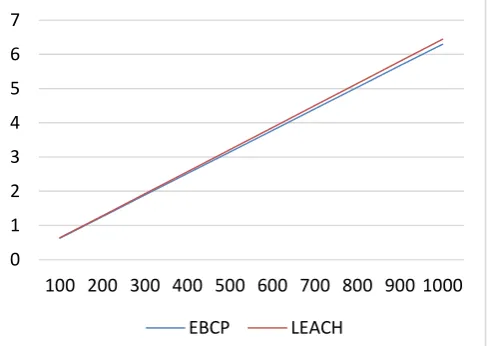
[image:4.595.31.300.430.616.2]Total energy consumed by the network upto 1000th round is measured and plotted. The simulation is performed for three different network sizes and for each size three different node scenarios are created. Average of all node scenarios for particular area is considered for comparison purpose. It can be seen from the figure that EBCP performs better than LEACH in all the areas. Fig.2, Fig.3 and Fig.4 shows the energy consumption comparison for WSN Area#1, WSN Area#2 and WSN Area#3 respectively.
Fig.2. Energy Consumption Comparison for WSN Area#1
0 1 2 3 4 5 6 7
100 200 300 400 500 600 700 800 900 1000
Fig.3. Energy Consumption Comparison for WSN Area#2
Fig.4. Energy Consumption Comparison for WSN Area#3
4.3. Network Lifetime Comparison
Round „r‟ at which the first node of the network becomes dead is considered for comparing the period for which a particular protocol can keep the WSN alive. For each WSN area, average lifetime of all node scenarios is taken for comparing the network lifetime. Fig.5. shows the obtained result of network lifetime for EBCP and LEACH. It can be observed that EBCP has shown much better lifetime as compared to LEACH. Reason for high lifetime of EBCP is the formation of balanced clusters and periodic rotation CH role according to its energy level. Also with an increase in network area, the decrease in network lifetime due to increase in energy consumption is minimal in EBCP.
Fig.5. Network Lifetime Comparison for different Network Areas
4.4. Energy Utilization Comparison
The ability of utilizing the energy resources by the proposed protocol in comparison to LEACH is tested and plotted in Fig.6. It is observed that which protocol consumes more energy in its lifetime. The protocol which has less residual energy left is considered to have more balanced cluster head selection approach. As seen from the figure, EBCP has very less residual energy as compared to LEACH which means EBCP has more stable and balanced clustering approach than LEACH. On the other hand, LEACH has very poor cluster head selection approach and result in the death of WSN very early before utilizing its energy resources.
Fig.6. Energy Utilization Comparison for different Network Areas
0 1 2 3 4 5 6 7
100 200 300 400 500 600 700 800 900 1000
EBCP LEACH
0 1 2 3 4 5 6 7
100 200 300 400 500 600 700 800 900 1000
EBCP LEACH
0 2000 4000 6000 8000 10000
WSN Area#1 WSN Area#2 WSN Area#3
EBCP LEACH
0 5 10 15 20 25
WSN Area#1 WSN Area#2 WSN Area#3 Energy Utilization Comparison
5.CONCLUSION
This study presents an efficient grid-based energy balanced clustering protocol (EBCP) to overcome the shortcomings of LEACH protocol. This protocol improves the LEACH protocol by introducing residual energy as a parameter to select cluster head and dividing the area of WSN into rectangular grids. These two factors overcome the limitations of the traditional LEACH protocol where first factor make sure that low residual energy sensor node will not be selected as cluster head thereby avoiding the premature death of WSN. While the latter factor tackles the problem of imbalanced clusters by dividing the whole area of the network in fixed size rectangular zones. The experiments are performed through simulating the WSN in MATLAB environment. The outcomes of the experiments demonstrate the superiority of the EBCP in contrast to LEACH protocol. Better network lifetime, energy conservation and efficient utilization of energy resources is observed which validates the presented work.
REFERENCES
[1] I. F. Akyildiz, W. Su, Y. Sankarasubramaniam, and E. Cayirci, “Wireless sensor networks: a survey,”
Comput. Networks, vol. 38, no. 4, pp. 393–422, 2002. [2] J. N. Al-Karaki and a. E. Kamal, “Routing
Techniques in Wireless Sensor Networks: A Survey,”
IEEE Wirel. Commun., vol. 11, no. 6, pp. 6–28, 2004. [3] M. Younis and K. Akkaya, “Strategies and techniques
for node placement in wireless sensor networks: A survey,” Ad Hoc Networks, vol. 6, no. 4, pp. 621–655, 2008.
[4] N. A. Pantazis, S. A. Nikolidakis, and D. D. Vergados, “Energy-Efficient Routing Protocols in Wireless Sensor Networks: A Survey,” IEEE Commun. Surv. Tutorials, vol. 15, no. 2, pp. 551–591, 2013.
[5] P. Bakaraniya and S. Mehta, “K-LEACH: An improved LEACH Protocol for Lifetime Improvement in WSN,” Ijettjournal.Org, vol. 4, no. 5, pp. 1521– 1526, 2013.
[6] W. B. Heinzelman, A. P. Chandrakasan, and H. Balakrishnan, “An application-specific protocol architecture for wireless microsensor networks,” IEEE Trans. Wirel. Commun., vol. 1, no. 4, pp. 660–670, 2002.
[7] G. Raval, M. Bhavsar, and N. Patel, “Analyzing the Performance of Centralized Clustering Techniques for Realistic Wireless Sensor Network Topologies,”
Procedia Comput. Sci., vol. 57, pp. 1026–1035, 2015.
[8] M. B. Yassein, S. Aljawarneh, and R. K. Al-huthaifi, “Enhancements of LEACH Protocol : Security and Open Issues,” pp. 1–8, 2017.
[9] A. A. Hassan and A. A. Mohammed, “Clustering Methods for Cluster-based Routing Protocols in Wireless Sensor Networks : Comparative Study,” vol. 12, no. 21, pp. 11350–11360, 2017.
[10] K. Pitke, P. Kumar, and S. K. Singh, “A Load Balancing Cross Clustering Approach in Wireless Sensor Network?,” in ACM International Conference Proceeding Series, 2017, pp. 52–57.
[11] G. Ran, H. Zhang, and G. Shulan, “Improving on LEACH Protocol of Wireless Sensor using Fuzzy Logic,” Inf. Comput. Sci., vol. 3, no. March, pp. 767– 775, 2010.
[12] S. Ghosh and I. S. Misra, “Design and testbed implementation of an energy efficient clustering protocol for WSN,” Proc. 2017 Int. Conf. Innov. Electron. Signal Process. Commun. IESC 2017, pp. 55–60, 2017.
[13] L. B. Oliveira et al., “SecLEACH-On the security of
clustered sensor networks,” Signal Processing, vol. 87, no. 12, pp. 2882–2895, 2007.
[14] N. G. Palan, B. V. Barbadekar, and S. Patil, “Low energy adaptive clustering hierarchy (LEACH) protocol: A retrospective analysis,” Proc. Int. Conf. Inven. Syst. Control. ICISC 2017, pp. 1–12, 2017. [15] A. Wang, D. Yang, and D. Sun, “A clustering
algorithm based on energy information and cluster heads expectation for wireless sensor networks,”
Comput. Electr. Eng., vol. 38, no. 3, pp. 662–671, 2012.
[16] F. Khan, F. Bashir, and K. Nakagawa, “Dual head clustering scheme in wireless sensor networks,” Proc. - 2012 Int. Conf. Emerg. Technol. ICET 2012, no. April 2015, pp. 456–460, 2012.
[17] G. R. S. Reddy, “A Review on Different Types of LEACH Protocol for Wireless Sensor Networks,” vol. 2, no. 4, pp. 840–844, 2017.
[18] V. Gupta and M. N. Doja, “H-LEACH: Modified and efficient LEACH protocol for hybrid clustering scenario in wireless sensor networks,” Adv. Intell. Syst. Comput., vol. 638, pp. 399–408, 2018.