Volume 5, No. 1, Jan-Feb 2014
International Journal of Advanced Research in Computer Science
RESEARCH PAPER
Available Online at www.ijarcs.info
Exploring Cloud Computing Services for Supply Chain Management
Shivani Dubey
Dept. of Computer Science & Engineering Ansal University, Gurgaon
Tara Rawat
Department of Computer Applications JSSATE, Noida
Abstract: Cloud computing is an emerging technology in the computer industry where the computing is moved to a cloud of computers. This emerging technology opens new era of e-services in different disciplines. Cloud computing is the style of computing where massively scaled IT related capabilities are provided as a service across the internet to multiple external customers and are billed by consumption. Cloud computing also provides power referenced with IT as a service. Users can enjoy the service even he knows nothing about the technology of cloud computing and the professional knowledge in this field and the power to control it. In this paper, we explore cloud computing services and applications, and distribution process of e-supply chain management which provides secure and dependable data storage center, so user needn’t do the awful things such as storing data and killing virus, this kind of task can be done by professionals. It can realize data share through different equipments. It analyses some questions and hidden troubles, and puts forward some solutions, and discusses the future of cloud computing.
Keywords: Cloud computing, Distribution process of e-supply chain management and SaaS, IaaS, PaaS.
I. INTRODUCTION
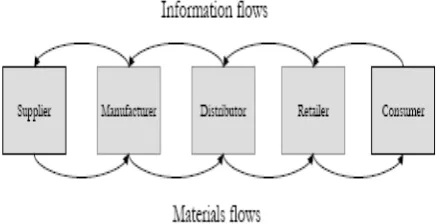
[image:1.595.46.266.530.642.2]A supply chain is a network of facilities and distribution options that performs the functions of procurement of materials, transformation of these materials into intermediate and finished products, and the distribution of these finished products to customers. Supply chains exist in both service and manufacturing organizations, although the complexity of the chain may vary greatly from industry to industry and firm to firm. Supply chain management (SCM) is concerned with the flow of products and information between supply chain members' organizations. Recent development in technologies enables the organization to avail information easily in their premises. These technologies are helpful to coordinates the activities to manage the supply chain. The cost of information is decreased due to the increasing rate of technologies [1].
Figure 1. Supply chain Representation
SCM is needed for various reasons: improving operations, better outsourcing, increasing profits, enhancing customer satisfaction, generating quality outcomes, tackling competitive pressures, increasing globalization, increasing importance of E-commerce, and growing complexity of supply chains. Supply chains relatively easy to define for manufacturing industries, where each participant in the chain receives inputs from a set of suppliers, processes those inputs and delivers them to a different set of customers.
II. CLOUD COMPUTING
A study by Gartner considered Cloud Computing as the first among the top 10 most important technologies and with a better prospect in successive years by companies and organizations. Cloud Computing enables ubiquitous, convenient, on-demand network access to a shared pool of configurable computing resources (e.g., networks, servers, storage, applications, and services) that can be rapidly provisioned and released with minimal management effort or service provider interaction [2]. Cloud Computing appears as a computational paradigm as well as distribution architecture and its main objective is to provide secure, quick, convenient data storage and net computing service, with all computing resources visualized as services and delivered over the Internet.
A. Software as a service or software as a server:
Software as a service or software as a server (SaaS) is somewhat in between the previous two terms in the respect that social business functions such as a sales department that has to know its customers, for example, would use this type of term. Software as a service is set to become the preeminent way to provide technology solutions to organizations within the coming years. A good example of a SaaS product would be online email [3].
B. Platform as a Service:
Platform as a service (PaaS) refers to renting server technology in order to use its development capabilities. Many small tech companies need in an ad-hoc manner to meet grad platform from which to process their customized code. Platform as a service offers these organizations the ability to do this all while saving huge amounts of money that would otherwise be wasted on hardware resources [3].
C. Infrastructure as a Service:
In IaaS virtualization is extremely used in order to integrate/decompose physical resource demand from cloud consumers. The virtualization is set up independent virtual machines that are isolated from both the underlying hardware and other virtual machines [3].
III. HISTORY OF CLOUD COMPUTING
Cloud computing is an expression used to describe a variety of of computers connected through a real-time communication a synonym fo means the ability to run a program or application on many connected computers at the same time. In the 1990s, however, they began expanding their offerings to include virtual private network services. This allowed the telecom companies to provide the same quality of service at a fraction of the cost, as they were able to optimize resource utilization in order to improve the efficiency of their overall bandwidth. In these earliest stages, the term “cloud” was used to represent the computing space between the provider and the end user. In 1997, Professor Ramnath Chellapa of Emory University and the University of South California defined cloud computing as the new “computing paradigm where the boundaries of computing will be determined by economic rationale rather than technical limits alone.” This has become the basis of what we refer to today when we discuss the concept of cloud computing. In 1999, Salesforce.com became one of the first major movers in the cloud arena, pioneering the concept of delivering enterprise-level applications to end users via the Internet.
The application could be accessed by any customer with Internet access and companies were able to purchase the service on a cost-effective on-demand basis. In 2002 Amazon.com proved it could outlast the dot-com bubble burst with the introduction of its web-based retail services. Amazon was the first major organization to modernize its data centers, which were utilizing only about 10% of their capacity at any given time (which was commonplace at the time, because companies were worried about sudden spikes in capacity needs). Amazon realized that the new cloud computing infrastructure model could allow them to use their existing capacity with much greater efficiency. 2005
was also a noteworthy year for cloud computing in the hedge fund industry. In 2006, there was Google Docs services, which brought the power of cloud computing and document sharing directly to end users. In 2008, the cloud environment supported 200+ users. In 2009, the entry of Microsoft into Cloud Computing is a clear indication of the growth of the space. Microsoft for long has not accepted the Internet and the web as a significant market and has continued to focus on the desktop market for all these years.
IV. CHARACTERSTICS OF CLOUD
COMPUTING
a. On demand self services: computer services such as
email, applications, network or server service can be provided without requiring human interaction with each service provider. Cloud service providers providing on demand self services include Amazon Web Services (AWS), Microsoft, Google, IBM and Salesforce.com. New York Times and NASDAQ are examples of companies using AWS (NIST).
b. Broad network access: Cloud Capabilities are
available over the network and accessed through standard mechanisms that promote use by heterogeneous thin or thick client platforms such as mobile phones, laptops and PDAs.
c. Resource pooling: The provider’s computing
resources are pooled together to serve multiple consumers using multiple-tenant model, with different physical and virtual resources dynamically assigned and reassigned according to consumer demand.
d. Rapid elasticity: Cloud services can be rapidly and
elastically provisioned, in some cases automatically, to quickly scale out and rapidly released to quickly scale in. To the consumer, the capabilities available for provisioning often appear to be unlimited and can be purchased in any quantity at any time.
e. Measured service: Cloud computing resource usage
can be measured, controlled, and reported providing transparency for both the provider and consumer of the utilized service. Cloud computing services use a metering capability which enables to control and optimize resource use. This implies that just like air time, electricity or municipality water IT services are charged per usage metrics pay per use.
f. Multi Tenacity: It refers to the need for policy-driven
enforcement, segmentation, isolation, governance, service levels, and chargeback/billing models for different consumer constituencies. Consumers might utilize a public cloud provider’s service offerings or actually be from the same organization, such as different business units rather than distinct organizational entities, but would still share infrastructure.
g. Pay per use: consumers are charged fees based on
their usage of a combination of computing power, bandwidth use and/or storage
h. Agility: Business agility is a business' ability to adapt
i. IT Service-Oriented Approach: Cloud Computing is IT/business service-oriented as opposed to traditional system- or server-oriented models. Rather than getting bogged down by the network administration of an environment, an IT service-oriented approach provides business agility, as users can perform administrative tasks faster [4].
j. Reliability and Fault-Tolerance: Cloud environments
have built-in redundancy because of the large number of servers that constitute them. If you take advantage of geo-redundancy, servers are more strategically placed at different geographical locations in order to alleviate downtime related issues.
k. Consumption-based Billing: Users only pay for
services they use, by subscription or transaction-based models.
l. SLA-driven: Clouds are managed dynamically based
on service-level agreements that define policies such as delivery parameters, costs, and additional factors.
m. APIs: Clouds virtualizes resources as a service, which
implies the need for an application programming interface (API), from which resources can be controlled and managed.
n. Flexible: clouds are flexible. They can be used to
serve a large variety of workload types-varying from small loads of a small consumer application to very heavy loads of a commercial application.
V. NEED OF CLOUD COMPUTING FOR
SUPPLY CHAIN MANAGEMENT
Supply chain has entered in a new era of informationization and network. In the competition between enterprises, the quality of supply chain has played an increasingly important role in terms of determining the future and destiny of the enterprise. The enterprises mastering and responding to the supply chain information rapidly are more possible to win in the fierce business competitions. The supply chain consists of supplier, manufacturer, distributor, vendor and customer and each of them consists of many entities. Moreover, each entity includes countless supply information and demand information. How to coordinate mass information from different objects in supply chain and how to maximize the overall benefit of supply chain have already become a burning issue in the current supply chain informationization process. The market of traditional supply chain is relatively stable; however, its technical progress is slow and the product life cycle is long. Therefore, usually the previous supply chain information coordination adopted the chained information flow mode. In order to solve the problems in the chained information flow such as information distortion, long transfer cycle, low utilization rate and hard-to-share, the scholars proposed a series of information coordination modes.
The process to add the channels feeding back is customer information to supplier, manufacturer, distributor and vendor. Although such a mode has solved the problem of customer demand information distortion in the supply chain, it still does not realize information sharing of the other four nodes including supplier. Such stages had the advantages of accurate information, fast transfer speed and sufficient information sharing, however, as all information is saved in one information center, it is easy to form
information management monopoly which can cause the information asymmetry at each node in supply chain [5].
The virtual information center scheme based on cloud computing to solve the problem of supply chain coordination. It takes the cloud computing platform as the information center at the integrated information flow mode. It has solved the problems of information management monopoly and security; however, as it adopts the centralized information management, this supply chain information flow mode will suffer a devastating blow if the cloud computing center is attacked. Some scholars implement the related studies from another perspective of information coordination. The document analyzes the social risks and technical risks in the process of cloud computing supply chain information coordination in depth. Aiming at the traditional agricultural product supply modes which are highly discrete, the documents and implement studies to the closed agricultural product supply chain informationization platform based on computing. The document proposes a para-virtual enterprise logistics mode and analyzes the main logistics relationship of this logistics mode by actual cases. Cloud computing is a new IT technology following grid computing. It has a certain risk while it brings the new opportunities for supply chain information coordination mode. Based on the cloud computing technology, this paper takes the advantages and disadvantages of its applications in supply chain information coordination into a comprehensive consideration and proposes a supply chain coordination mode which is capable of resisting the cloud computing risk [5].
The most advanced cloud computing solutions connect multiple enterprises to a “single version of the truth” (SVOT). That is, unlike traditional systems that live behind the firewall, cloud solutions live in the cloud and provide a master data repository and associated tools. Organizations no longer have to worry about inconsistent or stale data, as the data is available in real time to all parties. Furthermore, users and organizations can not only view that data, they can act on it in real-time, responding to situations as they arise and thus averting crises before they occur. Advanced cloud solutions are particularly suited to party and multi-enterprise problems, for example, supply chain management. The supply chain is comprised of many individuals, and many organizations, from suppliers, manufacturers, distributors, logistics and retailers, collaborating to manufacture and distribute goods, from the farm or the factory, right to the end consumer. Often each participant in the supply chain has different systems, and are scattered around the globe [6]. With these challenges, effective supply chain management has been an intractable problem. Thankfully that is changing. There are a few supply chain management cloud solutions emerging, among one of the first is processes in supply chain management to become particularly prominent venues for cloud computing:
A. Planning and forecasting:
B. Logistics:
Cloud computing applications for functions such as network strategy, inventory management, warehousing and transportation will appear with increasing regularity in the near future. Processes such as global trade compliance, replenishment planning, order processing, and transportation load building, fleet management and transportation route planning are likely candidates. Some basic warehouse-and transportation-management applications are already available online.
C. Sourcing and Procurement:
Cloud computing represents a great opportunity to reduce ‘total cost of ownership’: the most commonly cited success metric in sourcing and procurement.
D. Service and spare parts management:
Many companies underperform in this area – despite the fact that leading service and spare parts management programmes often generate a disproportionately high percentage of an organization’s profits. So the fact that companies might use cloud computing to upgrade their capabilities without extensive CapEx costs – and rapidly implement the processes prescribed by the software – could be a significant advantage [7].
VI. DISTRIBUTION PROCESS FOR E-SUPPLY
CHAIN MANAGEMENT
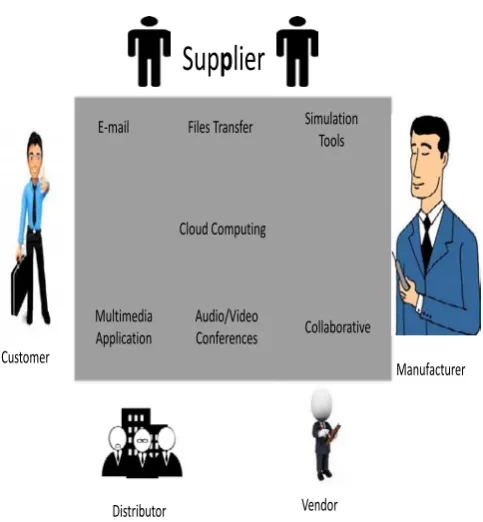
After taking an overall consideration of advantages and facilities of applying cloud computing, this paper proposes a supply chain distribution process which is capable of resisting cloud computing as shown in Figure.2. This distribution process has two basic statuses which are online status and offline status.
Supplier
Customer
Manufacturer
Distributor Vendor
Cloud Computing
E-mail Files Transfer Simulation
Tools
Multimedia Application
Audio/Video
[image:4.595.38.280.462.723.2]Conferences Collaborative
Figure 2: Distribution process of e-supply chain management in cloud computing
At the online stage, the network is smooth and the cloud computing center runs normally. At this stage, each node in
supply chain only exchanges information with the cloud computing center and gains the required services from the cloud computing center. The cloud computing center takes charge of distribution of the information at different nodes and realizing the optimal information integration and interest maximization of the whole supply chain [8]. At the online stage, each node can backup the supply chain information and the network address of the other nodes in real time within its own authorization range for using at the off-line stage. When network or the cloud computing center fails to work normally by attack, it will enter into the offline status. At the offline stage, each node can exchange information with the other nodes by using the backup supply chain information and address of the other nodes completed at the online stage for its own benefit maximization. This mode can guarantee the normal operation of supply chain in the case of network paralysis or cloud computing center breakdown. This process defines the information network at the online coordination status and at the offline coordination stage. As these two information networks are different, supporting two different information networks by using one.
This paper solves the problem of distribution of information at different stages. At the online stage, there are total five-layer online users in the cloud computing center including supplier, manufacturer, distributor, vendor and customer. Each layer user includes online user for order management, online user for material planning, online user for production planning, online user for capacity planning, online user for manufacturing, online user for inventory, online user for supplier management and online user for marketing, etc [9]. The functions of each online user are different. For example, the online user for order management is responsible for customer’s order processing such as receiving order, checking inventory and delivering according to the information transferred by different nodes in real time; the online user for material planning is responsible for purchasing and managing raw materials, formulating purchase plans and providing the material available quantity information according to each node information. The cloud computing center provides services for each node by establishing the five-layer user entities from supplier to customer and by the mutual coordination and communication among different user [10]. There is an offline user corresponding to each online user in each node.
The functions of the offline user are almost exactly same as those of the online user. When it is at the online status, the offline user will synchronize with the online user. The difference between them is that the offline user only works in case of network paralysis or cloud computing center breakdown; in that case, the offline user will communicate with each user distributed in the network and gain the information transferred from its upstream and downstream business users, based on such information, the offline user will provide services for the respective node.
VII. CONCLUSION
computing center is responsible for coordinating the whole supply chain information; while at the offline stage, information exchange can be realized among different nodes by using the pre-backup supply chain information and network address of other nodes. This distribution process coordinates the whole supply chain information through the cloud computing center at online stage and maximizes the overall benefit. Meanwhile, the offline stage effectively avoids the risks to the whole supply chain brought by the overdependence of cloud computing on network and the high information concentration.
VIII. REFERENCES
[1]. Lawrence D.Fredenedll, Ed Hill, `Basics of Supply Chain Management’ The St Lucia press/ APISC series on Resource Management
[2]. Gartner Inc Gartner identifies the Top10 strategic technologies for 2011.Online, Available
15 Jul 2011.
[3]. Y. Chen, X. Li and F. Chen, “Overview and Analysis of Cloud Computing Research and Application”, International Conference on E-Business and E -Government (ICEE), May 2011.
[4]. Santosh Kumar and R.H. Goudar,`Cloud Computing-Research Issues, Challenges, Architecture, Platforms ans Applications: Suvey’, International Journal of Future Computer and Communication, vol.1, no.4, Dec2012.
[5]. Y. Luo,"Network I/O Virtualization for Cloud Computing",IEEE Computer Society,Oct. 2010.
[6]. Gek Woo Tan, Michael.Shaw, Bill Fulkerson,`Web-based Supply Chain Management’, Kluwer Academic Manufactured in the Netherlands, 2000.
[7]. GTSI Group, “Cloud Computing -Building a Framework for Successful Transition,” White Paper, GTSI Corporation, 2009.
[8]. M. Venkata Ramana Reddy,` Status of Supply Chain Management in India’,International Journal of Emerging Technology and Advanced Engineering Volume 2, Issue 7, July 2012
[9]. Kresimir Popvoic and Zeljko Hocenski, “Cloud Computing Security Issues and Challenges”, MIPRO, Opatijia, Croatia, May 24-28, 2010.