DOI:
H
Abstr proce BAT algor from comb using Keyw 1. IN Vari sche sche resou algor In e wher optim optim alter make cons and m Job s a sin acco mult prob mini resul deve of b resul comp make gene Sche Thes clust appr clust clust ACO jobs. : http://dx.doi.HYBRID
PARA
ract: Schedulin
essing system. T+Cuckoo Algo rithm is used to distinct cluste bine them with g the proposed l
words: BAT, Cu
NTRODUCTI
ous research duling techn duling the jo urces or proc rithms are bi-early stages o reas latter two mized concur mization. In a rnative method
e some featur straints, as fea
minimizing th scheduling is ngle processo ording to our tiprocessor sy blem. But the imize the exe
lt under diffe eloped. In our bat and Cuck
lt and we also parison of m e span of ou etic algorithm. eduling is a pr se tasks can ter approach t roach every jo
ter with simi ter approach O, BAT, Cuc
.[8]
.org/10.26483/
Interna
BAT AN
ALLEL JO
ng in multi clust In this paper th orithm. Schedul o look for constr ers are maintai
in the mating p literature.
uckoo, Schedul
ION
hers have sho niques. There obs and then cessors by us -objective and only one obje o or more than rrently. The any problem o
d or is a proc es work more asible by max he parameters
the way to al or and even choice. Whe ystem it is k e main issue cution time o erent situation purposed pap koo heuristic o compare it w
ake span and ur hybridised
. [6]
rocess which follow singl to achieve op ob will be sch
lar types of multiheuristi ckoo and Fire
/ijarcs.v9i1.547
Volu
ational Jou
Av
ND CUCK
OB SCHE
ter environmen he parallel job ling policy is c raint resources. ined. In case r pool. Parametering, Mating poo
own an inte e are many
assigning th sing some cr d others are m ective functio
n two objectiv basic aim o optimization m ess of modify e accurately un ximizing requ s.
llocate jobs to we can exec en tasks are known to be e behind this of a task. To ns many heuri per we are usin
algorithms fo with genetic a d flow time w algorithm is
is used to sch e cluster app ptimal result. I heduled to ex serversBut in ic algorithms efly are used
70
ume 9, No.
urnal of Ad
RESE
vailable On
KOO BAS
EDULING
A Compu Tech Lovely P Pnt is NP Hard bu scheduling pro considered in w . Constraint res esources are li rs considered f
ol, Cluster
ense interest algorithms f ose jobs to t riteria.[1] Som multi objectiv on is optimiz ve functions a of algorithm means finding
ying a system nder some giv uired paramete
o be executed cute these tas scheduled on e NP-Comple s process is achieve optim istics have be ng hybridizati or taking bet algorithm. Af we find that t better than t
hedule the task proach or mu
In single clus xecute on sing n case of Mu s are used li to execute t
1, January
dvanced Re
EARCH PA
nline at ww
SED MET
G IN MUL
Amandeep Ka
uter Engineeri hnology Depar Professional U Phagwara, Ind
ut yet it is a fun oblem is being which BAT alg sources may be
imited, Cuckoo for evaluation i
in for the me es. zed are is an m to ven ers by sks n a ete to mal een ion tter fter the the ks. ulti ster gle ulti ike the Pr al av re In ap ev pr Cu Ex B Sc be to re pa ha an so Th ef jo w H be al fo A fo BA ba in sp bi fir
y-February
esearch in C
APER
ww.ijarcs.in
TA-HEUR
LTI-CLU
aur ing and rtment University diandamental to sa addressed in gorithm is used
located within o algorithm loo includes Makes
roposed litera llocation. In o vailable resou equirements in n that case jo ppear. Geneti valuating suc roposed litera
uckoo algorit xisting work i
ackground A cheduling is etter performa o achieve bett esources to ac arallel compu ard problems nd best solutio olution in sho
hese techniqu fficiency and obs parallel is well as cost.(Ya Heuristic and
ehaviour acco lgorithm flock oraging for fo Ant Colony Alg ood optimal p AT algorithm ats to achieve nspired by the pecies by lay irds[14] Firefl refly to find o
y 2018
Computer
nfo
RISTIC A
USTER EN
tisfying and im multicluster co d to allocate th distinct cluster ok for availabl span and Flowt
ature concentra other words jo urces.Problems ncreases beyo obs must wai ic algorithm ch jobs. In o
ature uses h thm. Worth o in next section
Analysis the most imp ance and opti ter performan hieve the obje uting scheduli
because ittake on. Metaheuri
rt span of tim ues can resol effectiveness to achieve be ang and Hosse d metaheuris ording to biolo ks of birds to s ood, prey eva gorithm with t path is achiev m is inspired b
e global optim e obligate bro ying their eg
ly algorithm w optimal distanc
Science
ISSN No
ALGORIT
NVIRON
mproving the per omputing enviro he available re rs.A mating poo le resources fro time which are
ate on Paralle obs are assign s starts to app ond the scope it. Starvation convergence order to reso hybrid approa of study is p n. [14]
portant issue mization is th ce. In schedu ective or mul ing is consid es more time istic algorithm me for certain lve large pro s. The main a etter performa
ein Gandomi stic approach ogical systems solve problem ading, or col the behaviour ved for certa by the echoloc mization, [10] ood parasitism ggs in the ne
was inspired b ce.
o. 0976‐5697
THM FOR
MENT
rformance of pa onment using h sources and Cu ol in which reso om each cluste substantially r
el jobs for reso ned to clusters
pear in case a of current clu problem star is at stake w olve the prob ach of BAT proved consid
which focuse he basic param uling every jo
tiple objective dered to solve to find the op m provides op kind of prob oblems with aim to proces ance in less tim
2012) hes mimic s like in [3] sw ms such as effe
lony re-locati r as ants for fin ain problems, cation behavio
Cuckoo algo m of some cu ests of other by the behavio
Meta heuristic algorithms provides mechanism to allocate jobs that exceed resources availability using pre-emption of resources on completion of existing jobs known as effective finish time.
1.1 Genetic Algorithm
Genetic algorithm is one of the most commonly used Meta heuristic algorithms used to process complex jobs. Jobs processing under this algorithm have multiple objectives associated with it. Genetic algorithm has multiple phases associated with it. All of these phases are as explained below
Initialization
Jobs and resources at first place required to be initialized. Jobs are known as chromosomes. These chromosomes are initially selected randomly for allocation. Generations, objective function, crossover and mutation probabilities are initialized in this phase. [4]
Selection
In genetic algorithm, Jobs are referred to as Chromosomes. Resources are required by chromosomes. Chromosomes are selected initially for resource allocation. This process is known as selection. In genetic algorithm, this selection is performed using variety of mechanism known as selection criteria’s. Chromosomes are selected for later breeding using this phase. Steps in selection are listed as under
1 Fitness function is evaluated associated with each job. Fitness values are normalized by adding the fitness values and then dividing it with total number of jobs.
2 Population is sorted according to descending value of fitness values
3 Population with highest fitness value is selected for mating.
Crossover or Mating
Selected Chromosomes are then go through this phase in order to determine chromosomes which are to be mutated. Uniform crossover is preferred in proposed thesis.
Mutation
Chromosomes selected for mating in crossover are mutated to generate new chromosomes and then evaluated again. After performing all the phases, fitness values are analysed again. This process continues until desired level of fitness values is achieved or generations terminates.
1.2 Ant Colony Optimization
This is another metaheuristic approach used to schedule resources among jobs. Ant colony optimization is an extension of Genetic algorithm used to handle more complex jobs as compared to Genetic approach. Resources may be located within same or distinct clusters and these jobs are handled using local and global solutions. Results obtained are compared against the previous solution to obtain optimal solution. Iterations terminates as optimal solution is reached or iterations expires against the specified value [2]. Ant Colony optimization follows the following steps
1 All the Ants must visit all the resources at least once
2 Distant resource is less likely to be visited due to visibility problem.
3 In case resource is fond by Ant, pheromone is laid down.
4 After previous iteration, Pheromone evaporated. 5 Process continues until optimal solution gbest and
lbest is found out or generations terminates.
Convergence problem exists while using Ant colony Optimization.
1.3 BAT Algorithm
A nature inspired BAT algorithm was developed by Xin-She Yang. To detect their chase and obstacles microbats have special quality i.e. “sonar”. In the dark nights they can also detect the cracks for their nest. Microbats hear the sound pulse and wait for reverberate of sound that comes back after striking the chase or obstacles.[5] Microbats usually use pulse rate i.e. 10-20 times per second and can also detect tiny obstacles like human hair. Time delay between emissions and reverberate of sound is used for navigation and can also detect distance, type of chase, its moving speed.[13] By variations of Doppler affect introduced by the wing flutter rates of the target insects they are able to differentiate targets. To easily detect the chase and its navigation they combine their all senses. Micro bats uses [0.7,17] mm range of wavelength or [20-500] kHz inbound frequencies. Algorithm is developed using three rules which are given below:
1. To sense the distance, hunt, food and obstacles echolocation is used.
2.Bats usually used to fly randomly with some velocity at position Si with fixed frequency [feq max, feq min],varying wavelength , pulse rate r[0,1] and loudness A.
3.Loudness varies from Amax to Amin. A[0,1].
Micro bats use varying loudness and frequency while their velocity, frequency and position remains fixed. Frequency can be varying corresponding to pulse rate and pulse emitted.
Movement of virtual bats:
For experiment, rules are updated with the frequency feq, position xi and velocity veli in d-dimensional search space. The corresponding updated solutions for SIt and velocity veli tat time step t are represented as:
feqi=feqmin+(feqmax-feqmin)U(0,1) velit= velit-1+(xit-best)feqi Sit= Sit-1+ velit
Distribution preferred is random indicated through U[0,1]. Best value availed from U[0,1] is used to find the location of resources used within the job allocation criteria. The following equation is used to calculate current best solution: snew=sold+EAt
where E [-1,1] is a random number between -1 to 1, and At is used for average loudness of all the bats at time step t. Pseudo code is as under
1 Obtain Job Sequence(J1,J2,J3,---,Jn) 2 Associate Objective Function with Each Job
, , ,
3 Define range of BAT in terms frequency(F) and Loudness(A)
4 Repeat following Steps until i<Max_Iterations Generate Solutions by adjusting Existing frequency Update location of BATS in case solution found If(Optimal_Solution==True)
Select this solution and replace it with existing solution
Randomize the BATS flying and relocate the resources.
In case optimal solution is located increase pulse rate and decrease loudness(A).
Rank the BATS and sort the solution. End of loop
5 Output Solution and job Ordering(J)
1.4 Cuckoo Search Algorithm
This algorithm is also nature inspired optimization metaheuristic. It was introduced by Young and Deb in 2009. It gives guarantee for solving many hard real world optimization problems. The main attraction of the [11] cuckoos is reproduction strategy. It is a parasitism in which a cuckoo lays its eggs in the nest of host species. To increase the hatching probability of their own eggs some cuckoo species lay their eggs in other bird’s nests and may remove the host bird’s eggs.[15,12]As many host birds do not like intruders and conflict with them. However, the host bird will throw their eggs out or may simply abandon its nest and build a new nest at some other place. This algorithm is a population based global search stochastic[9.] Each egg retains possible solution in cuckoo search algorithm. Simplification of natural systems is required to successfully implement them by computer algorithms because natural systems are complex in nature. Three assumptions to simplify the cuckoo search algorithm is as follows:
1. At a time each cuckoo lays only one egg and can leave this egg in a randomly choosen nest.
2.To maintain the elitist property, the best nest with the highest quality of eggs will make it to the next generations.[13]
3.The number of available host nests to lay eggs is fixed in nature. It’s egg can be identified by host bird with a probability pa [0, 1]. The host bird can either throw it away or the host may abandon its own nest and builds a new nest at some other location if they analyse it. [17]
1
Initialize Jobs(J) for Execution along with number of resources available(R), y=02
Input number of generations G.3
Define Objective function F(x).4
Define initial population in terms of nest5
Solution is in terms of eggs which must be assigned with rank examined through fitness values6
Repeat while stopping criteria is matched or y<G Y=y+1Produce new solution using levy flight of cuckoo Calculate Fitness value
Select the nest randomly If (Fi<Fi+1)
Replace current solution with the new solution z End of if
Acesses fitness and sort the solution with maximum fitness value.
End of loop
7
Produce result in terms of Job OrderingExisting literature suggest problems of convergence in case job requirements exceeded the available resources. It is possible that convergence never occurs and algorithm terminates without optimal solution. In order to overcome
the problem hybridization of BAT and Cuckoo Algorithm is proposed. Next section describes the proposed system.
2. PROPOSED WORK
Proposed system hybridised BAT with Cuckoo to provide optimal solution to the complex job scheduling problem. BAT algorithm in this system is used to allocate the jobs to available resources and Cuckoo algorithm look for resources in distinct clusters in case resources are not available on contiguous basis. Mating pool is maintained to determine available resources from clusters. Mating pool is defined through following equation
_
Equation 1: Mating Pool Configuration
Total of 5 clusters are considered for evaluation in current meta heuristic environment. Jobs are allocated to resources that consume resources. Number of resources required by jobs is then subtracted from Mating Pool. In case mating pool contains less resources then job requirements then Jobs must wait and early finish time of allotted jobs are examined. Mating pool in terms of job requirements is defined as under
Equation 2: Job Allocation to Mating Pool Parameter considered for evaluation are described as under
MAKESPAN
(Abdulal et al. 2012)Makespan is the total time consumed in executing all the jobs present within the system. In other words Makespan is the finish time of last job executed.
max
Equation 3: Makespan evaluation formula
FLOWTIME
[7] It is the time taken by individual job to be executed on machine. The Flowtime of a job consists of execution time and the waiting time.
Equation 4: Individual Finish time of jobs indicating Flowtime
TIME CONSUMPTION OR EXECUTION TIME Time consumption is total execution time required to execute the jobs presented to the system.
Equation 5: Time Consumption equation
WAITING TIME
This parameter defines the Jobs waiting time before allocation of resources to that job. Waiting time is given in terms of following equation
Equation 6: Waiting time calculation
parameter α. Value of α is fixed to 0.5. Fitness function is evaluated using following equation.
α makespan 1 α flowtime
Equation 7: Fitness Function Evaluation
BAT algorithm is a meta heuristic algorithm used for global optimization. BAT algorithm look for resources from mating pool. In case resources are located Bat frequency is reduced and located resources parameter r is increased. As
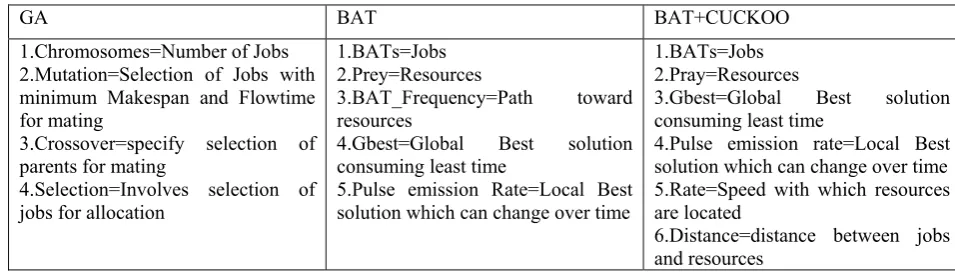
[image:4.595.55.533.190.326.2]resources from mating pool decreases, Jobs may face starvation. To overcome the problem Cuckoo search is applied. Cuckoo search algorithm pre-empt the resources from finished jobs. Size of mating pool thus increase again. To prove worth of the study, proposed system is compared against existing Genetic algorithm. Terminology is described as under
Table 1: Analogy associated with considered approaches
GA BAT BAT+CUCKOO 1.Chromosomes=Number of Jobs
2.Mutation=Selection of Jobs with minimum Makespan and Flowtime for mating
3.Crossover=specify selection of parents for mating
4.Selection=Involves selection of jobs for allocation
1.BATs=Jobs 2.Prey=Resources
3.BAT_Frequency=Path toward resources
4.Gbest=Global Best solution consuming least time
5.Pulse emission Rate=Local Best solution which can change over time
1.BATs=Jobs 2.Pray=Resources
3.Gbest=Global Best solution consuming least time
4.Pulse emission rate=Local Best solution which can change over time 5.Rate=Speed with which resources are located
6.Distance=distance between jobs and resources
Parameters used within distinct algorithms have distinct characteristics. Algorithms considered for evaluation can be used in simulated environment because of their correlation in terms of parameters. In all the algorithms prime objective is to minimize Makespan, Flowtime and Waiting time. In order to accomplish this goal parameter tuning is done. In other words resources are varied along with mutation and crossover probabilities and results are obtained.
The proposed system utilized hybrid approach of BAT and Cuckoo algorithm using methodology given as under
[image:4.595.66.257.497.682.2]3. METHODOLOGY
Figure : Proposed Methodology
Proposed methodology combine BAT and Cuckoo algorithm with the objective to minimize Makespan, Flowtime and Waiting time. Next section describes performance analysis of hybrid algorithm with genetic approach.
4. RESULTS
Results obtained through various strategies including GA, BAT and BAT+Cuckoo is analysed in this section. Parameter tuning is performed in terms of mutation probability, crossover probability, α , number of jobs and job requirements. Result obtained indicates proposed approach show better performance in terms of Makespan. Result show variation on increasing and decreasing value of
α. Number of jobs and jobs requirements also impact Makespan of overall schedule. Values of alpha subsequently impact fitness value and Makespan results. In other words Makespan increases as α increase. Results in the form of plots is given as under
4.1 Results in terms of Makespan
The total time that finish the job from beginning to the end, is known as makespan. In other words the shortest possible time in whichjob scheduling is completed, is known as make span.
Make Span of Schedule is given below:
As number of processors increased for fixed set of jobs then the value of Makespan is decreasing.
Figure 4.1 Makespan for 100 jobs 2. MP=0.03 CR=0.4 number of jobs=300
[image:5.595.45.514.39.723.2]Figure 4.2 Makespan for 300 jobs 3. MP=0.03 CR=0.4 number of jobs=500
Figure 4.3 Makespan for 500 jobs
4. MP=0.03 CR=0.4 number of jobs=700
Figure 4.4 Makespan for 700 jobs
4.2 Results in terms of Flowtime
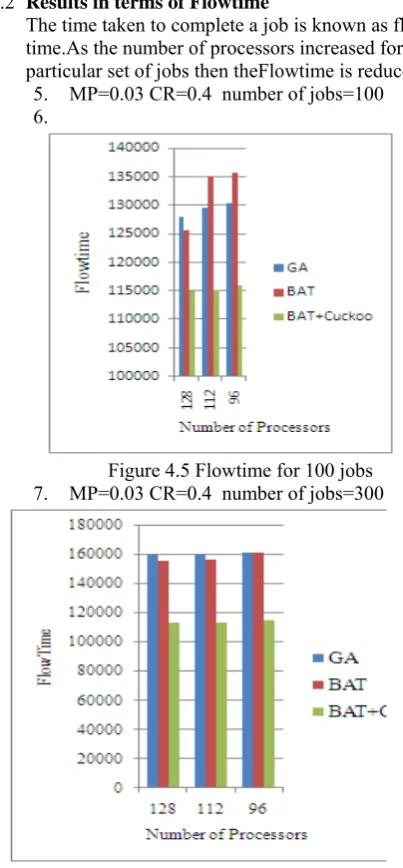
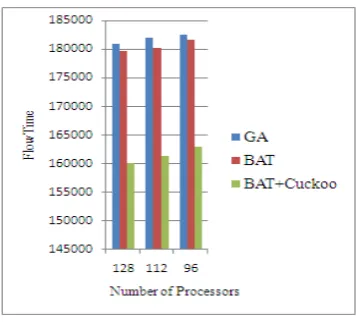
The time taken to complete a job is known as flow time.As the number of processors increased for particular set of jobs then theFlowtime is reduced.
[image:5.595.317.519.59.494.2]5. MP=0.03 CR=0.4 number of jobs=100 6.
Figure 4.5 Flowtime for 100 jobs 7. MP=0.03 CR=0.4 number of jobs=300
Figure 4.6 Flowtime for 300 jobs
8. MP=0.03 CR=0.4 NUMBER OF JOBS=500
Figure 4.7 Flowtime for 500 jobs
[image:5.595.42.227.496.685.2]Figure 4.8 Flowtime for 700 jobs
4.3 Results in terms of Mean WT
The time interval for which a job is waiting for processor, is known as waiting time. As the number of processors increased for same set of jobs, then Mean WT reduced
10. MP=0.03 CR=0.4 number of jobs=100
[image:6.595.319.516.56.222.2]Figure 4.9 Mean WT for 100 jobs 11. MP=0.03 CR=0.4 number of jobs=300
Fig: 4.10 Mean WT for 300 jobs 12. MP=0.03 CR=0.4 number of jobs=500
Fig: 4.11 Mean WT for 500 jobs
13. MP=0.03 CR=0.4 number of jobs=700
Fig: 4.12 Mean WT for 700 jobs
4.4 Results in terms of Normalization function
As the number of processors increased for particular set of jobs then the Normalization function is reduced. 14. MP=0.03 CR=0.4 number of jobs=100
[image:6.595.42.236.298.649.2]Figure 4.13 Normalization function for 100 jobs 15. MP=0.03 CR=0.4 NUMBER OF JOBS=300
[image:6.595.340.524.639.763.2]16. MP=0.03 CR=0.4 NUMBER OF JOBS=500
Figure 4.15 Normalization function for 500 jobs 17. MP=0.03 CR=0.4 number of jobs=700
Figure 4.16 Normalization function for 700 jobs
5. CONCLUSION AND FUTURE SCOPE
The proposed literature uses hybrid approach of BAT and Cuckoo algorithm. The BAT algorithm is used in order to allocate the resources. The Cuckoo algorithm is an optimal searched algorithm. The BAT algorithm act first and locate the resources .In case resources are not available then Cuckoo algorithm will locate the resources. If the resources are not available then process must wait result in higher make span and flow time. The flow time and make span can be reduced further by merging the BAT algorithm with Cuckoo algorithm. Makespan is improved by 23% and Flowtime is improved by 36%. In future, the authors may hybrid some other algorithm to overcome the drawback of BAT algorithm. In future work, we aim to reduce the
complexity of BAT andconsiderlargenumbersofjobstogether.We will also
address the study of new optimization criteria, such as utilization, energy consumption, and some other performance metric criteria etc.
REFERENCES
[1] Abdulal, Wael, Ahmad Jabas, S. Ramachandram, and Omar
Al Jadaan. 2012. “Task Scheduling in Grid Environment Using Simulated Annealing and Genetic Algorithm.” [2 ] Adebisi, Adigun Abimbola, Adegun Adekanmi Adeyinka,
and Asani Emmanuel Oluwatobi. 2015. “Performance Evaluation of Ant Colony Optimization and Genetic Algorithm for Facial Feature Selection.” 2(1):19–24.
[3] Al-Madi, Nailah, Ibrahim Aljarah, and Simone A. Ludwig. 2015. “Parallel Glowworm Swarm Optimization Clustering Algorithm Based on MapReduce.” IEEE SSCI 2014 - 2014 IEEE Symposium Series on Computational Intelligence - SIS 2014: 2014 IEEE Symposium on Swarm Intelligence, Proceedings 189–96.
[4] Allahverdi, A.; Gupta, J.N.D.; Aldowaisan, T. 1999. “A Survey of Scheduing Research Involving Setup Considerations.” OMEGA - International Journal of Management Science 27:219–39.
[5] Gigras, Yogita, Kusum Gupta, and Kavita Choudhary. 2015. “A Comparison between Bat Algorithm and Cuckoo Search for Path Planning.” 4459–66.
[6] Karatza, Helen D. and Ralph C. Hilzer. 2003. “Parallel Job Scheduling in Homogeneous Distributed Systems.” SIMULATION: Transactions of the Society for Modeling and Simulation 79(5):287–98. Retrieved
(http://www.ingentaselect.com/rpsv/cgi-bin/cgi?ini=xref&body=linker&reqdoi=10.1177/0037549030 37148).
[7] Kołodziej, Joanna and Fatos Xhafa. 2010. “A Game-Theoretic and Hybrid Genetic Meta-Heuristics Model for Security-Assured Scheduling of Independent Jobs in Computational Grids.” CISIS 2010 - The 4th International Conference on Complex, Intelligent and Software Intensive Systems 93–100.
[8] Leinberger, William, George Karypis, and Vipin Kumar. 1999. “Job Scheduling in the Presence of Multiple Resource Requirements.” Performance Computing 1–14.
[9] Optimisation, Numerical. 2013. “A Comprehensive Review of Cuckoo Search : Variants and Hybrids Iztok Fister Jr .*, Dušan Fister and Iztok Fister.” 4(4).
[10] Rabiee, Maryam. 2013. “Job Scheduling in Grid Computing with Cuckoo Optimization Algorithm.” International Journal of Computer Applications 62(16):38–43.
[11] Rajabioun, Ramin. 2011. “Cuckoo Optimization Algorithm.” Applied Soft Computing Journal 11(8):5508–18.
[12] Solanki, Sachin V. n.d. “Genetic Algorithm Approach for Implementation of Job Scheduling Problem.” 3867–72. [13] Vijaya, Venkata, Geeta Pentapalli, and Ravi Kiran Varma P.
2016. “Cuckoo Search Optimization and Its Applications : A Review.” 5(11):556–62.
[14] Xie, Jian, Yongquan Zhou, and Huan Chen. 2013. “A Novel Bat Algorithm Based on Differential Operator and Levy Flights Trajectory.” Computational Intelligence and Neuroscience 2013.
[15] Yang, Xin-she. 2011. “Bat Algorithm for Multi-Objective Optimisation.” 1–12.
[16] Yang, Xin-she. 2013. “Bat Algorithm : Literature Review and Applications.” 1–10.
[17] Yang, Xin-she and Suash Deb. 2009. “Engineering Optimisation by Cuckoo Search.” 1–17.