Learning to Map Text to Graph-based Meaning Representations via
Grammar Induction
Smaranda Muresan
Laboratory for Computational Linguistics and Information Processing Institute for Advanced Computer Studies
University of Maryland College Park, MD 20742, USA
Abstract
We argue in favor of using a graph-based representation for language meaning and propose a novel learning method to map natural language text to its graph-based meaning representation. We present a grammar formalism, which combines syn-tax and semantics, and has ontology con-straints at the rule level. These concon-straints establish links between language expres-sions and the entities they refer to in the real world. We present a relational learning algorithm that learns these grammars from a small representative set of annotated ex-amples, and show how this grammar in-duction framework and the ontology-based semantic representation allow us to di-rectly map text to graph-based meaning representations.
1 Introduction
Recent work (Wong and Mooney, 2007; Zettle-moyer and Collins, 2005; He and Young, 2006) has developed learning algorithms for the problem of mapping sentences to their underlying semantic representations. These semantic representations vary fromλ-expressions (Bos et al., 2004; Zettle-moyer and Collins, 2005; Wong and Mooney, 2007) to DB query languages and command-like languages (RoboCup Coach Language, CLang) (Ge and Mooney, 2005).
In this paper we focus on an ontology-based semantic representation which allows us to en-code the meaning of a text as a direct acyclic graph. Recently, there is a growing interest on ontology-based NLP, starting from efforts in defining ontology-based semantic representations
c
2008. Licensed under the Creative Commons Attribution-Noncommercial-Share Alike 3.0 Unported li-cense (http://creativecommons.org/licenses/by-nc-sa/3.0/). Some rights reserved.
(Nirenburg and Raskin, 2004), to using ontologi-cal resources in NLP applications, such as ques-tion answering (Basili et al., 2004; Beale et al., 2004), and building annotated corpora, such as the OntoNotes project (Hovy et al., 2006).
There are three novel properties to ontology-based semantics that we propose in this paper:
• There is a direct link between the ontology and the grammar through constraints at the grammar rule level. These ontology con-straints enable access to meaning during lan-guage processing (parsing and generation).
• Our ontology-based semantic representation is expressive enough to capture various phe-nomena of natural language, yet restric-tive enough to facilitate grammar learning. The representation encodes both ontological meaning (concepts and relations among con-cepts) and extra-ontological meaning, such as voice, tense, aspect, modality.
• Our representation and grammar learning framework allow a direct mapping of text to its meaning, encoded as a direct acyclic graph (DAG). We consider that “understanding” a text is the ability to correctly answer, at the conceptual level, all the questions asked w.r.t to that text, and thus Meaning = Text + all Questions/Answersw.r.t thatText. Under this assumption, obtaining the meaning of a text is reduced to a question answering process, which in our framework is aDAG matching problem.
First, we review our grammar formalism intro-duced in (Muresan, 2006; Muresan and Rambow, 2007), called Lexicalized Well-Founded Gram-mars. Second, we present a relational learning al-gorithm for inducing these grammars from a rep-resentative sample of strings annotated with their semantics, along with minimal assumptions about
I. Semantic Molecules a.(major/adj)0=0
B B B B B B B @h1
2 6 4
cat adj head X1
mod X2
3 7 5
b1
D
X1.isa = major,X2.Y=X1
E 1 C C C C C C C A
b.(damage/noun)0=0
B B B B B B B @h2
2 6 4
cat noun nr sg head X3
3 7 5
b2
D
X3.isa = damage
E 1 C C C C C C C A
c.(major damage)0=0
B B B B B B @h 2 6 4 cat n nr sg head X 3 7 5 b D
X1.isa = major, X.Y=X1, X.isa=damage
E 1 C C C C C C A
II. Constraint Grammar Rule
N(w,“hb”)→Adj(w1,
“h
1
b1
”
), N(w2,
“h
2
b2
”
) : Φc(h, h1, h2),Φo(b)
[image:2.595.76.531.74.171.2]Φc(h, h1, h2) ={h.cat=n, h.head=h1.mod, h.head=h2.head, h.nr=h2.nr, h1.cat=adj, h2.cat=n} Φo(b)returnshX1.isa=major, X.degree=X1, X.isa=damagei
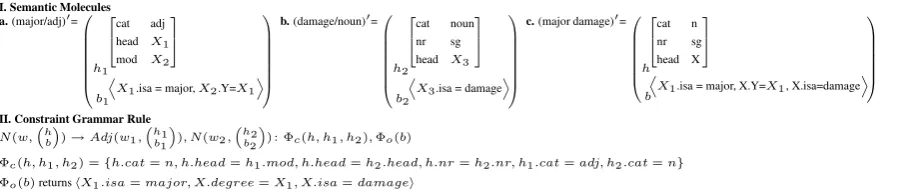
Figure 1: Examples of three semantic molecules (I), and a constraint grammar rule together with the semantic composition and ontology-based interpretation constraints,ΦcandΦo(II)
syntax. Then, we describe the levels of represen-tation we use to go from utterances to their graph-based meaning representations, and show how our representation is suitable to define the meaning of an utterance/text through answers to questions. As a proof of concept we discuss how our framework can be used to acquire terminological knowledge from natural language definitions and to query this knowledge using wh-questions.
2 Grammar Formalism
Lexicalized Well-Founded Grammars (LWFGs) introduced in (Muresan, 2006; Muresan and Ram-bow, 2007) are a type of Definite Clause Gram-mars (Pereira and Warren, 1980) where: (1) the context-free backbone is extended by introducing a partial ordering relation among nonterminals (the basis for “well-founded”); (2) each string is as-sociated with a syntactic-semantic representation called asemantic molecule; and (3) grammar rules have two types of constraints: one for semantic composition and one for ontology-based semantic interpretation. The last two properties allow us to have a syntactic-semantic grammar. The ontology constraints provide access to meaning during lan-guage learning, parsing and generation. The first property allows us to learn these grammars from a small set of annotated examples.
The semantic molecule is a syntactic-semantic representation of natural language strings w0 =
h b
, where h (head) encodes the information re-quired for semantic composition, and b (body) is the actual semantic representation of the string. Figure 1 gives examples of semantic molecules for an adjective, a noun and a noun phrase, as pre-sented in (Muresan and Rambow, 2007).
The head h of the semantic molecule is a flat feature structure (i.e., feature values are atomic), having at least two attributes that encode the syn-tactic category of the associated string, cat, and
the head of the string,head. In addition, attributes
for agreement and other grammatical features can be present (e.g.,nr,persfor number and person).
The set of attributes is finite and known a-priori for each syntactic category. Being a one-level feature structure, no recursive or embedded structures are allowed (unlike other grammar formalisms such as HPSG, LFG), which makes this representation ap-pealing for a learning framework. Recursion in the grammar is obtained through the recursive gram-mar rules and the composition constraint.
The body,b, of a semantic molecule is a flat rep-resentation, called OntoSeR (Ontology-based Se-mantic Representation). No embedding of pred-icates is allowed, as in Minimal Recursion Se-mantics (MRS) (Copestake et al., 1999). Unlike MRS, OntoSeR is a logical form built as a con-junction ofatomic predicateshconcepti.hattri =
hconcepti, where variables are either concept or slot (attr) identifiers in an ontology. For example, the adjective major is represented as hX1.isa = major, X2.Y =X1i, which says that the meaning of an adjective is a conceptX1(X1.isa=major) that is the value of a property of another concept X2(X2.Y =X1) in the ontology.
A LWFG specifies one or more semantic molecules for each string that can be parsed by the grammar. The lexicon of a LWFG consists of words paired with their semantic molecules shown in Figure 1(Ia and Ib). In addition to the lexicon, a LWFG has a set of constraint grammar rules. An example of a LWFG rule is given in Figure 1(II). Grammar nonterminals are augmented with pairs of strings and their semantic molecules. These pairs are called syntagmas, and are denoted by σ = (w, w0) = (w, h
b
meaning of a natural language expression is com-posed from the meaning of its parts) and one for ontology-based semantic interpretation. The com-position constraints Φcare applied to the heads of
the semantic molecules, the bodies being just con-catenated. Figure 1 shows that the body of the se-mantic molecule for major damage is a concate-nation of the bodies of the adjective major and noun damage, together with a variable substitu-tion. This variable substitution{X2/X, X3/X}is a result ofΦc, which is a system of equations —
a simplified version of “path equations” (Shieber et al., 1983), because the heads are flat feature structures. These constraints are learned together with the grammar rules. The ontology-based con-straints Φo represent the validation on the
ontol-ogy, and are applied to the body of the semantic molecule associated with the left-hand side non-terminal. The ontology-based interpretation is not done during the composition operation, but after-words. Thus, for example, the head of the noun phrase major damage does not need to store the slot Y, a fact that allows us to use flat feature structures to represent the head of the semantic molecules. The ontology-based constraints are not learned; rather, Φo is a general predicate applied
to the logical form semantic representation which fully contains all the required information needed for validation on the ontology. Thus, it is indepen-dent of grammatical categories. This predicate can succeed or fail as a result of querying the ontology — when it succeeds, it instantiates the variables of the semantic representation with concepts/slots in the ontology (Y = degree). For example, given the phrasemajor damage,Φosucceeds and returns
hX1.isa = major, X.degree = X1, X.isa = damagei, while givenmajor birthit fails.
3 Grammar Learning Algorithm
Unlike stochastic grammar learning for syntac-tic parsing (e.g., (Collins, 1999)), LWFG is well suited to learning from reduced-size training data. Furthermore, unlike previous formalisms used for deeper representations (e.g, HPSG, LFG), our LWFG formalism is characterized by a formal guarantee of polynomial learnability (Muresan, 2006).
A key to these properties is the partial order-ing among grammar nonterminals, i.e., the set of nonterminals is well-founded. This partial order-ing among nonterminals allows us to define the
representative examplesof a LWFG, and to learn LWFGs from this small set of examples. The rep-resentative examples ER of a LWFG, G, are the
simplest syntagmas ground-derived by the gram-mar G — i.e., for each grammar rule, there ex-ists a syntagma which is ground-derived from it in the minimum number of steps. Informally, repre-sentative examples are building blocks from which larger structures can be inferred via reference to a larger corpusEσ which can be only weakly
anno-tated (i.e., bracketed), or unannoanno-tated. This larger corpus,Eσ, is used for generalization during
learn-ing (Figure 2).
The theoretical learning model is Grammar Approximation by Representative Sublanguage (GARS) introduced in (Muresan, 2006; Muresan and Rambow, 2007). We proved that the search space for grammar induction is a complete gram-mar lattice, and we gave a learnability theorem for LWFG induction. The GARS model uses a poly-nomial algorithm for LWFG learning that takes advantage of the building blocks nature of repre-sentative examples. The learning algorithm be-longs to the class of Inductive Logic Programming methods (ILP), based on entailment (Muggleton, 1995; Dzeroski, 2007). Unlike existing ILP meth-ods that use randomly-selected examples, our al-gorithm learns from a set of representative exam-ples allowing a polynomial efficiency for learn-ing a syntactico-semantic constraint-based gram-mar, suitable to capture large fragments of natural language (Muresan, 2006).
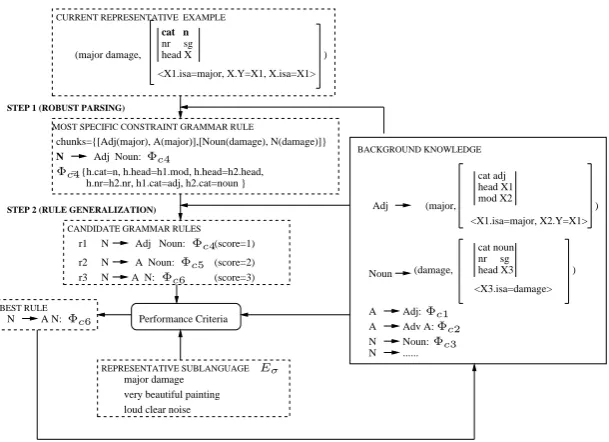
The LWFG induction algorithm is a cover set al-gorithm, where at each step a new constraint gram-mar rule is learned from the current representative example, σ ∈ ER. Then this rule is added to the
grammar rule set. The process continues until all the representative examples are covered. We de-scribe below the process of learning a grammar rule from the current representative example, illus-trated as well in Figure 2.
Step 1. In the first step, the most specific
ex-cat adj head X1 mod X2
cat noun
head X3 nr sg
cat n
head X nr sg
<X1.isa=major, X.Y=X1, X.isa=X1> ) (major damage,
N A N:
major damage very beautiful painting loud clear noise N
N N
Adj Noun: A Noun: A N:
(score=1) (score=2) (score=3)
CANDIDATE GRAMMAR RULES
r1
r3 r2
N Adj Noun:
Adj (major, )
<X1.isa=major, X2.Y=X1>
(damage,
<X3.isa=damage> ) Noun
BACKGROUND KNOWLEDGE
Performance Criteria
CURRENT REPRESENTATIVE EXAMPLE
MOST SPECIFIC CONSTRAINT GRAMMAR RULE
REPRESENTATIVE SUBLANGUAGE BEST RULE
STEP 1 (ROBUST PARSING)
chunks={[Adj(major), A(major)],[Noun(damage), N(damage)]}
A A N
Adj: Adv A: Noun: N ...
STEP 2 (RULE GENERALIZATION) =
h.nr=h2.nr, h1.cat=adj, h2.cat=noun } {h.cat=n, h.head=h1.mod, h.head=h2.head,
PSfrag replacements
ri
σ
Eσ
r
Φc1 Φc2 Φc3 Φc4
Φc4
Φc4 Φc5 Φc6
[image:4.595.148.453.68.289.2]Φc6
Figure 2: An iteration step of the learning algorithm
ample, in Figure 2, given the representative ex-ample major damage annotated with its seman-tic molecule, and the background knowledge con-taining the already learned rules A → Adj and N → Noun,1 the robust parser generates
the chunks corresponding to the adjective major and the noundamage: [Adj(major),A(major)] and [Noun(damage),N(damage)], respectively. The most specific rule generated is thus N →
Adj Noun: Φc4, where the left hand side nonter-minal is given by the category of the representative example, in this case n. The compositional
con-straintsΦc4are learned as well. It can be seen that the annotation of the representative example does not require us to provide ontology-specific roles or concepts. Thus, grammar learning is general, and can be done using a small, generic lexicon.
Step 2.In the second step, this most specific rule is
generalized, obtaining a set of candidate grammar rules. The performance criterion in choosing the best grammar rule among these candidate hypothe-ses is the number of the examples in the represen-tative sublanguageEσ(generalization corpus) that
can be parsed using the candidate grammar rule to-gether with the previous learned rules. In Figure 2 given the representative sublanguage Eσ={ ma-jor damage, loud clear noise, very beautiful paint-ing} the learner will generalize to the recursive ruleN →A N: Φ6, since only this rule can parse 1For readability, we only show the context-free backbone
of the grammar rules, andΦoare not discussed since they are not learned.
all the examples inEσ.
4 Levels of Representation
In order to transform natural language utterances to knowledge, we consider three levels of repre-sentation: the utterance level, the text level and the ontology level. In Section 4.4 we show that these levels of representation allow us to define meaning asMeaning=Text+all Questions/Answersw.r.t that Text, using a DAG matching approach.
4.1 Utterance-level Representation
At theutterance level, the semantic representation corresponds directly to a syntagmaσafter the on-tology constraint Φo is applied. This
representa-tion is called Ontology-based Semantic Represen-tation OntoSeR.At this level, the attrIDs are
in-stantiated with values of the slots from the ontol-ogy, while the conceptIDs remain variables to al-low further composition to take place. At OntoSeR level we can exploit the reversibility of the gram-mar, since this representation is used during pars-ing/generation.
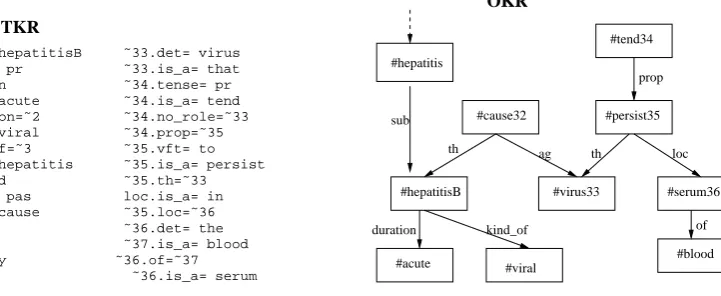
Hepatitis B is an acute viral hepatitis caused by a virus that tends to persist in the blood serum.
OntoSeR = h(A.name=hepatitisB)HepatitisB, (A.tense=pr)is, (A.det=an)an, (B.is a=acute, A.duration=B)acute,
(C.is a=viral, A.kind of=C)viral, (A.is a=hepatitis)hepatitis, (D.vft=ed, D.voice=pas, D.is a=cause, D.ag=E, D.th=A)caused, (ag.is a=by, D.ag=E)by, (E.det=a)a, (E.is a=virus)virus, (E.is a=that)that, (F.tense=pr, F.is a=tend, F.no ag=E, F.prop=G)tends, (G.vft=to, G.is a=persist, G.th=E)to persist, (loc.is a=in, G.loc=H)in, (H.det=the)the, (I.is a=blood, H.of=I)blood, (H.is a=serum)serumi
TKR
˜29.name= hepatitisB ˜33.det= virus ˜29.tense= pr ˜33.is_a= that ˜20.det= an ˜34.tense= pr ˜30.is_a= acute ˜34.is_a= tend ˜29.duration=˜2 ˜34.no_role=˜33 ˜31.is_a= viral ˜34.prop=˜35 ˜29.kind_of=˜3 ˜35.vft= to ˜29.is_a= hepatitis ˜35.is_a= persist
˜32.vft= ed ˜35.th=˜33
˜32.voice= pas loc.is_a= in ˜32.is_a= cause ˜35.loc=˜36
˜32.ag=˜5 ˜36.det= the
˜32.th=˜1 ˜37.is_a= blood
ag.is_a= by ˜36.of=˜37
˜32.ag=˜33 ˜36.is_a= serum
˜33.det= a
OKR
#viral #acute
#hepatitisB #virus33
#cause32 #persist35
#tend34
#serum36
#blood
th ag
duration kind_of of
th loc
prop #hepatitis
[image:5.595.115.476.156.304.2]sub
Figure 3: Example of an utterance and its levels of representation
seen as a local semantic interpretation at the ut-terance/grammar rule level, providing access to meaning during parsing/generation. In this pa-per, this semantic interpretation is based only on a weak “ontological model”. For the verb the-matic roles we considered the thethe-matic roles de-rived from Dorr’s LCS Database (e.g.,ag=agent, th=theme,prop=proposition) (Dorr, 1997). For
adjectives and adverbs we took the roles (prop-erties) from WordNet (Miller, 1990). For prepo-sitions we considered the LCS Database. We also have manually added specific/dummy seman-tic roles when they were not present in these re-sources (e.g.,ofbetweenbloodandserum).
The example in Figure 3 shows the output of our parser in conjunction with the learned gram-mar for a definitional sentence that contains several linguistic phenomena such as copulato-be predica-tive, reduced relative clauses (caused by ...), rel-ative clauses (virus that ...), raising construction (tends to persist, where virus is not the argument of tends but the argument of persist), and noun compounds (blood serum). For readability, we in-dicate what part of OntoSeR corresponds to each lexical item. It can be noticed that OntoSeR con-tains representations of both ontological meaning (concepts and relations among concepts) as well as extra-ontological meaning such as tense and voice (D.voice=pas;F.tense=pr).
4.2 Text-level Representation
The text-level representation TKR, or discourse
level representation, represents asserted represen-tations. ConceptIDs become constants, and no composition can happen at this level. However, we still have (indirect) reversibility, since TKR repre-sents all the asserted OntoSeRs. Therefore, all the information needed for reversibility is still present. Figure 3 shows an example of the TKR for the above utterance.
4.3 Ontology-level Representation
Ontology-level knowledge representation OKRis
obtained after task-specific interpretation, which can be seen as a global semantic interpretation. OKR is a directed acyclic graph (DAG) G = (V, E). Edges,E, are either semantic roles given by verbs, prepositions, adjectives and adverbs, or extra-ontological meaning properties, such as tense, aspect, modality, negation. Vertices,V are either concepts (corresponding to nouns, verbs, adjectives, adverbs, pronouns, cf. Quine’s crite-rion (Sowa, 1999, page 496)), or values of the extra-ontological properties such as present
cor-responding to tense property. In this paper, the
knowledge. However, we treat modals and nega-tion, as they are relevant for terminological knowl-edge. An example of OKR for the above utterance is given in Figure 3.
We consider both concepts (e.g., #acute, #blood), and instances of concepts (e.g., #virus33, #cause32). Concepts are denoted in OKR by #name concept, and they form a hierarchy of con-cepts based on thesubsumerelation (sub), which
is the inverse of the is arelation. An instance of
a concept is denoted by the name of a concept fol-lowed by the instance number (e.g., #virus33). A concept and an instance of this concept are two dif-ferent vertices in OKR, having the same name. At the OKR level we assume theprinciple of concept identity which means that there is a bijection be-tween a vertex in OKR and a referent. For exam-ple, if we do not have pronoun resolution, the pro-noun and the pro-noun it refers to will be represented as two separate vertices in the graph. Currently, our semantic interpreter implements only a weak concept identity principle which facilitates struc-ture sharing and inheritance.
To give these two properties we first introduce some notations. A DAG is calledrootedat a vertex u∈V, if there exists a path fromuto each vertex of the DAG. We have the following definition:
Definition 1. Two subDAGs rooted at two vertices
u, u0 are equal if the set of the adjacent vertices to uandu0respectively, are equal and if the edges in-cident fromuandu0have the same semantic roles as labels.
Property 1 (Structure Sharing). In an OKR, all
verticesu, u0 ∈V with the same name, and whose subDAGs are equal are identical (i.e., the same vertex in OKR).
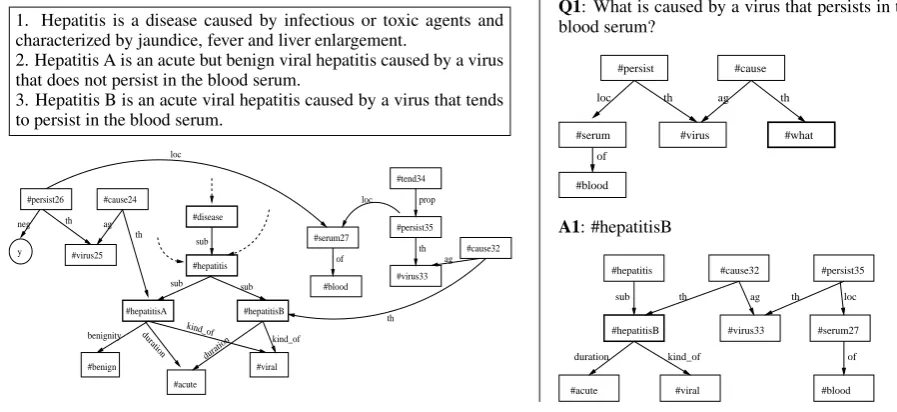
Using a hash table, there is a linear algorithm O(|V| + |E|) which transforms an OKR to an equivalent OKR which satisfies Property 1. In Fig-ure 4 it can be seen that the OKRs of Hepatitis A and Hepatitis B share the representation corre-sponding toblood serum (i.e., blood serumis the same concept instance and due to Property 1 we have that #serum36=#serum27 and thus they have the same vertex in the OKR).
Property 2(Inheritance). A concept in a hierarchy
of concepts can be linked by thesubrelation only to its parent(s), and not to any other ancestors. A subDAG defining a property of a concept from the hierarchy of concepts can be found only once in
the OKR at the level of the most general concept that has this property.
For terminological knowledge we have that any instance of a concept is a concept, and the defi-nition is the naming of a concept instance. For example, the definition of Hepatitis B, is an in-stance of a concept #hepatitis which has additional attributes acute, viral and caused by a virus that tends to persist in the blood serum. Thus, an additional instance of concept #hepatitis is cre-ated, which is named #hepatitisB. The fact that we can have the definition as a naming of a con-cept instance is facilitated also by our treatment of copulato-beat the OntoSeR level (A.name = hepatitisB, . . . , A.is a=hepatitisin Figure 3)
4.4 Meaning as Answers to Questions
We consider that “understanding” a text is the abil-ity to correctly answer, at the conceptual level, all the questions asked w.r.t to that text, and thus Meaning = Text + all Questions/Answersw.r.t that Text. In our framework we consider the principle of natural language as problem formulation, and not problem solving. Thus, we can represent at OKR level a paradox formulation in natural lan-guage, even if the reasoning about its solution can-not be emphasized. Our levels of representations allow us to define the meaning of questions, an-swers and utterances using a DAG matching ap-proach.
Definition 2. The meaning of a question, q, with respect to an utterance/discourse, is the set of all answers that can be directly obtained from that ut-terance/discourse. The semantic representation of a question is a subgraph of the utterance graph where the wh-word substitutes the answer con-cept(s).
Definition 3. The answer to a question is the
con-cept that matches the wh-word through the DAG matching algorithm between the question’s sub-DAG and the utterance/discourse sub-DAG.
Definition 4. The meaning of an utteranceuis the set of all questions that can be asked w.r.t that ut-terance, together with their answers.
algo-rithm obtains the same answers to questions, rela-tive to semantic equivalent DAGs. If we consider only the weak concept identity principle given by Properties 1 and 2, the problem is reduced to DAG/subDAG identity.
5 Discussion
The grammar formalism, learning model and our ontology-based representation allow us to directly map text to graph-based meaning representations. Our method relies on a general grammar learn-ing framework and a task-specific semantic inter-preter. Learning is done based on annotated ex-amples that do not contain ontology-specific roles or concepts as we saw in Section 3, and thus our learning framework is general. We can use any ontology, depending on the application. The task-specific semantic interpreter we are currently using is targeted for terminological knowledge, and uses a weak “ontological model” based on admissibility relations we can find at the level of lexical entries and a weak concept identity principle.
In (Muresan, 2006) we showed that our gram-mar formalism and induction model allow us to learn diverse and complex linguistic phenomena: complex noun phrases (e.g., noun compounds, nominalization), prepositional phrases, reduced relative clauses, finite and non-finite verbal con-structions (including, tense, aspect, negation), co-ordination, copula to be, raising and control con-structions, and rules for wh-questions (including long-distance dependencies).
In this section we discuss the processes of knowledge acquisition and natural language querying, by presenting an example of construct-ing terminological knowledge from definitions of hepatitis, Hepatitis A and Hepatitis B. The defi-nitional text and OKRs are presented in Figure 4, OKR being shown only for the last two definitions for readability reasons. A question and answer re-lated to the resulting OKR are also given.
The definiendum is always a concept, and it is part of thesubhierarchy. The concepts in thesub
hierarchy are presented in bold in Figure 4. In ad-dition to the concepts that are defined, we can also haveconcepts that are referred (i.e., they are part of the definiens), if they do not have any modifi-cation (e.g., #blood in definition of Hepatitis A, and Hepatitis B). If a referred concept has modi-fications, it is represented as an instance of a con-cept in OKR. As a consequence, various
verbal-izations of concept properties can be differentiated in OKR, allowing us to obtain direct answers that are specific to each verbalization. For example, the termvirusappears in the definition of both Hepati-tis AandHepatitis B. In OKR, they are two differ-ent instances of a concept, #virus25 and #virus33, since they have different modifications: persists in the blood serum, does not persists in the blood serum, respectively. These modifications are an es-sential part of the differentia of the two concepts #hepatitisA and #hepatitisB, causing the distinc-tion between the two. When we ask the quesdistinc-tion What is caused by a virus that persists in the blood serum?we obtain only the correct answer #hepati-tisB (Figure 4).
Another important aspect that shows the ade-quacy of our representation for direct acquisition and query is the OKR-equivalences that we ob-tain for different syntactic forms. They are related mainly to verbal constructions. Among OKR-equivalences we have: 1) active and passive con-structions; 2)-ed and -ing verb forms in reduced relative clauses are equivalent to passive/active verbal constructions; 3) constructions involving raising verbs, where we can take advantage of the fact that the controller is not the semantic argument of the raising verb (e.g., in the definition of Hep-atitis B we have. . . caused by a virus that tends to persist in the blood serum, while the question can be asked without the raising verbWhat is caused by a virus that persists in the blood serum?; see Figure 4).
Besides acquisition of terminological knowl-edge, our grammar and semantic interpreter facil-itates natural language querying of the acquired knowledge base, by treatment of wh-questions. Querying is a DAG matching problem, where the wh-word is matched to the answer concept.
6 Conclusions
This paper has presented a learning framework to automatically map natural language to graph-based meaning representations via grammar in-duction. We presented an ontology-based seman-tic representation that allows us to define meaning asMeaning=Text+all Questions/Answersw.r.t that Text, using a DAG matching approach.
1. Hepatitis is a disease caused by infectious or toxic agents and characterized by jaundice, fever and liver enlargement.
2. Hepatitis A is an acute but benign viral hepatitis caused by a virus that does not persist in the blood serum.
3. Hepatitis B is an acute viral hepatitis caused by a virus that tends to persist in the blood serum.
#persist26 #cause24
y #virus25
#disease
#hepatitis
#hepatitisA #hepatitisB
#benign
#acute
#viral
#serum27
#tend34
#persist35
#virus33
#cause32
#blood loc
neg th ag th
sub
sub sub
duration duration kind_of
benignity kind_of
ag prop
th loc
of
th
Q1: What is caused by a virus that persists in the
blood serum?
#serum #virus #what
#cause #persist
#blood
th ag th
of loc
A1: #hepatitisB
#hepatitis
#hepatitisB
#acute #viral #cause32
#virus33 #serum27
#blood #persist35
sub
duration kind_of
th ag th loc
[image:8.595.70.519.72.278.2]of
Figure 4: Acquisition/Query of terminological knowledge
semantic equivalences based on synonymy and anaphora. The second direction is to enhance the ontology with probabilities.
References
Basili, Roberto, Dorte H. Hansen, Patrizia Paggio, Maria Teresa Pazienza, and Fabio Zanzotto. 2004. On-tological resources and question answering. InWorkshop on Pragmatics of Question Answering, held jointly with NAACL 2004.
Beale, Stephen, Benoit Lavoie, Marjorie McShane, Sergei Nirenburg, and Tanya Korelsky. 2004. Question answer-ing usanswer-ing ontological semantics. InACL 2004: Second Workshop on Text Meaning and Interpretation.
Bos, Johan, Stephen Clark, Mark Steedman, James R. Cur-ran, and Julia Hockenmaier. 2004. Wide-coverage seman-tic representations from a CCG parser. InProceedings of COLING-04.
Collins, Michael. 1999. Head-Driven Statistical Models for Natural Language Parsing. Ph.D. thesis, University of Pennsylvania.
Copestake, Ann, Dan Flickinger, Ivan A. Sag, and Carl Pol-lard. 1999. Minimal Recursion Semantics: An introduc-tion.
Dorr, Bonnie J. 1997. Large-scale dictionary construction for foreign language tutoring and interlingual machine trans-lation.Machine Translation, 12(4):271–322.
Dzeroski, Saso. 2007. Inductive logic programming in a nut-shell. In Getoor, Lise and Ben Taskar, editors,Introduction to Statistical Relational Learning. The MIT Press. Ge, Ruifang and Raymond J. Mooney. 2005. A statistical
semantic parser that integrates syntax and semantics. In Proceedings of CoNLL-2005.
He, Yulan and Steve Young. 2006. Spoken language un-derstanding using the hidden vector state model. Speech Communication Special Issue on Spoken Language Under-standing in Conversational Systems, 48(3-4).
Hovy, Eduard, Mitchell Marcus, Martha Palmer, Lance Ramshaw, and Ralph Weischedel. 2006. Ontonotes: The 90% solution. InProceedings of HLT-NAACL 2006. Miller, George. 1990. WordNet: An on-line lexical database.
Journal of Lexicography, 3(4):235–312.
Muggleton, Stephen. 1995. Inverse Entailment and Progol. New Generation Computing, Special Issue on Inductive Logic Programming, 13(3-4):245–286.
Muresan, Smaranda and Owen Rambow. 2007. Grammar ap-proximation by representative sublanguage: A new model for language learning. InProceedings of the 45th Annual Meeting of the Association for Computational Linguistics (ACL).
Muresan, Smaranda. 2006. Learning constraint-based gram-mars from representative examples: Theory and applica-tions. Technical report, PhD Thesis, Columbia University. Nirenburg, Sergei and Victor Raskin. 2004. Ontological
Se-mantics. MIT Press.
Pereira, Fernando C. and David H.D Warren. 1980. Definite Clause Grammars for language analysis. Artificial Intelli-gence, 13:231–278.
Shieber, Stuart, Hans Uszkoreit, Fernando Pereira, Jane Robinson, and Mabry Tyson. 1983. The formalism and implementation of PATR-II. In Grosz, Barbara J. and Mark Stickel, editors,Research on Interactive Acquisition and Use of Knowledge, pages 39–79. SRI International, Menlo Park, CA, November.
Sowa, John F. 1999. Knowledge Representation: Logical, Philosophical, and Computational Foundations. Brooks Cole Publishing Co., Pacific Grove, CA.
Wong, Yuk Wah and Raymond Mooney. 2007. Learning syn-chronous grammars for semantic parsing with lambda cal-culus. InProceedings of the 45th Annual Meeting of the Association for Computational Linguistics (ACL-2007). Zettlemoyer, Luke S. and Michael Collins. 2005. Learning