A stream computing approach towards scalable NLP
Xabier Artola, Zuhaitz Beloki, Aitor Soroa
IXA NLP Group, University of the Basque Country, Donostia, Basque Country,
{xabier.artola, zuhaitz.beloki, a.soroa}@ehu.es
Abstract
Computational power needs have grown dramatically in recent years. This is also the case in many language processing tasks, due to overwhelming quantities of textual information that must be processed in a reasonable time frame. This scenario has led to a paradigm shift in the computing architectures and large-scale data processing strategies used in the NLP field. In this paper we describe a series of experiments carried out in the context of the NewsReader project with the goal of analyzing the scaling capabilities of the language processing pipeline used in it. We explore the use of Storm in a new approach for scalable distributed language processing across multiple machines and evaluate its effectiveness and efficiency when processing documents on a medium and large scale. The experiments have shown that there is a big room for improvement regarding language processing performance when adopting parallel architectures, and that we might expect even better results with the use of large clusters with many processing nodes.
Keywords:Distributed NLP architectures, Big Data, Storm
1.
Introduction
Nowadays there is a continuous increase of computational power needs due to an overwhelming flow of textual data. This calls for a paradigm shift in computing architecture and large scale data processing. For example, the main goal
of the NewsReader1 project is to perform real-time event
detection and extract from text what happened to whom, when and where, removing duplication, complementing in-formation, registering inconsistencies and keeping track of the original sources. The project foresees an estimating flow of 2 million news items per day and the linguistic anal-ysis of those documents needs to be done in a reasonable time frame (one or few hours). The project faces thus an important challenge regarding the scalability of the linguis-tic processing of texts.
The challenges NewsReader faces fall into a new class of the so called “Big Data” tasks, requiring large scale and in-tensive processing and which are able to scale efficiently to very big volumes of data (Elsayed et al., 2008; Pantel et al., 2009; Sarmento et al., 2009; Singh et al., 2011; Beheshti et al., 2013; Yu and Chen, 2013; McCreadie et al., 2013; Sakr et al., 2013).
MapReduce(Dean and Ghemawat, 2008) is a programming model framework designed to perform large scale compu-tations and that is able to scale to thousand of nodes in
a fault-tolerant manner. However, MapReduce follows a
batchprocessing model, where computations start and end
within a given time frame. Streaming computing
(Cher-niack et al., 2003) represents an alternative programming model for processing a continuous flow of data streams. Streaming computing systems have to deal with very a high level of data throughput still guaranteeing a low level of re-sponse latency. This programming model assumes that data are presented to the algorithm as one or more input streams that are processed in order, and only once.
In this paper we describe a series of experiments performed with the goal of analyzing the scaling capabilities of the
1http://www.newsreader-project.eu/
NewsReader NLP pipeline. We propose a new approach for scalable distributed NL processing across multiple ma-chines. We also evaluate the effectiveness and efficiency of the proposed approach when processing documents on a medium and large scale.
The paper is organized as follows. Section 2 analyzes exist-ing solutions for big data processexist-ing and presents the main framework used to implement the NLP pipeline used in the experiments. In section 3, we briefly describe the annota-tion format used in our framework. Experiments and results are described in sections 4 and 5. Finally, some conclusions are drawn and further work is depicted.
2.
Big data for scalable NLP
Processing large amounts of textual data has become a ma-jor challenge in the NLP research area. As the mama-jority of digital information is present in the form of unstruc-tured data like web pages or news articles, NLP tasks such as cross-document coreference resolution, event detection or calculating textual similarities often require processing millions of documents in a timely manner (Elsayed et al., 2008; Pantel et al., 2009; Sarmento et al., 2009; Singh et al., 2011; Beheshti et al., 2013; McCreadie et al., 2013). For instance, in (Singh et al., 2011) the authors process a corpus comprising news articles published during the last 20 years. McCreadie et al. (2013) present a distributed framework for event detection that is capable to effectively process thou-sand of twitter posts every second. The research activities conducted within the NewsReader project strongly rely on the automatic detection of events, which are the core in-formation units present in the news and which support any decision making process that depends on news articles. The research focuses on many challenging aspects such as event detection and modelling, storage and reasoning over events, etc.
The entity layer contains entity mentions. Entity mentions have an entity type (person, organization, etc.) and are linked to instances from external resources such as Wikipedia or Dbpedia.
The coreference layer contains clusters of term spans which refer to the same entity.
The semantic role layer, including predicates and argu-ments associated to it.
The time expression layer identifies time expressions mentioned on the text.
The factuality layer encodes the veracity orfactualityof
events as mentioned in the text. This information is useful for recognizing whether the events mentioned in the text actually happened (factual events), did not happen (contrafactual events), or there is some uncer-tainty about the event happening or not.
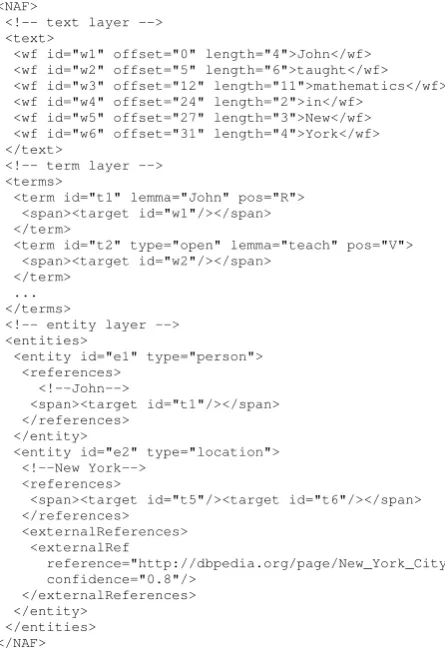
Figure 1 shows an excerpt of a NAF document compris-ing three layers: text, terms and entities. The characteristic of being multi-layered makes NAF to be particularly well suited to work on a distributed and parallel environment. Processing modules represent their output in different NAF layers and usually they do not modify the annotations of the lower layers. Therefore, several processors can create new annotations to the same document in parallel as far as there is no dependence between them.
4.
Experiment setting
In this section we describe the different settings established to carry out the experiments. Scalable NLP processing re-quires parallel processing of textual data. The paralleliza-tion can be effectively performed at several levels, from de-ploying copies of the same LP processor among servers to the reimplementation of the core algorithms of each module using multi-threading, parallel computing. This last type of fine-grained parallelization is clearly out of the scope of the present work, as it is unreasonable to reimplement all the modules needed to perform complex tasks as event min-ing. We rather aim to process huge amount of textual data by defining and implementing an architecture for NLP pro-cessing which allows the parallel propro-cessing of documents. First of all, let us explain how we interpret Storm concepts,
such asspoutandboltnodes, and tuples, in the case of our
particular language processing scenario:
• Thespoutnode is a process which reads a text docu-ment and sends it to the first bolt of the topology.
• The bolt nodes are wrapper programs which receive
input tuples, call the actual NLP modules for process-ing, and send the output tuples to the next stage in the topology.
• The tuples in our Storm topology comprise two
ele-ments, a document identifier and the XML serializa-tion of the NAF document encoded as a string.
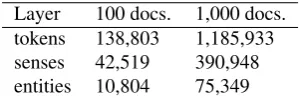
Layer 100 docs. 1,000 docs.
tokens 138,803 1,185,933
senses 42,519 390,948
entities 10,804 75,349
Figure 3: Number of annotations obtained for each layer.
We created a small NLP pipeline comprising four modules: a tokenizer (TOK), a part of speech tagger (POS), a Named Entity Recognition and Classification module (NERC), and a Word-Sense Disambiguation module (WSD). All this modules are based on the IXA-pipeline processing frame-work (Agerri et al., 2014).
Initially the four modules are executed following a pipeline architecture, i.e., each module running sequentially one af-ter the other. This setting is the baseline system and the starting point for our analysis.
On a second experiment, we implement a Storm topology following again a pipeline approach. This setting is simi-lar to the baseline system but has a main advantage. When a module finishes the processing, it passes the annotated document to the next step, and starts processing the next document. Therefore, in this setting there are as many documents processed in parallel as stages in the pipeline. Because we have a pipeline comprising 4 modules, the pipeline is able to process 4 documents at the same time. On a final setting, we experiment creating many instances
of some selectedboltnodes, therefore allowing the parallel
execution of them. Figure 2 illustrates this final experiment setting.
All the experiments were performed on a PC machine with an Intel Core i5-3570 3.4GHz processor with 4 cores and 4GB RAM, running on Linux.
5.
Results
We experimented the NLP pipeline with 1000 documents,
each one comprising an average of 1200 words and 50
sentences. We performed experiments with a subset of
10 documents (16,208words,682 sentences), a subset of
100 documents (138,803words,5,416sentences) and with
the complete set of 1000 documents (1,185,933 words,
48,746 sentences). Figure 3 shows the number of
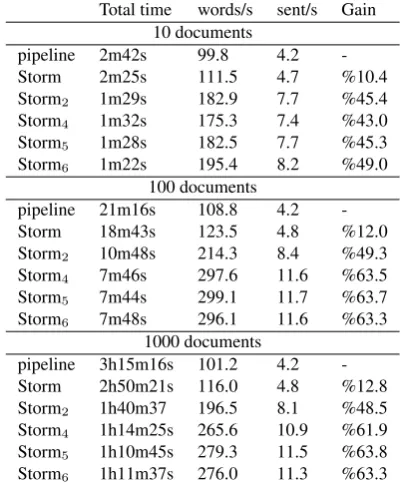
anno-tations obtained for each layer after the processing. Figure 4 shows the time elapsed in processing the docu-ments. The first six rows correspond to the processing of
10documents, the next six rows to the processing of100
documents and the last six rows to the processing of1000
documents. As the figure shows, the baseline system runs at
a performance of about100words per second. The simple
Storm topology yields a performance gain of less than13%,
which is less than expected. When analyzing the result, we realized that there is an unbalance regarding the time spent
by each module. The96% of the processing time is spent
Figure 2: The Storm topology of our pipeline. It is composed of aspout, fourboltsthat perform the actual NL processing,
and a special boltNafOutthat writes the resulting NAF documents to XML files. The NLPboltsare wrapper programs that
call the corresponding external NLP modules to do their job.
Total time words/s sent/s Gain 10 documents
pipeline 2m42s 99.8 4.2 -Storm 2m25s 111.5 4.7 %10.4 Storm2 1m29s 182.9 7.7 %45.4
Storm4 1m32s 175.3 7.4 %43.0
Storm5 1m28s 182.5 7.7 %45.3
Storm6 1m22s 195.4 8.2 %49.0
100 documents
pipeline 21m16s 108.8 4.2 -Storm 18m43s 123.5 4.8 %12.0 Storm2 10m48s 214.3 8.4 %49.3
Storm4 7m46s 297.6 11.6 %63.5
Storm5 7m44s 299.1 11.7 %63.7
Storm6 7m48s 296.1 11.6 %63.3
1000 documents
pipeline 3h15m16s 101.2 4.2 -Storm 2h50m21s 116.0 4.8 %12.8 Storm2 1h40m37 196.5 8.1 %48.5
Storm4 1h14m25s 265.6 10.9 %61.9
Storm5 1h10m45s 279.3 11.5 %63.8
Storm6 1h11m37s 276.0 11.3 %63.3
Figure 4: Performance of the NLP pipeline in different
set-tings:pipelineis the basic pipeline used as baseline;Storm
is the same pipeline executed as a Storm topology;Storm2
represents a Storm pipeline with 2 instances of the WSD module (Storm4has 4 instances,Storm55, andStorm66).
With these points in mind, we experimented four alterna-tives (dubbedStorm2,Storm4, Storm5, andStorm6), with respectively 2, 4, 5 and 6 instances of the WSD module running in parallel. The results in Figure 4 show that run-ning multiple instances of WSD does increase the overall performance significantly. The major gain is obtained with
five instances of WSD, with an increase of63% in the
over-all performance. More WSD instances do not help improv-ing the results, which is expected given the fact that the
machine used for the experiments has4CPU cores.
6.
Conclusion
In this paper a new approach for scalable distributed lan-guage processing across multiple machines using Storm has been proposed. We have described and evaluated the
effi-ciency of a series of experiments carried out with the goal of analyzing the scaling capabilities of the NewsReader NLP pipeline.
These initial experiments have shown that there is a big room for improvement regarding language processing per-formance when adopting parallel architectures such as Storm. With the use of large clusters with many nodes, we might expect a significant boost in the performance of overall NLP processing.
The experiments conducted in this paper are only an ap-proach on the way to get a much more sophisticated dis-tributed environment for NLP. Our next objectives focus on experimenting with a larger scale setup in three different as-pects: running the experiments in a multi-node cluster with high computing capabilities, enhancing the general system architecture and designing more sofisticated topologies and algorithms.
The hardware used for these experiments was useful only for testing purposes. In the future we aim to have a cluster composed of several nodes, an essential scenario to make the most of the distributed architecture designed for the pipeline. This will allow us to experiment with a much larger input document set as well.
As we are developing a totally distributed and highly scal-able system, several architecture-related issues come out. One of them is the input method that will receive text doc-uments and send them to the pipeline. To accomplish that, we foresee the need of a distributed message queue sys-tem as the input. Another issue is the fact that too much data traffic is produced between each NLP module, since a full NAF document with all the layers’ annotations must be sent from each module for every document to be pro-cessed. This could be avoided using a distributed database like MongoDB and retrieving and storing only the annota-tion layers required and produced by each module. Similarly, we have in mind a couple of topology design im-provements to be delved in the future:
• Use of non linear topologies. The experiments
We need to clearly identify the pre- and post-requisites of each module, thus deducting the indications as to which modules must precede which and which modules can be run in parallel on the same document.
We need a special bolt which receives input from
many NLP modulebolts(each one conveying
dif-ferent annotations on the same document) and
merges all this information producing a single, unified document.
• Granularity-based splitting of documents. NLP
mod-ules work at different levels of granularity. For in-stance, a POS tagger works at sentence level, the WSD module works at paragraph level, whereas a corefer-ence module works at document level. We want to experiment splitting the input document into pieces of the required granularity, so that the NLP modules can quickly analyze those pieces, thus increasing the over-all processing speed.
Acknowledgment
We are grateful to the anonymous reviewers for their in-sightful comments. This work has been partially funded by the NewsReader (FP7-ICT- 2011-8-316404) and SKaTer (TIN2012-38584-C06-02) projects. Zuhaitz Beloki’s work is funded by a PhD grant from the University of the Basque Country.
7.
References
Rodrigo Agerri, Josu Bermudez, and German Rigau. 2014. IXA pipeline: Efficient and ready to use multilingual
NLP tools. In Proceedings of the 9th Language
Re-sources and Evaluation Conference (LREC2014). Noga Alon, Yossi Matias, and Mario Szegedy. 1996. The
space complexity of approximating the frequency
mo-ments. InProceedings of the twenty-eighth annual ACM
symposium on Theory of computing, STOC ’96, pages 20–29, New York, NY, USA. ACM.
Seyed-Mehdi-Reza Beheshti, Srikumar Venugopal, Se-ung Hwan Ryu, Boualem Benatallah, and Wei Wang. 2013. Big data and cross-document coreference
reso-lution: Current state and future opportunities. CoRR,
abs/1311.3987.
Mitch Cherniack, Hari Balakrishnan, Magdalena Balazin-ska, Donald Carney, Ugur Cetintemel, Ying Xing, and Stan Zdonik. 2003. Scalable Distributed Stream
Pro-cessing. In CIDR 2003 - First Biennial Conference on
Innovative Data Systems Research, Asilomar, CA, Jan-uary.
Jeffrey Dean and Sanjay Ghemawat. 2008. Mapreduce:
simplified data processing on large clusters. Commun.
ACM, 51(1):107–113, January.
Tamer Elsayed, Jimmy J. Lin, and Douglas W. Oard. 2008. Pairwise document similarity in large collections with
mapreduce. InACL (Short Papers), pages 265–268. The
Association for Computer Linguistics.
Antske Fokkens, Aitor Soroa, Zuhaitz Beloki, Niels Ock-eloen, German Rigau, Willem Robert van Hage, and
Piek Vossen. 2014. NAF and GAF: Linking linguistic
annotations. InTo appear in Proceedings of 10th Joint
ACL/ISO Workshop on Interoperable Semantic Annota-tion (ISA-10).
Sebastian Hellmann, Jens Lehmann, S¨oren Auer, and Mar-tin Br¨ummer. 2013. IntegraMar-ting nlp using linked data. In Proceedings of the 12th International Semantic Web Conference (ISWC).
Carl Hewitt, Peter Bishop, and Richard Steiger. 1973. A universal modular actor formalism for artificial
intelli-gence. In Proceedings of the 3rd International Joint
Conference on Artificial Intelligence, IJCAI’73, pages 235–245, San Francisco, CA, USA. Morgan Kaufmann Publishers Inc.
Nancy Ide, Laurent Romary, and ´Eric Villemonte de
La Clergerie. 2003. International standard for a
linguis-tic annotation framework. InProceedings of the
HLT-NAACL 2003 Workshop on Software Engineering and Architecture of Language Technology Systems (SEALTS). Association for Computational Linguistics.
Richard McCreadie, Craig Macdonald, Iadh Ounis, Miles Osborne, and Sasa Petrovic. 2013. Scalable distributed
event detection for twitter. In Proceedings of IEEE
In-ternational Conference on Big Data.
Patrick Pantel, Eric Crestan, Arkady Borkovsky, Ana-Maria Popescu, and Vishnu Vyas. 2009. Web-scale
dis-tributional similarity and entity set expansion. In
Pro-ceedings of the 2009 Conference on Empirical Methods in Natural Language Processing: Volume 2 - Volume 2, pages 938–947, Stroudsburg, PA, USA. Association for Computational Linguistics.
Sherif Sakr, Anna Liu, and Ayman G. Fayoumi. 2013. The family of mapreduce and large scale data processing
sys-tems. CoRR, abs/1302.2966.
Lus Sarmento, Alexander Kehlenbeck, Eugnio C. Oliveira, and Lyle H. Ungar. 2009. An approach to web-scale named-entity disambiguation. In Petra Perner, editor,
MLDM, volume 5632 ofLecture Notes in Computer
Sci-ence, pages 689–703. Springer.
Sameer Singh, Amarnag Subramanya, Fernando Pereira,
and Andrew McCallum. 2011. Large-scale
cross-document coreference using distributed inference and
hierarchical models. In Association for Computational
Linguistics: Human Language Technologies (ACL HLT). Wei Yu and Junpeng Chen. 2013. The state-of-the-art in web-scale semantic information processing for cloud
computing.CoRR, abs/1305.4228.