Automatic Mapping Lexical Resources: A Lexical Unit as the Keystone
Eduard Bejˇcek, V´aclava Kettnerov´a and Mark´eta Lopatkov´a
Charles University in Prague, Faculty of Mathematics and Physics Institute of Formal and Applied Linguistics
Malostransk´e n´amˇest´ı 25, 118 00 Prague 1, Czech Republic
{bejcek,kettnerova,lopatkova}@ufal.mff.cuni.cz
Abstract
This paper presents the fully automatic linking of two valency lexicons of Czech verbs: VALLEX and PDT-VALLEX. Despite the same theoretical background adopted by these lexicons and the same linguistic phenomena they focus on, the fully automatic mapping of these resouces is not straightforward. We demonstrate that converting these lexicons into a common format represents a relatively easy part of the task whereas the automatic identification of pairs of corresponding valency frames (representing lexical units of verbs) poses difficulties. The overall achieved precision of 81% can be considered satisfactory. However, the higher number of lexical units a verb has, the lower the precision of their automatic mapping usually is. Moreover, we show that especially (i) supplementing further information on lexical units and (ii) revealing and reconciling regular discrepancies in their annotations can greatly assist in the automatic merging.
Keywords:linking lexical resources, valency lexicons, lexical units of verbs
1.
Introduction
Lexical resources play a crucial role in various NLP ap-plications. In the last decades, a great number of lexical resources (LRs)— encoding various linguistic information described at different levels of granularity— have emerged. However, for many languages, large-scale LRs complying with a wide range of NLP tasks have not been developed so far as their manual building is highly time and effort consuming (and automatically extracted information is not of sufficient quality for deeper layers of the language de-scription). As a result, the focus of the current computa-tional lexicography has shifted from building new LRs to the integration and harmonization of the existing ones. The aim is to create extensive LRs on the basis of the current ones. Let us mention at least the projectSemLink interlink-ing four prominent English LRs – PropBank1, VerbNet2, FrameNet3, and WordNet4(Loper et al., 2007).
Mapping projects typically share the basic assumption that merging linguistic data performs on the level of lexical units (LUs) as prominent form-meaning units in a language. In this paper, we demonstrate that fullyautomatic linking of LUs represents a tricky task, especially in case of verbs with a higher number of LUs. As an illustrative example, we take two close LRs: the VALLEX5 and PDT-Vallex6
1
http://verbs.colorado.edu/˜mpalmer/ projects/ace.html
2
http://verbs.colorado.edu/˜mpalmer/ projects/verbnet.html
3
https://framenet.icsi.berkeley.edu/ fndrupal/
4http://wordnet.princeton.edu/ 5
http://ufal.mff.cuni.cz/vallex/2.6/or
http://hdl.handle.net/11858/
00-097C-0000-0001-4908-9for the version 2.5
6http://lindat.mff.cuni.cz/services/
PDT-Vallex/ or http://hdl.handle.net/11858/ 00-097C-0000-0023-4338-F
lexicons. We show that even though (i) both lexicons have been built within the same theoretical framework, (ii) they both are monolingual lexicons describing Czech and (iii) they both encode the same type of information, their auto-matic mapping is not straightforward.
The mapping task is usually preceded by convert-ing merged LRs into a common format. To save such work, standardized representational formats have been proposed, e.g., Linguistic Annotation Framework (ISO:24612:2012), Morpho-syntactic Annotation Frame-work (ISO:24611:2012), Syntactic Annotation Frame-work(ISO:24615:2010),Semantic Annotation Framework (ISO:24617-1:2012, ISO:24617-2:2012). Some of them focus on the mapping of the existing formats, e.g., Lexi-cal Markup Framework (ISO:24613) (Francopoulo et al., 2006). These common formats has already been applied in several projects: UBY, (Gurevych et al., 2012), BOOT-Strep, (Quochi et al., 2008), KYOTO, (Vossen et al., 2010), etc.
PDT-Vallex and VALLEX
Let us introduce two LRs involved in our experiment: the PDT-Vallex and VALLEX lexicons.
PDT-Vallex, see esp. (Hajiˇc et al., 2003) and (Ureˇsov´a, 2011), has been built on the basis of the Prague Dependency Treebank 2.0 (PDT), see (Hajiˇc et al., 2006), with the aim to ensure data consistency in PDT. It became an important resource for further linguistic research as well as for com-putational processing of the Czech language. It stores the information on valency frames (primarily) of Czech verbs that occur at least once in PDT. All valency frames in PDT-Vallex are linked with verb occurrences in PDT 2.0. The description of valency in PDT-Vallex stems from the Func-tional Generative Description, see esp. (Sgall et al., 1986), (Panevov´a, 1994).
The same theoretical framework is used also in VALLEX, see esp. ( ˇZabokrtsk´y and Lopatkov´a, 2007). In contrast to PDT-Vallex, VALLEX aims at the complex description of valency behavior of selected Czech verbs in each of their senses (corresponding to LUs), i.e., at providing wider syn-tactic analysis of whole verb lexemes (not only those lexical units that appear in a particular corpus). The lexicon cov-ers more than 98% of verb occurrences in the Czech Na-tional Corpus;7 however, corpus evidence is not provided in VALLEX.
Thus the linking of PDT-Vallex and VALLEX fortifies both resources involved: PDT-Vallex profits from complex syn-tactic information encoded in VALLEX and the latter ob-tains corpus evidence from PDT.
3.
Common Format
As the involved lexicons, VALLEX and PDT-Vallex, are not based on any standardized format, converting them into a common format must precede their automatic linking. As a preliminary step of this task, the structure of lexical entries of the lexicons was carefully compared, with em-phasis put especially on the status of LUs. In both lexicons, the valency information is encoded in the form of valency frames, i.e., sequences of slots for obligatory and/or op-tional valency complementations comprising information on their (semantic) type and possible morphemic expres-sions.
However, the VALLEX lexicon is characterized by more complex lexical entries than PDT-Vallex: in VALLEX, each lexical entry stores the information on the whole lexeme. The lexeme is an abstract data structure associating lexical form(s) with LU(s):
(i) Different lexical forms, as aspectual counterparts and or-thographic variants (e.g., nam´ahatimpf,namoci/namoctpf ‘to strain’) are treated within a single lexeme; in such cases, a lexeme is represented by more than one lemma.
(ii) Each LU, roughly corresponding to a verb in a given meaning, is associated with a set of attributes—the valency frame encoding the information on valency behavior of the given LU represents the most important attribute; in addi-tion, further syntactic information (on control, reflexivity, reciprocity etc.) is rendered there.
7http://ucnk.ff.cuni.cz/
thographic variants are clustered together in PDT-Vallex. The lexical entry in PDT-Vallex consists of a set of valency frame(s) roughly corresponding to LU(s) associated with a verb lemma.
3.1. vallex pml
Since the VALLEX and PDT-Vallex lexicons employ simi-lar XML-based formats, there is no need to use a standard-ized format in this case. Instead, the Prague Markup Lan-guage (PML), see (Pajas and ˇStˇep´anek, 2009), an XML-based format close to both of them is used. This choice is supported by further advantages of PML: there is a query language and a search engine as well as a viewer and an editor available for any data encoded in PML.
The common vallex pml, a PML-based format, is straightforwardly derived from the PDT-Vallex format. Then also VALLEX is converted intovallex pml: each cluster of lemmas had to be split in order to create sep-arate entries for the respective lemmas. The information on aspectual counterparts or orthographic variants and their corresponding frames are encoded by means of references. More detailed description can be found in (Bejˇcek et al., 2010).
For our task, thevallex pmlformat offers a functional-ity comparable to universal formats. Considering the costs of converting lexicons into a common format, the val-lex pml solution proved to be more efficient than using any of universal formats.
4.
Mapping of VALLEX and PDT-Vallex
A mapping of LRs can rely on that linguistic information on LUs that is included in both resources. In principle, the more linguistic information of the same type is covered in both lexicons, the easier the mapping task is. However, the same linguistic information can be encoded in a different way even in similar resources. Thus, first of all, it is neces-sary to carefully compare annotation principles applied in both resources.
In case of VALLEX and PDT-Vallex, the following infor-mation on each LU identified as covered by both lexicons can be extracted:
(i) valency frame (4.1.1.), (ii) a set of lemmas (4.1.2.), (iii) reciprocity (4.1.3.), and (iv) control (4.1.4.).
4.1. Automatic Mapping
In case that compared LUs exhibit reciprocity of some of their valency complementations, however, they do not match with respect to types of the given complementations, 0.5 is added to theScore. Further, a full match of recipro-cally used valency complementations contributes 1 to the Scoreand a partial match gives 0.7 to theScore.
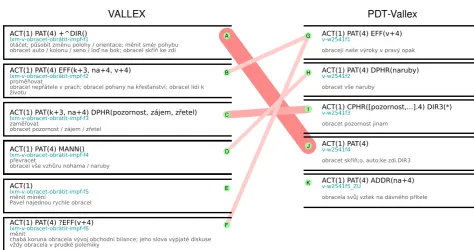
Example: The valency frames B and F from VALLEX are linked with the single frame G in PDT-Vallex, see Figure 1. There is no clue to decide whether both B and F or only one of them correspond(s) to G. In VALLEX, the valency frame B (and not the frame F) is marked with the attribute
-rcpproviding the information on possible reciprocal us-age of ACT and PAT. If there were an instance of the va-lency frame G in the PDT data with reciprocally used ACT and PAT, the mapping of B and G would be facilitated.
4.1.4. Control
Finally, the information on control is also included in both mapped lexicons. The control applies to a certain type of verbs (verbs of control) that have one of their valency slots expressed by infinitive, see esp. (Davies and Dubin-sky, 2004). Then coreferential relations can be observed between a ‘controller’ and a ‘controllee’: the controllee is a syntactic element in the subject position of the infinitive (structurally excluded in the surface) and the controller is a co-indexed expression typically filling one of valency slots of the verb of control.
Similarly as reciprocity, the information on control is ex-plicitly recorded in VALLEX; although it is not exex-plicitly encoded in PDT-Vallex, it can be obtained from the PDT data.
In sum, the pairs of matched LUs with the highest Score (a sum of the maximum constraint weight, lemmas inter-section, and reciprocity) represent candidate LUs for the linking. In the second phase of the experiment, candidate LUs trustworthy enough to be mapped are selected from a huge sum of pairs of candidate LUs obtained from the first phase of this experiment, as it is described in the following Section 4.2.
4.2. Pruning the Graph
The whole mapping can be seen as adding edges into a bipartite graph: one group of vertices represents LUs in VALLEX and the other one represents LUs in PDT-Vallex. An edge between two vertices (from different groups) rep-resent a candidate for the linking.
Note that (from the perspective of the graph theory) the whole task lies basically in searching for a subset of edges in a complete bipartite graph (under some linguistic condi-tions). However, the result does not need to be either an edge cover(as a LU may be omitted in one lexicon and as a consequence the corresponding LU should remain as an isolated vertex in the other lexicon), nor amatching (one LU in one lexicon may correspond to several LUs in the other lexicon). Even so, a perfect matching (i.e., one-to-one mapping between LUs) represents obviously the most satisfactory result, whenever the lexicons make it possible. The mapping procedure described above results in a biad-jacency matrixof a bipartite graph, i.e., a matrix where the
LU j from PDT-Vallex. This matrix needs to be pruned: the aim is to retain only those edges that are trustworthy enough, i.e., the edges with weight implying a sufficient match of compared LUs. The aim of the pruning procedure is to keep those edges that allow us to achieve the highest possible recall with the highest possible precision. Thus the retained edges follow these two principles:
• each vertex should have positive degree, if possible (= disapprove isolated vertices: get close to an edge cover), and
• no vertex should have degree (much) bigger than one, if possible (= disapprove multiple edges for one ver-tex: get close to a (perfect) matching).
Table 1 summarizes the overall number of the automatically merged data.
4.3. Evaluation
4.3.1. Testing Data
We carried out a complementary experiment with manual mapping of a sample of 200 verb lemmas. First, 90 verb lemmas were randomly selected according to a number of their lexical units in VALLEX: Let vi is the set of all
verbs with i LUs; ten verbs were selected from each set vi, i = 1. . .9. Second, 110 verbs were selected
follow-ing the frequency distribution of verbs with respect to their complexity (= a number of their LUs), i.e., the proportion of verbs withiLUs in the sample data reflects the proportion ofviin VALLEX.
4.3.2. Evaluation Measures
As for the complexity of the task, let us focus on the number of correct edges out of all the edges that can be assigned for the verbs from the sample data. There can be 2,721 edges between LUs of all 200 verbs (i.e., all the edges in the com-plete bipartite graphs for 200 verbs). Annotators A and B marked 529 and 493 edges as correct, respectively. Nat-urally, these edges are distributed unevenly among verbs with different numbers of LUs. Most edges (both potential and correct ones) are connected to verbs with nine LUs (ap-prox. 700 potential and 70 correct ones whereas most verbs in the lexicon has only one LU.
That is the reason why the precision and the recall are counted separately for each verb. Then they are averaged with weights corresponding to the cardinality of a set|vi|
to which the verb belongs (a bigger weight for a larger set: e.g.,v1 has a bigger weight as it contains more verbs than
v9even though verbs with 9 LUs contain much more edges
in our annotated sample). It reflects the fact that we are more interested in the number of the correct matching of verbs than in the number of correctly paired LUs of these verbs.
4.3.3. Results
VALLEX PDT-Vallex
Verb lemmas covered by both lexicons 3,541 3,541 LUs represented by the given verb lemmas 8,816 7,674
Average number of LUs per verb lemma 2.5 2.2
LUs with no link 2,245 1,622
LUs with just one link 5,537 4,670
LUs with more than one link 1,034 1,382
Table 1: The overall statistics on LUs in the lexicons and on the results of the automatic mapping.
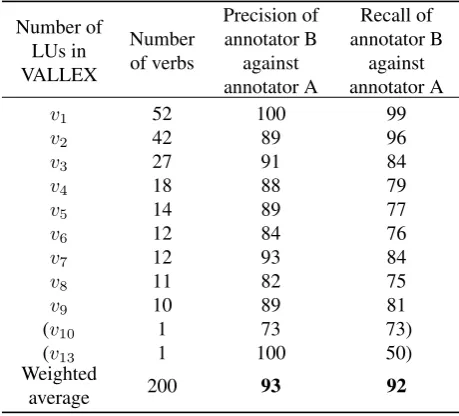
these two sets differ only in the number of verbs from the individual setsvi and the IAA is weighted to compensate
these differences. Therefore Table 2 shows IAA for all 200 verbs together.
Number of LUs in VALLEX
Number of verbs
Precision of annotator B
against annotator A
Recall of annotator B
against annotator A
v1 52 100 99
v2 42 89 96
v3 27 91 84
v4 18 88 79
v5 14 89 77
v6 12 84 76
v7 12 93 84
v8 11 82 75
v9 10 89 81
(v10 1 73 73)
(v13 1 100 50)
Weighted
average 200 93 92
Table 2: The inter annotator agreement on the manual link-ing of VALLEX and PDT-Vallex (calculated as a precision and recall of the second annotator on 200 verbs).
Table 3 summarizes the overall statistics on 200 sample automatically mapped verbs that are annotated manually. Note the bold numbers: after the automatic mapping, there are fewer LUs in VALLEX without a link and more LUs in PDT-Vallex with multiple links comparing to the results of manual mapping. It indicates that there are many superflu-ous edges between LUs: the VALLEX LUs should remain without a link and the PDT-Vallex LUs should have less links. Thus the pruning procedure could be more extensive and accept more isolated vertices, see Section 4.2.
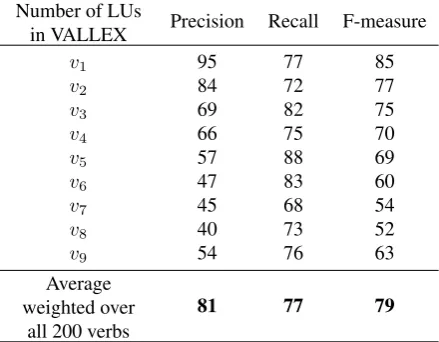
Let us focus now on the overall evaluation of the automatic mapping task. Table 4 displays the precision and the recall evaluated against the manual mapping.8 First, there are
re-sults given separately for each setvievaluated on at least
ten verbs. (Numbers of verbs are the same as in Table 2.) The precision is usually worse for biggeribut it oscillates for recall because of the diversity of verbs in our sample. In the last row, there is an overall result for all 200 verbs
8
The results of the automatic procedure are evaluated against the data of annotator A. (The numbers are very similar also for the annotator B.)
together: it is an average of the valuesviweighted by the
|vi|(see Section 4.3.2.).
The overall achieved precision and recall are satisfactory. However, the precision of more complex verbs, see espe-cially rowsv7 andv8, indicates that the mapping task is
much harder for verbs with a higher number of LUts.
Let us focus on reciprocity and its possible contribution to the task. This phenomenon has turned up to be too sparse in the PDT data: only 493 cases of reciprocity of verbal valency complementations appear in the PDT data; these cases belong to 144 LUs represented by 130 verb lemmas. Since it represents 1.2% of all LUs in PDT-Vallex, it is ob-vious that it cannot improve the results considerably —the reciprocity information is used only for three out of 90 se-lected verbs.9
Similarly, the information on control is sparse too (although it is not so sparse as reciprocity: in PDT 4,195 cases of con-trol that correspond to 280 LUs represented by 240 verb lemmas occur). Our linguistic inquiry confirms that the in-formation on control has only limited potential to improve our mapping procedure. If several LUs of a verb allow for control, the type of control is typically the same. Thus for the mapping procedure, the information on a type of con-trol (provided by a type of the valency complementation that represents the ‘controller’ (see Section 4.1.4.)) is not so beneficial as the information on control itself. However, this information is already implied by the morphemic form of infinitive present in a valency frame. For this reason, we have not used the information on the types of control explicitly in the mapping algorithm.
Let us conclude. The evaluation of the automatic mapping of VALLEX and PDT-Vallex performed on 200 manually annotated verbs has suggested that the automatic mapping represents a tricky task, especially in case of verbs with a higher number of LUs, even in case of merging similar lexical resources.
4.3.4. Error Analysis
According to our observation, there are the following sources of mismatches between VALLEX and PDT-Vallex which can result in wrong edges, compare also with Fig-ure 1.
(i) Insufficient information on LUs. Additional informa-tion on lexical units will be beneficial especially for
am-9
Verb lemmas selected for annotation 200 200
LUs represented by the given verb lemmas 716 528
Average number of LUs per verb lemma 3.6 2.6
A B auto A B auto
LUs with no link 249 280 175 61 72 93
LUs with just one link 415 386 464 417 422 312
LUs with more than one link 52 50 77 50 34 123
Table 3: The statistics on LUs for selected 200 verbs. The numbers are given for the manual annotation (annotators A and B) and for the automatic procedure (auto).
Number of LUs
in VALLEX Precision Recall F-measure
v1 95 77 85
v2 84 72 77
v3 69 82 75
v4 66 75 70
v5 57 88 69
v6 47 83 60
v7 45 68 54
v8 40 73 52
v9 54 76 63
Average weighted over
all 200 verbs
81 77 79
Table 4: The precision and recall of the automatic linking averaged over the set of 200 verbs.
biguous mapping resolution. However, as we have demon-strated on case of reciprocity and control, see Section 4.1.3. and Section 4.1.4., respectively, such information should be sufficiently frequent and/or heterogeneous in both mapped lexicons—sparse and/or not varied information does not as-sist in the task very much.
(ii)Word sense disambiguation. The differences in granu-larity of word sense disambiguation makes the automatic mapping difficult. For instance, if G in PDT-Vallex hy-pothetically covers both senses allowing for un/reciprocal usages, it should correspond both to B and F. To alleviate difficulties in word sense disambiguation, annotation prin-ciples adopted in both lexicons should be further analyzed and systematic differences made in word sense disambigua-tion should be harmonized, if it is possible.
(iii) Missing LUs. Valency frames may remain unlinked due to the absence of corresponding counterparts, e.g., the valency frames E and K. As for the frame E in VALLEX, it does not correlate with any frame in PDT-Vallex as the re-spective LU did not occur in the annotation of PDT. How-ever, the unlinked frames from PDT-Vallex point to missing LUs in VALLEX that should be covered, see K. As a result, the data completeness checking can be greatly assisted by linking LUs.
(iv)Inconsistencies in the annotations.The differences be-tween valency frames from VALLEX and PDT-Vallex may concern the number of complementations (A and J), their
types (D and H) and their morphemic forms (B and G). For the purpose of the automatic linking, regular discrep-ancies should be identified and harmonized. For instance, VALLEX and PDT-Vallex systematically treat verbal mut-liword expressions as light verbs in different ways. In PDT-Vallex, separate valency frames are assigned to light verbs; these frames are easily identifiable by the functor ‘CPHR’ indicating a predicative valency complementation. In contrast, an explicit indication of light verbs is missing in VALLEX: most light verbs are subsumed under valency frames corresponding to main verbs, less of them are repre-sented by separate valency frames with the functor ‘DPHR’ reserved for idioms. In the mapping, the regular differences in the light verb annotation are taken into account: the type of functors is disregarded whereas lemmas containing in examples, glosses and valency frames were emphasized.
5.
Conclusion
To sum up, we have provided a detailed outline of the auto-matic procedure for mapping two close valency lexicons of Czech verbs, VALLEX and PDT-Vallex. We have focused on different types of information that can be exploited for the task. We have demonstrated that converting VALLEX and PDT-Vallex into a common data format has represented a relatively easy task in their automatic merging. In con-trast, the automatic identification of corresponding lexical units has faced severe difficulties. The automatic mapping has been evaluated on a dataset of 200 manually linked verbs with the resulting precision of 81%. However, the precision of more complex verbs is much lower which indi-cates that the automatic mapping of LUs of complex verbs is a hard task which can rely only on phenomena covered in both mapped resources that are frequent and varied enough.
As to the future work, anedge thresholdshould be estab-lished. Only such edges between lexical units that have theScoreabove the threshold will be accepted as candidate LUs for the linking. The experiment revealed that the pro-posed automatic method allows a relatively high number of superfluous edges. The threshold could be the means how to remove them.
6.
Acknowledgements
This work has been using language resources developed and stored and distributed by the LINDAT/CLARIN project of the Ministry of Education, Youth and Sports of the Czech Republic (project LM2010013).
7.
References
Eduard Bejˇcek, V´aclava Kettnerov´a, and Mark´eta Lopatkov´a. 2010. Advanced searching in the valency lexicons using PML-TQ search engine. InThe Proceed-ings of the Text, Speech and Dialogue Conference, pages 51–58, Berlin/Heidelberg. Springer Verlag.
William Davies and Stanley Dubinsky. 2004. The gram-mar of raising and control. Blackwell, Malden, MA. Gil Francopoulo, Monte George, Nicoletta Calzolari,
Mo-nica Monachini, Nuria Bel, and Mandy Pet Claudia So-ria. 2006. Lexical markup framework (LMF). In The Proceedings of the International Conference on Lan-guage Resources and Evaluation – LREC 2006, pages 223–226, Genoa. LREC.
Iryna Gurevych, Judith Eckle-Kohler, Silvana Hartmann, Michael Matuschek, Christian M. Meyer, and Chris-tian Wirth. 2012. UBY – A large-scale unified lexical-semantic resource based on LMF. InProceedings of the 13th Conference of the European Chapter of the Associ-ation for ComputAssoci-ational Linguistics (EACL 2012), pages 580–590, Avignon, France, April.
Jan Hajiˇc, Jarmila Panevov´a, Zdeˇnka Ureˇsov´a, Alevtina B´emov´a, Veronika Kol´aˇrov´a, and Petr Pajas. 2003. PDT-VALLEX: Creating a Large-Coverage Valency Lexicon for Treebank Annotation. InProceedings of The Second Workshop on Treebanks and Linguistic Theories, volume Vol. 9, pages 57–68.
Jan Hajiˇc, Eva Hajiˇcov´a, Jarmila Panevov´a, Petr Sgall, Petr Pajas, Jan ˇStˇep´anek, Jiˇr´ı Havelka, and Marie Mikulov´a. 2006. Prague Dependency Treebank 2.0. Linguistic Data Consortium, Philadelphia, PA,
USA. http://hdl.handle.net/11858/
00-097C-0000-0001-B098-5, LDC2006T01,
ISBN 1-58563-370-4.
Edward Loper, Szu ting Yi, and Martha Palmer. 2007. Combining lexical resources: Mapping between Prop-Bank and VerbNet. In Proceedings of the 7th Inter-national Workshop on Computational Semantics, pages 118–128, Tilburg, the Netherlands. Iceland Centre for Language Technology (ICLT).
Petr Pajas and Jan ˇStˇep´anek. 2009. System for querying syntactically annotated corpora. InThe Proceedings of the ACL-IJCNLP, pages 33–36, Suntec, Singapore. As-sociation for Computational Linguistics.
Jarmila Panevov´a. 1994. Valency Frames and the Mean-ing of the Sentence. In Philip A. Luelsdorff, editor,The Prague School of Structural and Functional Linguistics, pages 223–243. John Benjamins Publishing Company, Amsterdam, Philadelphia.
Valeria Quochi, Monica Monachini, Riccardo Del Gratta, and Nicoletta Calzolari. 2008. A lexicon for bio-logy and bioinformatics: the BOOTStrep experience. In Nicoletta Calzolari, Khalid Choukri, Bente Mae-gaard, Joseph Mariani, Jan Odijk, Stelios Piperidis, and
Daniel Tapias, editors,Proceedings of the Sixth Interna-tional Conference on Language Resources and Evalu-ation (LREC’08), Marrakech, Morocco. European Lan-guage Resources Association (ELRA).
Petr Sgall, Eva Hajiˇcov´a, and Jarmila Panevov´a. 1986. The Meaning of the Sentence in Its Semantic and Pragmatic Aspects. Reidel, Dordrecht.
Zdeˇnka Ureˇsov´a. 2011. Valence sloves v Praˇzsk´em z´avislostn´ım korpusu. Studies in Computational and Theoretical Linguistics. Institute of Formal and Applied Linguistics, Praha, Czechia. ISBN 978-80-904571-0-2. P. Vossen, E. Agirre, F. Bond, W. Bosma, C. Fellbaum,
A. Hicks, S. Hsieh, H. Isahara, Ch.Huang, K. Kanzaki, A. Marchetti, G. Rigau, F. Ronzano, R. Segersand, and M. Tesconi. 2010. KYOTO: a Wiki for Establishing Semantic Interoperability for Knowledge Sharing across Languages and Cultures. In E. Blanchard and D. Allard, editors,Handbook of Research on Culturally-Aware In-formation Technology: Perspectives and Models, pages 265–294. IGI Global.