Using Log-linear Models for Selecting Best Machine Translation Output
Michael Carl
Institut für Angewandte Informationswissenschaft Martin Luther Str. 14, 66111 Saarbrücken, Germany
E-mail: [email protected]
Abstract
We describe a set of experiments to explore statistical techniques for ranking and selecting the best translations in a graph of translation hypotheses. In a previous paper (Carl, 2007) we have described how the hypotheses graph is generated through shallow mapping and permutation rules . We have given examples of its nodes consisting of vectors representing morpho-syntactic properties of words and phrases. This paper describes a number of methods for elaborating statistical feature functions from some of the vector components. The feature functions are trained off-line on different types of text and their log-linear combination is then used to retrieve the best translation paths in the graph. We compare two language modelling toolkits, the CMU and the SRI toolkit and arrive at three results: 1) word-lemma based feature function models produce better results than token-based models, 2) adding a PoS-tag feature function to the word-lemma model improves the output and 3) weights for lexical translations are suitable if the training
material is similar to the texts to be translated
1. Introduction
Feature functions are being increasingly used in recent Machine Translation (MT) approaches to select and rank translation candidates. Developed within a statistical processing framework (Och and Ney, 2002), the log-linear combination of feature functions provide a flexible
framework for discriminative modeling that allows to combine disparate and overlapping sources of information in a single model
According to Oepen et al. (2007), "a log-linear model is given in terms of (a) a set of specified features that describe properties of the data, and (b) an associated set of learned weights that determine the contribution of each feature." Each pair of source sentence f and target sentence e is represented as a real-valued feature vector h. A vector of weights w is then trained to optimize some objective function of the training data so as to allow a search procedure to find the target sentence ê with the
highest probability:
A number of feature functions have been explored in various system implementations (e.g. Oepen et al. 2007, Liu et al. 2007, Quirk 2007), separating the features roughly into source features, channel features and target features. Source features include probabilities of representations resulting from the SL analysis such as likelihood of the parse tree and dictionary matching. Channel models include SL-to-TL alignment and lexical translation probabilities. Target features refer to probabilities of the generated TL sentence, including, among other things, n-gram language models. In contrast to most purely statistical MT systems1 , we use rule-based methods to generate an AND/OR graph of translation hypotheses (Carl 2007) and a beam search algorithm to traverse the graph and feature functions to rank the paths, as e.g. in the MISTRAL system (Patry et
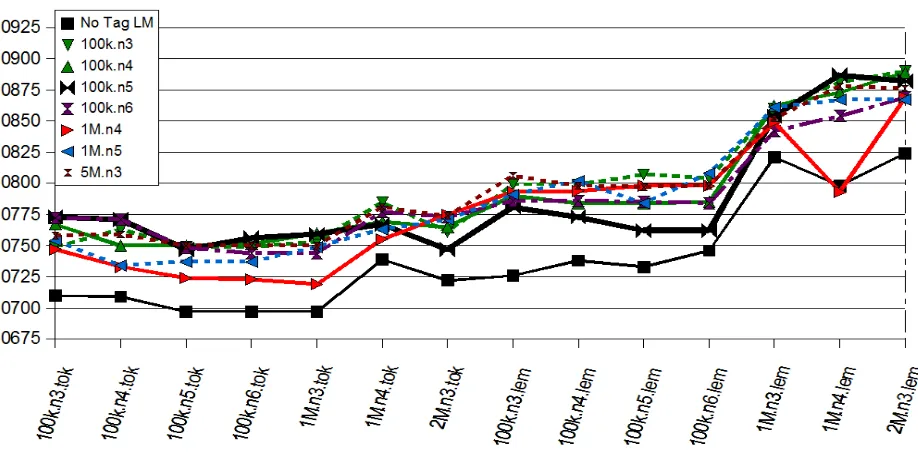
Figure 1: Test set of 200 sentences using various token, lemma and tag language models.
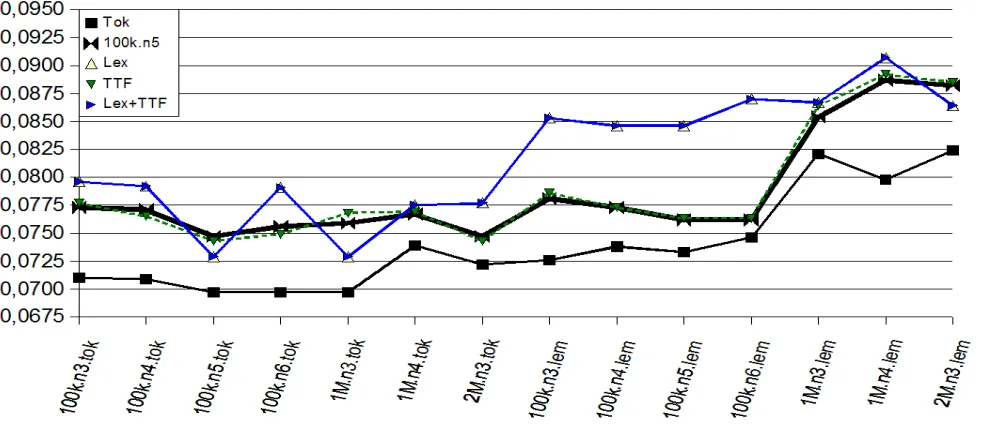
Figure 3: Results for the 200 sentence corpus when adding lexical and token-tag cooccurrence
functions.
Linguistics and Probabilities in MT, In Proceedings of the 11th International Conference on Theoretical and Methodological Issues in Machine Translation (TMI) Och, Franz J. (2002) Minimum Error Rate Training in
Statistical Machine Translation, In Proceeding of ACL, Liu, Zhanyi and Wang, Haifeng and Wu Hua (2007)
Example-Based Machine Translation Based on TSC and Statistical Generation, In Machine Translation (20).