Let’s not argue about semantics
Johan Bos
Universit`a di Roma “La Sapienza” Dipartimento di Informatica Via Salaria 113 – 00198 Rome (Italy)
Abstract
What’s the best way to assess the performance of a semantic component in an NLP system? Tradition in NLP evaluation tells us that comparing output against a gold standard is a good idea. To define a gold standard, one first needs to decide on the representation language, and in many cases a first-order language seems a good compromise between expressive power and efficiency. Secondly, one needs to decide how to represent the various semantic phenomena, in particular the depth of analysis of quantification, plurals, eventualities, thematic roles, scope, anaphora, presupposition, ellipsis, comparatives, superlatives, tense, aspect, and time-expressions. Hence it will be hard to come up with an annotation scheme unless one permits different level of semantic granularity. The alternative is a theory-neutral black-box type evaluation where we just look at how systems react on various inputs. For this approach, we can consider the well-known task of recognising textual entailment, or the lesser-known task of textual model checking. The disadvantage of black-box methods is that it is difficult to come up with natural data that cover specific semantic phenomena.
1.
Evaluating Meaning
Formal methods for the analysis of the meaning of natu-ral language expressions have long been restricted to the ivory tower built by semanticists, logicians, and philoso-phers of language. It was only in exceptional cases that they made their way directly into open domain NLP tools. Recently, this situation has changed. Thanks to the devel-opment of treebanks (large collections of texts annotated with syntactic structures), robust statistical parsers trained on such treebanks, and the development of large-scale se-mantic lexica, we now have at our disposal systems that are able to produce formal semantic representations achiev-ing high coverage (Schiehlen, 1999; Bos et al., 2004; Bos, 2005; Copestake et al., 2005; Delmonte, 2006; Sato et al., 2006; Moldovan et al., 2007).
Now, suppose we want to evaluate the semantic com-ponent of such NLP systems. How shall we go about it? Probably the most obvious way is to look at the semantic representations that the system produces and compare that with a gold standard annotation. After all, that’s what we do when evaluating part-of-speech tagging, chunking, named entity recognition, and syntactic parsing. But what exactly should such a gold standard for meaning representations look like? What exactly constitutes an adequate seman-tic representation? Should it follow a parseman-ticular (formal) theory of semantics, or rather take an independent stance? What semantic phenomena should it aim to cover?
Posing these questions is, moreover, a timely matter. As pointed out above, wide-coverage systems that claim to have genuine semantic components are now emerging and we need an unambiguous way of evaluating these systems for the sake of measuring progess and benchmarking. The key question is whether comparing to a gold standard (the so-called “Glass-Box” method) is an effective methodol-ogy for assessing semantic adequacy. Annotating text with semantic representations, is an immense task, with many choices to make, as I will show in this paper.
Alternatively, one could take “Black-Box” approaches
to semantic evaluation. I will discuss two such methods in this paper: the task of recognising textual entailment, and the task of textual model checking.
2.
Glass-Box Evaluation
For the glass-box evaluation we need to decide on two is-sues. The first is a global choice and concerns the nature of the representation language. The second concerns the depth of analysis of the various semantic phenomena that one needs to consider.
2.1 Which Representation Language?
In the scope of this paper, what I mean by a semantic repre-sentation is an interpretable structure, in other words, a log-ical form with a model-theoretic semantics. Such a repre-sentation has a logical foundation. There are many choices we can make here, among them, representation languages based on:
• propositional logic;
• some description logic (many choices here);
• some modal logic (many choices here, too);
• first-order logic (i.e. predicate logic);
• higher-order logic (i.e. lambda calculus).
The list above is, by and large, ordered on expressive power. An expressive language is nice to have, but often the price to pay is high. Assuming that, in the context of scalable language technology, we take “semantic analysis” not just as the task of representing meaning, but also as the task of automatic reasoning with produced meaning rep-resentations, a compromise between expressive power and practical reasoning capabilities is unavoidable.
3.18:Every European has the right to live in Europe. Every European is a person. Every person who has the right to live in Europe can travel freely within Europe.
Can every European travel freely within Europe? (Yes)
3.33:An Irishman won a Nobel prize.
Did an Irishman win the Nobel prize for litera-ture? (Don’t know)
3.38:No delegate finished the report.
Did any delegate finish the report on time? (No)
Figure 2: FRACAS test suite examples for generalised quantifiers (Cooper et al., 1996)
T:Jader Barbalho, once president of the country’s largest political party, was arrested on Saturday in the Amazonian city of Belem, after officials in the neighbouring state of Tocantins issued a war-rant against him.
H: Jader Barbalho is the president of Amazon.
Figure 3: Example 7 of the second PASCAL RTE challenge (Bar-Haim et al., 2006)
open domain data. An issue with the open domain PAS-CAL RTE examples is the difficulty of isolating the seman-tics task from the task of acquiring the relevant background knowledge (Zaenen et al., 2005). In contrast, the FRACAS test suite was deliberately constructed to limit the amount of additional background knowledge to make the required inferences.
A second criticism is that the PASCAL RTE text-hypothesis pairs are not designed to measure performance on specific phenonema. As a consequence, it is difficult to detect why a system fails or succeeds in certain cases, and it is often hard to explain why certain systems are good and others are bad. The FRACAS examples are grouped ac-cording to various linguistic phenomena (and are meant to test only one phenomenon per example), but a practical ob-stacle with the FRACAS style of examples is the difficulty to produce a natural test suite of training, development and test data.
Finally, there is often debate as to what constitutes “tex-tual entailment”. This is surprising, as there is a long tradi-tion to use textual entailment examples in formal semantic textbooks to illustrate the concept of meaning. (Indeed, the first examples of textual entailment are the syllogisms of Aristotle.) Perhaps it helps to use more commonplace ter-minology. Here is what I propose, given a pair of two texts A and B: B isinformative wrt A (not entailed), B isnot informativewrt A (entailed), or A and B areinconsistent. Hence, the example in Figure 3 is classified as informative — the H text contains new information with respect to the T text.
3.2 Textual Model Checking
An alternative black-box evaluation method that I would like to present here is to perform the evaluation of a seman-tic component by model checking. Simply put, an NLP sys-tem is given a sentence (or text) and an abstract description of a situation (a model) and is asked whether the sentence is true or false (or unknown) in the given situation. Sys-tems are then evaluated on the accuracy of correctly evalu-ated statements. As far as I know this proposal hasn’t been made before, although there is an obvious link with evalu-ating natural language queries to relational databases (Tang and Mooney, 2000; Minock, 2005).
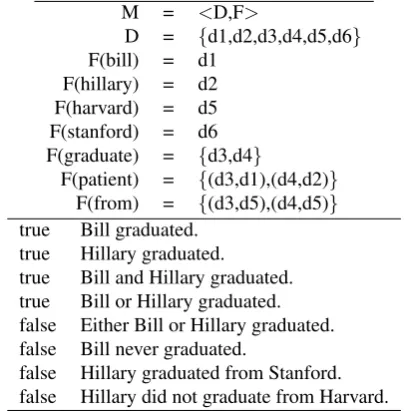
M = <D,F>
D = {d1,d2,d3,d4,d5,d6}
F(bill) = d1 F(hillary) = d2 F(harvard) = d5 F(stanford) = d6 F(graduate) = {d3,d4}
F(patient) = {(d3,d1),(d4,d2)}
F(from) = {(d3,d5),(d4,d5)}
true Bill graduated. true Hillary graduated.
true Bill and Hillary graduated. true Bill or Hillary graduated. false Either Bill or Hillary graduated. false Bill never graduated.
false Hillary graduated from Stanford. false Hillary did not graduate from Harvard.
Figure 4: Example of a (simplified) model and true and false statements.
What I mean by a model is the usual concept of a first-order model as employed in formal semantics. Formally, a model M consists of a domain (D) of entities and an in-terpretation function (F). The inin-terpretation function maps properties and relations symbols to elements of D, to sets of elements of D, or to set of tuples of elements of D. Such models only represent all positive information (all informa-tion not represented is implicitly negative). Figure 4 shows an example model and a set of true and false statements. An example application of textual model checking is the CURT system (Blackburn and Bos, 2005).
bust parser into typed dynamic logic. InProceedings of
the COLING/ACL on Main conference poster sessions,
pages 707–714, Morristown, NJ, USA. Association for Computational Linguistics.
Michael Schiehlen. 1999. Semantikkonstruktion. Ph.D. thesis, Universit¨at Stuttgart.
Satoshi Sekine, Kentaro Inui, Ido Dagan, Bill Dolan, Danilo Giampiccolo, and Bernardo Magnini, editors. 2007. Proceedings of the ACL-PASCAL Workshop on Textual Entailment and Paraphrasing. Association for Computational Linguistics, Prague, June.
Lappoon R. Tang and Raymond J. Mooney. 2000. Auto-mated construction of database interfaces: Integrating statistical and relational learning for semantic parsing. In Joint Conference on Empirical Methods in Natural Lan-guage Processing and Very Large Corpora, pages 133– 141, Hong Kong.
Terry Winograd. 1971. Procedures as a Representation for Data in a Computer Program for Understanding Natu-ral Language. Ph.D. thesis, Massachusetts Institute of Technology.