Towards a learning approach for abbreviation detection and resolution
Klaar Vanopstal
1,2, Bart Desmet
1,2and V´eronique Hoste
1,21LT3, Language and Translation Technology Team, University College Ghent
Groot-Brittanni¨elaan 45, 9000 Gent, Belgium klaar.vanopstal, bart.desmet, [email protected]
2Department of Applied Mathematics and Computer Science, Ghent University
Krijgslaan 281 (S9), 9000 Gent, Belgium
Abstract
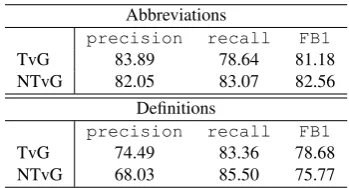
The explosion of biomedical literature and with it the -uncontrolled- creation of abbreviations presents some special challenges for both human readers and computer applications. We developed an annotated corpus of Dutch medical text, and experimented with two approaches to abbreviation detection and resolution. Our corpus is composed of abstracts from two medical journals from the Low Countries in which approximately 65 percent (NTvG) and 48 percent (TvG) of the abbreviations have a corresponding full form in the abstract. Our first approach, a pattern-based system, consists of two steps: abbreviation detection and definition matching. This system has an average F-score of 0.82 for the detection of both defined and undefined abbreviations and an average F-score of 0.77 was obtained for the definitions. For our second approach, an SVM-based classifier was used on the preprocessed data sets, leading to an average F-score of 0.93 for the abbreviations; for the definitions an average F-score of 0.82 was obtained.
1.
Introduction
With the explosion of biomedical information, the number of biomedical abbreviations is growing rapidly. As there are no rules for the formation of new abbreviations, their detection and association to the correct full form becomes increasingly difficult. Abbreviation detection is especially useful for language technology applications like informa-tion retrieval (Byrd et al., 1994) and extracinforma-tion (Maynard and Ananiadou, 1999; Roark and Charniak, 1998; Liu et al., 2002), NER and anaphora resolution. Yu et al. (2002b) claim that exploiting abbreviations in IR systems increases the number of relevant documents retrieved, and Friedman et al. (2001) argue that not handling abbreviations in NLP is a major source of errors.
In this paper, we describe the compilation of a monolingual corpus of Dutch medical texts which can be used as a gold standard for the detection of abbreviations. Chang and Sch¨utze (2006) mention the lack of a suitable standard for English as one of the factors that hamper the creation and evaluation of efficient abbreviation detection systems. In section 3, we describe the creation of a Dutch gold standard for abbreviation detection and resolution and the guidelines used for the annotation of the corpus. Section 4 presents some challenges for the automatic detection of abbreviation patterns and in section 5, we refer to related work and we present our approach. Finally, in section 6, we present some conclusions and describe our future work.
2.
Creation of a gold standard
2.1. CorpusAs the construction of a gold standard is both time-consuming and expensive, such inventories are scarce, and even more so for a niche language like Dutch. Chang and Sch¨utze (2006) list four criteria for a solid gold standard: size, breadth, accuracy and common use in the community. A bigger corpus generally leads to a larger coverage and thus to a higher accuracy. As we are focusing on a specific
domain, namely the medical domain, the second criterium, i.e. breadth of the corpus, is of lesser importance to our research.
There are two popular gold standards for English abbrevia-tion detecabbrevia-tion: the AbbRE gold standard and the Medstract acronym gold standard. The corpus used for the evaluation of the AbbRE algorithm (Yu et al., 2002a) is claimed to be reliable, as it was annotated by three experts in the field. However, its size is next to negligible: it consists of only 10 articles. Medstract, a publicly available and commonly used standard, is somewhat larger but seems to be less reliable (Chang and Sch¨utze, 2006). For Dutch, no such resources are available.
For the construction of our corpus, we randomly selected abstracts from the Dutch journal Nederlands Tijdschrift voor Geneeskunde1 (NTvG) and the Belgian journal
Bel-gisch Tijdschrift voor Geneeskunde2(TvG), two important sources of information for Dutch-speaking experts in the biomedical sector in the Netherlands and in Belgium. This resulted in a corpus of 66,739 words, 29,978 (100 abstracts) of which are from the NTvG, and 36,757 (256 abstracts) from the TvG. The corpus was tokenized before the annotation.
2.2. Annotation guidelines
In order to be able to mark all abbreviations in a text, we needed to define what we consider abbreviations, and what distinguishes them from acronyms, clipping and other short forms. The definitions found in the literature vary, but gen-erally, abbreviations are described asa shortened form of a word or phrase(Chang and Sch¨utze, 2006).
Liu et al. (2001) distinguish six types of abbreviations:
1. Truncating the end, e.g. admfor administration(or
administrator), also called clipping (Bloom, 2000)
1
http://www.ntvg.nl
2
2. First letter initialization, or acronyms, e.g. AAA for
abdominal aortic aneurysm
3. Opening letter initialization, e.g. HeLaforHenrietta Lacks
4. Syllabic initialization, e.g.BZDforbenzodiazepine
5. Combination initialization, e.g. e-mailforelectronic mail
6. Substitution initialization e.g.ASD IforPrimum atrial septal defect;Feforiron.
Liu et al. (2002) add a seventh type of ab-breviation, i.e. the chemical abbreviation, which is a combination of letters and numbers.
CXCR4 chemokinereceptor fusine (EN: chemokine receptor fusin) CTLA4-Ig cytotoxisch T-lymfocyt-A4-Ig
(EN: cytotoxic T-lymphocyte-associated antigen-4 Ig)
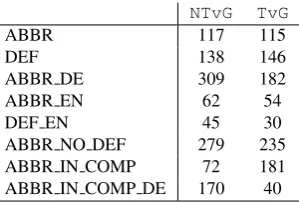
We used eight labels for the annotation of our corpus:
1. ABBR: Dutch abbreviations which have a full form in their local context.
(1) Hoge-resolutie-computertomografie (HRCT) kan een belangrijke rol spelen in [...]. (EN: High res-olution computed tomography (HRCT) can play an important role in [...].)
2. ABBR DE: Dutch abbreviations which have a full form somewhere (DE = defined elsewhere) in the same abstract, but not in their local context.
(2) Het chronische-vermoeidheidssyndroom (chronic fatigue syndrome , CFS) is [...]. Tegenwoordig wordt meer belang gehecht aan de mogelijke rol van het centrale zenuwstelsel (CZS) in de patho-fysiologie van hetCFS. (EN: The chronic fatigue syndrome (CFS) is [...]. The possible role of the central nerve system (CNS) is increasingly empha-sized in the pathophysiology of CFS.)
3. DEF: Dutch full forms which define an abbreviation in their local context.
(3) Recent onderzoek betreffende de atrofie van de
mediale temporale kwab (MTL), gaf bemoedi-gende resultaten voor de aanvullende diagnostiek van deziekte van Alzheimer(AD)[...]. (EN: Re-cent studies about the atrophy of the medial tem-poral lobe (MTL) showed optimistic results for the supplementary diagnostics of Alzheimer’s disease (AD)[...].)
(4) Gesystematiseerde lupus erythematosus(SLE) is h`et prototype van [...]. (EN: Systematized lupus erythematosus (SLE) is the prototype of [...])
As can be observed in example 3, this Dutch definition can also refer to an English abbreviation.
4. ABBR IN COMP: Abbreviations which are part of a compound word and which do not have a definition in the abstract.
(5) De fysiopathologische veranderingen zijn het gevolg van het tegenwerkend effect van een primair verhoogdeADH-secretie en een secundair gestegen
ANF-vrijzetting. (EN: These physiopathological changes are due to the countereffect of a primary inappropriate of ADH secretion and a secondary in-creased ANF secretion.)
(6) Men kan dez6 systemen in twee grote categorie¨en onderverdelen : deCa-transport-ATPasen, die [...]. (EN: These systems are divided into 2 large cate-gories: the Ca-Transport ATPases, which [...]
Usually, abbreviations in Dutch compounds are sepa-rated from the other part of the compound with a hy-phen. In some cases (see example 21), no such sepa-ration is used (ATPasen).
5. ABBR IN COMP DE: Abbreviations which are part of a compound word and which have a full form or definition in the abstract.
(7) [...] ernstige reumato¨ıde artritis (RA)-vasculitis. Bij de ziekte van Wegener en RA-vasculitis [...]. (EN: [...] severe rheumatoid arthritis (RA) vasculi-tis. Wegener’s disease and RA vasculitis [...])
6. ABBR NO DEF: These are abbreviations which have no definition or full form in their local context. How-ever, the term’s full form occurs somewhere else in the text.
(8) [...] orale 5-FU prodrugs (capecitabine, UFT), ethynyluracil en [...]. (EN: [...] oral 5-FU prodrugs (capecitabine, UFT), ethynyluracil and [...]. )
7. ABBR EN: An English abbreviation, with either a Dutch or an English definition in its local context.
(9) [...] gecorreleerd aan de score op de Mini Men-tal State Examination (MMSE). (EN: correlated with the Mini Mental State Examination (MMSE) score.)
(10) Endogeen stikstofmonoxide (NO) speelt een belan-grijke rol in [...] (EN: Endogenous nitric oxide (NO) plays an important role in [...])
8. DEF EN: An English definition or full form which ac-companies an English abbreviation.
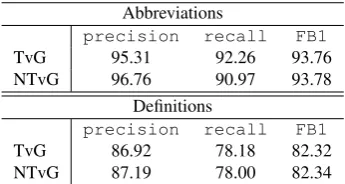
Abbreviations
precision recall FB1
TvG 95.31 92.26 93.76 NTvG 96.76 90.97 93.78
Definitions
precision recall FB1
TvG 86.92 78.18 82.32 NTvG 87.19 78.00 82.34
Table 4: Ten-fold cross-validation results of the learning experiments.
4.4. Manual error analysis
In order to better understand the errors on the abbreviation detection and resolution, we performed a manual error anal-ysis on the output of the more error-prone pattern-based ap-proach. This analysis can help us both to define new pat-terns and to develop new features for the learner. For both detection tasks, we distinguished between false positive and false negative results.
4.4.1. Abbreviation detection
In our error analysis of the abbreviation detection, we dis-tinguished five possible causes forfalse positiveresults, i.e. words that were detected as abbreviations, but which had not been annotated as such:
1. Titles which are printed in capital letters:
(17) FUNCTIONELE MRI : HET AFBEELDEN VAN MOTORISCHE HERSENFUNCTIES (EN: FUNCTIONAL MRI: AN IMAGE OF THE MO-TOR BRAIN FUNCTIONS)
In this example, the colon was seen as a text marker in-dicating the possible presence of an abbreviation. Our system detected ”HET” as an abbreviation.
2. First name initials which were erroneously detected as an abbreviation:
(18) V.de Vries
3. Roman numerals which are confused with a capita-lized i, v or x:
(19) Een coagulase-positieve Staphylococcus aureus be-horende tot faaggroepII [...] (EN: A coagulase-positieve Staphylococcus aureus of phage group II [...])
4. Single letters which are not abbreviations:
(20) hepatitisA,BenC(EN: hepatitis A, B and C)
In this example, A, B and C are not abbreviations, but rather a type of the disease.
5. Numerals in compounds consisting of an abbreviation, a numeral and a word.
(21) het PS-1-gen op chromosoom 14 (EN: PS1-1 gene on chromosome 14)
In this case, the system was not able to decide whether “-1” belonged to the compound word “1-gen” or to the abbreviation “PS-1”.
The false negatives, on the other hand, were caused by the lack of rules which cover specific abbreviation forma-tion patterns, such word-internal capital letters (22), the use of numerals and hyphens in compounds (23), single (low-ercase) letter abbreviations (24), etc. Also abbreviations which do not have the orthographical characteristics of an abbreviation (25) were not detected. Most of these false negatives, however, were solved in the classification-based approach.
(22) mmHg (EN: Torr)
(23) orale5-FU prodrugs (EN: oral 5-FU prodrugs) (24) leeftijd (>60 j) (EN: age (>60))
(25) 15-20 min (EN: 15-20 minutes)
4.4.2. Definition detection
The pattern-based definition detection step suffered from error percolation from the abbreviation detection, leading to both false positives (26, 27), indicated with “[]” in the examples below, and false negatives (28). Since both de-tection problems were handled completely independently as a binary classification task in the learning experiments, this error percolation was avoided in the classification ap-proach.
(26) [ELEKTRONENBESTRALING EFFECTIEF BIJ DE BEHANDELING VAN HUIDCAR-CINOMEN]; EEN VERGELIJKING MET R ¨ONTGENCONTACTTHERAPIE (EN: ELECTRON IRRADIATION EFFECTIVE FOR THE TREATMENT OF SKIN CARCINOMAS; A COMPARISON WITH CONTACT X-RAY THERAPY)
(27) In dit verband werd in deelI(6) [ingegaan] op de rol van [...] (EN: In part I (6), we examine the role of [...]) (28) [...] heeft de Werkgroep Su¨ıcide Onderzoek Vlaanderen
(WeSOV) [...] (EN: the Workgroup Suicide Research in Flanders (SRF) [...])
Otherfalse positivesin the definition detection can be at-tributed to:
1. Linking of the first letter of the abbreviation to an-other word in the sentence which starts with the same letter. The words following this mislinked word are also often erroneously labeled as parts of the defini-tion. Since the pattern-based approach operates on raw text, function words could be detected as first word of a definition. This problem was handled in the classification-based approach by incorporating part-of-speech information.
(29) het virus (HAV) (EN: the hepatitis-A-virus (HAV))
(30) Sedert de ontdekking van het hemochromatosegen (HLA-H- of HFE-gen)[...] (EN: Since the discov-ery of the hemochromatosis gene (HLA-H or HFE gene)[...])
False negativescould be observed in the following cases:
1. The use of function words, which cannot be linked to the letters in the abbreviation:
(31) op evidentie gebaseerde zorg (EGZ) (EN: evidence-based medicine (EBM))
2. English abbreviations with Dutch definitions or expan-sions.
(32) [...] voorkomen van een overmatig waterver-lies (TEWL). (EN: prevention of transepidermal
excessivewaterloss (TEWL).)
3. Definitions which describe the concept of the abbrevi-ation, rather than giving an expansion of it:
(33) lange arm van het Y-chromosoom(Yq) (EN: long arm of the Y chromosome (Yq))
4. The use of contractions. In the example below, “thera-piegebonden” is not repeated in the noun phrase “acute leukemie”, although the “t” in “t-AL” refers to that same adjective.
(34) De incidentie van therapiegebonden secundaire myelodysplasie (t - MDS) en acute leukemie (t - AL). (EN: the incidence of therapy-related secondary myelodysplasia (t-MDS) and acute leukemia (t-AL).)
5.
Conclusions
We created two approaches for the detection and resolution of abbreviations in Dutch medical texts. Both methods, a pattern-based system and a classification-based learning system, were evaluated on a dataset of about 65,000 words which was annotated for this task 4. For both detection tasks, the learning approach showed a performance increase over the pattern-based approach. For the detection of abbre-viations, an F-score of 93% was obtained; for definition de-tection, the classifier obtained an F-score of 82%. In future work, we will apply decompounding techniques to refine the matching of abbreviations against word and word part boundaries. In order to tackle the problem of cross-lingual matching, viz. matching English abbreviations to Dutch ex-pansions, we will use external sources and experiment with MT techniques. We will also try to resolve undefined ab-breviations with the use of external -internet- sources and we will add the formation patterns described by Liu et al. (2001) to our pattern-based and learning system.
4The data sets will be made available from
http://veto.hogent.be/lt3/downloads
6.
References
D. A. Bloom. 2000. Acronyms, abbreviations and ini-tialisms. BJU Int, 86(1):1–6. 1464-4096 (Print)Journal Article Review.
R. J. Byrd, Y. Ravin, and J. Prager. 1994. Lexical assis-tance at the information-retrieval user interface. Techni-cal report, IBM T.J. Watson Research Center.
J. Carletta. 1996. Assessing Agreement on Classification Tasks: The Kappa Statistic. Computational Linguistics, 22:249–254.
J.T. Chang and H. Sch¨utze. 2006. Abbreviations in Biomedical Text. In Sophia Ananiadou and John McNaught, editors, Text Mining for Biol-ogy and Biomedicine, pages 99–119. Artech House, Boston/London.
J.T. Chang, H. Sch¨utze, and R. B. Altman. 2002. Creating an online dictionary of abbreviations from MEDLINE. J Am Med Inform Assoc, 9(6):612–620.
W. Daelemans and A. van den Bosch. 2005. Memory-Based Language Processing. Cambridge University Press.
C. Friedman, H. Liu, L. Shagina, S. Johnson, and G. Hripc-sak. 2001. Evaluating the UMLS as a Source of Lexical Knowledge for Medical Language Processing. Proceed-ings of the American Medical Informatics Association Annual Symposium, pages 189–193.
T. Kudo and Y. Matsumoto. 2003. Fast methods for kernel-based text analysis. In Proceedings of the 41st Annual Meeting of the Association for Computational Linguis-tics, pages 24–31.
H. Liu, Y. A. Lussier, and C. Friedman. 2001. A study of abbreviations in the UMLS. Proc AMIA Symp, pages 393–7. 1531-605X (Print) Evaluation Studies Journal Article Research Support, U.S. Gov’t, Non-P.H.S. Re-search Support, U.S. Gov’t, P.H.S.
H. Liu, A. R. Aronson, and C. Friedman. 2002. A study of abbreviations in MEDLINE abstracts. Proc AMIA Symp, pages 464–8. 1531-605X (Print) Journal Arti-cle Research Support, U.S. Gov’t, Non-P.H.S. Research Support, U.S. Gov’t, P.H.S.
D. Maynard and S. Ananiadou. 1999. Term Extraction us-ing a Similarity-based Approach. InRecent Advances in Computational Terminology. John Benjamins.
Y. Park and R.J. Byrd. 2001. Hybrid Text Mining for Find-ing Abbreviations and Their Definitions.
J. Pustejovsky, J. Casta˜no, B. Cochran, M. Kotecki, and M. Morrell. 2001. Automatic extraction of acronym-meaning pairs from MEDLINE databases. Medinfo, 10(Pt 1):371–375.
J. Pustejovsky, J. Casta no, R. Saur´ı, A. Rumshinsky, J. Zhang, and W. Luo. 2002. Medstract: creating large-scale information servers for biomedical libraries. In
Proceedings of the ACL-02 workshop on Natural lan-guage processing in the biomedical domain, pages 85– 92.
K. Taghva and J. Gilbreth. 1999. Recognizing acronyms and their definitions. IJDAR, 1(4):191–198.
J. D. Wren and H. R. Garner. 2002. Heuristics for identification of acronym-definition patterns within text: towards an automated construction of comprehensive acronym-definition dictionaries. Methods of information in medicine, 41(5):426–434.
H. Yu, G. Hripcsak, and C. Friedman. 2002a. Mapping abbreviations to full forms in biomedical articles. J Am Med Inform Assoc, 9(3):262–72. 1067-5027 (Print) Journal Article Research Support, U.S. Gov’t, Non-P.H.S. Research Support, U.S. Gov’t, Non-P.H.S.