Extraction and evaluation of keywords from Learning Objects – a multilingual
approach
Lothar Lemnitzer and Paola Monachesi
Seminar f¨ur Sprachwissenschaft, Universit¨at T¨ubingen,
Germany,
[email protected] University of Utrecht
The Netherlands [email protected]
Abstract
We report about a project which brings together Natural Language Processing and eLearning. One of the functionalities developed within this project is the possibility to annotate learning objects semi-automatically with keywords. To this end, a keyword extractor has been created which is able to handle documents in 8 languages. The approach employed is based on a linguistic processing step which is followed by a filtering step of candidate keywords and their subsequent ranking based on frequency criteria. Three tests have been carried out to provide a rough evaluation of the performance of the tool, to measure inter annotator agreement in order to determine the complexity of the task and to evaluate the acceptance of the proposed keywords by users.
1.
Introduction
eLearning aims at replacing the traditional learning style in which content, time and place are predetermined with a more flexible, customized process of learning. While in tra-ditional learning, the instructor plays an intermediate role between the learner and the learning material, this is not always the case within eLearning since learners are in a position to combine learning material and to create their own courses. However, a necessary condition is that con-tent should be easy to find and metadata plays a crucial role to this end. It provides a common set of tags that can be viewed as data describing data. Metadata tagging enables organizations to describe, index, and search their resources and this is essential for reusing them.
In the eLearning community, various metadata standards have emerged to describe eLearning resources. The
Learn-ing Object Metadata standard launched by the IEEE1 is
the most widespread standard used for learning objects. Among other information, keywords can be provided as part of the LOM metadata set. Providing metadata, how-ever, is a tedious activity and it is not widely accepted by content providers and authors as part of their work. This has, however, the highly undesirable consequence that con-tent becomes less visible and more difficult to retrieve. One of the goals of the LT4eL project2, cf. (Monachesi et al., 2006), is to show that language technology can pro-vide significant support for this task. The solution we offer is to provide a Language Technology based functionality, that is a keyword extractor which allows for semi-automatic metadata annotation of the learning objects within a Learn-ing Management System (LMS). Keyword extraction is the
1
cf. http://ltsc.ieee.org/doc/wg12/LOM3.6. html.
2The project is funded by the EC under the IST programme.
We are grateful for the support. For further details, visitwww. lt4el.eu.
process of extracting a few salient words or phrases from a given document and using these words as a surrogate of this document. Keyword extraction has been widely ex-plored in the natural language processing and information retrieval communities and in our project we take advantage of the techniques and the results achieved in these areas and adapt them to the eLearning context. More specifically, our approach employs statistical measures in combination with linguistic processing to detect salient words which are good keyword candidates.
It should be noticed, however, that keyword and keyphrase extractors have been provided mainly for English, cf. (Sclano and Velardi, 2007), (Frank et al., 1999), (Wan et al., 2007),(Zha, 2002), (Witten et al., 1999), (Turney, 2000), (Mihalcea and Tarau, 2004), (Hulth, 2003). One innovative aspect of our project is that we provide this functionality for all the eight languages represented in our project, that is Bulgarian, Czech, Dutch, English, German, Polish, Por-tuguese and Romanian. This makes it necessary to address language specific aspect. The linguistic annotation for each language differs, and so do the parts of speech. With a lan-guage dependent lingistic model we intend to exclude all words which are assigned a part of speech that is not rele-vant for keywords (e.g. adverb, conjunction). Second, and we embed this tool in an eLearning context. Another salient feature is that keyphrases are extracted in addition to key-words. This responds to findings that users frequently use keyphrases to describe a document, cf. (Jones and Paynter, 2006).
More generally, the main objective of the LT4eL project is to show that the integration of Language Technology based functionalities and Semantic Web techniques will enhance the management, distribution and retrieval of the learning material within Learning Management Systems.
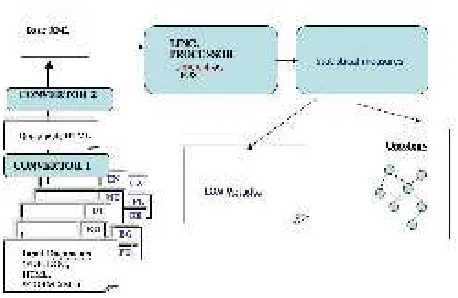
Figure 1: Architecture of the keyword extractor
During our experiments with these metrics we recognized that RIDF does not take the term frequency in the analysed document into account. Since this is the most important factor in our statistics, we added it and arrived at a statistics which we call Adjusted Residual IDF (short: ADRIDF. cf. equation 5).
ADR IDF =R IDF
p
tf (5)
In our project, we have implemented and evaluated the ap-propriateness of these statistical measures in ranking the most relevant keywords from our multilingual learning ob-jects. In section 3., the results are discussed in detail. The keyword extractor is built to deal with a wide range of languages: Bulgarian, Czech, Dutch, English, German, Polish, Portuguese and Romanian. This is a relevant result since techniques to extract keywords and keyphrases have been usually tested on English and never on such a variety of languages.
On the one hand, the management of such a wide range of languages makes it necessary: a) to build a common anno-tation format for all annotated corpora and b) to keep the language specific components of the tool as lean as possi-ble. On the other hand, the multilingual aspect of the devel-opment gives us the chance to broadly evaluate the perfor-mance of the tool and its underlying information extraction methods, as discussed in detail in the next section.
It should be noticed that the great variety of languages we have dealt with, and the high number of parameter settings used to find the optimal results complicates the evaluation procedure and makes it necessary to perform several tests and experiments. The evaluation strategy must be both for-mative – i.e. inform the development of the tool, in partic-ular the language-specific settings – and summative – i.e. assess the performance of the final tool. It has to be both intrinsic – i.e. assess the performance of the tool in isola-tion – and extrinsic – i.e. assess the performance of the tool as part of a learning environment.
As discussed more at length in section 3., the novelty of our application makes it difficult to adapt current evaluation tests for our purposes. On the other hand, we do need to as-sess the performance of the tool and verify that it achieves acceptable results before integrating it in the Learning Man-agement System. Therefore we have to accept the
limita-language Keyords (%) Keyphrases (%)
Bulgarian 57 43
Czech 73 27
Dutch 75 25
English 38 62
German 90 10
Polish 33 67
Portuguese 86 14
Romanian 70 30
Table 1: Percentages of keywords and keyphrases per lan-guage
tion of these tests and work towards the development of new ones more fit to the purpose. It should be noticed that a non-optimal performance of the tool in the intrinsic evalu-ation might still lead to an appropriate behavior of the key-word extractor in the extrinsic evaluation. In particular, a scenario based evaluation of the tool in the context of the ILIAS system which takes into consideration the degree of satisfaction of the user and the impact on the learning pro-cess might be a more appropriate way to validate the key-word extractor.
In the development of the keyword extractor, special atten-tion has been devoted to multiword terms. A first analysis of the manually selected keywords revealed, that for some languages a substantial amount of them is multi word. E.g. for Polish we have 67 % keyphrases of two or more words. For other languages, e.g. German, multi word key phrases do not play a significant role, see table 1 for details. We therefore put some effort to properly deal with these items and several tests have been carried out to detect the most appropriate length for multiword keywords and possi-ble variation due to language. We followed the approach of Yamamoto and Church, cf. (Yamamoto and Church, 2001), to effectively identify and extract recurrent multi-word key phrases up to a predefined length. Additionally, we used linguistic information to further restrict this set of multi-word key phrases, e.g. to exclude phrases which end in a preposition. Statistically, multi-word phrases are treated as single words.
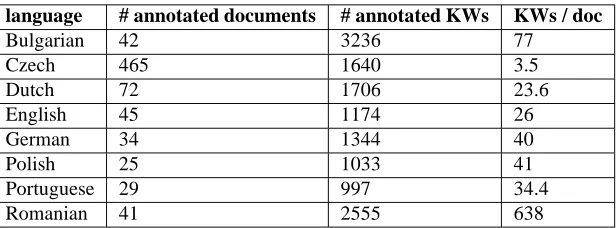
language # annotated documents # annotated KWs KWs / doc
Bulgarian 42 3236 77
Czech 465 1640 3.5
Dutch 72 1706 23.6
English 45 1174 26
German 34 1344 40
Polish 25 1033 41
Portuguese 29 997 34.4
Romanian 41 2555 638
Table 2: Percentages of keywords and keyphrases per document
These calculations take into account that for the user it is better to be presented a part of a good multi word keyword than nothing at all. For precision, though, only the exact matches count.
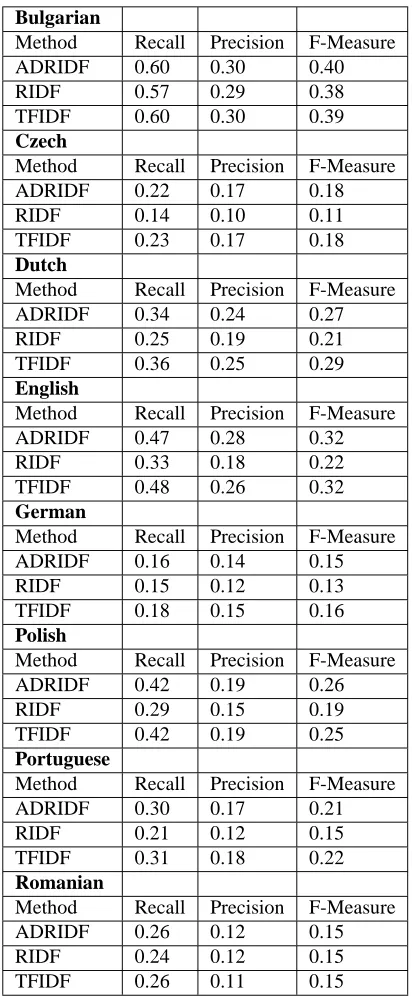
Table 3 gives an overview of the performance of the key-word extractor for the various languages.
The various statistical measures employed, that is TFIDF, ADRIDF and RIDF, were tested on the various languages and results show that, in general, TFIDF and ADRIDF nearly produced the same results. ADRIDF performs better than TFIDF only in the case of Bulgarian and Polish, in all the other cases, performance is either the same of worst. RIDF performed worst for almost all settings; therefore, the statement of Church that residual inverse document fre-quency of a term is a good indicator of its keywordiness could not be proven. Simple frequency of occurrence of a term in a document plays a much more important role. With respect to precision and recall, results varied signif-icantly across languages. If we only consider TFIDF, the best result is 60 % for recall reached for Bulgarian and the worst is 18 % for German, while with respect to precision, the best result is again obtained for Bulgarian with 25 % while the worst is obtained for Romanian with 11 %. These values are influenced by two factors: a) the quality of the human judgment when selecting the keywords; b) the qual-ity of the linguistic annotation of the corpora.
We also tested the impact of multiwords on results and we noticed that results improved for all languages if multi-word keymulti-words up to a length of 3 multi-words were included. This is at least partially due to the fact that a higher propor-tion of multi word keywords increases the number of partial matches.
As already mentioned, this test was performed only to get a rough impression of the performance of the keyword ex-tractor as well as to determine which statistical measure performed best and to determine the maximum length for multiword keywords. More generally, its major purpose lies in informing the developers by presenting those key-words which did not match with the manually annotated ones and by presenting those manually selected keywords which have not been extracted by the tool. Note that not all keyword candidates which do not match manually selected keywords are necessarily bad keywords.
In fact, we believe that there might be some variation among users in identifying keywords and it is for this rea-son that we have performed an experiment to measure inter
annotator agreement which is described in detail in the fol-lowing section.
3.2. Test 2: Inter annotator agreement
In order to assess the intrinsic difficulties of the keyword selection task and to verify the performance of the keyword extractor compared to human annotators, we have investi-gated the inter annotator agreement on at least one docu-ment for each language. More specifically, we wanted to investigate where the performance of our keyword extrac-tor stands relative to the performance of a group of human annotators.
In the test described in the previous section, we have com-pared the output of the keyword extractor the the choices of one single human annotator. We have thus relied com-pletely on the performance of this individual annotator, thus taking his choices as gold standard. The experiments which we describe in this section reveals how reliable the human judgement is and where the judgments of the keyword ex-tractor stands relative to the human judgments.
A document of a manageable size – around 10 pages – has been chosen for manual keyword selection. The content of the learning object was chosen so that it would be easy to understand for the test persons: it was a document deal-ing with Multimedia belongdeal-ing to chapter 3, part 7 of the Calimera Guidelines.4 This material is available for all the
languages under consideration.
A minimum of 12 test persons have been recruited for the experiment (with the exception of English and Czech). In the instructions, which have been written in English and have been translated into the eight languages we have tested, the annotators were asked to select not more than 15 keywords and to mark for each keyword how sure they were that this is a good keyword. A scale was given from 1 (very sure) to 3 (not so sure).
For German and Romanian, two experiments were per-formed. For German, the same text was given to two groups, a group of students who were not familiar with the topic and a group of experienced scientists. We wanted to investigate whether experienced scientists achieve a higher inter-annotator agreement than students who are not famil-iar with the topic. The Romanian group ran the experiment with two different texts to check whether characteristics of the text influence inter annotator agreement.
4
judge how adequate the selected words are as keywords for this document.
In this sections we report about the results and findings of this experiment which has been run for all languages. A document of moderate size – around 10 pages – was chosen and keywords for this diocument extracted. Six to twelve test persons per language took part in the experiment. We presented test persons with the 20 highest ranked key-words and asked them to judge their adeqacy on a scale from 1 to 4:
1 = very relevant (would be a definite searching term)
2 = quite relevant (would be a secondary searching
term)
3 = not relevant to the document
4 = not a valid term
Additionally, a value could be given in the case that the test person was not confident enough to decide. Test per-sons where also given the opportunity for adding keywords which they were missing in the list. Not all language group used this opportunity though.
The following table summarizes the average values for each language:
Table 6: Average acceptance rate for generated keywords per language
Language Average score for first 20 KW
Number of addi-tional keywords suggested
Bulgarian 2.21 21
Czech 2.22 none
Dutch 1.93 12
English 2.15 22
German 2.06 none
Polish 1.95 45
Portuguese 2.34 7
Romanian 2.14 none
From table 6 on can infer that the results are acceptable for all languages, with some room left for improvement. Second, we observed a tendency towards better scores for the first 10 keywords, in contrast to the score for the first 20 keywords and for some languages even compared to the score for the first 5 keywords. From these results we can infer that it is a good decision to present the user, in the real system, the first ten keywords, with the option to look at further keywords if they want to.
The lists of additional keywords are used by the developers and language groups as an advice to optimizing the tool. They also prove the usefulness of allowing, in the real sys-tem, users to add their own keywords in addition to those which are suggested by the system and approved by them.
Figure 2: Architecture of the Language Technology en-hanced LMS
4.
Integration into ILIAS
The keyword extractor is a functionality which has been integrated in a learning management system to support the semi-automatic metadata annotation of the learning objects. It should assist authors of learning material to find and as-sign appropriate keywords to their learning objects. In the context of the LT4eL project, the tool has been integrated in the ILIAS learning management system even though it should be possible to enhance other LMS with it.
The tools and data reside on a dedicated server and are ap-proached from inside the Learning Management System via Web Services. Figure 2 shows the major components of the integration setup. The language technology server on the left provides the keyword extractor and other NLP compo-nents (cf. (Lemnitzer et al., 2007) for more details). The functionalities can be accessed directly on the webserver for test purposes or they can be used by the learning man-agement system through the web service interface. Figure 3
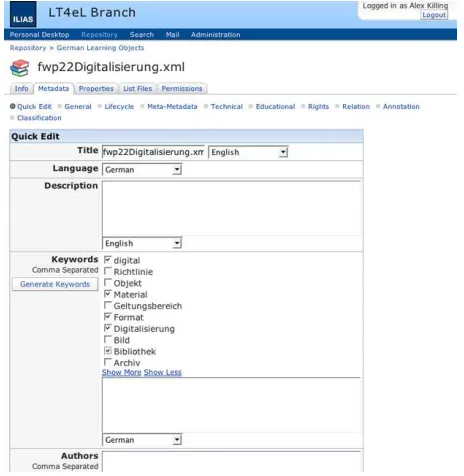
Figure 3: User interface to the Keyword Extractor
ILIAS learning management system. The function is em-bedded into the existing LOM metadata handling of ILIAS to enable a semi-automatic generation of keywords. Users can: a) run the keyword extractor and get a list showing a predefined number of keywords for a document; b) select keywords from this list and c) and add their own keywords. The interactivity is an important feature of this tool. It will not be used to completely perform the task of keywording a documents, but to make informed suggestions which the user has to approve or reject.
The best way to evaluate the tool is in the context of its use within ILIAS. Therefore, a scenario based evaluation, which will take user satisfaction into account, might be the best way to assess its performance.
5.
Conclusions and future work
One of the functionalities developed within the LT4eL project is the possibility to annotate learning objects semi-automatically with keywords that describe them, to this end a keyword extractor has been created. The approach em-ployed is based on a linguistic processing step which is fol-lowed by a filtering step and keyword ranking based on fre-quency criteria.
Three tests have been carried out to provide a rough eval-uation of the performance of the tool, to measure inter an-notator agreement in order to determine the complexity of the task and to evaluate the acceptance of the extraced key-words by users.
The results are promising also considering that the task has been carried out for 8 different languages. However, there are possible ways in which the results of the keyword ex-tractor could be improved.
Keyword candidates tend to appear in certain salient re-gions of a text. These are the headings and the first para-graphs after the headings as well as an abstract or summary. Salient terms might also be highlighted or emphasised by the author, e.g. by using italics. Investigations of the man-ually annotated keywords have shown that a word with a salient position or marked by layout features is at average twice as probable to be marked as keyword as those words which do not bear these features. Therefore, we will use layout information as additional filter in proposing salient keywords (cf. also (Sclano and Velardi, 2007)).
Currently, a user- and scenario-oriented evaluation is being performed in order to evaluate the influence the impact of the keyword extractor and its results on the learning pro-cess. The scenarios chosen are, in short: for tutors, to find relevant documents for a certains topic, probably in various languages, for an international audience. Keywords should be helpful in this task; for students: preepare a paper synop-sis for a seminar presentation. Again, the keywords should give first hints about the relevance of a learning object for this task. Of course, the most important use of the tool for authors is to facilitate the assignment of keywords to their learning objects.
As part of the our dissemination activities, we maintain a user panel. Registered users will be informed about the status and availability of our tools and data. If you want to join the panel, please inform us.
6.
References
Kenneth W. Church and W. Gale. 1995. Inverse document frequency (idf): A measure of deviations from poisson. In Proc. Third Workshop on Very Large Corpora. K. Church and W. Gale. 1995a. Poisson mixtures. Natural
Language Engineering, 1(2):163–190.
E. Frank, G. Paynter, I. Witten, C. Gutwin, and C. Nevill-Manning. 1999. Domain-specific Keyphrase Extraction. In Proceedings of the Sixteenth International Joint
Con-ference on Artificial Intelligence, pages 668–673.
Kilem Gwet. 2001. Handbook of Inter-Rater Reliability:
How to Estimate the Level of Agreement Between Two or Multiple Raters.
Debra Trusso Haley. 2007. Using a New Inter-rater
Relia-bility Statistics. Ph.D. thesis, The Open University,
Mil-ton Keynes.
A. Hulth. 2003. Improved automatic keyword extraction given more linguistic knowledge. In Proceedings of
EMNLP2003.
S. Jones and G. W. Paynter. 2006. An Evaluation of Doc-ument Keyphrase Sets. Journal of Digital Information, 4(1).
L. Lemnitzer, C. Vertan, A. Killing, K. Simov, D. Evans, D. Cristea, and P. Monachesi. 2007. Improving the search for learning objects with keywords and ontolo-gies. In Proceedings of the ECTEL 2007 conference. Springer Verlag.
R. Mihalcea and P. Tarau. 2004. TextRank: Bringing Order into Texts. In Proceedings of the Conference on
Empir-ical Methods in Natural Language Processing (EMNLP 2004), Barcelona, Spain.
Paola Monachesi, Lothar Lemnitzer, and Kiril Simov. 2006. Language Technology for eLearning. In
Proceed-ings of EC-TEL, Crete 2006. Springer.
F. Sclano and P. Velardi. 2007. TermExtractor: a Web Application to Learn the Shared Terminology of Emer-gent Web Communities. In Proc. of the 3rd International
Conference on Interoperability for Enterprise Software and Applications I-ESA 2007, Funchal, Madeira Island,
Portugali.
P. D Turney. 2000. Learning algorithms for keyphrase ex-traction. Information Retrieval, 2:303–336.
X. Wan, J. Yang, and J. Xiao. 2007. Towards an Itera-tive Reinforcement Approach for Simultaneous Docu-ment Summarization and Keyword Extraction. In
Pro-ceedings of the 45th Annual Meeting of the Association of Computational Linguistics, pages 552–559, Prague.
I.H. Witten, G. W. Paynter, E. Frank, C. Gutwin, and C. G. Nevill-Manning. 1999. KEA: Practical auto-matic keyphrase extraction. In Proceedings of Digital
Libraries 99 (DL’99), pages 254–256.
M. Yamamoto and Kenneth W. Church. 2001. Using suf-fix arrays to compute term frequency and document fre-quency for all substrings in a corpus. Computational
Linguistics, 27(1):1–30.