detection of neologism has become an important research topic in the recent years.
In this paper, we aim to begin with a corpus-driven approach in exploring the linguistic features of Chinese neologisms. We use PTT as our corpus data. As widely known, PTT is one of the largest web forums in Taiwan that contain users from various backgrounds and ages. In these years, its importance has been growing rapidly because it has been widely mentioned by most of the mainstream media in Taiwan. As Magistry (2012) suggested, “PTT should be seen as an extension of the modern society in Taiwan.” This implies that PTT has great influence not only on the society but also the novel language use in Taiwan, which motives this research to exploit PTT as data source.
Section 2 explains the pipeline framework developed for data crawling and pre-processing, and the lexicon and filter for capturing two-character neologisms in PTT. Section 3 introduces the methodological part, where the rationale of our proposed ‘diachronic n-gram model’ is introduced and classification results are shown. Section 4 provides the discussion on the evaluation task as well as explanation from linguistic perspective. A time series analysis on the extracted diachronic n-gram data is conducted for further investigation. Section 5 concludes this paper.
2. Corpus Data
2.1. PTT
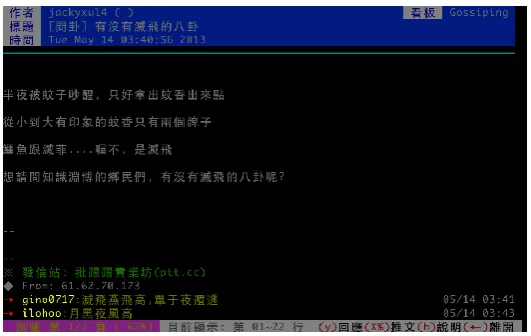
PTT (批踢踢)2, founded in 1999, is a terminal-based bulletin board system (BBS) based in
Taiwan. It is a non-profit, free and open online community, and it is claimed to be one of the
largest BBS sites in the world. PTT contains over 20,000 discussion boards with more than
1.5 million registered users, and over 10,000 articles are posted every day. The screenshot of
PTT is shown in Figure 1.
Figure 1. Screenshot of PTT
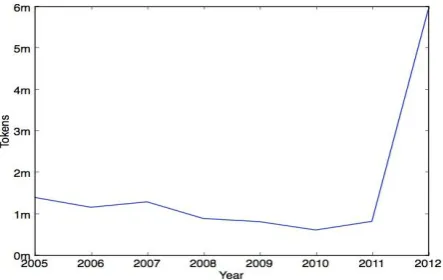
The data are collected from 2005 to 2012 from three major boards on PTT, which are Gossiping (八卦版), joke (就可版) and StupidClown (笨版). Figure 2 shows the number of tokens in the corpus per year, and Table 1 provides some basic meta-information
2
Figure 2. Number of tokens in the corpus per year from 2005 to 2012 Table 1. PTT Corpus
Boards Gossiping(八卦版), joke (就可版), StupidClown (笨版) Years 2005 – 2012
Posts 33,450 Authors 17,031
Tokens 14,285,768 Types 7,010 Bigrams 785,494
2.2. Lexicon
In this research, the lexicon was used for filtering out existed words. It is comprised of The Revised Chinese Dictionary (教育部重編國語辭典修訂本, TRCD)3 and Taiwan Spoken Mandarin Wordlist (中研院漢語口語語料庫詞頻表, TSMW)4. TRCD was compiled by Ministry of Education with 139,401 words and expressions, and TSMW was collected by
Academia Sinica with 16,683 entries. Since two-character words are dominant in modern
Chinese, as a first step, only two-character words will be chosen.
Table 2. Lexicon
TRCD TSMW
Entries 159,401 16,683
Two-character word 86,907 10,198
Two-character words in total: 89,118
2.3. Data pre-processing
We have developed a pipeline framework for the corpus-driven analysis. A crawler module
3 http://dict.revised.moe.edu.tw/ 4
collects the textual data and meta-information from the PTT; a cleaner module removes the
unnecessary information of the retrieved raw data; an n-gram module creates bigram
candidates and compares them with the lexicon; and finally a linguistic module filters out
some noisy data via encodes heuristic rules5. The resulting bigrams are thus divided into three
basic categories: words, nonwords and potential neologisms. The main steps can be listed as
follows and illustrated in Figure 3:
Step 1. Transforming all the tokens into bigrams
Step 2. Exploiting the lexicon to exclude existed words from out-of-vocabulary
(OOV)
Step 3. Linguistics rules were applied to separate OOV into nonwords and potential
neologisms
Figure 3. Data processing flowchart
3. Methodology
Most previous works on unknown word / OOV extraction exploited complicated
morphological rules and various machine learning techniques (Chen and Ma, 2002). In order
to utilize the contextual information, as much linguistic resource (such as syntax, semantics,
morphology and world knowledge) as possible were explored. It is worth mentioning that
why the (naive) n-gram model is adopted in this study.
3.1.
N
-gram in Diachronic Contexts
An n-gram is a contiguous sequence of n items from a given sequence of text. In Mandarin
Chinese, the items correspond to individual characters. The n-grams of size 2, viz. bigrams,
will be the major focus in this research. A bigram is a sequence of two adjacent elements in a
5 Linguistic rules are used to exclude bigrams with function words or affixes, such as pronouns, particles and
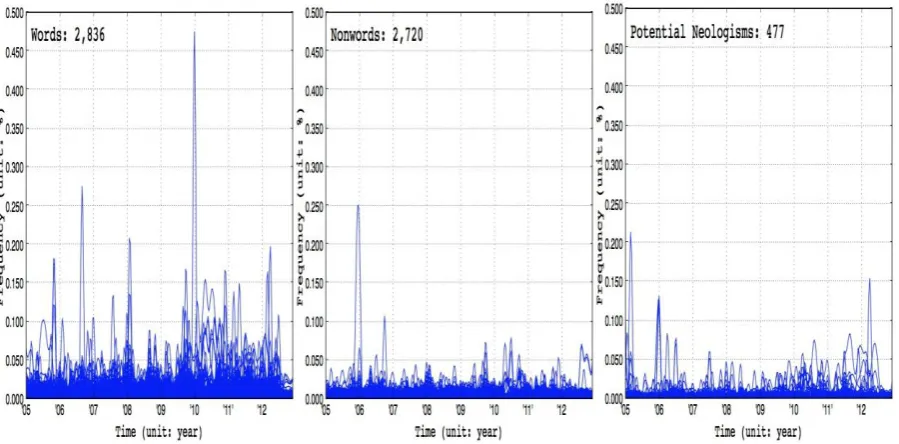
there are 2,836 bigrams in the category words.)
Generally, a first look at the data shows that the overall frequency of words is higher than
nonwords and potential neologisms, and the frequency of potential neologisms is slightly
lower than nonwords.
Figure 4. Plots of words, nonwords and potential neologisms
4. Evaluation and Discussions
4.1. Human Judgment Experiment
In order to evaluate the classification performance, the results were manually annotated, and
measured with Fleiss’ kappa (1971), a statistical measure of inter-rater reliability. The
equation is shown as the following:
𝜅 (𝐹𝑙𝑒𝑖𝑠𝑠′𝑘𝑎𝑝𝑝𝑎) =𝑃 − 𝑃𝑒
1 − 𝑃𝑒
The score of Fleiss’ kappa is 𝑃 − 𝑃𝑒, the degree of agreement actually achieved above chance, divided by 1 − 𝑃𝑒, the degree of agreement that is attainable above chance. It can be interpreted as expressing the extent to which the observed amount of agreement among raters
exceeds what would be expected if all raters made their ratings completely randomly.
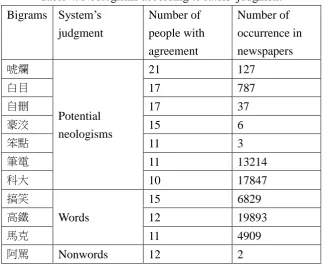
In this annotation task, 25 raters (n) were assigned 75 bigrams (N,which were selected from
each category randomly and equally) into three categories (k, i.e., words, nonwords, potential
neologisms) according to the following definitions:
(1) Words: bigrams that are stable or already exist in current language use.
(2) Nonwords: bigrams that are unstable, does not exist, or being used only by a very
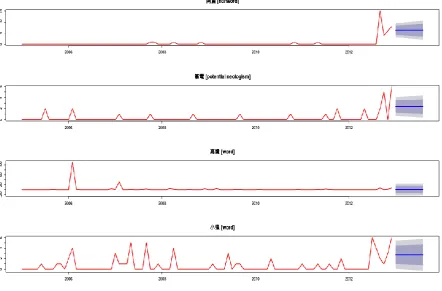
Figure 5. The time series of the frequency data
Although the overall frequency of 筆電 is low, its occurrence is relatively stable. The figure shows that it has a higher probability of being a neologism. According to this observation, we
suggest that a bigram with low frequency and high stability has a higher chance of being a
neologism.
In terms of the distribution, we can divide words into two patterns. Take小鬼 and 高鐵 for
example. The former one has peaks with high frequency during its development, which
implies that it has a higher stability of being a word. The latter one has a significant peak at the beginning, and then it starts decreasing gradually. In fact, 高鐵 (Taiwan High Speed Rail)
was a popular issue since late 2005 after the construction was formally announced by the
government, but the topic was out of focus year after year. This reflects that public issues
sometimes can dominate the occurrence of a potential neologism, and also implies that the
difficulty of detecting a potential neologisms not only due to its low frequency but also due to
some extralingusitics factors.
5. Conclusion
In this research, we have built a diachronic corpus of PTT from 2005 to 2012., neologisms are
experiment of human judgment was conducted among 25 raters. The score of the inter-rater
agreement measured by Fleiss’ kappa is 0.54, which indicates the moderate agreement. The characteristics of the neologisms and the inconsistency between the system’s judgment and the raters’ judgment are then discussed in an attempt to improve the detection of neologisms in PTT. Comparison with newly released Google book n-gram data will be conducted in the
future study, which would facilitate the prediction and deeper understanding of neologisms.
References
[1] P. Magistry, "PTT 批踢踢 as a corpus," presented at the annual meeting of the
European Association of Taiwan Studies, Sønderborg, 2012.
[2] K.-J. Chen and W.-Y. Ma, "Unknown word extraction for Chinese documents," in
Proceedings of the 19th international conference on Computational
linguistics-Volume 1, 2002, pp. 1-7.
[3] C. N. Li and S. A. Thompson, Mandarin Chinese: A functional reference grammar:
University of California Pr, 1989.
[4] P. Stenetorp, Automated extraction of swedish neologisms using a temporally
annotated corpus: Skolan för datavetenskap och kommunikation, Kungliga Tekniska
högskolan, 2010.
[5] J. Bybee, Frequency of Use and the Organization of Language: Oxford University
Press, 2007.
[6] P. Hopper, "Emergent grammar," Berkeley Linguistics Conference (BLS), vol. 13, pp.
139-157, 1987.
[7] J. L. Fleiss, "Measuring nominal scale agreement among many raters," Psychological
bulletin, vol. 76, p. 378, 1971.
[8] J. R. Landis and G. G. Koch, "The measurement of observer agreement for
categorical data," biometrics, pp. 159-174, 1977.
[9] 許斐絢, "台灣當代國語新詞探微," 臺灣師範大學華語文教學研究所學位論文,