FORM: An Extensible, Kinematically-based Gesture Annotation Scheme
Craig Martell
Linguistic Data Consortium University of Pennsylvania 3615 Market Street, Suite 200
Philadelphia, PA 19104 [email protected]
Department of Computer and Information Sciences University of Pennsylvania
200 S. 33rd St Philadelphia, PA 19104
Abstract
Annotated corpora have played a critical role in speech and natural language research; and, there is an increasing interest in corpora-based research in sign language and gesture as well. As examples, consider the tools Anvil and MediaTagger. These are excellent tools which allow for multi-track annotation of videos of speakers or signers. With tools such as these, researchers can create corpora containing, for example, grammatical information, discourse structure, facial expression, and gesture. The issue, then, is not the ability to create corpora containing gesture and speech information, but the type of information captured when describing gestures. We present a non-semantic, geometrically-based annotation scheme, FORM, which allows an annotator to capture the kinematic information in a gesture just from videos of speakers. In addition, FORM stores this gestural information in Annotation Graph format—allowing for easy integration of gesture information with other types of communication information, e.g., discourse structure, parts of speech, intonation information, etc.
1.
Annotated Corpora and Multi-Modal
Data
Annotated corpora have played a critical role in speech and natural language research; and, there is an increasing interest in corpus-based research in sign language and ges-ture as well. It was for this purpose that the FORM anno-tation scheme was developed1. This is a useful tool which
allows for multi-tier gesture annotation of videos of speak-ers or signspeak-ers. For example, Figure 1’s four stills are from a video sequence of Brian MacWhinney teaching a research methods course at Carnegie Mellon University. These data were chosen because they are part of the TalkBank collec-tion (http://www.talkbank.org).
Figure 1: Snapshots of Brian MacWhinney on January 24, 2000
The FORM annotation of the video, from timestamp 1:13.34 (1 minute 13.34 seconds) to timestamp 1:14.01 is
1
The author wishes to sincerely thank Adam Kendon for his input on the FORM project. He has provided not only suggestions as to the direction of the project, but also his unpublished work on a kinematically-based gesture annotation scheme was the FORM project’s starting point (Kendon, 2000).
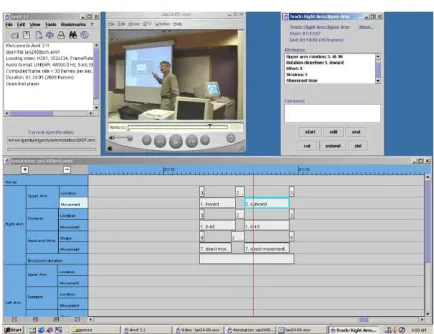
shown in Figure 2.
Figure 2: FORM annotation of Jan24.mov, using Anvil as the annotation tool
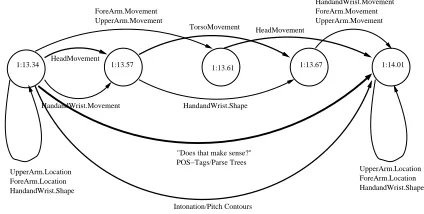
This is the view on the data that a particular tool, Anvil (Kipp, 2001), presents to the annotator. However, FORM uses annotation graphs (Bird and Liberman, 1999) as its logical representation of the data. So regardless of which annotation tool is used, FORM’s internal view is the anno-tation graph given in Figure 3.
1:13.34 1:13.57 1:13.61 1:13.67 1:14.01
with motion-capture methods, one is only able to capture conversations staged for a specific lab session. The FORM method allows a researcher to capture kinematic informa-tion from any video-recorded conversainforma-tion. This allows us to take advantage of vast amounts of already-recorded con-versational data. This aspect is invaluable if we want to study the gestures of other cultures or linguistic groups in natural, unimpeded settings. And, even when doing con-trolled experiments, the setting can be almost natural. The only addition to the natural setting would be video cameras, which are now quite small and can be easily hidden.
3.1. Structure of FORM3
FORM is designed as a series of tracks representing dif-ferent aspects of the gestural space. Generally, each in-dependently moved part of the body has two tracks, one track for Location/Shape/Orientation, and one for Move-ment. When a part of the body is held without movement, a Location object describes its position and spans the amount of time the position is held. When a part of the body is in motion, Location objects with no time period are placed at the beginning and end of the movement to show where the gesture began and ended. Location objects spanning no period of time are also used to indicate the Location infor-mation at critical points in certain complex gestures.
An object in a movement track spans the time period in which the body part in question is in motion. It is often the case that one part of the body will remain static while others move. For example, a single hand shape may be held throughout a gesture in which the upper arm moves. FORM’s multi-track system allows such disparate parts of single gestures to be recorded separately and efficiently and to be viewed easily once recorded. Once all tracks are filled with the appropriate information, it is easy to see the struc-ture of a gesstruc-ture broken down into its anatomical compo-nents.‘
At the highest level of FORM are groups. Groups can contain subgroups. Within each group or subgroup are tracks. Each track contains a list of attributes concerning a particular part of the arm or body. At the lowest level (under each attribute), all possible values are listed. The structure, then, is as follow:
Group
Subgroup
Track
ATTRIBUTE
Value
The following description will follow this structure. De-scribed are the tracks for the Location of the Right or Left UpperArm.
Right/Left Arm
Upper Arm (from the shoulder to the elbow).
3The author wishes to acknowlege Jesse
Fried-man and Paul Howard in this section. Most of what is written here is from their “Code Book” section of http://www.ldc.upenn.edu/Projects/FORM/.
Location
UPPER ARM LIFT(from side of the body)
no lift 0-45 approx. 45 45-90 approx. 90 90-135 approx. 135 135-180 approx. 180
RELATIVE ELBOW POSITION: The upper arm lift attribute defines a circle on which the elbow can lie. The relative elbow position attribute indicates where on that circle the elbow lies. Combined, these two attributes pro-vide full information about the location of the elbow and reveal total location information (in relation to the shoul-der) of the upper arm.
extremely inward inward
front
front-outward
outward (in frontal plane) behind
far behind
The next three attributes individually indicate the direc-tion in which the biceps muscle is pointed in one spatial dimension. Taken together, these three attributes reveal the orientation of the upper arm.
BICEPS: INWARD/OUTWARD
none inward outward
BICEPS: UPWARD/DOWNWARD
none upward downward
BICEPS: FORWARD/BACKWARD
none forward backward
OBSCURED: This is an binary attribute which allows the annotator to indicate if the attributes and values chosen were “guesses” necessitated by visual occlu-sion. This attribute is present in each of FORM’s tracks.
Again, we have only presented the
guarantee that these data accurately represent the phenom-ena. With a strong annotation-manager, and a very specific coding manual, a team might achieve high inter-annotator agreement scores, but still not have sufficiently captured the phenomena in question.
To deal with these issues, we plan to concomitantly do research concerning the following.
Visualization and Animation Tools which will “play
back” an annotation. This will allow the annotator to better judge how well he/she has captured the linguis-tic phenomenon in question.
New Metrics for Inner-Annotator Agreement. As
mentioned in Section 4, above, our current numbers are based on the bag-of-arcs technique. However, as the scores there indicate, often annotators agree to a large degree on structure, but differ only on exact be-ginning or ending timestamp, or on the value of an at-tribute. Unfortunately, small differences in timestamp and value are judged incorrect to the same degree as large differences. Visual feedback, as just described, will allow us to discover whether small differences in coding actually have little difference visually. If this proves to be the case, then we will need to experiment with more geometrically-based measures of similarity, e.g., distance in n-dimensional space.
Augmented Search Algorthims for Annotation Graphs. The annotation-graph community has al-ready begun research into the most efficient ways to search AG data (Bird and Buneman, 2000). But, as we add richer information, we need to extend the search capabilities to allow researchers fast access to this complex data. An example would be the need to search for all gestures similar to the one given in our example. Further, the researcher might want to then search those results for gestures which accompany cer-tain syntactic or intonational structures.
6.
Conclusion: Applications to HLT and
HCI?
The augmentation of FORM to include richer par-alinguistic information (Head/Torso Movement, Transcrip-tion/Syntactic Information, and Intonation/Pitch Informa-tion) will create a corpus that allows for research that heretofore we have been unable to do. It will facilitate ex-periments that we predict will be useful for speech recog-nition, as well as other Human-Language Technologies (HLT). As an example of similar research, consider the work of Francis Quek et al. (Quek and others, 2001). They have been able to demonstrate that gestural information is useful in helping with automatic detection of discourse transition. However, their results are limited by the amount of kinematic information they can gather with their video-capture system. Further, an augmented-FORM corpus will contain much more specific data and will allow for more fine-grained analyses than is currently feasible.
Additionally, knowing the relationships among the dif-ferent facets of human conversation will allow for more in-formed research in Human-Computer Interaction (HCI). If
one of the goals of HCI is to have better immersive-training, then it will be imperative that we understand the subtle con-nections among the paralinguistic aspects of interaction. A virtual human, for example, would be much better if it were able to understand, and act in accordance with, all of our communicative quirks
Having an extensible corpus such as we describe in this paper is a first-step that will allow many researchers, across many disciplines, to explore these and other useful ideas.
7.
References
S. Bird and P. Buneman. 2000. Towards a query language for annotation graphs. In International Conference on Language Resources and Evalua-tion., Paris. European Language Resources Association. http://citeseer.nj.nec.com/298297.html.
Steven Bird and Mark Liberman. 1999. A for-mal framework for linguistic annotation. Tech-nical Report MS-CIS-99-01, Department of Computer and Information Sciences, Univer-sity of Pennsylvania, Philadelphia, Pennsylvania. http://citeseer.nj.nec.com/article/bird99formal.html. Adam Kendon. 2000. Suggestions for a descriptive
nota-tion for manual gestures. Unpublished.
Michael Kipp. 2001. Anvil - a generic annotation tool for multimodal dialogue. In Proceedings of Eurospeech 2001, pages 1367–1370.