© 2018 IJSRCSEIT | Volume 3 | Issue 5 | ISSN : 2456-3307
Acquisition of Soil Ph, Data Logging and Crop Assistance for Smart
Farming
Bhojraj Kalaskar1, Shubham tak2, Shekhar kale3, Siddhasen R Patil4.
1Student, Department of Electronics & Telecommunication Engineering, Dr D Y Patil SOET, Pune,
Maharashtra, India
2Student, Department of Electronics & Telecommunication Engineering, Dr D Y Patil SOET, Pune,
Maharashtra, India
3Student, Department of Electronics & Telecommunication Engineering, Dr D Y Patil SOET, Pune,
Maharashtra, India
4Prof, Department of Electronics & Telecommunication Engineering, Dr D Y Patil SOET, Pune, Maharashtra,
India
ABSTRACT
Presently India is facing huge agrarian crisis which is affecting the productivity. Technological solutions based on Internet of Things (IoT) and information technologies helps to provide solutions to the few of the unpredictable challenges in agricultural sector. This work proposes the conceptual model and system design for decision support of smart farming with wireless sensor so that necessary decisions can be taken by farmers. We propose a comprehensive technique using IoT approach which will be applied to agriculture. Data acquisition via sensors, control and tasks management, and data analysis are considered in the development of model and system design. The data analysis of Wireless Sensor Network (WSN) based temperature, humidity, soil moisture on the fields are uploaded onto IoT site ThingSpeak. The IoT supports analysis and visualization of the uploaded data. IoT helps to visualize the data anywhere, anytime and by anyone. This technical assistance system will help farmers to improve the crop yield by providing information with regard to soil testing based on sensor network in agriculture.
Keywords: WSN, TDMS, Soil pH.
I.
INTRODUCTION
In recent decade’s farmers are facing many problems due to shortage of soil testing units and lack of knowledge to utilize the technology. Because of wrong weather predictions desired yield is not been obtained. Soil fertility is the measure factor to be looked for getting better yield [1]. Measure constrain in promoting balanced use of fertilizers includes inadequate soil testing facilities, wide gap in dissemination of knowledge, lack of awareness among farmers about benefits of balanced fertilization. This technical assistance system will help farmers to improve the crop yield by providing
system farmers can grow the suitable crop and can get desirable yield & profit. Our objectives are to develop and implement practical embedded decision support system for smart farming with precisely implemented sensors and sensor network. Proposed work presents a means to identify the field
parameters using wireless sensor network
communication system. The main contribution of the project is the development of data base maintenance unit and wireless sensor network
system to monitor the agriculture farm.
Technological development in wireless sensor network (WSN) made it possible to use it in monitoring and controlling field parameters. Parameters are monitored and sent to the Technical Database Monitoring Station (TDMS) using ZigBee and to the IoT site ThingSpeak using GSM modem .In this entire system two interrelated units are proposed. In the existing work they have proposed a application based Agricultural Crop Predictor and Advisor using ANN for Smartphone’s. This system uses artificial neural network to predict crop. In this system we have to give various parameters such as pH, phosphate, potassium, nitrogen, depth, temperature and rainfall as input then by using ANN it will predict the output .
II.
SURVEY ANALYSIS
management and planning, environment factorsmeasurements, and information distribution
[International Research Journal of Engineering and Technology (IRJET) e-ISSN: 2395-0056 Volume: 04 Issue: 08 | Aug -2017 www.irjet.net p-ISSN: 2395-0072 © 2017, IRJET | Impact Factor value: 5.181 | ISO 9001:2008 Certified Journal | Page 1710 Piyush K. Surkar et al. have proposed a arduino based Automatic Testing of Soil Samples Using Ion
Selective Electrodes (ISEs). In this work they have used three different sensors that are pH Sensor, Electro conductivity Sensor and Potassium ISE to measure various soil properties. They used arduino uno as control unit which converts analog information and gives suitable data to output unit consisting of LCD and printer [5]. Giritharan Ravichandran et al. have proposed a application based Agricultural Crop Predictor and Advisor using ANN for Smartphones. This system uses artificial neural network to predict crop. In this system we have to give various parameters such as pH, phosphate, potassium, nitrogen, depth, temperature and rainfall as input then by using ANN it will predict the output . Aakash G Ratkal et al. have proposed a Farmer’s Analytical Assistant system based on sliding window nonlinear regression technique to predict crop yield and price by analysing patterns in past data. For this they have analyze and collect past data of several districts of the state of Karnataka, India. In this system we have to give area, district, previous crop and sowing date as input then it will predict crop, price of crop, yield, water requirement and soil requirements as output.
III. OBJECTIVE BEHIND THIS PROJECT
Soil pH is important as one can decide the amount and type of crop.
Use of fertilizer and other additional nutrients required in the soil.
Decide the type of fertilizer and amount of fertilizer required.
Take the previous data of various type of soil content and accordingly assist for the
IV. SYSTEM ARCHITECTURE
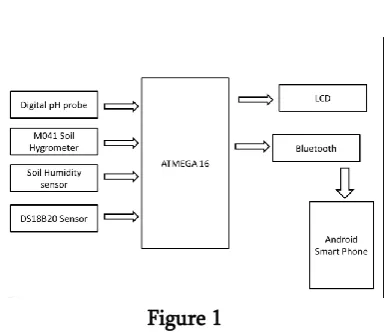
Figure 1
The main component of the power supply unit is transformer which isolate the power supply unit from the power line. The transformer steps up or steps down the input line voltage. The step down alternating current input signal converted to a pulsating direct current by using the rectifier. By using filter pulsating dc current change into a pure form of dc voltage. The final section, the regulator that maintain the output of the power supply at a constant level in spite of large changes in load current or input line voltages.
Soil moisture sensors measure the water content in soil. A soil moisture probe is made up of multiple soil moisture sensors. One common type of soil moisture sensors in commercial use is a Frequency domain sensor such as a capacitance sensor. Another sensor, the neutron moisture gauge, utilize the moderator properties of water for neutrons.
Soil moisture content may be determined via its effect on dielectric constant by measuring the capacitance between two electrodes implanted in the soil. Where soil moisture is predominantly in the form of free water (e.g., in sandy soils), the dielectric constant is directly proportional to the moisture content. The probe is normally given a frequency excitation to permit measurement of the dielectric constant. The readout from the probe is not linear with water content and is influenced by soil type and soil temperature. Therefore, careful calibration is
required and long-term stability of the calibration is questionable.
In This sensor We are using 2 Probes to be dipped into the Soil As per Moisture We will get Analoug Output variations from 0.60volts - 5volts
Input Voltage 5V DC
Advantages
• Soil pH
• Soil Moisture
• Soil Temperature
• Soil Humidity
• User can decide the type of crop
• User can decide the time-to-market for the crop and decide accordingly
• The approximate rate of crop
• Market approximation
• Fertilizers to be used
V.
ALGORITHM
1. Start
2. Put a spoon of soil into the beaker having pH sensor
3. Check for pH value 4. Decide the nature of soil 5. Decide Alkaline, Acidic or 6. Neutral
7. If Alkaline? Then Go to block “A” 8. If Acidic? Then Go to block “B” 9. Else Neutral
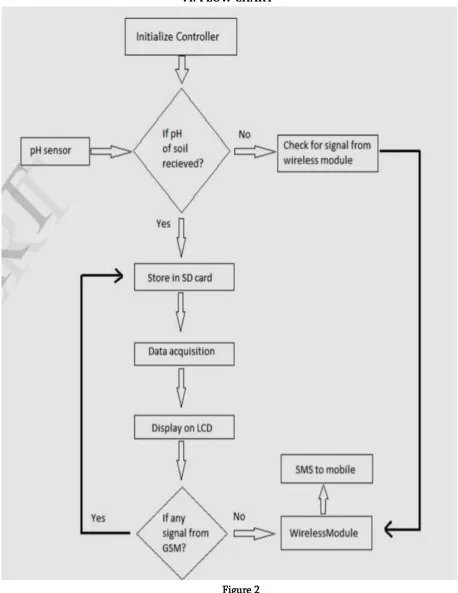
VI. FLOW CHART
Figure 3
VII.
HEART OF THE SYSTEM
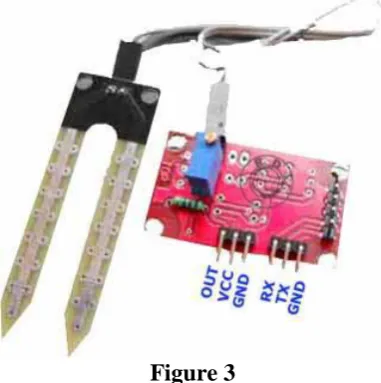
(Soil Moisture Sensor )
This sensor can be used to test the moisture of soil, when the soil is having water shortage, the module output is at high level, else the output is at low level. By using this sensor one can automatically water the flower plant, or any other plants requiring automatic watering technique. Module triple output mode, digital output is simple, analog output more accurate, serial output with exact readings.
Features
Sensitivity adjustable.
Has fixed bolt hole, convenient installation. Threshold level can be configured.
Module triple output mode, digital output is simple, analog output more accurate, serial output with exact readings.
Applications Agriculture
Landscape irrigation
VIII. FUTURE SCOPE
This project can be further extend by connected a temperature sensor. The most common cause of error in pH measurements is temperature. So temperature sensor can be incorporated in the system in order to get the exact value of the solution. The system can also be used for measuring the electrical conductivity (EC) properties of the soil by Incorporating more
implementation of a data acquisition technique .This hardware device act as inexpensive method for making a better management decisions related to the improvement of soil fertility by doing analysis on its pH value. From the base station result can be send to the farmer by using GSM module so that farmer can take correcting method to improve soil fertility.
X.
REFERENCES
[1]. R. van Hooijdonk, "Smart farming: the new agricultural benchmark - Trendwatchter en Futurist Richard van Hooijdonk," 2015.
Online]. Available:
https://en.richardvanhooijdonk.com/smart-farmingnewbenchmark/.
[2]. ThingSpeak (www.ThingSpeak.co.in)
[3]. Giritharan Ravichandran, and Koteeshwari R S, "Agricultural Crop Predictor and Advisor using ANN for Smartphones", 978-1-4673-6725-7/16/$31.00 ©2016 IEEE.
[4]. Sinung Suakanto, Ventje J. L. Engel, Maclaurin Hutagalung and Dina Angela, "Sensor
Networks Data Acquisition and Task
Management for Decision Support of Smart Farming", 2016 International Conference on
Information Technology Systems and
Innovation (ICITSI) Bandung-Bali, October 24-27, 2016 ISBN: 978-1-5090-2449-0.
[5]. Piyush K. Surkar and A. R. Karwankar, "Automatic Testing of Soil Samples Using Ion Selective Electrodes (ISEs)", International Conference on Communication and Signal Processing, April 6-8, 2016, India.
Assistant", 2016 IEEE International Conference on Cloud Computing in Emerging Markets.
[7]. Internet of things
(http://en.wikipedia.org/wiki/Internet-of-Things)
[8]. Arturo MEDELA, Bruno CENDÓN, Lucía
GONZÁLEZ, Raúl CRESPO and Ignacio NEVARES, "IoT Multiplatform Networking to Monitor and Control Wineries and Vineyards", Future Network & MobileSummit 2013 Conference Proceedings Paul Cunningham and Miriam Cunningham (Eds) IIMC International Information Management Corporation, 2013 ISBN: 978-1-905824- 37-3.
[9]. Mohanraj I, Kirthika Ashokumar and Naren J, "Field Monitoring and Automation using IOT in Agriculture Domain", 6th International Conference On Advances In Computing & Communications, ICACC 2016, 6-8 September 2016, Cochin, India.
[10]. F. Guerrini, "The Future Of Agriculture? Smart Farming," 2015. Online]. Available: http://www.forbes.com/sites/federicoguerrini/2 015/0 2/18/thefuture-of-agriculture-smart farming/#338e9d6e337c.
[11]. FAO, "Agriculture to 2050-the challenges ahead," FAO News. Online]. Available: http://www.fao.org/news/story/en/item/36193/i code /.
[12]. "FAOSTAT," Food and Agriculture Organization of the United Nations (FAO).
Online]. Available:
http://faostat.fao.org/site/291/default.aspx. [13]. CoiNet Technology solutions LLP, LPC2148
ARTIST Instruction manual
[14]. A. McBratney, B. Whelan, T. Ancev, and J. Bouma, "Future Directions of Precision Agriculture," Precis. Agric., vol. 6, no. July 2004, pp. 7–23, 2005.
[15]. V. Lakshmi Narasimhan, Alex A. Arvind and Ken Bever, "Greenhouse Asset Management Using Wireless SensorActor Networks",
International Conference on Mobile
Ubiquitous Computing, Systems, Services and Technologies 2007.
[16]. Muhamad Azman Miskam, Azwan bin
Nasirudin and Inzarulfaisham Abd. Rahim, "Preliminary Design on the Development of Wireless Sensor Network for Paddy Rice Cropping Monitoring Application in Malaysia", European Journal of Scientific Research ISSN 1450-216X Vol.37 No.4 (2009), pp.649-657 © EuroJournals Publishing, Inc. 2009.
BIOGRAPHIES :
Student,E&TC,Dr.D.Y.Patil School of Engineering & Technology, Lohegaon, Pune-412105, India.
Student, E&TC, Dr.D.Y.Patil School of Engineering & Technology, Lohegaon, Pune-412105, India.
Student, E&TC, Dr.D.Y.Patil School of Engineering & Technology, Lohegaon, Pune-412105, India.
Professor, E&TC, Dr. D. Y. Patil School
of Engineering & Technology,