Proceedings of the 2019 Conference on Empirical Methods in Natural Language Processing
4925
Connecting the Dots: Document-level Neural Relation Extraction
with Edge-oriented Graphs
Fenia Christopoulou1, Makoto Miwa2,3, Sophia Ananiadou1
1National Centre for Text Mining,
School of Computer Science, The University of Manchester, United Kingdom
2Toyota Technological Institute, Nagoya, 468-8511, Japan 3Artificial Intelligence Research Center (AIRC),
National Institute of Advanced Industrial Science and Technology (AIST), Japan {efstathia.christopoulou, sophia.ananiadou}@manchester.ac.uk
Abstract
Document-level relation extraction is a com-plex human process that requires logical infer-ence to extract relationships between named entities in text. Existing approaches use graph-based neural models with words as nodes and edges as relations between them, to encode relations across sentences. These models are node-based, i.e., they form pair representa-tions based solely on the two target node rep-resentations. However, entity relations can be better expressed through unique edge repre-sentations formed as paths between nodes. We thus propose an edge-oriented graph neural model for document-level relation extraction. The model utilises different types of nodes and edges to create a document-level graph. An inference mechanism on the graph edges en-ables to learn intra- and inter-sentence rela-tions using multi-instance learning internally. Experiments on two document-level biomed-ical datasets for chembiomed-ical-disease and gene-disease associations show the usefulness of the proposed edge-oriented approach.1
1 Introduction
The extraction of relations between named enti-ties in text, known as Relation Extraction (RE), is an important task of Natural Language Processing (NLP). Lately, RE has attracted a lot of attention from the field, in an effort to improve the inference capability of current methods (Zeng et al., 2017; Christopoulou et al.,2018;Luan et al.,2019).
In real-world scenarios, a large amount of rela-tions are expressed across sentences. The task of identifying these relations is named inter-sentence RE. Typically, inter-sentence relations occur in
1Source code available at https://github.com/
fenchri/edge-oriented-graph
The case of a 40 - year - old patient who underwent an unsuccessful
Bilateral optic neuropathydue to combined and treatment .
ethambutolandisoniazid
is reported . A with an unusual central
was found . cadaver kidney transplantation and was treated with
scotoma
isoniazid ethambutol
bilateral retrobulbar neuropathy
bitemporal hemianopic
Figure 1: Example of document-level, inter-sentence relations adapted from the CDR dataset (Li et al., 2016a). The solid and dotted lines represent intra- and inter-sentence relations, respectively.
textual snippets with several sentences, such as documents. In these snippets, each entity is usu-ally repeated with the same phrases or aliases, the occurrences of which are often named entity men-tions and regarded as instances of the entity. The multiple mentions of the target entities in differ-ent sdiffer-entences can be useful for the iddiffer-entification of inter-sentential relations, as these relations may depend on the interactions of their mentions with other entities in the same document.
As shown in the example of Figure 1, the en-tities bilateral optic neuropathy, ethambutol and
isoniazidhave two mentions each, while the entity
scotomahas one mention. The relation between the chemicalethambutoland the diseasescotoma
is clearly inter-sentential. Their association can only be determined if we consider the interactions between the mentions of these entities in different sentences. A mention ofbilateral optic neuropa-thyinteracts with a mention of ethambutolin the first sentence. Another mention of the former in-teracts with the mention of scotoma in the third sentence. This chain of interactions can help us infer that the entityethambutolhas a relation with the entityscotoma.
used to deal with multiple mentions of named en-tities is Multi-Instance Learning (MIL). Initially, MIL was introduced by Riedel et al. (2010) in order to reduce noise in distantly supervised cor-pora (Mintz et al.,2009). In DS, training instances are created from large, raw corpora using Knowl-edge Base (KB) entity linking and automatic an-notation with heuristic rules. MIL in this setting considers multiple sentences (bags) that contain a pair of entities serving as the multiple instances of this pair. Verga et al. (2018) introduced an-other MIL setting for relation extraction between named entities in a document. In this setting, en-tities mapped to the same KB ID are considered as mentions of an entity concept and pairs of men-tions correspond to the pair’s multiple instances. However, document-level RE is not common in the general domain, as the entity types of interest can often be found in the same sentence (Banko et al., 2007). On the contrary, in the biomedical domain, document-level relations are particularly important given the numerous aliases that biomed-ical entities can have (Quirk and Poon,2017).
To deal with document-level RE, recent ap-proaches assume that only two mentions of the tar-get entities reside in the document (Nguyen and Verspoor,2018;Verga et al.,2018) or utilise dif-ferent models for intra- and inter-sentence RE (Gu et al.,2016;Li et al.,2016b;Gu et al.,2017). In contrast with approaches that employ sequential models (Nguyen and Verspoor, 2018; Gu et al., 2017;Zhou et al., 2016), graph-based neural ap-proaches have proven useful in encoding long-distance, inter-sentential information (Peng et al., 2017;Quirk and Poon,2017;Gupta et al.,2019). These models interpret words as nodes and con-nections between them as edges. They typically perform on the nodes by updating the represen-tations during training. However, a relation be-tween two entities depends on different contexts. It could thus be better expressed with an edge con-nection that is unique for the pair. A straightfor-ward way to address this is to create graph-based models that rely on edge representations rather fo-cusing on node representations, which are shared between multiple entity pairs.
In this work, we tackle document-level, intra-and inter-sentence RE using MIL with a graph-based neural model. Our objective is to infer the relation between two entities by exploiting other interactions in the document. We construct a
doc-ument graph with heterogeneous types of nodes and edges to better capture different dependencies between nodes. In the proposed graph, a node cor-responds to either entities, mentions, or sentences, instead of words. We connect distinct nodes based on simple heuristic rules and generate different edge representations for the connected nodes. To achieve our objective, we design the model to be edge-oriented in a sense that it learns edge repre-sentations (between the graph nodes) rather than node representations. An iterative algorithm over the graph edges is used to model dependencies be-tween the nodes in the form of edge representa-tions. The intra- and inter-sentence entity relations are predicted by employing these edges. Our con-tributions can be summarised as follows:
• We propose a novel edge-oriented graph neural model for document-level relation extraction. The model deviates from existing graph mod-els as it focuses on constructing unique nodes and edges, encoding information into edge rep-resentations rather than node reprep-resentations. • The proposed model is independent of
syn-tactic dependency tools and can achieve state-of-the-art performance on a manually anno-tated, document-level chemical-disease interac-tion dataset.
• Analysis of the model components indicates that the document-level graph can effectively encode document-level dependencies. Addi-tionally, we show that inter-sentence associa-tions can be beneficial for the detection of intra-sentence relations.
2 Proposed Model
We build our model as a significant exten-sion of our previously proposed sentence-level model (Christopoulou et al.,2018) for document-level RE. The most critical difference between the two models is the introduction and construc-tion of a partially-connected document graph, in-stead of a fully-connected sentence-level graph. Additionally, the document graph consists of het-erogeneous types of nodes and edges in compar-ison with the sentence-level graph that contains only entity-nodes and single edge types among them. Furthermore, the proposed approach utilises multi-instance learning when mention-level anno-tations are available.
BiLSTM Classifier
Bilateral optic neuropathy due
ethambutol and isoniazid
treatment
N iterations
Document sentences Sentence Encoding Layer Graph Construction Inference Layer
[...]
isoniazid
The case of [...] and is reported
ethambutol
bilateral retrobulbar neuropathy
A
scotoma was found with [...]
... ...
...
... ...
...
BiLSTM BiLSTM
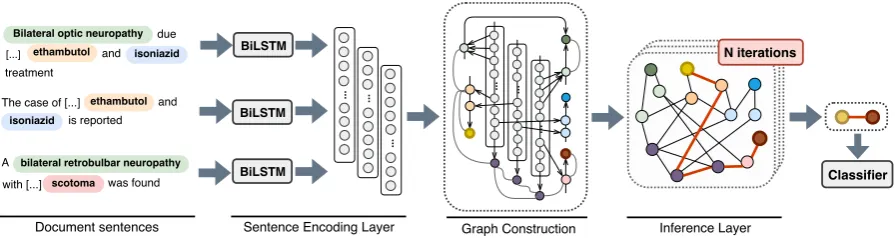
Figure 2: Abstract architecture of the proposed approach. The model receives a document and encodes each sentence separately. A document-level graph is constructed and fed into an iterative algorithm to generate edge representations between the target entity nodes. Some node connections are not shown for brevity.
construction, inference and classification layers. The model receives as input a document with iden-tified concept-level entities and their textual men-tions. Next, a document-level graph with multiple types of nodes and edges is constructed. An in-ference algorithm is applied on the graph edges to generate concept-level pair representations. In the final layer, the edge representations between the target concept-entity nodes are classified into rela-tion categories.
For the remainder of this section, we first briefly introduce the document-level RE task setting and then explain the four layers of the proposed model.
2.1 Task Setting
In concept, document-level RE the input is con-sidered an annotated document. The annotations include concept-level entities (with assigned KB IDs), as well as multiple occurrences of each en-tity under the same phrase of alias, i.e., enen-tity men-tions. We consider the associations of mentions to concept entities given (also known as entity link-ing (Shen et al.,2014)). The objective of the task is given an annotated document, to identify all the re-lated concept-level pairs in that document. In this work, we refer to concept-level annotations as en-titiesand mention-level annotations asmentions.
2.2 Sentence Encoding Layer
First, each word in the sentences of the input doc-ument is transformed into a dense vector repre-sentation, i.e., a word embedding. The vectorised words of each sentence are then fed into a Bi-directional LSTM network (BiLSTM) (Hochre-iter and Schmidhuber,1997;Schuster and Paliwal, 1997), named the encoder. The output of the en-coder results in contextualised representations for each word of the input sentence.
2.3 Graph Layer
The contextualised word representations from the encoder are used to construct a document-level graph structure. The graph layer comprises of two sub-layers, a node construction layer and an edge construction layer. We compose the representa-tions of the graph nodes in the first sub-layer and the representations of the edges in the second.
2.3.1 Node construction
We form three distinct types of nodes in the graph: mention nodes (M)nm, entity nodes (E)ne, and
sentence nodes (S)ns. Each node representation
is computed as the average of the embeddings of different elements. Firstly, mention nodes corre-spond to different mentions of entities in the in-put document. The representation of a mention node is formed as the average of the words (w) that the mention contains. Secondly, entity nodes represent unique entity concepts. The represen-tation of an entity node is computed as the av-erage of the mention (m) representations associ-ated with the entity. Finally, sentence nodes cor-respond to sentences. A sentence node is rep-resented as the average of the word representa-tions in the sentence. In order to distinguish dif-ferent node types in the graph, we concatenate a node type (t) embedding to each node represen-tation. The final node representations are then estimated as nm = [avgwi∈m(wi);tm], ne = [avgmi∈e(mi);te],ns= [avgwi∈s(wi);ts].
2.3.2 Edge construction
entities are related, we do not directly connect en-tity nodes. Connections between nodes are based on pre-defined document-level interactions. The model objective is to generate entity-to-entity (EE) edge representations using other existing edges in the graph and consequently infer entity-to-entity relations. The different pre-defined edge types are described below.
Mention-Mention (MM): Co-occurrence of men-tions in a sentence might be a weak indication of an interaction. For this reason, we create mention-to-mention edges only if the corresponding men-tions reside in the same sentence. The edge rep-resentation between each mention pairmiandmj
is generated by concatenating the representations of the nodes, the contexts cmi,mj and a distance
embedding associated with the distance between the two mentions dmi,mj, in terms of
intermedi-ate words: xMM = [nmi;nmj;cmi,mj;dmi,mj].
Here, we generate the context representation for these pairs in order to encode local, pair-centric information. We use an argument-based attention mechanism (Wang et al.,2016), to measure the im-portance of other words in the sentence towards the mention, denotingk ∈ {1,2} as the mention arguments.
αk,i=n⊺mkwi,
ak,i=
exp (αk,i) P
j∈[1,n],j6∈mkexp (αk,j)
,
ai= (a1,i+a2,i)/2,
cm1,m2 =H
⊺a,
(1)
wherenmkis a mention node representation,wiis
a sentence word representation, ai is the attention
weight of wordifor mention pair m1, m2, H ∈
Rw×d is a sentence word representations matrix, a∈Rwis the attention weights vector for the pair andcm1,m2 is the final context representation for the mention pair.
Mention-Sentence (MS): Mention-to-sentence nodes are connected only if the mention resides in the sentence. Their initial edge representation is constructed as a concatenation of the mention and sentence nodes,xMS= [nm;ns].
Mention-Entity (ME): We connect a mention node to an entity node if the mention is associated with the entity,xME= [nm;ne].
Sentence-Sentence (SS): Motivated byQuirk and Poon (2017), we connect sentence nodes to en-code non-local information. The main differences with prior work is that our edges are unlabelled,
non-directed and span multiple sentences. To en-code the distance between sentences, we concate-nate to the sentence node representations their distance in the form of an embedding: xSS = [nsi;nsj;dsi,sj]. We connect all sentence nodes in
the graph. We considerSSdirectas direct, ordered edges (distance equal to 1) and SSindirectas indi-rect, non-ordered edges (distance>1) between S nodes, respectively. In our setting,SSdenotes the combination of SSdirectand SSindirect.
Entity-Sentence (ES): To directly model entity-to-sentence associations, we connect an entity node to a sentence node if at least one mention of the entity resides in this sentence,xES= [ne;ns].
In order to result in edge representations of equal dimensionality, we use different linear re-duction layers for different edge representations,
e(1)z =Wz xz, (2)
where e(1)z is an edge representation of length1,
Wz ∈Rdz×dcorresponds to a learned matrix and z∈[MM,MS,ME,SS,ES].
2.4 Inference Layer
We utilise an iterative algorithm to generate edges between different nodes in the graph, as well as to update existing edges. We initialise the graph only with the edges described in Section 2.3.2, mean-ing that direct entity-to-entity (EE) edges are ab-sent. We can only generate EE edge representa-tions by representing a path between their nodes. This implies that entities can be associated through an edge path of minimum length equal to32.
For this purpose, we adapt our two-step infer-ence mechanism, proposed inChristopoulou et al. (2018), to encode interactions between nodes and edges in the graph and hence model EE associa-tions.
At the first step, we aim to generate a path be-tween two nodesiandjusing intermediate nodes
k. We thus combine the representations of two consecutive edges eik and ekj, using a modified
bilinear transformation. This action generates an edge representation of double length. We combine all existing paths betweeniandjthroughk. Thei,
j, andknodes can be any of the three node types E, M, or S. Intermediate nodes without adjacent
2Length2for an intra-sentence pair (E-S-E) or length3
edges to the target nodes are ignored.
fe(l)ik,e(l)kj=σe(l)ik ⊙W e(l)kj, (3)
whereσis the sigmoid non-linear function,W ∈
Rdz×dz is a learned parameter matrix,⊙refers to
element-wise multiplication,lis the length of the edge andeik corresponds to the representation of
the edge between nodesiandk.
During the second step, we aggregate the original (short) edge representation and the new (longer) edge representation resulted from Equa-tion (3) with linear interpolaEqua-tion as follows:
e(2l)ij =βe(l)ij + (1−β) X k6=i,j
fe(l)ik,e(l)kj
, (4)
whereβ ∈ [0,1]is a scalar that controls the con-tribution of the shorter edge presentation. In gen-eralβis larger for shorter edges as we expect that the relation between two nodes is better expressed through the shortest path between them (Xu et al., 2015;Borgwardt and Kriegel,2005).
The two steps are repeated a finite number of times N. The number of iterations is correlated with the final length of the edge representations. With initial edge lengthlequal to1, the first itera-tion results in edges of length up-to2. The second iteration results in edges of length up-to4. Sim-ilarly, afterN iterations, the length of edges will be up-to2N.
2.5 Classification Layer
To classify the concept-level entity pairs of inter-est, we incorporate a softmax classifier, using the entity-to-entity edges (EE) of the document graph that correspond to the concept-level entity pairs.
y= softmax (WceEE+bc), (5)
where Wc ∈ Rr×dz and bc ∈ Rr are learned
parameters of the classification layer andr is the number of relation categories.
3 Experimental Settings
The model was developed using PyTorch (Paszke et al., 2017). We incorporated early stopping to identify the best training epoch and used Adam (Kingma and Ba, 2015) as the model op-timiser.
3.1 Data and Task Settings
We evaluated the proposed model on two datasets: CDR(BioCreative V): The Chemical-Disease Re-actions dataset was created byLi et al.(2016a) for document-level RE. It consists of1,500PubMed abstracts, which are split into three equally sized sets for training, development and testing. The dataset was manually annotated with binary inter-actions between Chemical and Disease concepts. For this dataset, we utilised PubMed pre-trained word embeddings (Chiu et al.,2016).
GDA (DisGeNet): The Gene-Disease Associa-tions dataset was introduced byWu et al.(2019), containing30,192MEDLINE abstracts, split into
29,192 articles for training and 1,000 for test-ing. The dataset was annotated with binary in-teractions between Gene and Disease concepts at the document-level, using distant supervision. As-sociations between concepts were generated by aligning the DisGeNet (Pi˜nero et al.,2016) plat-form with PubMed3abstracts. We further split the training set into a 80/20 percentage split as train-ing and development sets. For the GDA dataset, we used randomly initialized word embeddings.
3.2 Model Settings
We explore multiple settings of the proposed graph using different edges (MM, ME, MS, ES, SS) and enhancements (node type embeddings, mention-pairs context embeddings, distance em-beddings). We name our model EoG, an abbrevi-ation of Edge-oriented Graph. We briefly describe the model settings in this section.
EoG refers to our main model with edges{MM, ME, MS, ES, SS}. The EoG (Full) setting refers to a model with afully connectedgraph, where the graph nodes are all connected to each other, in-cluding E nodes. For this purpose, we introduce an additional linear layer for the EE edges as in Equation (2). The EoG (NoInf) setting refers to ano inferencemodel, where the iterative infer-ence algorithm (Section2.4) is ignored. The con-catenation of the entity node embeddings is used to represent the target pair. In this case, we also make use of an additional EE linear layer for EE edges. Finally, the EoG (Sent) setting refers to a model that was trained onsentences instead of documents. For each entity-level pair we merge the predictions of the mention-level pairs in differ-ent sdiffer-entences using a maximum assumption: if at
Method Overall (%) Intra (%) Inter (%)
P R F1 P R F1 P R F1
Gu et al.(2017) 55.7 68.1 61.3 59.7 55.0 57.2 51.9 7.0 11.7
Verga et al.(2018) 55.6 70.8 62.1 - - -
-Nguyen and Verspoor(2018) 57.0 68.6 62.3 - - -
-EoG 62.1 65.2 63.6 64.0 73.0 68.2 56.0 46.7 50.9
EoG (Full) 59.1 56.2 57.6 71.2 62.3 66.5 37.1 42.0 39.4
EoG (NoInf) 48.2 50.2 49.2 65.8 55.2 60.2 25.4 38.5 30.6
EoG (Sent) 56.9 53.5 55.2 56.9 76.4 65.2 - -
-Zhou et al.(2016) 55.6 68.4 61.3 - - -
-Peng et al.(2016) 62.1 64.2 63.1 - - -
-Li et al.(2016b) 60.8 76.4 67.7 67.3 52.4 58.9 - -
-Panyam et al.(2018) 53.2 69.7 60.3 54.7 80.6 65.1 47.8 43.8 45.7
Zheng et al.(2018) 56.2 67.9 61.5 - - -
-Table 1: Overall, intra- and inter-sentence pairs performance comparison with the state-of-the-art on the CDR test set. The methods below the double line take advantage of additional training data and/or incorporate external tools.
least one mention-level prediction indicates a re-lation then we predict the entity pair as related, similarly to Gu et al. (2017). All of the settings incorporate node type embeddings, contextual em-beddings for MM edges and distance emem-beddings for MM and SS edges, unless otherwise stated.
4 Results
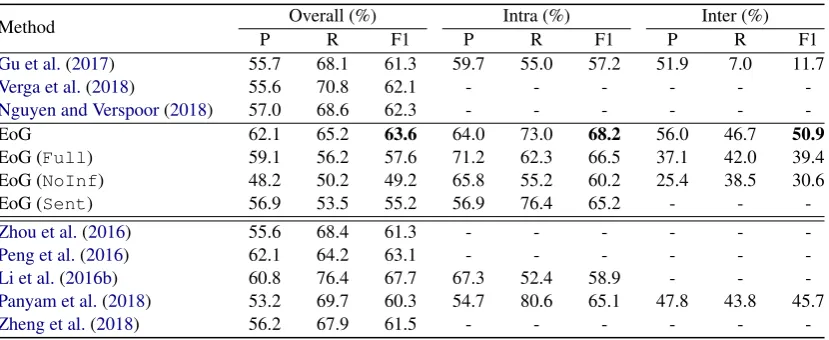
Table1 depicts the performance of our proposed model on the CDR test set, in comparison with the state-of-the-art. We directly compare our model with models that do not incorporate exter-nal knowledge. Verga et al.(2018) and Nguyen and Verspoor (2018) consider a single pair per document, whileGu et al. (2017) develops sepa-rate models for intra- and inter-sentence pairs. As it can be observed, the proposed model outper-forms the state-of-the-art in CDR dataset by 1.3
percentage points of overall performance. We also show the methods that take advantage of syntac-tic dependency tools. Li et al.(2016b) uses co-training with additional unlabeled co-training data. Our model performs significantly better on intra-and inter-sentential pairs, even compared to most of the models with external knowledge, except for Li et al.(2016b).
In addition, we report the performance of three baseline models. The EoG model outperforms all baselines for all pair types. In particular, for the inter-sentence pairs, performance significantly drops with a fully connected graph (Full) or without inference (NoInf). The former might in-dicate the existence of certain reasoning paths that should be followed in order to relate entities re-siding in different sentences. It is also important
Model Dev|Test F1 (%)
Overall Intra Inter
EoG 78.7 81.5 82.5 85.2 48.8 50.0 EoG (Full) 78.6 80.8 82.4 84.1 52.3 54.7 EoG (NoInf) 71.8 74.6 76.8 79.1 45.5 49.3 EoG (Sent) 73.8 73.8 78.1 78.8 -
-Table 2: Performance comparison on the GDA devel-opment and test sets.
to note that the intra-sentence pairs substantially benefit from the document-level information, as EoG surpasses the performance of training on sin-gle sentences (Sent) by 3%. Finally, the per-formance drop in intra-sentence pairs, as a result of the inference algorithm removal (NoInf), sug-gests that multiple entity associations exist in sen-tences (Christopoulou et al., 2018). Their inter-actions can be beneficial in cases of lack of word context information.
Embeddings F1 (%)
Overall Intra Inter EoG (PubMed) 63.62 68.25 50.94 EoG (GloVe) 63.01 67.52 50.26 EoG (random) 61.41 66.80 46.51
Table 3: Performance of EoG on the CDR test set with different pre-trained word embeddings.
2 4 8 16 32
55 60 65
F1 (%) EoG (SS)
EoG (SS direct)
(a) Overall
2 4 8 16 32
60 65 70
F1 (%) EoG (SS)
EoG (SS direct)
(b) Intra-sentential
2 4 8 16 32
Number of inference steps
0 20 40 60
F1 (%) EoG (SS)
EoG (SS direct)
(c) Inter-sentential
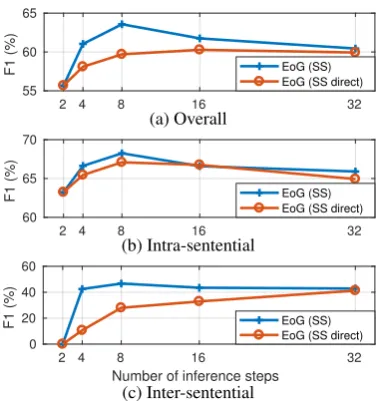
Figure 3: Performance as a function of the number of inference steps when using direct (SSdirect) or direct and indirect (SS) sentence-to-sentence edges, on the CDR development set.
5 Analysis & Discussion
We first analyse the performance of our main model (EoG) using different pre-trained word em-beddings. Table 3 shows the performance dif-ference between domain-specific (PubMed) (Chiu et al., 2016), general-domain (GloVe) (Pen-nington et al., 2014) and randomly initialized (random) word embeddings. As observed, our proposed model performs consistently with both in-domain and out-of-domain pre-trained word embeddings. The low performance of random em-beddings is due to the small size of the dataset, which results in lower quality embeddings.
For further analysis, we choose the CDR dataset as it is manually annotated. To better analyse the behaviour of our model, we conduct analysis on the effect of direct and indirect sentence-to-sentence edges as a function of the inference steps. Figures3a,3band3cillustrate the performance of both graphs for overall, intra- and inter-sentence pairs respectively.
The first observation is that usage of direct edges only, reduces the overall performance
al-Edge Types F1 (%)
Overall Intra Inter
EE 55.14 61.31 40.34
EoG 63.57 68.25 46.68
−MM 62.77 67.93 46.65
−ME 61.57 66.39 45.40
−MS 62.92 67.55 44.74
−ES 61.41 66.44 43.04
−SSindirect 59.70 67.09 28.00
−SS 57.41 65.45 1.59
−MM,ME,MS 60.46 66.07 39.56
−ES,MS,SS 56.86 64.63 0.00
Table 4: Ablation analysis for different edge and node types on the CDR development set.
most by4%, for inference step l = 8. This drop mostly affects inter-sentence pairs, where a18%
point drop is observed. In fact, ordered edges (SSdirect) need longer inference to perform better,
in comparison with additional indirect edges (SS) for which less steps are required. The superior-ity of SS edges, for all inference steps, compared to SSdirect edges on inter-sentence pairs detection,
indicates that in a narrative, some intermediate in-formation is not important. The observation that indirect edges perform slightly better than direct for intra-sentence pairs (l ≤ 16) agrees with the results of Table 1 where we showed that inter-sentence information can act as complementary evidence for intra-sentence pairs.
We additionally conduct ablation analysis on the graph edges and nodes, as shown in Table4. Usage of EE edges only results in poor perfor-mance across pairs. Removal of MM and ME edges does not significantly affect the performance as ES edges can replace their impact. Complete removal of connections to M nodes results in low inter-sentence performance. This behaviour pin-points the importance of some local dependencies in identifying cross-sentence relations.
Removal of ES edges reduces the perfor-mance of all pairs, as encoding of EE edges be-comes more difficult4. We further observe very poor identification of inter-sentence pairs without sentence-to-sentence connections. This is comple-mentary with the inability of the model to identify any inter-sentence pairs without connections to S nodes. In this scenario, we enable identification of pairs across sentences only through MM and ME edges, as shown in Figure4a. In the CDR dataset,
4Length3(E-M-M-E) for intra- and length5
(a) MM, ME edges (b) ES, SS edges
Figure 4: Relation paths with different types of edges.
Model F1 (%)
Overall Intra Inter
EoG 63.57 68.25 46.68
−node types (T) 62.31 67.50 44.80
−MM context (C) 62.88 67.67 46.59
−distances (D) 62.53 68.00 41.53
−T,C,D 63.10 68.44 43.48
Table 5: Ablation analysis of edge enhancements on the CDR development set.
78% of inter-sentential pairs have at least one ar-gument that is mentioned only once in the doc-ument. The identification of these pairs, without S nodes, requires very long inference paths5. As shown in Figure 4b, the introduction of S nodes results in a path with half the length, which we ex-pect to better represent the relation. Longer infer-ence representations are much weaker than shorter ones. This suggests that the inference mechanism has limited capability in identifying very complex associations.
We then investigate the additional enhance-ments of the graph edges in Table5. In general, intra-sentence pairs are not affected by these set-tings. However, for inter-sentence pairs, removal of node type embeddings and distance embed-dings results in a2%and5%drop in terms of F1-score. These results indicate that the interactions between different elements in a document, along with the distance between sentences and mentions, play an important role in inter-sentence pair in-ference. Removing all of these settings does not perform worse than removing one of them, which might indicate model overfitting. We plan to fur-ther investigate this as part of future work.
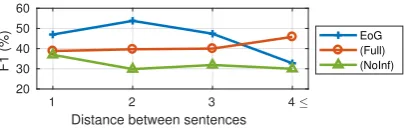
We examine the performance of different models on inter-sentence pairs, based on their sentence-level distances. Figure5 illustrates that for long-distanced pairs, EoG has lower per-formance, indicating the difficulty in predicting them and a possible requirement for other, latent document-level information (EoG (Full)).
5Minimum inference length6(E-M-M-E-M-M-E).
1 2 3 4
Distance between sentences
20 30 40 50 60
F1 (%)
EoG (Full) (NoInf)
Figure 5: Performance of inter-sentence pairs on the CDR development set as a function of their sentence distance.
Following short exposure to oral prednisone [...]. Both presented in the emergency room with profoundcoma,hypotension, severe hyper-glycemia, and acidosis.
The etiology ofpyeloureteritis cysticahas long been [...] Thediseaseoccurred subsequent to the initiation ofheparintherapy [...]
Time trends inwarfarin-associatedhemorrhage. [...] The proportion of patients with major and intracranial bleedingincreased [...]
Table 6: Inter-sentence pairs from the CDR develop-ment set that EoG fails to detect.
As final analysis, we investigate some of the cases where the graph models are unable to iden-tify inter-sentence related pairs. For this purpose, we randomly check some of the common false negative errors among the EoG models. We iden-tify three frequent cases of errors, as shown in Table 6. In the first case, when multiple enti-ties reside in the same sentence and are connected with conjunctions (e.g., ‘and’) or commas, the model often failed to find associations with all of them. The second error derives from missing co-reference connections. For instance, pyeloureteri-tis cysticais referred to asdisease. Although our model cannot directly create these edges, S nodes potentially simulate such links, by encoding the co-referring entities into the sentence representa-tion. Finally, incomplete entity linking results into additional model errors. For instance, in the third example, hemorrhage and intracranial bleeding
are synonymous terms. However, they are as-signed different KB IDs, hence treated as different entities. The model can find the intra-sentential relation but not the inter-sentential one.
6 Related Work
2016; Zhang et al., 2018). Christopoulou et al. (2018) considered intra-sentence entity interac-tions without domain dependencies by modelling long dependencies between the entities of a sen-tence.
Other approaches deal with distantly-supervised datasets but are also limited to intra-sentential relations. They utilise Piecewise Convolutional Neural Networks (PCNN) (Zeng et al., 2015), attention mechanisms (Lin et al., 2016;Zhou et al.,2018), entity descriptors (Jiang et al., 2016) and graph CNNs (Vashishth et al., 2018) to perform MIL on bags-of-sentences that contain multiple mentions of an entity pair. Re-cently, Zeng et al. (2017) proposed a method for extracting paths between entities using the target entities’ mentions in several different sentences (in possibly different documents) as intermediate connectors. They allow mention-mention edges only if these mentions belong to the same entity and consider that a single mention pair exists in a sentence. On the contrary, we not only allow interactions between all mentions in the same sentence, but also consider multiple edges between mentions, entities and sentences in a document.
Current approaches that try to deal with document-level RE are mostly graph-based.Quirk and Poon(2017) introduced the notion of a doc-ument graph, where nodes are words and edges represent intra- and inter-sentential relations be-tween the words. They connected words with dif-ferent dependency edges and trained a binary lo-gistic regression classifier. They evaluated their model on distantly supervised full-text articles from PubMed for Gene-Drug associations, re-stricting pairs within a window of consecutive sen-tences. Following this work, other approaches in-corporated graphical models for document-level RE such as graph LSTM (Peng et al.,2017), graph CNN (Song et al.,2018) or RNNs on dependency tree structures (Gupta et al., 2019). Recently, Jia et al. (2019) improved n-ary RE using informa-tion from multiple sentences and paragraphs in a document. Similar to our approach, they choose to directly classify concept-level pairs rather than multiple mention-level pairs. Although they con-sider sub-relations to model related tuples, they ig-nore interactions with other entities outside of the target tuple in the discourse units.
Non-graph-based approaches utilise different
intra- and inter-sentence models and merge the resulted predictions (Gu et al., 2016, 2017). Other approaches extract document-level repre-sentations for each candidate entity pair (Zheng et al., 2018;Li et al., 2018;Wu et al., 2019), or use syntactic dependency structures (Zhou et al., 2016;Peng et al.,2016). Verga et al. (2018) pro-posed a Transformer-based model for document-level relation extraction with multi-instance learn-ing, merging multiple mention pairs. Nguyen and Verspoor(2018) used a CNN with additional character-level embeddings. Singh and Bhatia (2019) also utilised Transformer and connected two target entities by combining them directly and via a contextual token. However, they consider a single target entity pair per document.
7 Conclusion
We presented a novel edge-oriented graph neural model for document-level relation extraction us-ing multi-instance learnus-ing. The proposed model constructs a document-level graph with heteroge-neous types of nodes and edges, modelling intra-and inter-sentence pairs simultaneously with an it-erative algorithm over the graph edges. To the best of our knowledge, this is the first approach to utilise an edge-oriented model for document-level RE.
Analysis on intra- and inter-sentence pairs indi-cated that the proposed, partially-connected, doc-ument graph structure can effectively encode de-pendencies between document elements. Addi-tionally, we deduce that document-level informa-tion can contribute to the identificainforma-tion of intra-sentence pairs leading to higher precision and F1-score.
As future work, we plan to improve the infer-ence mechanism and potentially incorporate ad-ditional information in the document-graph struc-ture. We hope that this study will inspire the com-munity to further investigate the usage of edge-oriented models on RE and other related tasks.
Acknowledgments
References
Michele Banko, Michael J Cafarella, Stephen Soder-land, Matt Broadhead, and Oren Etzioni. 2007. Open information extraction from the web. In
Proceedings of the International Joint Conference on Artifical Intelligence, pages 2670–2676. Morgan Kaufmann Publishers Inc.
Karsten M Borgwardt and Hans-Peter Kriegel. 2005. Shortest-path kernels on graphs. InProceedings of the IEEE International Conference on Data Mining, pages 74–81. IEEE Computer Society.
Billy Chiu, Gamal Crichton, Anna Korhonen, and Sampo Pyysalo. 2016. How to train good word em-beddings for biomedical nlp. InProceedings of the BioNLP workshop, pages 166–174.
Fenia Christopoulou, Makoto Miwa, and Sophia Ana-niadou. 2018. A walk-based model on entity graphs for relation extraction. InProceedings of the Annual Meeting of the Association for Computational Lin-guistics (Volume 2), pages 81–88. Association for Computational Linguistics.
Jinghang Gu, Longhua Qian, and Guodong Zhou. 2016. Chemical-induced disease relation extraction with various linguistic features. Database.
Jinghang Gu, Fuqing Sun, Longhua Qian, and Guodong Zhou. 2017. Chemical-induced disease re-lation extraction via convolutional neural network.
Database.
Pankaj Gupta, Subburam Rajaram, Hinrich Schtze, and Thomas Runkler. 2019. Neural relation extraction within and across sentence boundaries. In Proceed-ings of the AAAI Conference on Artificial Intelli-gence, volume 33, pages 6513–6520.
Sepp Hochreiter and J¨urgen Schmidhuber. 1997. Long short-term memory. Neural computation, 9(8):1735–1780.
Robin Jia, Cliff Wong, and Hoifung Poon. 2019. Document-level n-ary relation extraction with multi-scale representation learning. InProceedings of the Conference of the North American Chapter of the Association for Computational Linguistics: Human Language Technologies (Volume 1), pages 3693– 3704. Association for Computational Linguistics.
Xiaotian Jiang, Quan Wang, Peng Li, and Bin Wang. 2016. Relation extraction with instance multi-label convolutional neural networks. In Proceed-ings of the International Conference on Computa-tional Linguistics: Technical Papers, pages 1471– 1480. The COLING Organizing Committee.
Diederik P Kingma and Jimmy Ba. 2015. Adam: A method for stochastic optimization. InProceedings of the International Conference on Learning Repre-sentations.
Haodi Li, Ming Yang, Qingcai Chen, Buzhou Tang, Xiaolong Wang, and Jun Yan. 2018. Chemical-induced disease extraction via recurrent piecewise convolutional neural networks. BMC medical infor-matics and decision making, 18(2):60.
Jiao Li, Yueping Sun, Robin J Johnson, Daniela Sci-aky, Chih-Hsuan Wei, Robert Leaman, Allan Peter Davis, Carolyn J Mattingly, Thomas C Wiegers, and Zhiyong Lu. 2016a. Biocreative v cdr task corpus: a resource for chemical disease relation extraction.
Database.
Zhiheng Li, Zhihao Yang, Hongfei Lin, Jian Wang, Yingyi Gui, Yin Zhang, and Lei Wang. 2016b. CIDextractor: A chemical-induced disease relation extraction system for biomedical literature. In
IEEE International Conference on Bioinformatics and Biomedicine, pages 994–1001. IEEE.
Yankai Lin, Shiqi Shen, Zhiyuan Liu, Huanbo Luan, and Maosong Sun. 2016. Neural relation extraction with selective attention over instances. In Proceed-ings of the Annual Meeting of the Association for Computational Linguistics (Volume 1), pages 2124– 2133.
Yi Luan, Dave Wadden, Luheng He, Amy Shah, Mari Ostendorf, and Hannaneh Hajishirzi. 2019. A gen-eral framework for information extraction using dy-namic span graphs. In Proceedings of the Confer-ence of the North American Chapter of the Associ-ation for ComputAssoci-ational Linguistics: Human Lan-guage Technologies (Volume 1), pages 3036–3046. Association for Computational Linguistics.
Mike Mintz, Steven Bills, Rion Snow, and Dan Ju-rafsky. 2009. Distant supervision for relation ex-traction without labeled data. In Proceedings of the Joint Conference of the Annual Meeting of the ACL and the 4th International Joint Conference on Natural Language Processing of the AFNLP (Vol-ume 2), pages 1003–1011. Association for Compu-tational Linguistics.
Makoto Miwa and Mohit Bansal. 2016. End-to-end re-lation extraction using LSTMs on sequences and tree structures. InProceedings of the Annual Meeting of the Association for Computational Linguistics (Vol-ume 1), pages 1105–1116. Association for Compu-tational Linguistics.
Dat Quoc Nguyen and Karin Verspoor. 2018. Con-volutional neural networks for chemical-disease re-lation extraction are improved with character-based word embeddings. In Proceedings of the BioNLP workshop, pages 129–136. Association for Compu-tational Linguistics.
Nagesh C Panyam, Karin Verspoor, Trevor Cohn, and Kotagiri Ramamohanarao. 2018. Exploiting graph kernels for high performance biomedical relation ex-traction. Journal of biomedical semantics, 9(1):7.
Adam Paszke, Sam Gross, Soumith Chintala, Gre-gory Chanan, Edward Yang, Zachary DeVito, Zem-ing Lin, Alban Desmaison, Luca Antiga, and Adam Lerer. 2017. Automatic differentiation in pytorch. InNIPS-W.
Nanyun Peng, Hoifung Poon, Chris Quirk, Kristina Toutanova, and Wen-tau Yih. 2017. Cross-sentence n-ary relation extraction with graph lstms. Transac-tions of the Association for Computational Linguis-tics, 5:101–115.
Yifan Peng, Chih-Hsuan Wei, and Zhiyong Lu. 2016. Improving chemical disease relation extraction with rich features and weakly labeled data. Journal of cheminformatics, 8(1):53.
Jeffrey Pennington, Richard Socher, and Christopher D Manning. 2014. Glove: Global vectors for word representation. In Proceedings of the Empirical Methods in Natural Language Processing, pages 1532–1543. Association for Computational Linguis-tics.
Janet Pi˜nero, `Alex Bravo, N´uria Queralt-Rosinach, Alba Guti´errez-Sacrist´an, Jordi Deu-Pons, Emilio Centeno, Javier Garc´ıa-Garc´ıa, Ferran Sanz, and Laura I Furlong. 2016. Disgenet: a comprehensive platform integrating information on human disease-associated genes and variants. Nucleic acids re-search, pages D833–D839.
Chris Quirk and Hoifung Poon. 2017. Distant super-vision for relation extraction beyond the sentence boundary. InProceedings of the Conference of the European Chapter of the Association for Computa-tional Linguistics (Volume 1), pages 1171–1182. As-sociation for Computational Linguistics.
Sebastian Riedel, Limin Yao, and Andrew McCallum. 2010. Modeling relations and their mentions with-out labeled text. In Joint European Conference on Machine Learning and Knowledge Discovery in Databases, pages 148–163. Springer.
Mike Schuster and Kuldip K Paliwal. 1997. Bidirec-tional recurrent neural networks. IEEE Transactions on Signal Processing, 45(11):2673–2681.
Wei Shen, Jianyong Wang, and Jiawei Han. 2014. En-tity linking with a knowledge base: Issues, tech-niques, and solutions. IEEE Transactions on Knowl-edge and Data Engineering, 27(2):443–460.
Gaurav Singh and Parminder Bhatia. 2019. Relation extraction using explicit context conditioning. In
Proceedings of the Conference of the North Amer-ican Chapter of the Association for Computational Linguistics: Human Language Technologies, Vol-ume 1 (Long and Short Papers), pages 1442–1447. Association for Computational Linguistics.
Linfeng Song, Yue Zhang, Zhiguo Wang, and Daniel Gildea. 2018. N-ary relation extraction using graph-state lstm. In Proceedings of the Conference on Empirical Methods in Natural Language Process-ing, pages 2226–2235. Association for Computa-tional Linguistics.
Shikhar Vashishth, Rishabh Joshi, Sai Suman Prayaga, Chiranjib Bhattacharyya, and Partha Talukdar. 2018. Reside: Improving distantly-supervised neural rela-tion extracrela-tion using side informarela-tion. In Proceed-ings of the Conference on Empirical Methods in Nat-ural Language Processing, pages 1257–1266. Asso-ciation for Computational Linguistics.
Patrick Verga, Emma Strubell, and Andrew McCallum. 2018. Simultaneously self-attending to all mentions for full-abstract biological relation extraction. In
Proceedings of the Conference of the North Amer-ican Chapter of the Association for Computational Linguistics: Human Language Technologies (Vol-ume 1), pages 872–884. Association for Computa-tional Linguistics.
Linlin Wang, Zhu Cao, Gerard de Melo, and Zhiyuan Liu. 2016. Relation classification via multi-level at-tention CNNs. InProceedings of the Annual Meet-ing of the Association for Computational LMeet-inguistics (Volume 1), pages 1298–1307. Association for Com-putational Linguistics.
Ye Wu, Ruibang Luo, Henry CM Leung, Hing-Fung Ting, and Tak-Wah Lam. 2019. Renet: A deep learning approach for extracting gene-disease asso-ciations from literature. InInternational Conference on Research in Computational Molecular Biology, pages 272–284. Springer.
Yan Xu, Lili Mou, Ge Li, Yunchuan Chen, Hao Peng, and Zhi Jin. 2015. Classifying relations via long short term memory networks along shortest depen-dency paths. InProceedings of Conference on Em-pirical Methods in Natural Language Processing, pages 1785–1794. Association for Computational Linguistics.
Daojian Zeng, Kang Liu, Yubo Chen, and Jun Zhao. 2015. Distant supervision for relation extraction via piecewise convolutional neural networks. In Pro-ceedings of the Conference on Empirical Methods in Natural Language Processing, pages 1753–1762.
Daojian Zeng, Kang Liu, Siwei Lai, Guangyou Zhou, and Jun Zhao. 2014. Relation classification via con-volutional deep neural network. In Proceedings of the International Conference on Computational Linguistics: Technical Papers, pages 2335–2344. Dublin City University and Association for Compu-tational Linguistics.
Yuhao Zhang, Peng Qi, and Christopher D Manning. 2018. Graph convolution over pruned dependency trees improves relation extraction. InProceedings of the Conference on Empirical Methods in Natu-ral Language Processing, pages 2205–2215. Asso-ciation for Computational Linguistics.
Wei Zheng, Hongfei Lin, Zhiheng Li, Xiaoxia Liu, Zhengguang Li, Bo Xu, Yijia Zhang, Zhihao Yang, and Jian Wang. 2018. An effective neural model extracting document level chemical-induced disease relations from biomedical literature. Journal of biomedical informatics, 83:1–9.
Huiwei Zhou, Huijie Deng, Long Chen, Yunlong Yang, Chen Jia, and Degen Huang. 2016. Exploiting syntactic and semantics information for chemical– disease relation extraction.Database.
Peng Zhou, Jiaming Xu, Zhenyu Qi, Hongyun Bao, Zhineng Chen, and Bo Xu. 2018. Distant supervi-sion for relation extraction with hierarchical selec-tive attention.Neural Networks, 108:240–247.
A Datasets
In Tables 7-8we summarise the statistics for the CDR and GDA datasets, respectively. For all datasets, we used the GENIA Sentence Splitter6 and GENIA Tagger7 for sentence splitting and word tokenisation respectively. We additionally removed mentions in the given abstracts that were not grounded to a Knowledge Base ID (ID equal to−1).
Due to the small size of the CDR dataset, some approaches create a new split from the union of train and development sets (Verga et al., 2018; Zhou et al., 2018). We select to merge the train and development sets and re-train our model on their entire union for evaluation on the test set fol-lowing Lin et al. (2016) and Zhou et al. (2016). To compare with related work, we followedVerga et al.(2018) andGu et al.(2016) and ignored non-related pairs that correspond to general concepts (MeSH vocabulary hypernym filtering).
B Hyper-parameter Setting
We used the development set to identify the stop-ping training epoch and tune the number of infer-ence iterations. Except from these parameters, all experiments used the same hyperparameters, with a fixed initialisation seed. For the CDR dataset EoG, (Full) and (Sent) models performed best withl = 8,2,4inference steps, respectively. The
6http://www.nactem.ac.uk/y-matsu/
geniass/
7http://www.nactem.ac.uk/GENIA/tagger/
Train Dev Test
Documents 500 500 500
Positive pairs 1,038 1,012 1,066 Intra 754 766 747 Inter 284 246 319 Negative pairs 4,202 4,075 4,138 Entities
Chemical 1,467 1,507 1,434 Disease 1,965 1,864 1,988 Mentions
Chemical 5,162 5,307 5,370 Disease 4,252 4,328 4,430
Table 7: CDR (BioCreative V) dataset statistics.
Train Dev Test Documents 23,353 5,839 1,000 Positive pairs 36,079 8,762 1,502 Intra 30,905 7,558 1,305 Inter 5,174 1,204 197 Negative pairs 96,399 24,362 3,720 Entities
Gene 46,151 11,406 1,903 Disease 67,257 16,703 2,778 Mentions
Gene 205,457 51,410 8,404 Disease 226,015 56,318 9,524
Table 8: GDA (DisGeNet) dataset statistics.
chosen batchsize was equal to 2. For the GDA dataset, EoG and EoG (Full) performed best with l = 16 and EoG (Sent) with l = 8 infer-ence steps. The chosen batchsize was equal to3. For all experiments performance was measured in terms of micro precision (P), recall (R) and F1-score (F1). We list the hyper-parameters used to train the proposed model in Table9.
Parameter Value
Batch size [2,3]
Learning rate 0.002
Gradient clipping 10
Early stop patience 10
Regularization 10−4
Dropout word embedding layer 0.5 Dropout classification layer 0.3
Word dimension 200
Node type dimension 10
Distance dimension 10
Edge dimension 100
β 0.8
Optimizer Adam
Inference iterations [0,5]