Automatic evaluation of surface coherence
in L2 texts in Czech
Kateřina Rysová, Magdaléna Rysová, Jiří Mírovský
Charles University in Prague, Czech Republic
Faculty of Mathematics and Physics
Institute of Formal and Applied Linguistics
{rysova|magdalena.rysova|mirovsky}@ufal.mff.cuni.cz
Abstract
We introduce possibilities of automatic evaluation of surface text coherence (cohesion) in texts written by learners of Czech during certified exams for non-native speakers. On the basis of a corpus analysis, we focus on finding and describing relevant distinctive features for automatic detection of A1–C1 levels (established by CEFR – the Common European Framework of Reference for Languages) in terms of surface text coherence. The CEFR levels are evaluated by human assessors and we try to reach this assessment automatically by using several discourse features like frequency and diversity of discourse connectives, density of discourse relations etc. We present experiments with various features using two machine learning algorithms. Our results of automatic evaluation of CEFR coherence/cohesion marks (compared to human assessment) achieved 73.2% success rate for the detection of A1–C1 levels and 74.9% for the detection of A2–B2 levels.
1
Introduction
Our research is carried out on texts written during the international language examinations
provided by the Test Centre of the Institute of Language and Preparatory Studies at the
Charles University in Prague in line with the high ALTE (Association of Language Testers
The 2016 Conference on Computational Linguistics and Speech Processing ROCLING 2016, pp. 214-228
in Europe) standards. Such type of examination is required by Czech universities (the
needed CEFR level is usually B2) or often also by employers and the exam is compulsory
for foreigners to be granted permanent residence in the Czech Republic (the required CEFR
level is A1) or state citizenship (the required CEFR level is B1).1 Therefore, it is of great
importance to assess these examinations as objectively as possible and according to uniform
criteria.
This is rather difficult because the writing samples are evaluated manually by human
assessors (although according to the uniform rating grid) who naturally bring to the
evalu-ation a subjective human factor. In the present paper, we aim at finding several objective
criteria (concerning surface text coherence) for distinguishing the individual CEFR levels
automatically. Specifically, we carry out a research on surface text coherence concerning
various discourse phenomena (like the use and frequency of connectives etc.) and we test
the possibility of their automatic monitoring and evaluating. The results of our research will
become a part of a software application that will serve as a tool for objective assessment
of surface text coherence, i.e. for automatic division of submitted writing samples into the
suitable CEFR levels in the coherence/cohesion category.
2
Previous Research
There are many studies and projects dealing with automatic evaluation of various language
phenomena especially for English. Many of them focus on grammatical aspects of language
(e.g. on automatic evaluation of grammatical accuracy, detection of grammatical errors etc.
– see [1]; [2] or [3]). On the other hand, only few of them aim at automatic evaluation of
text coherence.
Text coherence may be viewed as local (in smaller text segments covering e.g. discourse
relations between sentences within a paragraph) or global (coherence concerning larger text
segments like correlation between a title and content etc.). Automatic evaluation of local
1Common European Framework of Reference for Languages (CEFR, the document of the Council of
Eu-rope) divides language learners into three broad categories (A: Basic user, B: Independent user, C: Proficient
coherence is a topic investigated e.g. by Miltsakaki and Kukich [4] analyzing student’s essays
or Lapata and Barzilay [5] focusing on machine-generated texts. Higgins et al. [6] examine
possibilities of automatic assessment of both local and global coherence at once carried out
on student’s writing samples.
A specific topic of automatic evaluation of language is an analysis and assessment of
L2 texts, i.e. (both written and spoken) texts by non-native speakers. Again there are
many studies focusing especially on English (or languages like German or Dutch) as L2 and
examining various aspects of language like automatic assessment of non-native prosody [7],
automatic classification of article errors [8] or automatic detection of frequent pronunciation
errors [9].
Whereas there is a number of studies focusing on automatic evaluation of texts written by
non-native speakers for different languages, there is no similar research for Czech as L2/FL so
far. Therefore, we open this topic for Czech by introducing automatic evaluation of surface
text coherence, which has a clear potential for practical usage.
3
Text Coherence
There are many approaches to text coherence as well as capturing and monitoring coherence
relations in large corpora, such as Rhetorical Structure Theory (RST, [10]), Segmented
Discourse Representation Theory (SDRT, [11]) and the project Penn Discourse Treebank
(PDTB, [12]). The PDTB approach inspired also the annotation of discourse in the Prague
Dependency Treebank for Czech (PDT, [13]) – the only corpus of Czech marking relations
of text coherence relations.
In this paper, we use the PDT way of capturing coherence relations. We focus on the
aspects of surface coherence (cohesion), i.e. on the surface realization of coherence relations
that may be processed automatically (like signalization of discourse relations by discourse
connectives, distribution of inter- and intra-sentential discourse relations, distribution of
4
Language Material: Corpus MERLIN
For our analysis, we use the language data of the corpus MERLIN [14]2 containing altogether
2,286 writing samples by non-native speakers (learners) of Czech, German and Italian.
German and Italian texts of the corpus were collected by TELC (The European Language
Certificates) and Czech texts were provided by the Test Centre of the Institute of Language
and Preparatory Studies at the Charles University in Prague. Both institutions (as full
members of The Association of Language Testers in Europe (ALTE)) offer internationally
recognized language exams in accordance with the high ALTE standards.
All texts forming the corpus MERLIN were created as out-puts of standardized tasks
aligned to the Common European Framework of Reference for Languages (CEFR) – it means
that all writing samples are evaluated across the CEFR levels, in the MERLIN case as A1–
C1.3
The evaluation reflects both an overall level (general linguistic range) and the individual
rating criteria including vocabulary range, vocabulary control, grammatical accuracy, surface
coherence (cohesion), sociolinguistic appropriateness and orthography.
MERLIN uses two rating instruments: an assessor-oriented version of the holistic scale (see
Alderson [15]) for the general linguistic range and an analytical rating grid closely related to
CEFR rating table4 used in the process of scaling the CEFR descriptors, see [16] and [17].
4.1 Sample of Learners’ Texts
Example 1 demonstrates a Czech writing sample from the corpus MERLIN (the overall
CEFR rating of this text is A2, i.e. basic user – elementary level):
(1) Čau Martine,
Chci Tě zaprvé poděkovat že si mě pozval. Já ještě potřebuju ale vědet kdy to začíná?
Abychom jsem mohl vědět kdy musím z domova odejít. Kdo ještě příjde, budou tam
Tomáš a Lukáš, jestli ano, tak fajn. Budou tam tvoje rodiče, Radek chtěl vědět.
2 http://merlin-platform.eu/index.php
3 Corpus MERLIN does not contain C2 texts at the moment.
4 Common European Framework of Reference for Languages: Learning, Teaching, Assessment (Council
Uvidím tě poždeji
David
Literal translation into English:5
Hello Martin,
First, I want to thank you that you have invited me. But I need to know when it begins?
In order to know when I must leave my home. Who will come – Tomáš and Lukáš as
well? If yes, it is fine. Your parents will be there? Radek wanted to know.
See you later
David
The writing sample in Example 1 is provided with the MERLIN evaluation criteria presented
in Table 1, i.e. with the assessments by the trained human evaluators.
Table 1: Evaluating table for the MERLIN writing sample in Example 1
Overall CEFR rating A2
Grammatical accuracy A2
Orthography B1
Vocabulary range A2
Vocabulary control A2
Coherence/Cohesion A2
Sociolinguistic appropriateness A1
4.2
Levels of Coherence in MERLIN
The writing sample in Example 1 was assigned A2 level for Coherence/Cohesion. Corpus
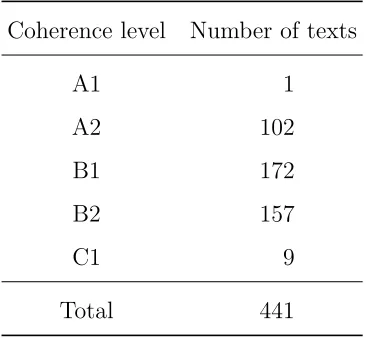
MERLIN contains altogether 441 writing samples in Czech across the A1–C1 levels. Their
distribution concerning Coherence/Cohesion is captured in Table 2.
5 The original Czech text contains some errors in morphology and spelling that are not represented in
Table 2: Distribution of Czech writing samples across CEFR levels of coherence in corpus
MERLIN
Coherence level Number of texts
A1 1
A2 102
B1 172
B2 157
C1 9
Total 441
5
The Experiment
Our goal was to experimentally verify whether and to what extent the human annotation
of the Coherence/Cohesion CEFR mark can be simulated by automatic methods. We tried
to find possible distinctive criteria/features for automatic detection of the individual CEFR
levels in this category.
5.1
Processing the Data
The first step was to parse the data (441 texts) from the raw text up to the deep
syntactico-semantic (tectogrammatical) layer in the annotation framework of the Prague Dependency
Treebank (PDT)6 following the theoretical framework of the Functional Generative
Descrip-tion, see Sgall [18, 19]. To parse the data, we used the current version of Treex, a modular
system for natural language processing [20], with a pre-defined scenario for Czech text
ana-lysis, which includes tokenization, sentence segmentation, morphological tagging,7 surface
6 The Prague Dependency Treebank [13] is a corpus of Czech newspaper texts (containing almost 50
thousand sentences) with a multi-layer annotation: morphological, surface syntactic and deep
semantico-syntactic. On top of the dependency trees of the tectogrammatical layer, the PDT contains also manual
annotation of discourse relations including annotation of discourse connectives.
7 with recognition of unknown words (by heuristic guessing), which is very helpful for L2 texts with high
syntactic parsing and deep syntactic parsing.
On top of the automatically parsed dependency trees of the tectogrammatical layer, we
automatically annotated explicit discourse relations (i.e. relations expressed by discourse
connectives). As a theoretical background for capturing discourse relations in text, we
employed the approach described in Poláková et al. [21] and used first in the annotation
of the Prague Discourse Treebank 1.0 (PDiT; [22]) and later in the Prague Dependency
Treebank 3.0 [13]. It is an approach similar to (and based on) the approach used for the
annotation of the Penn Discourse Treebank 2.0 (PDTB; [12]). Both these approaches are
lexically based and aim at capturing local discourse relations (between clauses, sentences, or
short spans of texts), which is in accordance with our project and aims.8
For automatic annotation of intra-sentential discourse relations, we used a slightly modified
algorithm originally designed by Jínová et al. [23] for a pre-annotation of intra-sentential
discourse relations in the Prague Dependency Treebank. For automatic annotation of
inter-sentential discourse relations, we devised and implemented an algorithm based on combining
features from the automatically parsed deep-syntax dependency trees and lists of common
Czech inter-sentential connectives and their most frequent discourse types (senses) extracted
from the PDT using the query engine PML-Tree Query [24].
5.2
Features and Methods
To select features for automatic assessment of Coherence/Cohesion text levels, we first carried
out a linguistic analysis of a couple of sample texts. Then we extracted (values of) these
features from the automatically parsed texts. We established a relatively simple baseline
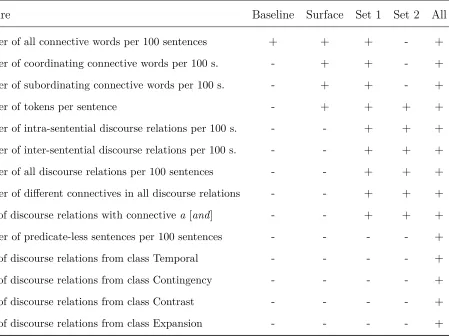
and experimented with several other sets of features, as described below and summarized in
Table 3.
The Baseline consists of a single feature that uses a list of 45 most frequent discourse
connectives first extracted from the discourse annotation in the PDT 3.0 and complemented
by a few informal variants that are likely to appear in texts written by non-native speakers
8 If we aimed at evaluating the global coherence of texts, other theories would be more appropriate,
such as the Rhetorical Structure Theory (RST; [10]), which tries to represent a document as a single tree
(e.g. teda as an informal variant of tedy [so, therefore]). The feature counts number of
occurrences of these connective words in the tested text, without trying to distinguish their
connective and non-connective usages, and normalizes the count to 100 sentences. The
Baseline is thus as follows:
• number of all connective words per 100 sentences
Another set of features – called Surface features – consists of features that only use
tokeniza-tion and sentence segmentatokeniza-tion. They do not use any advanced part of the text analysis
such as syntactic parsing and discourse parsing. These features include also the baseline
feature and all together are:
• number of all connective words per 100 sentences
• number of coordinating connective words per 100 sentences
• number of subordinating connective words per 100 sentences
• number of tokens per sentence
Other features extract information from the automatically parsed tree structures and from
automatically annotated discourse relations. Together with the surface features they form a
feature set called All features. Here is a list of the additional features:
• number of intra-sentential discourse relations per 100 sentences
• number of inter-sentential discourse relations per 100 sentences
• number of all discourse relations per 100 sentences
• number of different connectives in all discourse relations
• ratio of discourse relations with connective a [and]
• number of predicate-less sentences per 100 sentences
• ratio of discourse relations from class Temporal
• ratio of discourse relations from class Contingency
• ratio of discourse relations from class Contrast
• ratio of discourse relations from class Expansion
These three sets of features (Baseline, Surface, All) were predefined before the experiments
Table 3: Various sets of features used in the experiments.
Feature Baseline Surface Set 1 Set 2 All
number of all connective words per 100 sentences + + + - +
number of coordinating connective words per 100 s. - + + - +
number of subordinating connective words per 100 s. - + + - +
number of tokens per sentence - + + + +
number of intra-sentential discourse relations per 100 s. - - + + +
number of inter-sentential discourse relations per 100 s. - - + + +
number of all discourse relations per 100 sentences - - + + +
number of different connectives in all discourse relations - - + + +
ratio of discourse relations with connective a [and] - - + + +
number of predicate-less sentences per 100 sentences - - - - +
ratio of discourse relations from class Temporal - - - - +
ratio of discourse relations from class Contingency - - - - +
ratio of discourse relations from class Contrast - - - - +
ratio of discourse relations from class Expansion - - - - +
and Set 2 in Table 3), trying to find the best sets of features for the learning algorithms.
As for selection of these features as well as for testing the algorithms with these features we
used the 10-fold cross validation on all the data, results on these two sets may be slightly
biased.
We used two machine learning algorithms – Random Forest and Multilayer Perceptron,9
namely their implementation in the Waikato Environment for Knowledge Analysis – Weka
toolkit [25].10
We trained and tested the algorithms with 10-fold cross validation on all the available
data from the MERLIN corpus (441 instances), using the sets of features defined in Table 3.
9 These two algorithms provided the best results among several other algorithms that we tried in the
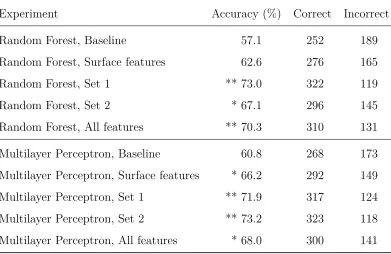
Table 4: Results of the experiments – accuracy, number of correctly classified instances and
number of incorrectly classified instances. Statistically significant improvements over the
respective baselines (tested with paired t-test) are marked with * for significance level 0.1
and ** for significance level 0.05.
Experiment Accuracy (%) Correct Incorrect
Random Forest, Baseline 57.1 252 189
Random Forest, Surface features 62.6 276 165
Random Forest, Set 1 ** 73.0 322 119
Random Forest, Set 2 * 67.1 296 145
Random Forest, All features ** 70.3 310 131
Multilayer Perceptron, Baseline 60.8 268 173
Multilayer Perceptron, Surface features * 66.2 292 149
Multilayer Perceptron, Set 1 ** 71.9 317 124
Multilayer Perceptron, Set 2 ** 73.2 323 118
Multilayer Perceptron, All features * 68.0 300 141
As the data are relatively small, we chose the 10-fold cross validation instead of setting aside
an evaluation test data, which in this case would be too small.
5.3
Results and Evaluation
Table 4 gives an overview of the performance of the two algorithms run with different
fea-ture sets.11 The table gives the accuracy, i.e. the percentage of correctly classified instances,
and also the absolute numbers of correctly and incorrectly classified instances. Statistically
significant improvements over the baselines are marked with * for significance level 0.1 and
** for significance level 0.05.
11 Please note again that feature sets Baseline, Surface and All were set beforehand, thus the results of
the algorithms using these feature sets may be considered more reliable than for feature sets Set 1 and Set 2,
which were defined by subsequent experimenting with the two algorithms in an attempt to find the best set
Table 5: Confusion matrix for Random Forest with Set 1 (classes in the rows classified as
classes in the columns).
A1 A2 B1 B2 C1
A1 0 1 0 0 0
A2 0 56 36 10 0
B1 0 25 123 24 0
B2 0 2 12 143 0
C1 0 0 0 9 0
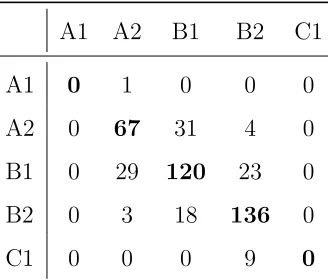
Table 6: Confusion matrix for Multilayer Perceptron with Set 2 (classes in the rows classified
as classes in the columns).
A1 A2 B1 B2 C1
A1 0 1 0 0 0
A2 0 67 31 4 0
B1 0 29 120 23 0
B2 0 3 18 136 0
C1 0 0 0 9 0
The confusion matrix for the Random Forest algorithm run with features from Set 1 is
given in Table 5. The confusion matrix for the Multilayer Perceptron algorithm run with
features from Set 2 is given in Table 6. We can count from the tables that if we allow for
“one level” error in the classification (i.e. for example if we consider classification A2 instead
of B1 still correct), the accuracy of the algorithms is 97.3% and 98.4%.
The tables also demonstrate that the algorithms have never classified levels A1 and C1
correctly. The reason is that these levels are represented by very small numbers of texts
in the corpus (1 writing sample of A1 and 9 of C1) and therefore they do not provide a
sufficient language material for training. If the texts of A1 and C1 levels are excluded from
results: Random Forest reaches 74.7% over Set 1 and Multilayer Perceptron 74.9% over Set 2.
In this case, if we allow for “one level” error, the results are 97.2% for Random Forest and
98.4% for Multilayer Perceptron.
Linguistically, the experiments demonstrate that the most relevant features of surface
coherence the (human or automatic) assessors should take into account are especially the
following: frequency of connective words (expressing inter- or intra-sentential discourse
rela-tions such asand, but, because,although etc.); richness or variety of connective words (there
is a difference between texts using almost exclusively the conjunction and and texts with a
bigger diversity of connective words) and lexical richness of text spans (measured as word
count per sentence).
6 Conclusion
In the paper, we have presented experiments on automatic evaluation of surface text
co-herence in writing samples by non-native speakers of Czech, more specifically on automatic
detection of the individual CEFR levels. The main aim of our research was to examine to
what extent the human assessment of surface text coherence can be simulated by automatic
methods.
We have used several distinctive features concerning discourse and observed which
com-bination of them reaches the best results for the two selected algorithms.
The algorithm Random Forest achieved the highest succession rate (73%) with Set 1 and
the algorithm Multilayer Perceptron with Set 2 (73.2%). With “one level” error in the
classification, the accuracy of the algorithms is 97.3% and 98.4%.
The experiments were carried out on the language data of the corpus MERLIN containing
altogether 441 writing samples across A1–C1 levels of coherence. However, levels A1 and
C1 are rather rare (1 text of A1 and 9 of C1). If we exclude these two levels from the
experiments and focus only on detection of A2/B1/B2 levels, Random Forest reaches 74.7%
Acknowledgment
The authors acknowledge support from the Ministry of Culture of the Czech Republic
(project No. DG16P02B016 Automatic evaluation of text coherence in Czech).
This work has been using language resources developed, stored and distributed by the
LINDAT/CLARIN project of the Ministry of Education, Youth and Sports of the Czech
Republic (project LM2015071).
References
[1] S. Bangalore, O. Rambow, and S. Whittaker, “Evaluation metrics for generation,” in
Proceedings of the First International Conference on Natural Language Generation –
Volume 14. Morristown, AJ, USA: Association for Computational Linguistics, 2000,
pp. 1–8.
[2] M. Chodorow and C. Leacock, “An unsupervised method for detecting grammatical
errors,” in Proceedings of the 1st North American chapter of the Association for
Com-putational Linguistics conference (NAACL 2000). Stroudsburg, PA, USA: Association
for Computational Linguistics, 2000, pp. 140–147.
[3] K. Papineni, S. Roukos, T. Ward, and W.-J. Zhu, “Bleu: a method for automatic
evalu-ation of machine translevalu-ation,” in Proceedings of the 40th annual meeting on association
for computational linguistics. Philadelphia, USA: Association for Computational
Lin-guistics, 2002, pp. 311–318.
[4] E. Miltsakaki and K. Kukich, “Evaluation of text coherence for electronic essay scoring
systems,” Natural Language Engineering, vol. 10, no. 1, pp. 25–55, 2004.
[5] M. Lapata and R. Barzilay, “Automatic Evaluation of Text Coherence: Models and
Representations,” inProceedings of the 19th International Joint Conference on Artificial
Intelligence (IJCAI), vol. 5, Edinburgh, 2005, pp. 1085–1090.
[6] D. Higgins, J. Burstein, D. Marcu, and C. Gentile, “Evaluating multiple aspects of
coherence in student essays.” in Proceedings of HLT–NAACL, Boston, 2004, pp. 185–
[7] F. Hönig, A. Batliner, K. Weilhammer, and E. Nöth, “Automatic Assessment of
Non-Native Prosody for English as L2,” inProceedings of Speech Prosody, vol. 100973, no. 1,
Chicago, 2010, pp. 1–4.
[8] A. M. Pradhan, A. S. Varde, J. Peng, and E. Fitzpatrick, “Automatic Classification of
Article Errors in L2 Written English,” inTwenty-Third International FLAIRS
Confer-ence, Florida, USA, 2010.
[9] K. P. Truong, A. Neri, F. De Wet, C. Cucchiarini, and H. Strik, “Automatic detection
of frequent pronunciation errors made by L2-learners,” in Proceedings of InterSpeech,
Lisbon, Portugal, 2005, pp. 1345–1348.
[10] W. C. Mann and S. A. Thompson, “Rhetorical Structure Theory: Toward a Functional
Theory of Text Organization,”Text, vol. 8, no. 3, pp. 243–281, 1988.
[11] N. Asher, Reference to Abstract Objects in Discourse. Dordrecht: Kluwer Academic
Publishers, 1993.
[12] R. Prasad, N. Dinesh, A. Lee, E. Miltsakaki, L. Robaldo, A. Joshi, and B. Webber, “The
Penn Discourse Treebank 2.0,” in Proceedings of the Sixth International Conference on
Language Resources and Evaluation (LREC’08), N. Calzolari, K. Choukri, B. Maegaard,
J. Mariani, J. Odijk, S. Piperidis, and D. Tapias, Eds. Marrakech: European Language
Resources Association, 2008, pp. 2961–2968.
[13] E. Bejček, E. Hajičová, J. Hajič, P. Jínová, V. Kettnerová, V. Kolářová, M. Mikulová,
J. Mírovský, A. Nedoluzhko, J. Panevová, L. Poláková, M. Ševčíková, J. Štěpánek, and
Š. Zikánová, “Prague Dependency Treebank 3.0,” Data/software, Prague, 2013.
[14] A. Boyd, J. Hana, L. Nicolas, D. Meurers, K. Wisniewski, A. Abel, K. Schöne,
B. Stindlová, and C. Vettori, “The MERLIN corpus: Learner language and the CEFR.”
inProceedings of LREC 2014, 2014, pp. 1281–1288.
[15] J. C. Alderson, “Bands and scores,” Language testing in the 1990s, pp. 71–86, 1991.
[16] B. North, “The CEFR levels and descriptor scales,” inUnpublished manuscript, from a
[17] ——, The development of a common framework scale of language proficiency. Peter
Lang New York, USA, 2000.
[18] P. Sgall, “Generativní systémy v lingvistice [Generative systems in linguistics],”Slovo a
slovesnost, vol. 25(4), no. 274–282, 1964.
[19] ——, Generativní popis jazyka a česká deklinace [Generative Description of Language
and Czech Declension]. Prague: Academia, 1967.
[20] Z. Žabokrtský, “Treex – an open-source framework for natural language processing,”
in Information Technologies – Applications and Theory, M. Lopatková, Ed., vol. 788.
Košice, Slovakia: Univerzita Pavla Jozefa Šafárika v Košiciach, 2011, pp. 7–14.
[21] L. Poláková, J. Mírovský, A. Nedoluzhko, P. Jínová, Š. Zikánová, and E. Hajičová,
“Introducing the Prague Discourse Treebank 1.0,” in Proceedings of the Sixth
Interna-tional Joint Conference on Natural Language Processing. Nagoya: Asian Federation
of Natural Language Processing, 2013, pp. 91–99.
[22] L. Poláková, P. Jínová, Š. Zikánová, E. Hajičová, J. Mírovský, A. Nedoluzhko, M. Rysová,
V. Pavlíková, J. Zdeňková, J. Pergler, and R. Ocelák, “Prague Discourse Treebank 1.0,”
Data/software, Prague, 2012.
[23] P. Jínová, J. Mírovský, and L. Poláková, “Semi-Automatic Annotation of
Intra-Sentential Discourse Relations in PDT,” in Proceedings of the Workshop on Advances
in Discourse Analysis and its Computational Aspects (ADACA) at Coling 2012, E.
Ha-jičová, L. Poláková, and J. Mírovský, Eds. Bombay: Coling 2012 Organizing
Commit-tee, 2012, pp. 43–58.
[24] J. Štěpánek and P. Pajas, “Querying Diverse Treebanks in a Uniform Way,” in
Pro-ceedings of the 7th International Conference on Language Resources and Evaluation
(LREC 2010). Valletta, Malta: European Language Resources Association, 2010, pp.
1828–1835.
[25] M. Hall, E. Frank, G. Holmes, B. Pfahringer, P. Reutemann, and I. H. Witten, “The
weka data mining software: an update,”ACM SIGKDD explorations newsletter, vol. 11,