Annotating Negation and Speculation: the Case of the Review Domain
Natalia Konstantinova
and
Sheila C. M. de Sousa
Research Group in Computational Linguistics
University of Wolverhampton
Stafford Street, Wolverhampton, WV1 1SB, UK
{
n.konstantinova,sheila.castilhomonteirodesousa
}
@wlv.ac.uk
Abstract
The paper presents the annotation of negation and speculation which is important for many NLP applications. Unlike previous research focusing on the medical domain, we investi-gate the review domain and attempt to annotate the SFU Review Corpus. In order to guaran-tee consistent annotation, we develop specific guidelines. Given the lack of research into an-notation in the review domain, we explore the possibility of adapting the existing BioScope guidelines for the domain of interest. In order to reveal cases that need additional investiga-tion, initially a small part of the corpus was an-notated and this information was used for de-veloping the guidelines. The paper describes the general principles our guidelines are based on and discusses differences with those in Bio-Scope. It discusses the cases which were diffi-cult to annotate. We include some insight into future work in order to improve the annotation process as well.
1
Introduction
Identification of negation and speculation is a very important problem for a wide range of NLP appli-cations, including but not limited to information ex-traction, text mining, opinion mining and textual en-tailment. For all of these tasks it is crucial to know when a part of the text should get e.g. the oppo-site meaning (in the case of negation) or should be treated as subjective and non-factual (in the case of speculation).
Speculation and negation are important aspects of language. Speculation is related to the broader con-cept of “modality” which has been extensively stud-ied both in linguistics and philosophy (Saur´ı, 2008). Various classifications of modality can be found in literature (Morante and Daelemans, 2009). Related terms like “hedging”, “evidentiality”, “uncertainty”, and “factuality” are also used when talking about different aspects of modality. Saur´ı et al. (2006) state that modality “expresses the speaker’s degree of commitment to the events being referred to in a text”.
Negation is part of the broader concept of “po-larity”, which indicates whether a statement is pre-sented as positive or negative (Saur´ı, 2008). In sim-ple propositional logic, negation is an operator that reverses the truth value of a proposition (Miestamo, 2007).
In defining speculation and negation we follow the definitions introduced by Vincze (2010): “spec-ulation is understood as the possible existence of a thing is claimed – neither its existence nor its non-existence is known for sure”, so there is not enough evidence in the text to say whether information is true or not. Whereas “negation is seen as the impli-cation of nonexistence of something”.
These two phenomena are interrelated (de Haan, 1997) and have similar characteristics in the text: they both have scope, so affect part of the text which is denoted by the presence of negation or specula-tion cue words.
The problem of treatment of negation and specu-lation is quite recent, but it is becoming more pop-ular (more details can be found in Section 2). A large scale corpus is needed for training statistical algorithms to identify of these aspects of the lan-guage. However most of the work is done for the biomedical domain and general domain texts have not received much attention (Morante et al., 2011). To our knowledge there is no big corpus from the review domain annotated with negation and specu-lation. This motivated our work of annotation of the SFU Review Corpus (Taboada et al., 2006) which is widely used in the domain of sentiment analysis and opinion mining. Identification of speculation in reviews can help by providing a measure of the re-liability of the opinion contained and can be used for opinion mining (e.g. as suggested in (Wilson et al., 2005)). Also there is no doubt that negation is important for this task as well, because the phrase “this movie is good” has completely different polar-ity from “this movie is not good”, even though they both contain the positive word “good”.
It was decided to use the currently available guidelines for the BioScope corpus (Vincze et al., 2008) and attempt to adapt them to the review do-main.
The structure of the paper is the following:
tion 2 outlines related research, Section 3 describes the corpus used for the annotation and the annota-tion tool. Secannota-tion 4 discusses the way the BioScope guidelines should be adapted to the review domain in order to take into account the peculiarities of an-other domain. The paper finishes with the conclu-sions and discussion of the directions of the future work (Section 5).
2
Related Work
The topic of negation and speculation became pop-ular only recently, there are not a lot of works tackling this problem. The workshop organised at ACL 2010 (NeSp-NLP 2010)1 was the key event to bring together researchers working on this prob-lem. Also CoNLL-2010 Shared Task Learning to detect hedges and their scope in natural language text2contributed a lot to the development of this
re-search topic.
Annotation of these phenomena was done at different levels ranging from words (Hassan and Radev, 2010) to whole events (Saur´ı, 2008). Just recently the idea of annotating keywords and scope was introduced by (Vincze, 2010; Kim et al., 2008). There are several already annotated corpora: the GENIA Event corpus (Kim et al., 2008), which con-tains annotation of biological events with negation and two types of uncertainty. Medlock and Briscoe (2007) based their system on a corpus consisting of six papers from genomics literature, which were an-notated for speculation. Settles et al. (2008) con-structed a corpus where sentences were classified as either speculative or definite, however, no keywords were marked in the corpus.
The research community is trying to explore other domains and not only biomedical texts, so the CoNLL-2010 Shared Task on Hedge Detection (Farkas et al., 2010) included not only biomedical texts, but also Wikipedia articles, which were an-notated for weasel words (“a word is considered to be a weasel word if it creates an impression that something important has been said, but what is re-ally communicated is vague, misleading, evasive or ambiguous”).
As can be noticed most of the work was done for the biomedical domain and there are only now some attempts to annotate general texts like in (Councill et al., 2010). Morante et al. (2011) also discuss the need for corpora which cover other domains. The authors point out that existing guidelines should be adapted to new domains and mention that they are currently annotating texts by Conan Doyle.
We are aware of only one corpus in the review do-main described in (Councill et al., 2010), however it
1
Proceedings of the workshop can be found at: http://aclweb.org/anthology-new/W/W10/#3100
2Website:http://www.inf.u-szeged.hu/rgai/
conll2010st/
was annotated only for negation, but not specula-tion. Also this corpus is not big and contains only 2111 sentences in total, out of which 679 sentences contain negation.
There are several guidelines available for this task: guidelines for annotation of speculation in the biomedical domain can be found in (Light et al., 2004; Medlock, 2006) (however no cues are annotated there); partial guidelines for annotation of speculation and its keywords are presented in (Farkas et al., 2010). As mentioned earlier (Coun-cill et al., 2010) provide some guidelines for annota-tion of negaannota-tion. However the most detailed guide-lines for both negation and speculation can be found for the BioScope corpus and are freely available on-line3.
3
Annotation Process
The aim of this research was to further study the problem of negation and speculation and to adapt the BioScope guidelines for the annotation of texts from the review domain. A small part of the corpus was initially annotated to provide a comparison of the domains and reveal cases that need to be treated differently in the review domain. The following sec-tions will provide more information about the cor-pus and the annotation tool used for the task.
3.1 Corpus Description
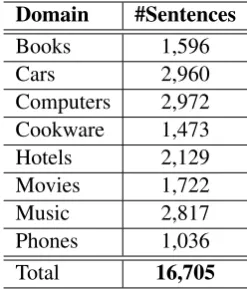
The SFU Review corpus (Taboada et al., 2006) was chosen for our annotation of negation and specula-tion. As mentioned earlier, the choice of the corpus was motivated by the lack of annotated corpora for the review domain and also by the need for identifi-cation of these phenomena in this domain. This cor-pus consists of 400 reviews from the website Epin-ions.com. All the texts are split into several sections such as movies, music, books, hotels etc. Each text gets a label based on whether it is a positive or neg-ative review. All the texts differ in size and are writ-ten by different people (more information about the size of the corpus can be found in Table 1).
The BioScope corpus (Vincze et al., 2008) con-sists of three different types of texts, which is done to ensure the heterogeneity of language used in the biomedical domain. It includes abstracts of the GE-NIA corpus, 9 full scientific articles and clinical free-texts (more information is provided in Table 2). As can be seen from Tables 1 and 2 the amount of sentences in the SFU Review corpus is 16,705 and therefore the corpus is of comparable size with BioScope, which consists of more than 20,000 an-notated sentences altogether (Vincze et al., 2008).
In the first stage of our work reported here we an-notated 20% of the SFU Review corpus using the
3Website:http://www.inf.u-szeged.hu/
Domain #Sentences
Books 1,596
Cars 2,960
Computers 2,972 Cookware 1,473
Hotels 2,129
Movies 1,722
Music 2,817
Phones 1,036
Total 16,705
Table 1: Statistics of the SFU Review corpus
Subcorpora #Documents #Sentences
GENIA Abstracts 1,273 11,872
Full papers 9 2,624
Clinical free-texts 1,954 6,383
Total 3,236 20,879
Table 2: Statistics of three BioScope subcorpora
BioScope guidelines. 10 texts were taken from each of 8 domains described in Table 1 to ensure differ-ent kinds of texts are studied. This initial step of annotation was used to understand what cases can-not be covered by the BioScope guidelines and how these guidelines should be adapted to the review do-main (more detailed discussion of this is presented in Section 4).
The next section will present the annotation tool which was used for our task.
3.2 Annotation Tool
To speed up annotation and ensure its consistency the annotation tool PALinkA (Or˘asan, 2003) was used. It is a language- and task-independent tool which allows you to define your own link types. Users can benefit from its intuitive graphical inter-face which does not require complicated training and is easy to use. The output of this program is a valid xml document, which makes the following processing easier. And the users do not need any technical education, the tool itself prevents them from introducing mistakes into the xml file struc-ture.
The tool allowed us to select keywords and an-notate them as negation or speculation. Afterwards the scope was marked in the text and then linked to the cue it belonged to. Graphical interface does not show xml tags in the texts, but uses colours to denote the keywords and scope, which makes anno-tation representative and easy to analyse and correct if needed. When complex keywords, such as “ei-ther...or”, “neither...nor” were annotated, there was a possibility to link the scope to both keywords. The
use of this annotation tool made us introduce some additional changes to the annotation guidelines de-scribed in the next section.
4
Adaptation of Guidelines
Consistent and detailed guidelines are needed when annotating a corpus in order to avoid mistakes and to ensure consistency of the annotation. We at-tempted to adapt the existing BioScope guidelines in order to fit the needs of the review domain. The BioScope guidelines consist of two parts: specula-tion and negaspecula-tion. Each part provides informaspecula-tion about the marking schemes, the keywords used and the scopes to be annotated. The authors attempted to provide an extensive description of all different cases and also give examples illustrating their rules. To illustrate examples of the annotation process we use the keywords in bold and their types in sub-script; we use()to indicate the scope of speculative keywords; and[]to indicate the scope of negative keywords.
4.1 Main Principles
The BioScope guidelines are based on four main principles (Vincze, 2010):
• Each keyword has a scope.
• The scope must include its keyword.
• Min-max strategy.
– The minimal unit expressing
hedge/negation is marked as the keyword.
– The scope is extended to the maximal syntactic unit.
• No intersecting scopes are allowed.
There are several principles we also try to follow in order to make annotation consistent:
Min-max strategy: We follow the min-max strategy suggested before in (Vincze, 2010; Farkas et al., 2010). When annotating cues, we try to choose the minimal unit which expresses negation or speculation. In this situation special attention should be paid to distinguishing complex cues and sequences of several keywords. However when an-notating scope we try to annotate the maximum words affected by the phenomenon:
They ended up hitting me in the nuts, which, to say the least, wasprobablyspec(better than what the director of this film did to the memory of Dr.Seuss).
Negation scope: Similar to the BioScope guide-lines for the negation scope, only the words that are modified by the negation cue are included in the scope:
Elliptic sentences:For elliptic sentences the key-word is marked and the scope is neglected:
The Bioscope guidelines provide an example of such a case:
This decrease was seen in patients who re-sponded to the therapy as well as in those who did
notneg.
When annotating the SFU Review corpus we fol-low the strategy suggested in the BioScope guide-lines:
I later discovered that my 11 year old understood all of them. I wish hehadn’tneg.
Complex keywords: We also follow the prin-ciples of the Bioscope guidelines when annotating complex keywords. When speculation or negation is expressed through a phrase rather than a single word and these words cannot express speculation separately, they are annotated as complex keywords:
I have a feelingspec (that many readers would have given up before the end due to boredom, frus-tration or the maddening feeling of ’ What the hell is Patterson thinking when he wrote this?’).
In this case,have a feelingcould be substituted by (I)thinkwhich clearly expresses uncertainty. How-ever the wordshave,a,feeling,thatcannot express uncertainty on their own.
4.2 Differences with BioScope
Some differences between the BioScope guidelines and ours are presented in this Section.
Keywords: Unlike the Bioscope corpus, where the cue words are annotated as part of the scope, for the SFU corpus we decided not to include the cue words in the scope.
The choice of the annotation tool was one of the reasons why the keywords were not included in the scope. When using PALinkA the annotation is done more easily and more intuitively if instead of includ-ing the keywords in the scope, we link the scope to the keyword it belongs to, while making it possi-ble to have embedded scopes for different keywords. Therefore the resulting xml file is easier to read as one could have the same scope linked to different keyword IDs.
Scope:When the annotator is unsure of the scope of a keyword only the keyword should be annotated.
Type of keyword: When the annotator is un-sure what type the keyword should be assigned to (whether it expresses negation or speculation), noth-ing should be annotated.
For these last cases we set up an ‘undecided’ cat-egory. Those cases will additionally discussed and annotated at the next stage.
Coordination: The Bioscope guidelines suggest extending the scope for speculation and negation
keywords to all members of the coordination. How-ever in the case of the review domain as the key-words were not included in the scope, the scopes were annotated separately and then linked to the keywords:
As far as I remember , vacation with accommo-dation in (Rio), (Golden Nugget),(Excalibur)orspec (Las Vegas Hilton) were available for cheaper rates than what I paid for Riviera.
Embedded scopes: Although keywords are not included in their own scope, a keyword can be in-cluded in the scope of other keywords and situations of embedded scopes are possible:
I’m not surespec (ifspec (he shouldspec ((be an-grier at his widow for giving studios the rights to his stories), orspec (to the studios for stabbing his widow in the back when she trusted them)))).
There were also cases when the combination of different types of keywords (ie. negation and spec-ulation ones) resulted in the embedded scopes:
Itisn’tneg[(vulgar)orspec(sexual)]
It should be noted that while the scope for the keyword orspec should include (vulgar) and (sex-ual), the scope for the keywordisn’tneg should in-clude [vulgar or sexual]. It is explained by the fact that isn’t modifies both coordinations, and should be understood as ‘it isn’t vulgar and it isn’t sexual either’.
No scope:Unlike the BioScope guidelines which mention only the cases of negation keywords with-out scope, situations where speculation keywords had no scope were encountered as well in the review domain:
This movie didn’t have anything to do with a chil-dren’s movie as itshouldspec.
4.3 Problematic Cases
While annotating the review domain using the Bio-Scope guidelines we had to face some problematic cases of annotation that had to be discussed addi-tionally.
Titles: As we are dealing with review texts, a great number of them include titles of the books or songs or even quotations from them which au-thors were referring to. Therefore it was not un-usual to find sentences which contain the name of a song/book such as:
Ludacris spits fluidly on “it wasn’t us”
and
When ya came in the party and you saw the crowd shoulda read the sign, ‘no suckas allowed’
We believe that even when these sentences con-tain a cue word they should not be annotated be-cause they do not express the writer’s uncertainty or negation.
Keyword sequences: The presence of the se-quences of the keywords created additional difficul-ties for the annotation. We feel that the nature of the review domain texts introduces a greater possibil-ity of encountering such cases than in the biomedi-cal domain. Therefore special care should be taken when distinguishing several keywords that go one after another. Although some examples of two or more keywords in a sequence could be also consid-ered as complex keywords they should be annotated separately if they can express hedge on their own:
I didn’tneg [thinkspec (it wouldspec (be
possiblespec (for anyone to rip the heart out of a Dr. Seuss book)))].
In this example the keywords didn’t and think may seem complex keywords but they should be an-notated as separate keywords since didn’t negates thinkwhich is the leading cue of the whole idea of speculation.
Not sure: Also it was noted that the case of the keywordnot surecan be difficult for annotation as its scope should include all the elements it modifies, for instance, it should include all the elements on the right in the following example:
not surespec(if he should be angrier at his widow for giving studios the rights to his stories, or to the studios for stabbing his widow in the back when she trusted them).
Great number of keywords: Close attention should be paid to sentences with a great number of keywords, which can lead the annotator to make mistakes. One of these difficult cases is presented below as an illustration:
This creative re-engineering draws (the viewer)1
or1spec (reader)1 into a parallel universe where age-old lessons canspec ((be taught)2 or2spec (re-taught)2) withoutneg [(the obstructions created in the minds)3,4,5, or3spec (interferences)3,4,5, or4spec (misconceptions)3,4,5 ifspec (you prefer), or5spec even (pre-concepts)3,4,5] thatmayspec(probablyspec
(lead to misunderstandings)).
While for the keywords or1spec and or2spec the scopes are easily identified, for the or3,4,5spec the scopes are tricky since they should include all the members modified by the keywordnoteven if these members are syntactically distant from the key-words.
Passive voice: The case of the passive voice turned out to be a difficult one and generated a lot of discussions. As Morante et al. (2011) noticed there are some inconsistencies in the way the Bio-Scope guidelines describe this problem. Therefore additional discussions and more studies are needed to decide how to mark the scope in sentences con-taining the passive voice. Therefore at the initial stage of annotation it was decided to mark these cases with a special label ‘undecided’. However in the final version of the guidelines we are planning to describe the ways to treat the passive voice and also correct the annotation accordingly.
As can be noted, the examples of the difficult cases of the annotation presented in this Section re-veal once again the need for more detailed and spe-cific guidelines for the review domain.
5
Conclusions and Future Work
A lot of work in the field of negation and speculation was done for the biomedical domain, but there is a need for studies in other domains. In this work we attempted to study the review domain and the ways the BioScope guidelines can be adapted to this do-main. The research showed the need for detailed guidelines, however we understand that they can-not account for all possible cases in the corpus and therefore difficult cases should be discussed by sev-eral annotators.
We made an initial attempt of annotation of the SFU Review Corpus and annotated 20% of the cor-pus, this information was used for studying the dif-ferences of the review and biomedical domains and developing the guidelines for the review domain. We provided analysis of the ways the BioScope guidelines can be adopted to the review domain and what cases should be additionally discussed. We are planning to use the created guidelines to annotate the whole SFU Review Corpus. Also several anno-tators will be involved in this process and that will allow us to calculate the inter-annotator agreement. Based on this information we will refine the guide-lines if needed and correct the annotation. Once this is done, we are planning to make both corpus and guidelines publicly available. We hope that this cor-pus will be helpful for further development of nega-tion and speculanega-tion detecnega-tion.
review domain and that of biomedical texts.
Acknowledgements
We would like to thank the reviewers for their valuable comments, which helped us a lot in im-proving the paper. We are also grateful to Prof. Maite Taboada and Prof. Ruslan Mitkov for their support of our research. We wish to thank our col-leagues Alison Carminke, Noa P. Cruz D´ıaz, Dr. Constantin Or˘asan and Wilker Aziz for their help with various aspects of our work.
References
Isaac Councill, Ryan McDonald, and Leonid Ve-likovich. 2010. What’s great and what’s not: learn-ing to classify the scope of negation for improved sentiment analysis. InProceedings of the Workshop on Negation and Speculation in Natural Language Processing, pages 51–59, Uppsala, Sweden, July. University of Antwerp.
Ferdinand de Haan. 1997. The interaction of modality and negation: a typological study. Garland Publish-ing, New York, USA.
Rich´ard Farkas, Veronika Vincze, Gy¨orgy M´ora, J´anos Csirik, and Gy¨orgy Szarvas. 2010. The CoNLL-2010 shared task: learning to detect hedges and their scope in natural language text. In Proceedings of the Fourteenth Conference on Computational Natu-ral Language Learning — Shared Task, CoNLL ’10: Shared Task, pages 1–12, Stroudsburg, PA, USA. Association for Computational Linguistics.
Ahmed Hassan and Dragomir R. Radev. 2010. Identi-fying text polarity using random walks. In Proceed-ings of the 48th Annual Meeting of the Association for Computational Linguistics, pages 395–403, Up-psala, Sweden, July. Association for Computational Linguistics.
Jin-Dong Kim, Tomoko Ohta, and Jun’ichi Tsujii. 2008. Corpus annotation for mining biomedical events from literature. BMC Bioinformatics, 9.
Marc Light, Xin Ying Qiu, and Padmini Srinivasan. 2004. The language of bioscience: Facts, spec-ulations, and statements in between. In Lynette Hirschman and James Pustejovsky, editors, HLT-NAACL 2004 Workshop: BioLINK 2004, Linking Biological Literature, Ontologies and Databases, pages 17–24, Boston, Massachusetts, USA, May 6. Association for Computational Linguistics.
Ben Medlock and Ted Briscoe. 2007. Weakly super-vised learning for hedge classification in scientific literature. InProceedings of the ACL, pages 992– 999, Prague, Czech Republic, June.
Ben Medlock. 2006. Guidelines for speculative sen-tence annotation.
Matti Miestamo. 2007. Negation an overview of ty-pological research. Language and Linguistics Com-pass, 1(5):552–570, September.
Roser Morante and Walter Daelemans. 2009. Learn-ing the scope of hedge cues in biomedical texts. In Proceedings of the Workshop on Current Trends in Biomedical Natural Language Processing, BioNLP ’09, pages 28–36, Stroudsburg, PA, USA. Associa-tion for ComputaAssocia-tional Linguistics.
Roser Morante, Sarah Schrauwen, and Walter Daele-mans. 2011. Corpus-based approaches to process-ing the scope of negation cues: an evaluation of the state of the art. InProceedings of the Ninth Inter-national Conference on Computational Semantics, IWCS ’11, pages 350–354, Stroudsburg, PA, USA. Association for Computational Linguistics.
Constantin Or˘asan. 2003. PALinkA: a highly cus-tomizable tool for discourse annotation. In Proceed-ings of the 4th SIGdial Workshop on Discourse and Dialog, pages 39 – 43, Sapporo, Japan, July, 5 -6.
Roser Saur´ı, Marc Verhagen, and James Pustejovsky. 2006. Annotating and recognizing event modality in text. InIn The 19th International FLAIRS Con-ference, FLAIRS 2006.
Roser Saur´ı. 2008. A factuality profiler for eventuali-ties in text. Ph.D. thesis, Waltham, MA, USA.
Burr Settles, Mark Craven, and Lewis Friedland. 2008. Active learning with real annotation costs. In Pro-ceedings of the NIPS Workshop on Cost-Sensitive Learning, pages 1–10.
Maite Taboada, Caroline Anthony, and Kimberly Voll. 2006. Methods for creating semantic orientation dictionaries. In Proceedings of 5th International Conference on Language Resources and Evaluation (LREC), pages 427–432, Genoa, Italy, May.
Veronika Vincze, Gy¨orgy Szarvas, Rich´ard Farkas, Gy¨orgy M´ora, and J´anos Csirik. 2008. The Bio-Scope corpus: biomedical texts annotated for uncer-tainty, negation and their scopes.BMC Bioinformat-ics, 9(Suppl 11):S9+.
Veronika Vincze. 2010. Speculation and negation an-notation in natural language texts: what the case of BioScope might (not) reveal. InProceedings of the Workshop on Negation and Speculation in Natural Language Processing, pages 28–31, Uppsala, Swe-den, July. University of Antwerp.