Improving Language Model Adaptation using Automatic Data
Selec-tion and Neural Network
Shahab Jalalvand
HLT research unit, FBK, 38123 Povo (TN), Italy
[email protected]
Abstract
Since language model (LM) is very sensitive to domain mismatch between training and test data, using a group of techniques to adapt a big LM to specific domains is quite helpful. In this paper, we, benefit from salient perfor-mance of recurrent neural network to improve domain adapted LM. In this way, we first ap-ply an automatic data selection procedure on a limited amount of in-domain data in order to enrich the training set. After that, we train a domain specific N-gram LM and improve it by using recurrent neural network language mod-el trained on limited in-domain data. Experi-ments in the framework of EUBRIDGE1 project on weather forecast dataset show that the automatic data selection procedure im-proves the word error rate around 2% and RNNLM makes additional improvement over 0.3%.
Keywords: Language model, automatic data se-lection, neural network language model, speech recognition
1
Introduction
Language models are widely used in different applications such as automatic speech recognition (ASR), machine translation; spell checking, handwriting detection etc. Basically, a language model tries to predict the next word in a sentence by considering a history of previous words. To provide this history, the language model needs to be trained on a large set of texts.
1 This work has been partially founded by the European
project EUBRIDGE, under the contract FP7-287658
Generally, the larger train set the better language model.
A main issue in language modeling arises from data sparseness in training set. It means that in a large training set, many of the n-grams2 are
very rare and, consequently, their probabilities are very small. Katz (1987) tried to overcome this problem by proposing back-off technique. In it, the probabilities of rare n-grams are estimated through linear interpolation of the probabilities of the lower order n-grams.
Discounting methods such as Witten-Bell es-timate (Witten and Bell, 1991), absolute dis-counting (Ney and Essen, 1991), Kneser-Ney method (Kneser and Ney, 1995) and modified Kneser-Ney (Chen and Goodman, 1999) allow estimating back-off coefficients.
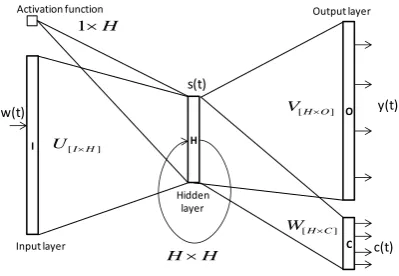
Recently, using neural network language model (NNLM) has been become of interest be-cause it results more generalization in compari-son to N-gram models. In NNLM, the words are represented in a continuous space. The idea of representing words in a continuous space for language modeling was started by Bengio (2003). It was followed by Schwenk (2007) who applied neural network for language modeling in large scale vocabulary speech recognition and obtained a noticeable improvement in word error rate. Mikolov (2010) pursued this way and used recurrent neural network for language modeling (RNNLM). The advantage of RNNLM on feed forward neural network, which was used by Bengio (2003) and Schwenk (2007) is that RNNLM can consider an arbitrary number of preceding words to estimate the probability of
2
Sequence of n words (usually 2, 3 or 4 words). By n-gram (with small “n”) we refer to an n-word sequence and by N-gram (with capital “N”) we refer to a language model based on n-grams
lay- First, training a language model on a large domain-independent set is very costly in time and computation and also the resulted model cannot be very effi-cient in our specific task which is weath-er forecast transcription.
Second, the available domain-specific data is to some extent small and the model which is trained on it is not gener-al enough.
Two possible solutions are:
We can use the available in-domain set to select similar sentences from the huge out-domain set in order to enrich our in-domain training set.
Or, we can cluster the domain-independent set using word similarity measures. It is expected that the sentences from the same cluster belong to the same domain. Then, we can train a specific language model for each cluster. We focus on the first solution and utilize it in our experiments. This idea is already proposed by Maskey (2009) for re-sampling an auxiliary data set for language model adaptation in a machine translation task. We use a similar approach to collect in-domain sentences from GoogleNews.
4.1 Text Corpora and Language Models
The source used for generating the documents for training a domain-independent LM is Google-news. Google-news is an aggregator of news provided and operated by Google, that collects news from many different sources, in different languages, and each group of articles consists of similar contents. We download daily news from this site, filter-out useless tags and collect texts. Google-news data is grouped into 7 broad domains (such as economy, sports, science, technology, etc). After cleaning, removing double lines and application of a text normalization procedure, the corpus results into about 5.7M of documents, or a total of about 1.6G of words. The average number of words per document is 272 (refer to (Girardi, 2007) for details about the web document retrieval process applied in this work).
On this data we trained a 4-gram back-off LM using the modified shift beta smoothing method as supplied by the IRSTLM toolkit (Federico, 2008). The LM results into about 1.6M unigrams, 73M bigrams, 120M 3-grams and 195M 4-grams. The LM is used to compile a static Finite State Network (FSN) which includes
LM probabilities and lexicon for two ASR decoding passes. In the following we will refer to this LM as GN4gr-ALL.
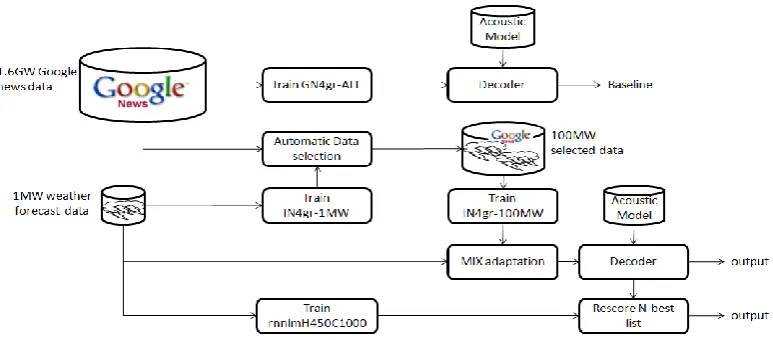
Within the EUBRIDGE project we were also given a set of in-domain text data, specifically around 1M words related to weather reports published on the BBC web site, that was first used to train a corresponding 4-gram LM (in the following we will call it IN4gr-1MW).Then, with the latter LM we automatically select, using perplexity as similarity measure, from the whole Google-news database an auxiliary corpus of about 100M words. On this corpus we trained a corresponding 4-gram LM and we adapted it to the weather domain using the 1MW in-domain corpus (as adaptation data) and LM-mixture (as adaptation method). The resulting adapted LM contains about 278K unigrams, 9.4M bigrams, 7.9M 3-grams and 9.5M 4-grams. In the following we will refer to it as IN4gr-100MW.
Using the last language model (IN4gr-100MW) and a pre-trained acoustic model which is described in the next subsection we extract the 1000-best list from the decoder and re-score this list using a recurrent neural network language model (RNNLM).
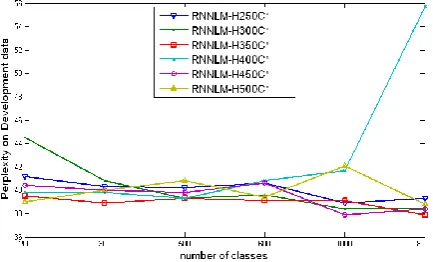
Before that, we need to investigate different types of RNNLM with different configuration in order to find the best one for our specific task. In this way, we trained RNNLMs with 250, 300, 350, 400, 450, 500 hidden neurons and 200, 300, 500, 600, 1000 and 8000 classes on the 1MW in-domain data. Figure 4 compares the perplexity of these models on a development set consisting of 12K words which is completely isolated from the test set.
Figure 3. Perplexity of different RNNLMs on devel-opment data
H450C1000 and H300C1000 (exp. rnnlmH300C1000 is an RNNLM with 300 hid-den neurons and 1000 classes).
In accordance with Mikolov (2011), RNNLM works better when it is interpolated with an N-gram. Thus, we train a 4-gram language model based on Kneser-Ney smoothing method using SRI toolkit (Stolcke, 2002) and interpolate it with the best RNNLMs by different weights (lambda). Figure 5 shows the result of these in-terpolations.
Figure 4. Interpolation of RNNLM scores and 4-gram scores
When lambda is zero, just N-gram score has been considered and when lambda is 1, just the score of RNNLM is used. It is seen that interpolation of N-gram and RNNLM improves the performance of the system. Correspondingly, we see that rnnlmH350C8000 and rnnlmH450C1000 show the highest performance in interpolation with IN4grKN-1MW. In following, we will use the latter to re-score the n-best list obtained from decoder.
4.2 Generation of N-best Lists
As previously mentioned we used the RNNLM, trained on 1MW in-domain set of data, to re-score n-best lists produced during ASR decoding. Details on both acoustic model training and ASR decoding process can be found in (Falavigna, 2012). In short for this work, speech segments to transcribe have been manually detected and labeled in terms of speaker names (i.e. no automatic speech segmentation and speaker diarization procedures have been applied).
In both first and second decoding passes the system uses continuous density Hidden Markov Models (HMMs) and a static network embedding the probabilities of the baseline LM. A frame synchronous Viterbi beam-search is used to find the most likely word sequence corresponding to
each speech segment. In addition, in the second decoding pass the system generates a word graph for each speech segment. To do this, all of the word hypotheses that survive inside the trellis during Viterbi beam search are saved in a word lattice containing the following information: initial word state in the trellis, final word state in the trellis, related time instants and word log-likelihood. From this data structure and given the LM used in the recognition steps, WGs are built with separate acoustic likelihood and LM probabilities associated to word transitions. To increase the recombination of paths inside the trellis and consequently the densities of the WGs, the so called word pair approximation is applied. In this way the resulting graph error rate was estimated to be around 1/3 of the corresponding WER.
The best word sequences generated in the second decoding pass are used to evaluate the baseline performance. Instead, the corresponding word graphs are used to generate lists of 1000 sentences each. To do this a stack decoding algorithm is employed (Hart, 1972), where the score of each partial theory is given by summing the forward score of the theory itself with the total backward score in the final state of the same theory (i.e. the look-ahead function used in the algorithm is the total backward probability associated to the final state of the given theory). Finally, each 1000-best list is re-scored using the RNNLM trained on 1MW in-domain text data set. Note that in this latter decoding step, acoustic probabilities remain unchanged, i.e. the latter decoding step implements a pure linguistic rescoring.
4.3 Speech Recognition Results
An overview of the experiments has been given in Figure 5. The first set of results is obtained by using GN4gr-ALL language model which is trained on whole Google-news data. Then, a small N-gram (IN4gr-100MW) is trained on the in-domain data that is used in the procedure of automatic data selection (see section 4.1). Utilizing the resulted data set, a bigger model (IN4gr-100MW) is trained and adapted to the in-domain data.
Table 1. compares the WER resulted from us-ing these language models in the decodus-ing phase. It can be seen that the in-domain language model which is trained on the small set of in-domain text is dramatically better than the huge out-domain model. By applying automatic data se-lection approach and collecting the most useful texts from Google-news we obtained 0.3% im-provement and by utilizing RNNLM for re-scoring the n-best lists we reach another 0.3% improvement in word error rate.
Table 1. %WER with different language models (Oracle Error Rate is 9.7%)
Language model Development set Test set
GN4gr-ALL 16.2 15.1 IN4gr-1MW 14.3 12.8 IN4gr-100MW 14.0 12.6 0.5*IN4gr-100MW +
0.5*rnnlmH450C1000 13.7 12.3
Although it’s not a salient improvement from the third to fourth row of the table, we should notice that the RNNLM model has re-scored an N-best list, which in the best conditions, it gives 9.7% WER. That is, if we ideally select the best sentences from these n-best lists we cannot reach better result than 9.7%.
5
Conclusion
Given a small set of in-domain data and a huge out-domain corpus, we proposed a thorough sys-tem which applies an automatic data selection approach to train a general in-domain language model. In addition, we used a continuous space language model to improve the generality of the model and consequently to improve the accuracy of ASR.
In future, we will benefit from RNNLM in the procedure of data selection. That is, instead of evaluation of candidate sentences using N-gram, we will rank them using RNNLM.
Moreover, it would be worthwhile to explore the performance of a group of small RNNLM on the selected data rather than a single N-gram LM.
Acknowledgments
I would like to express my special thanks of gra-titude to my supervisor, Daniele Falavigna, who kindly helped me to do the experiments and write this paper.
References
Andreas Stolcke. 2002. SRILM - An Extensible Lan-guage Modeling Toolkit. In Proceedings of the In-ternational Conference on Statistical Language Processing, Denver, Colorado.
Christian Girardi. 2007. Htmcleaner: Extracting Rele-vant Text from Web. 3rd Web as Corpus workshop (WAC3), Presses Universitaires de Louvain, pp. 141-143.
Daniele Falavigna, Roberto Gretter, Fabio Brugnara, and Diego Giuliani. 2012. Fbk @ iwslt 2012 - ASR Track. in Proc. of the International Workshop on Spoken Language Translation, Hong Kong, HK.
George Foster and Roland Kuhn. 2007. Mixture Mod-el Adaptation for SMT. In Proceedings of the Second Workshop on Statistical Machine Transla-tion, StatMT ’07, pages 128–135, Stroudsburg, PA, USA. association for Computational Linguistics.
Hermann Ney, Ute Essen. 1991. On Smoothing Tech-niques for Bigram-based Natural Language Mod-elling. Proceedings of the IEEE International Con-ference on Acoustics, Speech and Signal Processing ’91, volume 2, pp. 825–829.
Holger Schwenk. 2007. Continuous Space Language Models. in Computer Speech and Language, vo-lume 21, pp. 492-518.
Ian H. Witten and Timothy C. Bell. 1991. The Zero-frequency Problem: Estimating the Probabilities of Novel Events in Adaptive Text Compression. IEEE Transactions on Information Theory, 37, pp. 1085– 1094.
Jerome R. Bellegarda. 1998. A Multispan Language Modeling Frame-work for Large Vocabulary Speech Recognition. IEEE Transactions on Speech and Audio Processing, vol. 6, no. 5, pp. 456–467.
Marcello Federico, Nicola Bertoldi, and Mauro Cetto-lo. 2008. IRSTLM: an Open Source Toolkit for Handling Large Scale Language Model. in Proc. Of INTERSPEECH, Brisbane, Australia, pp. 1618–1621
Marcello Federico. 1999. Efficient Language Model Adaptation Through MDI Estimation. In Proceed-ings of the 6th European Conference on Speech Communication and Technology, vol. 4, Budapest, Hungary, pp. 1583–1586.
Nick Ruiz and Marcello Federico. 2012. MDI Adapta-tion for the Lazy: Avoiding NormalizaAdapta-tion in LM Adaptation for Lecture Translation. In Proceedings of the International Workshop on Spoken Lan-guage Translation, Hong Kong, China.
Peter E. Hart. Nils J. Nilsson. Bertram Raphael. 1972.
Correction to A Formal Basis for the Heuristic Determination of Minimum Cost Paths. SIGART Newsletter 37: 28–29
Sameer Maskey, Abhinav Sethy. 2009. Resampling Auxiliary Data for Language Model Adaptation in Machine Translation for Speech. in ICASSP 2009, Taiwan
Stanley F. Chen and Jushua Goodman. 1999. An Em-pirical Study of Smoothing Techniques for Lan-guage Modeling. Computer Science and Language, 4(13), pp. 359-393.
Tomas Mikolov, Anoop Deoras, Stefan Kombrink, Lukas Burget, Jan Cernocky. 2011. Empirical Evaluation and Combination of Advanced Lan-guage Modeling Techniques. In: Proceedings of the 12th Annual Conference of the International Speech Communication Association (INTERS-PEECH 2011). Florence, IT.
Tomas Mikolov, Martin Karafiat, Lukas Burget, Jan Honza Cernocky, Sanjeev Khudanpur. 2010. Re-current Neural Network Based Language Model. In Proc. INTERSPEECH2010. pp. 1045–1048