CSEIT1846193 | Published – 08 May 2018 | May-June 2018 [ (4 ) 6 : 1016-1023 ]
National conference on Engineering Innovations and Solutions (NCEIS – 2018)
International Journal of Scientific Research in Computer Science, Engineering and Information Technology © 2018 IJSRCSEIT | Volume 4 | Issue 6 | ISSN : 2456-3307
1016
Effect of Dispersed Generation On Distribution System
Security – An Overview
Divya S1, Dr. S B Shivakumar2, Dr. T Ananthapadmanabha3
1Assistant Professor, Department of Electrical Engg. GSSSIETW, Mysuru, Karnataka, India
2Principal, Proudhadevaraya Engineering College, Hosapete, Karnataka, India
3Principal, NIEIT, Mysuru, Karnataka, India
ABSTRACT
Due to the increasing demand of energy consumption along with the need for renewable energy sources, distributed generation (DG) has come into picture in recent days. Power system protection is one the foremost concern which arises due to the incorporation of a DG into an existing distribution system. The interference of this DG could affect power quality issues, deprivation in system dependability, decrease in the efficiency, over voltages and safety issues. This paper discusses the different definitions projected in the literature. Further the DG system to become a major contributor in the current power expansion it needs to be connected with the prevailing grid system. This incorporation will cause some technical, functional and economic impacts on distribution systems. A summary of the operating concerns that must to be tackledin context with the distribution protection with DGs areconversed. This article also recapitulates these unusualconsequencesof DG on the power system.
Keywords: Distribution System,issues, impact, islanding, coordination, Protection schemes.
I.
INTRODUCTION
Electrical energygenerated and dispersed to consumerssets up one of the biggest consumer markets in the world.
As a nation we have turned out to be so reliant that most of the day-to-daytasks would be deferred if there were any disruption in electric energy production, transmission and dissemination [3]. Traditionally there has been anexcessive deal of effort put into modeling and improving the reliability of the generation and transmission systems. Yet, when equated to the generation and transmission systems, substantial less resources has been placed on the facts of making the distribution system more dependable[1]. Bulk of all disruptions
experienced by the consumer in a given year are owed by the distribution system.
Incorporation of DG creates a lot of issues in the power system due to the fact that the power system would not have been designed or planned keeping DG in the thought. The procurement of DGmay perhaps influence power quality hitches, deprivation in system reliability, drop in the efficiency, over voltages and safety disputes [7]. On the converse the power system dispersal are finelyplanned which might take care the adding of DG if there is appropriateEarthing, transformers and protection is delivered.
important to modify and change the already designed distributed system equipment and protection, which could in a result facilitate theincorporation of new compeers [6].
On the other hand, interconnected DG could worsen the performance of the power system leading to negative upkeep benefits. The assimilation of DGmay possiblyconsequence the power
quality owing to deprived voltage regulation, voltage flickers and harmonics. These circumstances can have a thoughtfulimpression on the functioning and robustness of the electricalpower system and also cause destructiveconditions to equipment [12].
This paper aims to broadly review all protection practices which have been endorsed for distribution networks. It is expected that the work presented will be advantageous for research scholars in DG protection in finding appropriate references and applying suitable protection schemes. Subsequently, application of the correct protection scheme will enhance the dependability and fidelity of active distribution networks.
II.
INCORPORATION OF DG
Dispersion of DG in Distribution networks has an impact on various fields. These impacts could be positive ornegative and are considered as the benefits and drawbacks of the distributed generation.
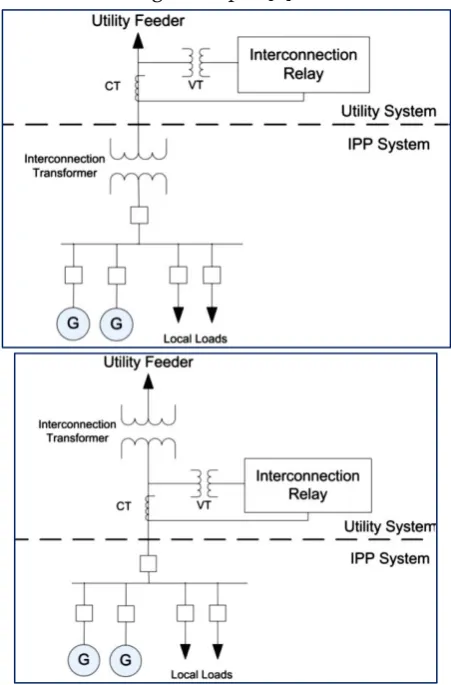
The DG protection is recognized from the Point of ConjointConnection (PCC) and the interconnection transformer. [2]
The objective of the interconnection protection is to safeguard the grid from the DG unit on the grid-side throughout the paralleloperations of the DG and the grid. The protection can be positioned either on the primary side of the interconnectiontransformer or on the secondary.Even though DG is a reasonableoption to bump into the power demand of the market, there are multiplicities of practical,functional, commercial,
and supervisorydisputes that have tobe
measuredafore the DG plants are intersected withthe centralgridiron. The interconnection issues have enough prospective toavoid distributed generation schemes from being developed.[5]
Figure 1. Interconnection Protection at the Secondary
III. TECHNICAL ISSUES
The key technical issues for DG connection connect to power quality, protection, islanding and stability of the system.
The integration of DG couldupshot in disparities in voltage profile alongside a feeder by altering the track and scale of active and reactive power flows.DG consequence on voltage regulation can be optimistic or pessimisticliable on distribution system and distributed generator topographies as well as DGlocality [3].
The connection of DG entities alongside the power distribution feeders may expedite to overvoltage owed to superfluous of active and reactive power. For example, a minor DG system partaking a conjoint distribution transformer with numerous loads possibly willshoot the voltage on the ancillary side, which is adequate to root high voltage at these consumers [5].
ForinconsequentialDG unit(less than 10MW) the influence on the primary is trivial. On the other hand, if the collective competencyfeeder upsurges in anticipation ofperilous thresholds, then voltage regulation analysis is compulsory to surefire that the feeder voltage will be secure surrounded by appropriate boundaries [3].
Voltage Glitches:
A Voltage glitch is initiated by variation of dynamism which upshots due to spasmodic production from wind turbine generators and photovoltaic grounds, or association and suspension of induction generators from the distribution network.
Most of the DG mechanism are competent to delivergrid lock generation during the instance of interludes or cessation of the central system. DG centered on an induction generator, or with an incorrigible inverter, or lacking proper storage might be unqualified to function in off gridgenre. [6]
Harmonics
A few types of DG, i.e., photovoltaic (PV) and fuel cells, are linked to the dispersalnetwork through
power electronic converters. The
contemporaryconverters use pulse width modulation (PWM) practice and as a result yieldsmaller amount
Variable frequency components than the
conventional compeers of thyristor based line commutated inverters.
DG centered on induction and synchronous generators tune the reaction of the scheme to the other Variable frequency componentbases by fluctuatingvocal impedance of the grid. In addition, one of the roots for resonance are the condensers used for excitation of induction generators
Table 1. Variable Frequency Components (Harmonics) current instillationnecessitiesas per
Overall Harmonic Variation 5.00%
Voltage Unbalance
Voltage unbalance can arise due to incorporation of a solitarystage DG, i.e., DG grounded on PV units, in DisseminationSystem. This destabilizationturns out to beobvious as graduallysolitary stage DG entities are acquainted withDissemination System. [6]
3.2 Protection Issues
The existence of DG may perhapssource a numerouscomplicationscorrelated to inappropriate action of coordinationsecurities. The clangs amongst
DG and safety schemes are:
Customarydispersalschemes were not planned to devourdynamicpower engenderingcomponents in them. Power is deliveredby the transmission scheme and power drift is primarilyunidirectional. With the incorporation DG in the structure, power flow can be bi-directional [5]
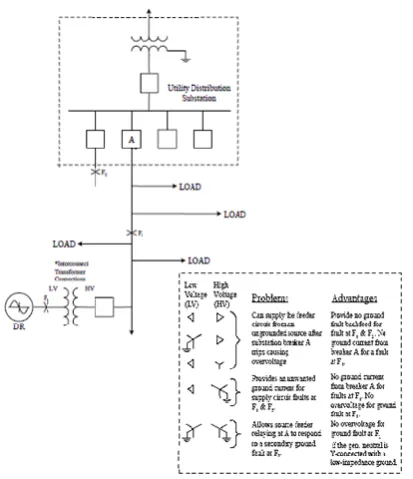
Figure 3. Interconnection Transformer Connections
a).Influence of co-ordination on Protection Scheme:
Coordination can be apprehended by the
subsequentinstance.
The current IUCdeprived of the DG is not equivalent
to the currentIUCusing the DG as understood from
the figure. Through the DG interrelated, the fault current perceivedby the recloser (IRE) would be
greater than shorn of the DG associated. This would commonly not source a problem usingthe recloser size as long as the new superiorIREdoes not overdo
the recloser extremeinterjectinggrade.
Nevertheless, it is to be expected that
harmonizationamongst the recloser and a few fuses will be mislaid. For the reason thattogether the recloser and fuses functionmore rapidly at greater error currents, the essentialboundariesconcerning there closer curvature and the fuse least possible melting curvaturemay perhaps be condensed to dropsynchronization [6].
Figure 4. Classic feeder by means ofinclusion of DG up track recloser.
IUC - Current from the Utility Center
IRE - Fault current perceived by the recloser.
IF- Fault Current
Deprived of DG : IUC = IRE = IF
Using the DG pooled : IF= IUC + IDG
IRE = IF
However, IRE ≠ IUC
Liable on features of the grid and DG, numerousaddedsafetycomplications can arise. They are:
1. Feeders may experience False Tripping which is also called as sympathetic tripping)
2. Variation in fuse coordination with fast tripping of recloser due to DG action
3. Generating units may undergo nuisance tripping 4. Protection unsighting
5. Amplified or diminished fault intensities 6. Unsolicited islanding
7. Proscription of spontaneous reclosing 8. Unsynchronization in the reclosing action
b) Consequenceon Short Circuit Levels of the Network due to DG
The short circuit levels of the grid might get upset due to manifestation of DG. An escalation is created in the fault currents whileequated to usual situations where DG is not incorporated to the grid [3].
elements such as fuses or relays. The reliability and safety of the distribution system may be disturbed due to this.
Figure 6displays a usual fuse adjacent on a feeder where fuse optimization is engaged and DGs are implanted in the scheme. In this circumstance if the fault current is sufficiently huge, the fuse might not match up with the feeder circuit breaker in the course of a fault.
This may lead to superfluous fuse functioning and declineddependability on the adjacent [3].
Figure 5. Fault influences due to DGs injected to the system. Fuse-breaker super visionmight not be
accomplished.
In case the DR is positioned intermediate of the fault and the utility center, a reduction in fault current from the utility center may be witnessed. Conversely, if the DRs arerobustwhen related to the servicecenter, it may have a momentousimpression on the fault current upcoming from the service center. This might be the root cause to trip, serial tripping, or synchronization problems [14].
The characteristics of the DG also influences the short circuit intensities. The synchronous generator is the uppermostcontributing DG to faults. In the course of the first few sequences its involvement is one and the same as of the induction generator and self-excited synchronous generator, whereas after a first few phases the synchronous generator is the extreme fault current causal DG type. The inverter interfaced DG typedonates the minimum fault current. In a few inverter categories the fault
contribution persists for less than one succession. [11].
c). Instantaneous Reclosing.
Figure 7 shows theprinciple of fault currents and the recloseintermission between “shots”. [5] It displays first TwoShots of a Usual Distribution System ReclosingArrangement in the course of a Short Circuit. Many utilities practice “instantaneous” reclose for power quality persistence and obfuscate the concern. The recloseinterval is technically 0.5s but can be as small as 0.2s.
However, this upturns the option that the DG may notdetach in time. The encounter between necessity of a DG anduse of instantaneous reclose will become significant withcumulative penetration of DGs.
Henceforth it is suggestedin contradiction
ofconsuming instantaneous reclose on feeder sections thatcontain DG. A reclose interval of 1.0s or more would bedesirable. This will radicallycondense the probabilities thatthe DG will be unsuccessful to detach in time, but will also causereduced power quality to a certain section of customs.
Figure 6. Fault current and Reclose interval
imperative anddiscussed unconventionally in the next section.
a) Islanding
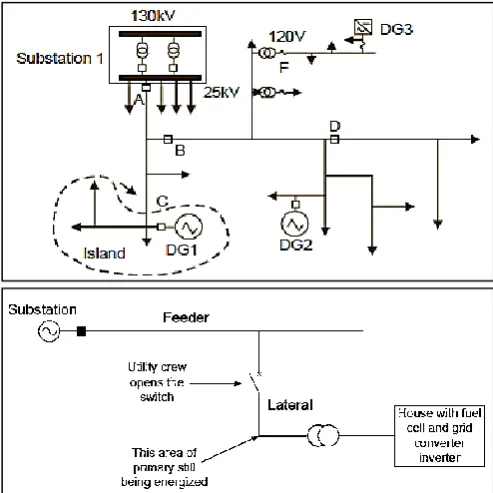
An island is “That fragment of a power system comprising of one or more power sources and load that is, for a certain periodof time, disconnected from the rest of the system.”
Islanding is the circumstance when the DG is no longer functioning in analogous with the utility and may occur as aconsequence of the following situations:
- A fault that is sensed by the utility, and which upshots in opening a disconnect device but which is notsensed by the DG protection devices
- Unintentional opening of the usual utility supply be equipment failure
- Utility switching of the distribution system and loads
- Deliberatedetach for servicing either at a point on the utility or at the service entrance
- Human error - Act of nature [16]
In the Figure 8, a substation is shown which steps downtransmission voltage into distribution voltage. One of the feedersis shown in detail. There are many consumer joiningpoints in the feeder. Large DGs are normallyattached to the primary feeders (DG1 and DG2).Small DGs such as inverter based PVsystems are linked to the low voltage secondary feeders (DG3). Islanded procedure can be Intentional Islanding orUnintentional islanding. In intentional islanding, the islandinghas been scheduled prior and the system has been intended to handlethe situation. The DG at that time is well suitable to regulate voltage and frequency in theislanded grid. [14, 15] Unintentional islanding takes place if the switching devicebetween the DG and the rest of the utility grid is openedand the DGcarries on to feed the distribution grid.
The DG equipment may not at all be appropriate to control voltageand frequency. The voltage and
frequency caneven get so out of range that connectedconvention equipment isruined. [7]
Figure 7: Islanding of a DG system
b) Temporary faults
In radial schemes, fault clearance necessitates the opening ofonly one device since there is only one sourcecontributing current to the fault. On the contrary, meshedsystems call for breakers at both ends of afaulted line to open. Apparently, when DG is existing, there are several power sources and opening only theutility breaker does not assure that the fault will clearrapidly. [5][6]
As a result, DG will be mandatory to detach fromthe system when a fault is suspicious, before the fastreclosing time has lapsed, so that the system regresses toa true radial system and the normal fault clearing processmay proceed.
In this outlook DG appears to be rather discordantspecifically with fast reclosing during temporary faults.This procedure may not allow the DG units to haveenough time to be cut off from the grid. In thiscase DG units may tolerate the voltage and fault arc,avoiding effective reclosing in the instance of temporaryfaults. [11]
c) Sympathetic tripping
Sympathetic tripping arises when a protective devicefunctions unreasonably for faults in other protection zones.This can happen with distributed generation due tounpredicted fault contributions from the DG.
An exampleof how sympathetic tripping may perhaps arise is shown in Figure 9.
The relays at breaker “A” and there closer are not directional.
Therefore, adequate fault current undeniably from the distributed generation would source any of these devices to function in “sympathy (understanding)” with “B” which essentially perceives thefault.[7][4]
Figure 9: Illustration of Sympathetic tripping
IV.
CONCLUSION
DG has much potential to upsurge the
systemperformance. Nevertheless,distribution system schemes and functional practices aretypically based on radial power flows and this produces an unusual
challenge to the incorporation of
distributedgeneration. Diverse concerns related to power quality when DR is integratedwith the
existing power system has been conversed in the paper.
DGs are a feasible substitute for emerging countries where grid supply has dependability below appropriate levels.
The association of DGs todistribution grids significantly influences the grids performance. This paper has defined a few of the concerns thatneed be deliberated to assure that DG will not worsen the system’s power quality, safety or reliability.
Penetration of DG can be magnificently in corporated with the power system on condition that the interconnection strategiesbump into the in tricatenecessities that contemplate not only power quality but also system efficiency, power reliability and safety.
This paper also emphases on the DG’s influence on the gridsmechanism and protection patterns. A number of protection problems are recognized to study the requirements for protection in the existence of DGs.
V.
REFERENCES
1) Manohar Singh, B.K.Panigrahi, Senior Member, IEEE and A. R. Abhyankar, Member IEEE “A Hybrid Protection scheme to mitigate the effect of Distributed Generation on Relay Coordination in Distribution System” , 978-1-4799-1303-9/13/$31.00 ©2013 IEEE
2) Seyed Ali Mohammad Javadian and Maryam
Massaeli, “An adaptive overcurrent protection scheme for distribution networks including DG using distribution automation system and its implementation on a real distribution network”, Indian Journal of Science and Technology Vol. 4 No. 11 (Nov 2011) ISSN: 0974- 6846.
Protection Scheme for Radial Feeders”, 978-1-4244-3811-2/09/$25.00 ©2009 IEEE
4) M. Vinoth kannan1, S. Rajanbabu, Department
of Electrical Engineering, Valliammai
Engineering College, India, “Analysis on protection coordination of protective devices with a fault current limiter in the application location of a dispersed generation” International Journal of Enhanced Research in Science Technology & Engineering, ISSN: 2319-7463, Vol. 3 Issue 2, February-2014.
5) Viral S Chaudhari Electrical Engineering
Department PG Student of L D College of Engineering ,Ahemedabad,Gujarat , Prof.V J Upadhyay Electrical Engineering Department L D College of Engineering Ahemedabad, Gujarat “Co-ordination of Overcurrent Relay In Interconnected Power System Protection”, 13-14 May 2011
6) Smita Shrivastava, S. Jain* and R.K. Nema, Deptt. of Electrical Engg., Hitkarini College of Engineering and Technology Jabalpur, (MP) INDIA, “Distributed generation : technical aspects of interconnection” International Journal on Emerging Technologies 1(1): 37-40(2010) 7) Galina Antonova ABB Inc., Canada Massimo
Nardi ABB Inc., USA Alan Scott Dixie Escalante Power, USA Michael Pesin Seattle City Light, USA, “Distributed Generation and Its Impact on Power Grids and Microgrids Protection” 978-1-4673-1842-6/12/$31.00 ©2012 IEEE
8) Hadi Zayandehroodi, Azah Mohamed, Hussain Shareef, Marjan Mohammadjafari, Department of Electrical Engineering, Kerman Branch, Islamic Azad University, Kerman, Iran, “Distributed Generators and Their Effects on Distribution System Protection Performance” Australian Journal of Basic and Applied Sciences, 5(10): 398-405, 2011, ISSN 1991-8178
9) F. Bignucolo, R. Caldon, M. Frigo, University of Padova, A. Morini, A. Pitto, F. Silvestro, University of Genova, “Impact of Distributed Generation on network security: effects on loss-of-main protection reliability”
10)M. M. Mijalili, Yazd University, Yazd, Iran, A. R. Sedighi, Yazd University, Member IEEE, M. R. Haghifam Tarbiat Modares University Senior Member IEEE, “Impact of DG Location on Protection Coordination in Distribution Systems”, IEEE Iran section, Electric Power Distribution Conference With coopration of electric utilities, EPDC 2012
11)Lazhar Bougouffa and Abdelaziz Chaghi , LSP-IE Laboratory Research Laboratory, Faculty of Technology, Department of Electrical of Engineering, University of Batna, Algeria, “Impact of Distributed Generation and Series FACTS Compensator on Directional Overcurrent Protection Coordination”, International Journal of Hybrid Information Technology Vol.7, No.4 (2014), pp.299-308.
12)Viraj Pradeep Mahadanaarachchi, Student
Member, IEEE, and Rama Ramakumar, Life Fellow, IEEE, “Impact of Distributed Generation on Distance Protection Performance - A Review”, ©2008 IEEE.
13)Umar Naseem Khan, “Impact of Distributed Generation on Electrical Power Network”
14)Shah Arifur Rahman, Member, IEEE, and
Byomakesh Das, Member,IEEE, “Impact of Distributed Generation on Power System Protection”, Shah Arifur Rahman is with the University of Western Ontario, London, ON, N6A 5B9, Canada.