CSEIT184672 | Published – 08 May 2018 | May-June 2018 [ (4 ) 6 : 383-388 ]
National Conference on Engineering Innovations and Solutions (NCEIS – 2018)
International Journal of Scientific Research in Computer Science, Engineering and Information Technology © 2018 IJSRCSEIT | Volume 4 | Issue 6 | ISSN : 2456-3307
383
A Framework to Improve Network Performance by using
Mobile Relay
Khansa sultana, Saroja .H, Yashaswini .P, Purnima Singh, Dr. A. B. Rajendra
Final Year Students, Professor and Head Department of Information Science and Engineering Vidyavardhaka College of Engineering Mysuru, Karnataka, India
ABSTRACT
Ad-hoc networks are array of mobile nodes connected by wireless links forming a temporary network. MANET’s are infrastructure less network and all nodes are battery powered. The primary objective of the paper is to address the two major issues that is energy depletion and congestion in MANET’s by considering relay nodes as intermediate hops for data transmission by mobile nodes, as relay nodes have abundant energy. We determine the residual energy of a node by considering the rate of energy consumption. The relay nodes are implemented using the network simulator NS-2. This framework improves the energy efficiency and thereby improving the overall network lifetime.
Keywords: Relay Nodes, Wireless Network, Energy Efficient Routing, Congestion Control, MANET’s.
I.
INTRODUCTION
The term MANET refers to a multihop packet based wireless network composed of a set of mobile nodes, that can communicate and move at the same time, without using any fixed infrastructure. Wireless networks are classified as infrastructure based networks and infrastructure less networks[1].In mobile ad-hoc network[MANET] the mobile node communicate with each other by sending data flows either directly or intermediate relay. Every mobile node in a network will be associated with certain amount of energy, the energy will be dependent on the battery associated with each node.
The node loses its energy when an event occurs. The events involve are receiving a packet, transmitting a packet, energy consumption in ideal state and transition from sleep state to active state[2].The major events that consume most of the node energy are receiving and transmitting packets. The
remaining energy of a node after transmitting data packets in the network is called as residual energy[3]. Energy efficient routing may be the most important design criteria for MANETs. .Mobile nodes are battery powered hence they have limited capacity.Failure of a node effects the node as well as its ability to forward packet and thus it effects the overall network lifetime[4].
Congestion refers to bandwidth issues,the bandwidth keeps varying and when there is insufficient bandwidth the demand of packet flow is not satisfied and the issue of congestion occur. Traditional congestion control mechanism applied by the Transport layer protocol (TCP) is unable to catch up the network dynamics of adhoc network[5]. The main objective of this work is to solve both energy depletion and congestion problem in MANETs.
and congestion control by using mobile relay. Section 1V explains the strategy for implementation. Finally, conclusions are drawn in section V.
II.
RELATED WORK
A. Extending the Lifetime of Wireless Sensor Networks
The authors Wei Wang, Vikram Srinivasan, and Kee-Chaun proposed “extending the lifetime of wireless sensor network[6]” here they investigate the benefits of a heterogeneous architecture for wireless sensor networks (WSNs) composed of a few resource rich mobile relay nodes and a large number of simple static nodes. The mobile relays have more energy than the static sensors. They can dynamically move around the network and help relieve sensors that are heavily burdened by high network traffic, thus extending the latter’s lifetime. We first study the performance of a large dense network with one mobile relay and show that network lifetime improves over that of a purely static network by up to a factor of four. Also, the mobile relay needs to stay only within a two-hop radius of the sink. We then construct a joint mobility and routing algorithm which can yield a network lifetime close to the upper bound. The advantage of this algorithm is that it only requires a limited number of nodes in the network to be aware of the location of the mobile relay. Our simulation results show that one mobile relay can at least double the network lifetime in a randomly deployed WSN. By comparing the mobile relay approach with various static energy-provisioning methods, we demonstrate the importance of node mobility for resource provisioning in a WSN
B. Mitigating Performance Degradation in Congested Sensor Networks.
The authors Raju Kumar, Riccardo Crepaldi, Hosam Rowaihy, Albert F. Harris III, Guohong Cao, Michele Zorzi, and Thomas F. La Porta proposed “mitigating performance degradation in congested sensor netwoks[7]”.Data generated in wireless sensor
networks may not all be alike some data may be more important than others and hence may have different delivery requirements. In this paper, we address differentiated data delivery in the presence of congestion in wireless sensor networks. We propose a class of algorithms that enforce differentiated routing based on the congested areas of a network and data priority. The basic protocol, called Congestion-Aware Routing (CAR), discovers the congested zone of the network that exists between high-priority data sources and the data sink and, using simple forwarding rules, dedicates this portion of the network to
C. Congestion-Aware Routing Protocol for Mobile Ad Hoc Networks
The authors Xiaoqin Chen, Haley M. Jones, A.D.S Jayalath Proposed “congestion aware routing protocol for mobile ad-hoc networks[8]”.Congestion in mobile ad hoc networks leads to transmission delays and packet loss, and causes wastage of time and energy on recovery. Routing protocols which are adaptive to the congestion status of a mobile ad hoc network can greatly improve the network performance. In this paper, we propose a congestion-aware routing protocol for mobile ad hoc networks which uses a metric incorporating data-rate, MAC overhead, and buffer delay to combat congestion. This metric is used, together with the avoidance of mismatched link data-rate routes, to make mobile ad hoc networks robust and adaptive to congestion.
Using a proper energy efficient routing and congestion control techniques will enhance the network life in Wireless sensor network . Our work is based on all the above studies we did from various papers and referred web .
III.
PROPOSED METHOD
node will act as an intermediate node and thus helps to maintain and improve the connectivity of the network. A node has multiple threshold like low rate energy consumption(LREC),High rate energy consumption(HREC),Average rate energy consumption(AREC).
LOW RATE ENERGY CONSUMPTION Pseudo code: if (REC < thresh1)
REC = LREC; Pseudo code: if (LREC)
{
if (residual energy < rthreshl)
node = critical; //Call for mobile relay else
node != critical; }
HIGH RATE ENERGY CONSUMPTION Pseudo code: if (REC > thresh2)
REC = HREC; Pseudo code: if (HREC)
{
if (residual energy < rthreshh) node = critical; //Call for mobile relay else
node != critical; }
AVERAGE RATE ENERGY CONSUMPTION Pseudo code:
if ((REC > thresh1) && (REC < thresh2)) REC = AREC;
Pseudo code: if (AREC) {
if (residual energy < rthresha) node = critical; //Call for mobile relay else
node != critical; }
For heavier load of applications the threshold will be set high. On reaching this high threshold the node becomes critical, And the service of mobile relay will be required to balance the node. Once the rate of energy consumption returns to an efficient level, the node will no more be in a critical state[9].Thus,
we can say that mobile nodes have multiple threshold Based on the rate of consumption of energy rather than a single threshold based on analysis. The approach of using mobile relay enchance the overall lifetime and performance of MANET’s[10].
IV.
STRATEGY FOR IMPLEMENTATION
1. Simulation Setup for the Energy depletion problem
A. Checking residual energy of a node deprived of mobile relays
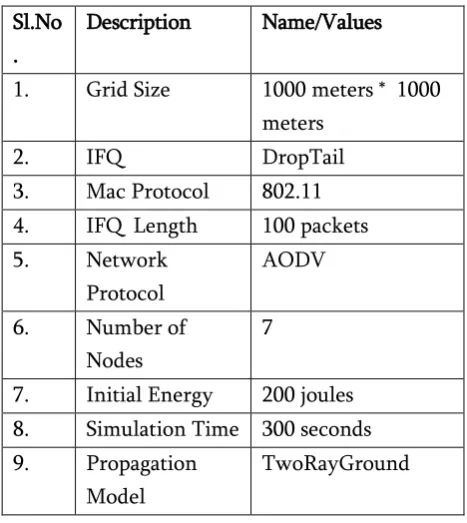
We carry out the simulation on 7 nodes.The nodes 1, 2,3 and 4 are considered as source nodes that generate huge amount of data. Nodes 6 and 7 will be the destination nodes. Node 5 is the intermediate node that transmits the data from source nodes to destination node.
Table 1. Details of Simulation Parameters Sl.No
.
Description Name/Values
1. Grid Size 1000 meters * 1000 meters
2. IFQ DropTail
3. Mac Protocol 802.11 4. IFQ Length 100 packets 5. Network
Protocol
AODV
6. Number of Nodes
7
7. Initial Energy 200 joules 8. Simulation Time 300 seconds 9. Propagation
Model
(a) (b)
(c)
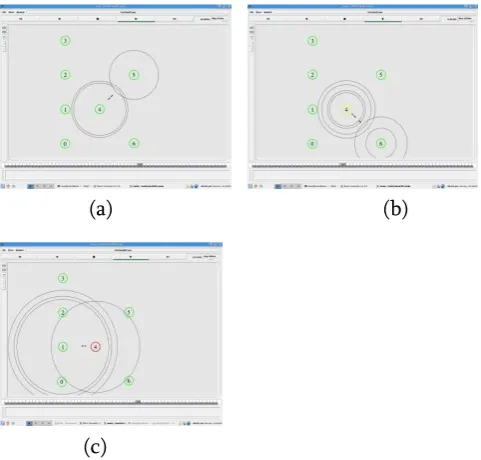
Figure 1. (a) Topology of 7 nodes in 1000m x 1000m boundary.
(b) Node 4 changes its colour from green to yellow. (c) Node 4 changes its colour from yellow to red.
Node 5 loses most of its energy in receiving and transmitting packets from source nodes to destination nodes .The color of node 5 changes to red when only 20 % of initial energy is left.
B. Checking residual energy and rate of energy consumption (REC) of a node using concept of a mobile relay
The simulation is performed on 7 mobile nodes + 1 mobile relay i.e. 8 nodes. Based on the setup, the nodes will change their colors from green to yellow based on the measure of the residual energy. Green color indicates that the node is not in critical state and service of mobile relay is not required. Yellow colour indicates that the node is in critical state and the service of a mobile relay is mandatory to share the load. Node 8 acts as a mobile relay and will keep moving around the topology waiting to be called for service by the critical nodes. Thus, when a node becomes critical based on REC and the measure of residual energy, the node will change its color from green to yellow and calls for a mobile relay.Once the rate of energy consumption (REC) returns to an efficient level the node changes its
color from yellow to green again and will release the mobile relay, so that it can provide service to other critical nodes.
(a) (b)
(c)
Figure 2. (a) Topology of 8 nodes. (b) Service of mobile relay is called to share the load. (c) Mobile
relay is released and node 5 becomes green. 1) Monitoring only residual energy of a node without using mobile relays
The simulation will be performed for 300 seconds
and the
residual energy will be observed for critical nodes at the end of the simulation. In this scenario we have only one critical node (node 5).
Critical Node ID Residual Energy
5 7 joules
2) Monitoring residual energy and REC of a node and use of a mobile relay
Critical Node ID Residual
energy
5 15 joules
3)Calculating the number of dropped packets at a congested node without using mobile relays
Congested node id
Total packets sent by sources
Total packets received by destinations
4)Calculating the number of dropped packets at a congested node using mobile relays
Congeste congestion in mobile ad hoc network is proposed.
Energy efficiency is most important because all the nodes are battery powered. Failure of one node may affect the entire network. If a node runs out of
energy the probability of network failure will be increased. Since all mobile nodes have limited power supply, energy depletion has become one of the mobile relay decreases the power consumption in the node by balancing the load. When the rate of energy consumption that is based on the application returns to efficient levels, the mobile relay is released so that it can be used for the service of other critical nodes. This technique can be applied to any protocol used in Mobile Ad-hoc Networks(DSDV, DSR, AODV, etc).
The second major problem is congestion in Mobile Ad-hoc Network. when the node becomes congested (starts dropping the packet due to queue overflow), it calls for the service of a mobile relay . The mobile improving the overall performance of the network.
VI.
REFERENCES
1. Elizabeth M. Royer, C-K Toh “A Review of Current Routing Protocols for Ad-hoc Mobile Wireless Networks”, Dept. of Electrical & Computer Engineering, University of California, Santa Barbara and Dept. of Electrical & Computer Engineering, Georgia Institute of Technology, Atlanta.
2. Sanjay Chatterjee, Siuli Roy, Somprakash Bandyopadhyay, Tetsuro Ueda, Hisato Iwai, Sadao Obana “A Power Aware Routing Strategy for Ad-hoc Networks with Directional Antenna Optimizing Control Traffic and Power Consumption”, Indian Institute of Management, Energy Efficient Algorithm
start
1. Input the no of nodes(n)
2. Initialize the energy values for the nodes. 3. Input the mobile relay node(+1).
Node=critical; //call for mobile relay
Else
Node!=critical;
}
7.measure the energy of all the nodes and no of packets dropped
Calcutta, India and ATR Adaptive Communications Research Laboratories, Kyoto, Japan
3. Elizabeth M. Royer, C-K Toh “A Review of Current Routing Protocolsfor Ad-hoc Mobile Wireless Networks”, Dept. of Electrical &Computer Engineering, University of California. Atlanta.
4. Chao Gui, Prashant Mohapatra “SHORT: Self Healingand Optimizing Routing Techniques for Mobile Ad-hocNetworks”, Computer Science Department, University of California, Davis. 5. Sanjay Chatterjee, Siuli Roy, Somprakas
Bandyopadhyay, Tetsuro Ueda, Hisato Iwai, Sadao Obana“A Power Aware Routing Strategy for Ad-hoc Networks with Directional Antenna Optimizing Control Traffic and PowerConsumption”, Indian Institute of Management,Calcutta, India and ATR Adaptive CommunicationsResearch Laboratories, Kyoto, Japan.
6. Wei Wang, Vikram Srinivasan, Kee-Chaing Chua “Extending theLifetime of Wireless Sensor Networks through Mobile Relays”,EEE/ACM Transactions on Networking, Vol. 16, No. 5, October 2008.
7. Raju Kumar, Riccardo Crepaldi, Hosam Rowaihy, Albert F. Harris III,Guohong Cao, Michele Zorzi, Thomas F. La Porta “Mitigating Performance Degradation in Congested Sensor Networks”, IEEETransactions on Mobile Computing, Vol. 7, No. 6, June 2008.
8. Xiaoqin Chen, Haley M. Jones, A.D.S Jayalath “Congestion Aware Routing Protocol for Mobile Ad-hoc Networks”, Department of Information Engineering, CECS, The Australian NationalUniversity,Canberra.
9. Janhavi V,Yuvraju B.N,”A Unified method to solve Energy Depletion and Congestion problem using Mobile Relay in MANETs”.