Alignment-based reordering for SMT
Maria Holmqvist, Sara Stymne, Lars Ahrenberg and Magnus Merkel
Department of Computer and Information Science Link¨oping University, Sweden
Abstract
We present a method for improving word alignment quality for phrase-based SMT by reordering the source text according to the target word order suggested by an initial word alignment. The reordered text is used to create a second word alignment which can be an improvement of the first alignment, since the word order is more similar. The method requires no other pre-processing such as part-of-speech tagging or parsing. We report improved Bleu scores for English–German and English–Swedish translation. We also examined the effect on word alignment quality and found that the reordering method increased recall while lowering precision, which partly can explain the improved Bleu scores. A manual evaluation of the translation output was also performed to understand what effect our reordering method has on the translation system. We found that where the system employing reordering differed from the baseline in terms of having more words, or a different word order, this generally led to an improvement in translation quality.
Keywords:statistical machine translation, reordering, evaluation
1.
Introduction
Word order differences between languages create several problems for statistical machine translation systems. They present a challenge in translation decoding, where trans-lated phrases must be rearranged correctly, but also during word alignment with statistical methods. For example, the placement of finite verbs in German at the end of a clause makes English and German verbs notoriously difficult to align because of their different positions in the sentence.
In this paper we present a pre-processing method that reorders source words according to the corresponding tar-get word order suggested by an initial word alignment. By making the two texts more similar we hope to address some of the difficulty that word order differences pose to word alignment. A second word alignment is performed on the reordered source and target text when the word order is more similar.
2.
Word order and SMT
In phrase-based SMT (PBSMT) the decoder tries to find the most probable translation of a sentence by combining trans-lated phrase segments into a well formed target sentence. The final choice of phrases and the order in which they are placed are based on a number of weighted probabilistic fea-tures. The phrase translation model and reordering model are estimated from a word aligned parallel corpus. Word alignment is an important step in training a SMT systems since it determines the probabilities of phrase translations and reordering.
During training, state-of-the-art statistical word ment methods may have difficulty finding the correct align-ment of words that are placed at considerably different po-sitions in the source and target sentence. Errors or miss-ing alignments will add incorrect phrase translations to the translation model, and produce a less accurate reordering model as well as less accurate estimations in the reordering model.
3.
Related work
The challenges of word order differences have been ap-proached in different ways. Since the original word-based distortion models of Brown et al. (1993) reordering models learnt in training and employed by the decoder has become more and more sophisticated, often using both lexical and syntactic features (Koehn et al., 2005; Xiang et al., 2011).
Another approach is to modify the source text before training by making the order of words and phrases more similar to the target language. The most successful of these approaches employ some form of syntactic analysis and the reordering rules can be handwritten as in Collins et al. (2005), or automatically extracted from parallel text as in Xia and McCord (2004); Elming (2008). Language specific reordering rules are applied to the source text and a system is built that translates from reordered source text to target text. This means that a source text must first be reordered using the same reordering rules before it can be translated by the system.
The pre-processing approach has two possible benefits. First, the most obvious benefit is that some of the difficulty of reordering is removed from the translation step. Since the bulk of reordering has already been performed on the source text the translation system will only need to find ap-propriate phrase translations and do minor changes in word order.
The second benefit appears during the training of the translation system since statistical word alignment meth-ods perform better on translations with similar word order. Improved word alignment quality may also have a positive effect on the translation model and thereby improve trans-lation quality.
than from its effect on reordering during decoding. The effect on alignment quality was isolated by reordering the source text before word alignment, translating alignments back to match the words of the original text and then train-ing the final system on the original text, but with the new (improved) alignment.
4.
Alignment-based reordering
In this paper, we present a simple, language-independent reordering method to improve word alignment quality and apply it to English–German and English–Swedish transla-tion. After reordering we perform statistical word align-ment on the reordered corpus. The hypothesis is that the reordering will result in improved word alignments which in turn will result in a better translation model and better translation quality. Our reordering algorithm is simple, yet effective. It is based on the alignments created by an ini-tial word alignment on the original texts. It does not re-quire any handcrafted or automatically acre-quired grammati-cal reordering rules and the process is completely language-independent. The following steps are performed:
(a) perform statistical word alignment with Giza++ (Och and Ney, 2003) on the original texts
(b) reorder one of the texts according to the word align-ments
(c) perform statistical word alignment on the pre-processed texts
(d) keep the new word alignments but transfer them back to the original texts to connect words in their original order
The result is a parallel text with potentially improved word alignment from which we build a standard phrase-based SMT system that translates from source to target text.
4.1. Reordering algorithm
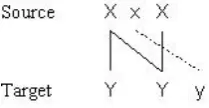
The reordering algorithm puts the words in one text in the order of the corresponding words in the other text. The initial word-to-word correspondences are created us-ing Giza++ which produces two word alignments one in each translation direction. We then apply a standard al-gorithm for combining both alignments into one bidirec-tional alignment. The result is an unconstrained align-ment which may contain incomplete alignalign-ments where an aligned phrase has not been fully linked as the lines show in Figure 4.1.. Aligned phrases may also contain gaps that consist of words that connect to a phrase in a different po-sition (dashed line in Figure 4.1.) or words that have no alignment.
Figure 1: Incomplete alignment with gap.
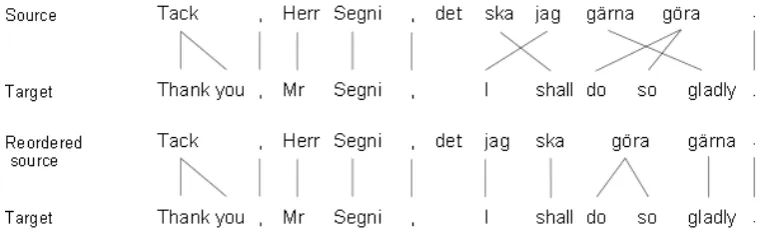
A correctly unaligned word has no counterpart in the tar-get sentence and by removing it we would make source and target sentences more similar which is the goal of the re-ordering. However, if the null-alignment is an error (which is often the case) we want to keep the word in the reordered sentence so it can be correctly aligned in the second align-ment pass. We therefore keep all words from the source, and move all gap words (unaligned or not) to the right of the containing phrase. The reordering is performed in the following steps, illustrated in Figure 2:
1. Reorder discontinuities by placing the gap words to the right of the containing phrase
2. Add dummy target words for unlinked source words
3. Identify all word aligned groups (phrase alignments)
4. Reorder the source phrases according to the alignment to target phrases.
5.
Reordering experiments
We have performed experiments on English-German and English-Swedish PBSMT. Systems are built using Moses (Koehn et al., 2007). We report results in Bleu (Papineni et al., 2002) and Meteor ranking scores (Agarwal and Lavie, 2008).
5.1. Experiment corpora
Table 1 presents an overview of the corpora used in the experiments. The German–English data was released as shared task data in WMT2009 and WMT2010 workshops (Callison-Burch et al., 2009). This dataset contains both in-domain (news text) and out-of-in-domain data (Europarl) with a limited amount of in-domain parallel data. The English– Swedish corpora were extracted from the Europarl data and comes in two sizes.
Parallel Monolingual
Name ep News ep News
En–De wmt09 1,3M 81141 - de 9,6M
en 21,2M
wmt10 1,5M 100K de 17,5M
en 48,6M
En–Sv ep700K 700K - 700K
-ep100K 100K - 100K
-Table 1: News and Europarl (ep) corpora used in experi-ments. Size in number of sentences.
5.2. English–German translation
The German–English and English–German translation sys-tems consist of two translation models, one from each par-allel data set, a reordering model trained on the Europarl data and sequence models on surface form and part-of-speech from all news data. The system is described in (Holmqvist et al., 2009).
Figure 2: Source text reordered according to alignment with target sentence.
two directed Giza++ alignments using the grow-diag-final-and (gdfa) symmetrization heuristic which gives a good precision-recall trade-off suitable for PBSMT. The results on test data (1025 sentences) are shown in Table 2 and 3.
En–De De–En
BLEU Meteor-r BLEU Meteor-r
Baseline 14.62 49.48 19.92 38.18
Reorder (src) 14.63 49.80 20.54 38.86 Reorder (trg) 14.51 48.62 20.48 38.73
Table 2: Results of WMT09 experiments.
En–De De–En
BLEU Meteor-r BLEU Meteor-r Baseline 14.24 49.41 18.50 38.47
Reorder 14.32 49.58 18.77 38.53
Table 3: Results of WMT10 experiments.
We compared the effects of reordering the source text versus the target text and found that reordering the source resulted in better Bleu scores. Reordering improved trans-lation from German into English more than in the other direction. Table 2 shows the most notable improvements on both metrics, +0.6 in Bleu and +0.7 in Meteor-ranking. A possible reason for this result is that alignment quality might be more important in the German–English direction.
5.3. English–Swedish translation
In the English-Swedish experiments we compared the ef-fect of reordering on two datasets, a small set of 100K sen-tences and a larger set of 700K sensen-tences. The results in Table 4 show that the reordered system outperformed base-line in terms of Bleu for both datasets and in both transla-tion directransla-tions. However, the improvement was only sta-tistically significant for the large corpus and in translation into Swedish. In terms of word alignment quality, both reordered alignments had higher recall than the baseline alignment, at the expense of lower precision.
5.3.1. Symmetrization heuristic
Creating a word alignment consists of three steps (1) use Giza++ to create 1-to-n alignments from source to target (2) use Giza++ to create 1-to-n alignments in the other
di-rection, and (3) apply a symmetrization heuristic to create a bidirectional m-to-n word alignment.
The symmetrization heuristic determines precision and recall of the word alignment. By keeping only links that the two alignments have in common (intersection) we get a high precision/low recall alignment. Most useful heuris-tics start from the intersection and add links from the union using the intersection as a guide. The grow-diag (gd) heuristics adds links that are adjacent to previously aligned words. The grow-diag-final-and (gdfa) heuristic also adds links that connect previously unaligned words. The gdfa heuristic has higher recall than gd and is often the preferred heuristic for building PBSMT systems.
When creating a word-alignment in a reordered system we perform two separate alignments. The first alignment is the basis of our reordering. The second alignment is per-formed on the reordered corpus and it is from this alignment that we extract the phrase table for our translation model.
In the experiments reported above, both word alignments have been performed with the gdfa heuristic. However, there is reason to believe that the reordering algorithm may perform better if it bases the reordering on an align-ment with higher precision, i.e., the reorderings that take place will be more accurate while fewer words will be re-ordered. To test this hypothesis we built systems using dif-ferent combinations of gd and gdfa alignments and mea-sured word alignment and translation quality. The results are shown in Table 5 where First denotes the word align-ment performed before reordering and Final the alignalign-ment that the translation model is based on. Only one alignment is performed in the baseline systems.
We found that using gd for the first alignment gave equal or better results for en-sv translation but worse results for sv-en. Word alignment precision and recall for this setup (gd-gdfa) were worse than gdfa-gdfa. An alignment combi-nation of gd-gd showed improvements in Bleu comparable to gdfa-gdfa for en-sv but not for sv-en.
6.
Manual Evaluation
System Precision Recall F BLEU En–Sv Sv–En
100k Base 81.65 75.07 78.22 23.41 28.35
Reo 80.22 75.49 77.78 23.54 28.60
700k Base 83.82 77.78 80.69 24.62 30.86 Reo 82.78 78.54 80.61 24.96* 30.98
Table 4: Translation and alignment quality for English–Swedish (*Significant at p<0.05 using approximate randomization (Riezler and Maxwell, 2005))
First Final Precision Recall F BLEU
En–Sv Sv–En
- gd 85.31 76.86 80.86 24.71 30.73
gd gd 83.46 77.70 80.48 24.93 30.88
gdfa gd 83.33 78.20 80.68 24.70 30.49
- gdfa 83.82 77.78 80.69 24.62 30.86
gdfa gdfa 82.78 78.54 80.61 24.96* 30.98 gd gdfa 82.69 78.28 80.43 25.12* 30.73
Table 5: A comparison of symmetrization heuristics (ep700k).
6.1. System comparison
A comparison between the reordered system and the base-line system based on the large English-Swedish corpus show that the phrase table of the reordered system is almost 10% smaller than the baseline table. One reason could be that higher word alignment recall creates fewer alternative phrases that apparently still produces good translations.
We also compared the tuned weights of the different sys-tem components. By comparing the tuned weights of com-ponents that rely on the word alignment with the tuned weights of the monolingual language models we wanted to find out if in fact, the improvement in translation quality come from a stronger reliance on the language model which would indicate that alignment-based reordering created a less accurate translation model. Fortunately, this was not the case as the language model weight was slightly higher for the baseline system (0.048 vs. 0.045). On the contrary, it shows that more importance is attributed to the translation model created from alignment-based reordering.
Another difference in the tuned weights is that the re-ordered system favors slightly shorter output than the base-line system. This is determined by the tuned word penalty parameter which was set to -0.096 and -0.102, respectively. Another thing to note is that the language model has higher weight in the Swedish–English system than the English–Swedish, which explains the smaller effect of re-ordering on the Swedish–English systems.
6.2. Manual translation evaluation
The English–Swedish reordered system achieved a statis-tically significant improvement in Bleu over the baseline. To find out what this actually means a manual evaluation was performed on 133 sentences that differed between sys-tems. The two systems were anonymized and three an-notators were asked to categorize each difference between translations into one of six categories, using the Blast an-notation tool (Stymne, 2011). Annotators also had to judge if the difference was better in one of the systems or similar
in quality. The classification of each difference and which system this difference was in favor of is shown in Table 6.
Category Reordered Baseline Neutral
Word choice 91 111 223
Agreement 29 32 53
Word order 18 7 14
Addition 90 22 23
Deletion 29 66 27
Other 2 2 4
Total 31% 28% 41%
Table 6: Frequency of judged improvements per system and divergence category.
Three categories have a clear effect in favor of one sys-tem: Addition, Deletion and Word order. Added word(s) tend to be in favor of the reordered system and deletions are often favorable to the baseline system. Both systems tend to benefit from having the extra word, but the reordered system has the most additions. Each sentence from the re-ordered system was labeled as better, worse or neutral com-pared to the sentence from the baseline system based on a majority vote of the non-neutral differences from each an-notator (Table 7). The difference between reordered and baseline was not significant using Wilcoxon signed rank test. The sentence level judgments were fairly consistent between annotators. All three annotators agreed on 54% of the sentences and at least two agreed on 97%.
Reordered Baseline Neutral
Sentences 50 42 43
Table 7: Frequency of judged improvements per system at the sentence-level.
7.
Conclusion
for phrase-based SMT systems. Translation experiments on German–English and Swedish–English showed improve-ments in translation quality as measured in Bleu. The improvements were larger for German-English translation than English–German, and larger for English–Swedish than Swedish–English Manual evaluation of the differences in translations from reordered and baseline systems revealed that reordered systems are better in cases of additions and word order differences. In terms of word alignment quality, improved Bleu score often correlates with improved word alignment recall. Reordered systems tend to have higher recall which results in smaller phrase translation models.
8.
References
Abhaya Agarwal and Alon Lavie. 2008. Meteor, M-BLEU and M-TER: Evaluation metrics for high-correlation with human rankings of machine translation output. In Proceedings of the Third Workshop on Statistical Ma-chine Translation, pages 115–118, Columbus, Ohio. Peter F. Brown, Vincent J. Della Pietra, Stephen A.
Della Pietra, and Robert L. Mercer. 1993. The mathe-matics of statistical machine translation: Parameter esti-mation. Computational Linguistics, 19(2):263–311. Chris Callison-Burch, Philipp Koehn, Christof Monz, and
Josh Schroeder. 2009. Findings of the 2009 Workshop on Statistical Machine Translation. In Proceedings of the Fourth Workshop on Statistical Machine Translation, pages 1–28, Athens, Greece.
Marine Carpuat, Yuval Marton, and Nizar Habash. 2010. Improving Arabic-to-English statistical machine trans-lation by reordering post-verbal subjects for alignment.
InProceedings of the 48th Annual Meeting of the ACL,
Short papers, pages 178–183, Uppsala, Sweden. Michael Collins, Philipp Koehn, and Ivona Kucerov´a.
2005. Clause restructuring for statistical machine trans-lation. InProceedings of the 43rd Annual Meeting of the ACL, pages 531–540, Ann Arbor, Michigan.
Jakob Elming. 2008. Syntactic reordering integrated with phrase-based SMT. InProceedings of the Second Work-shop on Syntax and Structure in Statistical Translation, pages 46–54, Columbus, Ohio, USA.
Maria Holmqvist, Sara Stymne, Jody Foo, and Lars Ahren-berg. 2009. Improving alignment for SMT by reordering and augmenting the training corpus. In Proceedings of the Fourth Workshop on Statistical Machine Translation, pages 120–124, Athens, Greece.
Philipp Koehn, Amittai Axelrod, Alexandra Birch Mayne, Chris Callison-Burch, Miles Osborne, and David Talbot. 2005. Edinburgh system description for the 2005 IWSLT speech translation evaluation. InProceedings of the In-ternational Workshop on Spoken Language Translation, Pittsburgh, Pennsylvania, USA.
Philipp Koehn, Hieu Hoang, Alexandra Birch, Chris Callison-Burch, Marcello Federico, Nicola Bertoldi, Brooke Cowan, Wade Shen, Christine Moran, Richard Zens, Chris Dyer, Ondrej Bojar, Alexandra Constantin, and Evan Herbst. 2007. Moses: Open source toolkit for statistical machine translation. InProceedings of the 45th Annual Meeting of the ACL, Demonstration session, Prague, Czech Republic.
Franz Josef Och and Hermann Ney. 2003. A system-atic comparison of various statistical alignment models. Computational Linguistics, 29(1):19–51.
Kishore Papineni, Salim Roukos, Todd Ward, and Wei-Jing Zhu. 2002. BLEU: A method for automatic evaluation of machine translation. InProceedings of the 40th An-nual Meeting of the ACL, pages 311–318, Philadelphia, Pennsylvania.
Stefan Riezler and John Maxwell. 2005. On Some Pit-falls in Automatic Evaluation and Significance Testing for MT. InProceedings of the ACL-05 Workshop on In-trinsic and ExIn-trinsic Evaluation Measures for MT and/or Summarization, Ann Arbor, MI, USA.
Sara Stymne. 2011. Blast: A tool for error analysis of ma-chine translation output. InProceedings of the 49th An-nual Meeting of the ACL, demonstration session, Port-land, Oregon, USA.
Fei Xia and Michael McCord. 2004. Improving a statisti-cal MT system with automatistatisti-cally learned rewrite pat-terns. In Proceedings of the 20th International Con-ference on Computational Linguistics, pages 508–514, Geneva, Switzerland.