International Conference on Machine Learning and Computational Intelligence-2017 International Journal of Scientific Research in Computer Science, Engineering and Information Technology © 2017 IJSRCSEIT | Volume 2 | Issue 7 | ISSN : 2456-3307
A Robust and Secure Method of Copyright Protection for Digital
Videos using Split Watermark Embedding Algorithm : SWEA
Jabir Ali, Prof. S.P. Ghrera
Computer Science & Engineering Jaypee University of Information Technology Solan, Himachal Pradesh, India
ABSTRACT
In the current scenario, Copyright Protection of the digital media is a serious issue and watermarking is an important method of protecting the intellectual property and copyright of the digital media. In this paper, we proposed a robust and secure algorithm SWEA (Split Watermark Embedding Algorithm) for digital videos. SWEA has three important parts, first one is splitting of original watermark into small pieces, second is embedding of the small pieces of watermark into the detail coefficients of identical frames (I Frames)of digital video and the third is extracted these small pieces and merge them in an efficient manner. Watermark data is inserted into the detail coefficients in an adaptive manner based on the energy of high frequency. The proposed algorithm has undergone various attacks, such as compression, uniform noise, Gaussian noise frame repetition and frame averaging attacks. The proposed algorithm, sustain all the above attacks and offers improved performance compared with the other methods from the literature.
Keywords : SWEA, DWT, I-Frame, Detail Coefficient, H.264, MPEG-4., SCD
I.
INTRODUCTIONThe future growth of the domestic digital copyright protection products basically depends on real network and Microsoft windows media. A huge amount of multimedia data has been exchanged with the internet but the security is provided to protect the data is not enough. There are various approaches for data security such as steganography [1], fingerprinting and copyright protection etc. In this paper we have introduced a new copyright protection technique i.e. SWEA. For this, a block of digital watermark or digital pattern (text, image, audio or video) is inserted inside Digital Video Frames. In this paper, digital video copyright protection using DWT [1]-[5] is proposed. Extraction of I-frame, watermark pre-processing, watermark embedding and extraction, piracy tracking are implemented. In the case of
SWEA, it is very hard to detect the original pattern of inserted watermark. In this paper, the robustness and security of inserting a digital pattern or watermark and transparency of watermarked media is improved using SWEA.
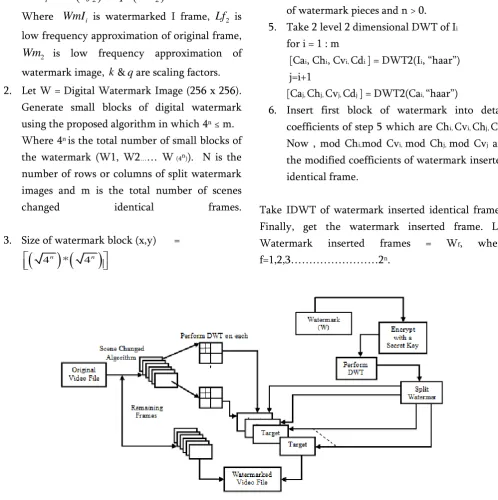
In Figure 1 we are showing the block diagram of our algorithm. Here we have applied SWEA (Split watermark embedding algorithm) algorithm on original watermark and SCD (Scene changed detection) algorithm on original video. Now to extract the watermark, apply the de-watermarking algorithm on watermarked video.
some experimental results and evaluates the performance of the proposed technique. At the end, conclusions are drawn in Section IV and provide some future work directions.
Figure 1. Block Diagram of Video Watermarking
II.
PROPOSED WATERMARKING TECHNIQUEA gray level image (256 x 256) is used as a watermark signal. For embedding the watermark we have taken „Foreman‟ video sequence. After applying scene changed algorithm [6] on these video sequences, 77 scenes changed frames are obtained. Before embedding the watermark inside the original video, preprocess the watermark and input video.
2.1.Watermark Pre-Process
For the process of watermark embedding, scale the watermark to a particular size with the help of equation 1. Fig. 1 shows an original watermark juit.jpg (256 x 256).
4n ; 0
m n
(1)
Where m is the total no. of scene changed frames and 4n is the total number of split watermark in which n
is an integer. In this case, the watermark will be divided into 4n smallimages using SWEA that are
shown in Figure 1.
(a) (b)
(c)
Figuer 2. Watermark Pre-process
(a) Original Watermark. (b) Split watermark in 8x8 using proposed algorithm. (c) 64 small pieces of
original watermark.
The MPEG-4 video coding standard has the sequence of GOPs (group of pictures) and each GOP has 12 frames of images which are managed as IBBPBBPBBPBB where I, P and B areidentical frame, predictive frame and Bidirectional frame respectively.
2.2.Video Pre-Process
In Figure 2, a scene changed detection algorithm is applied on input video sequence and get the non-overlapping GOP [7], [8]. Select the I-frame with the help of the identical frame selection scheme. After getting the I-frames, apply 2-level DWT and embed the watermark information.
2.3.Watermark Embedding Algorithm
1. Apply a scene changed detection algorithm [6] on the original video sequence (Ovideo) and then
divide the each scene into non-overlapping
Video File Watermarking
Algorithm Copyright
Information
Video File
De-Watermarking Algorithm
group of pictures. Each group of pictures has an Identical frame (I). Select all the I-frame from input video for embedding the watermark.
Where is watermarked I frame, is
low frequency approximation of original frame, is low frequency approximation of
watermark image, & are scaling factors. 2. Let W = Digital Watermark Image (256 x 256).
Generate small blocks of digital watermark using the proposed algorithm in which 4n ≤ m.
Where 4n is the total number of small blocks of
the watermark (W1, W2…… W (4n)). N is the
number of rows or columns of split watermark images and m is the total number of scenes
changed identical frames.
3. Size of watermark block (x,y) =
4. while m ≥ 4n, Ii = W4n Ii, Ii is Original identical
frame (where small blocks of watermark has to be embedded), W4n Ii = watermarked identical
frame, i = 1,2,3………m, 4n = total number
of watermark pieces and n > 0. 5. Take 2 level 2 dimensional DWT of Ii
for i = 1 : m
[Cai, Chi, Cvi, Cdi ] = DWT2(Ii, “haar”)
j=i+1
[Caj, Chj, Cvj, Cdj ] = DWT2(Cai, “haar”)
6. Insert first block of watermark into detail coefficients of step 5 which are Chi, Cvi, Chj, Cvj.
Now , mod Chi,mod Cvi, mod Chj, mod Cvj are
the modified coefficients of watermark inserted identical frame.
Take IDWT of watermark inserted identical frames. Finally, get the watermark inserted frame. Let Watermark inserted frames = Wf, where
f=1,2,3………2n.
Figure 3. Video Pre-process
2.4. Watermark Detection Algorithm
1. Apply a scene changed detection algorithm [6] on the watermarked video sequence (Wvideo) and then divide the each scene into non-overlapping GOPs. Select all I frames from input watermarked video. Take the watermarked frame (Wf) (I-frame) and
original identical frames (Ii). Apply DWT on both watermarked image and identical frames.
2. Subtract first level detail coefficients of the watermarked frame from the first level detail coefficients of original I frame which are mod Chi, mod Cvi, Chi and Cvi respectively.
2
2
i
WmI
k
Lf
q
Wm
i
WmI Lf2
2 Wm
k q
4n
* 4n
Now, NewChi = mod Chi - Chi NewCvi = mod Cvi – Cvi
3. Calculate cross correlation between the new values of detail coefficients (NewChi and NewCvi) and the detail coefficients of original watermark.
4. If correlation = high
Then, Stop the execution. Detected watermark is similar to original watermark.
else
Take both detail coefficients together and repeat from step 3.
else if
Take 2-level detail coefficients and repeat from step 3 until the detected watermark will get similarity with original watermark.
else
Watermark not found.
2.5. Merging small pieces of watermark images Propose watermark split and detection algorithm on the watermarked I-frames, collect all the small pieces of watermark picture and embed one after another. Vertical and horizontal axes of final matrix picture have the same rule. Now Scan xy where x = number of rows and y = number of columns. These pictures are stored in the program folder with the same name. With the help of „for‟ loop all grayscale images are used. Total no of scene changed frames are 77 for foreman video.
Now with the SWEA- : 43 ≤ 77 for n =3. Then, the watermark is divided into 4n smallblocks are 64. Now, size of watermark block for foreman video = 8 x 8.
Now applied watermark detection algorithm on the watermarked I frames and collect all the small pieces of watermark picture. When one picture stops, a new picture always starts. It means that these pictures are not having over-end points. Vertical and horizontal axes of final matrix picture have the same rule.
Now Scan xy
Where x = number of rows y = number of columns
We have the pictures of an object with the help of a proposed watermark split algorithm. These pictures are stored in the program folder with the same name given by the proposed watermark split algorithm.
This algorithm creates a new empty image frame. With the help of „for‟ loop all grayscale images are used. In Matlab, „imread‟ function is used to read images.
These empty image frames are composed from the read images & finally, the output image is created.
In Figure 5 we have smaller pieces of split watermark and in Figure 6 we have shown the process of merging the small pieces of split watermark. In the next part it has been shown in the form of a matrix.
img[1]
img[n]
[n[k] m[l]]
n[k]m[l]
Foreman video and Car race video respectively. Now with the help of the proposed watermark split algorithm generate small blocks of digital watermark as follows for Foreman video.III.
EXPERIMENTAL RESULTS
shows original video frames and 3(b) watermarked frames using SWEA, 3(c) extracted watermark pieces and 3(d) extracted watermark. TABLE I shows the results, when the size of inserting a watermark is small, the PSNR of watermarked frame will reach too high.
(a)
(b)
(c)
Figure 4. SWEA algorithm on Foreman Video. (a) Original Frames of Foreman video. (b)
Watermarked frames of Foreman video. (c) Extracted watermark.
Gamma correction
0.5
Gamma correction 2
Gamma correction 4
A
tt
ack
ed fr
am
e
PSNR=25.3 4 dB
PSNR = 19.80 dB
PSNR = 13.54 dB
Ex
tract
ed
wa
ter
m
ar
k
Figure 5. Block Diagram of Video Watermarking
Table 1. Experimental results for car race video. Size of
inserted watermark
PSNR (dB)
MSE
8 x 8 40.1001 6.3544 16 x 16 39.6682 7.0188 32 x 32 39.4523 7.3765 64 x 64 39.4006 7.4648 128 x 128 39.3987 7.4893 256 x 256 39.3812 7.4982
TABLE 2. EXPERIMENTAL RESULTS FOR WAKNA ROAD VIDEO.
Size of inserted watermark
PSNR MSE
IV.
CONCLUSION
The proposed approach is more efficient because the watermark has been divided into small pieces and every piece of watermark has a very low space. So it increases the imperceptibility of watermarked frame just because of its small size. The proposed approach also increases privacy and security of the original watermark because it is very hard to detect the pattern of inserted watermark by using splittance technique.
Video watermarking is an essential need of copyright protection and a lot of research is still going on to find out the new methods for security and privacy of the multimedia contents. Current methods for video watermarking are extended form of image watermarking and there is a great scope of innovation. Research can be carried out to establish new strategies for digital video copyright protection which makes the system more robust and efficient.
V.
REFERENCES
[1]. I. J. Cox, M. L. Miller, J. A. Bloom, J. Fridrich, and T. Kalker, "Digital Watermarkingand Steganography," in 2nd ed. San Mateo, CA, USA: Morgan Kauffman, 2008.
[2]. X. Niu, S. Sun, "A new wavelet-based digital watermarking for video, "In Proceedings of the IEEE Digital Signal Processing Workshop", pp. 1–6. Texas, 2000.
[3]. Y. Wang, J. F. Doherty, and R. E. Van Dyck, "A wavelet-based watermarking algorithmfor ownership verification of digital images," IEEE Trans. Image Process, vol. 11, no. 2,pp. 77–88, Feb. 2002.
[4]. P. Campisi and A. Neri, "Perceptual video watermarking in the 3D-DWT domain using amultiplicative approach," in Lecture Notes in Computer Science, vol. 3710. New York,NY, USA: Springer-Verlag, pp. 432–443, Sep. 2005.
[5]. E. Ganic, Eskicioglu, "Robust DWT-SVD domain image watermarking: embedding datain all frequencies," In Proceedings of the ACM Multimedia and Security Workshop, pp.166– 174, 2004.
[6]. I.B Shahraray "Scene Change Detection and Content-Based Sampling of VideoSequences," in SPIE 2419 (Digital Video Compression: Algorithms and Technologies):2–13, 1995. [7]. H. Khalilian, S. Ghaemmaghami, and M.
Omidyeganeh, "Digital video watermarking in3D ridge let domain," in Proc. 11th ICACT, vol. 3, pp. 1643–1646, Feb. 2009.
[8]. S. Gandhe, U. Potdar, and K. Talele, "Dual watermarking in video using discrete wavelet transform," in Second International Conference on Machine Vision, ICMV ‟09, pp. 216 –219, Dec. 2009.
[9]. George, M., J. Chouinard and N. Georganas, "Digital watermarking of images and video using direct sequence spread spectrum techniques," Proceeding of the IEEE Canadian Conference on Electrical and Computer Engineering, May 9-12, IEEE XplorePress, Edmonton, Canada, pp:116-121H. Huang, C. Yang, and W. Hsu, "A video watermarking technique based on pseudo-3D DCT and quantization index modulation," IEEE Trans. Inf. Forensics Security, vol. 5, no. 4, pp. 625– 637, Dec. 2010.
[10]. S. Bhattacharya, T. Chattopadhyay, and A. Pal, "A survey on different video watermarking techniques and comparative analysis with reference to h. 264/avc," in IEEE Tenth International Symposium on Consumer Electronics, ISCE‟06. IEEE, pp. 1–6, 2006. [11]. H. Khalilian and I. V. Bajic, "Multiplicative
[12]. B. Yeo and B. Liu, "Rapid scene change detection on compressed video," in IEEE Trans. Circuits Syst. Video Technol., vol. 5, no. 6, pp. 533–544, Dec. 1995.
[13]. F. Hartung and B. Girod, "Watermarking of uncompressed and compressed video," in Signal Process., vol. 66, no. 3, pp. 283–301, May 1998. [14]. A. Hampapur, R Jain and T. Weymouth,
"Digital Video Segmentation," In: Limb J, Blattner M (eds) Proc Second Annual ACM Multimedia Conference and Exposition, ACM, New York, NY, USA, pp 357–364, 1994.
[15]. M. A. Akhaee, S. M. E. Saheaeian, and F. Marvasti, "Contourlet based image watermarking using optimum detector in a noisy environment," IEEE Trans. Image Process., vol. 19, no. 4, pp. 967–980, Apr. 2010. [16]. B Shahraray "Scene Change Detection and