CSEIT183165 | Received: 06 Nov 2017 | Accepted: 30 Nov 2017 | November-December-2017 [(2)6 : 1365-1371 ]
International Journal of Scientific Research in Computer Science, Engineering and Information Technology © 2017 IJSRCSEIT | Volume 2 | Issue 6 | ISSN : 2456-3307
1365
Public Infrastructure-As-A-Service Cloud Security
Dr. V. Goutham
Professor and HOD of CSE, Teegla Krishna Reddy Engineering College, Telangana , India
ABSTRACT
The public Infrastructure-as-a-Service (IaaS) cloud trade has reached a important mass within the past few years, with several cloud service suppliers fielding competitor services. Despite the competition, we discover a number of the protection mechanisms offered by the services to be similar, indicating that the cloud trade has established variety of “best-practices,” whereas different security mechanisms vary wide, indicating that there's conjointly still area for innovation and experimentation. we have a tendency to investigate these variations and potential underlying reasons for it. we have a tendency to conjointly distinction the protection mechanisms offered by public IaaS cloud offerings and with security mechanisms planned by academe over an equivalent amount.
Keywords: Security, privacy, virtualization, Distributed systems security, Networks, Cloud computing, Public Infrastructure-as-a-Service Cloud.
I.
INTRODUCTION
Cloud computing has told an excellent deal of interest in each domain and trade in recent years. With associate calculable trade size of $131B,1 there's very little doubt that it's each a thriving technology and business model. By combining technologies like virtualization, web APIs, and quick networks, cloud technology permits the provisioning and rental of figure infrastructure over the net. Similarly, by providing business benefits like physical property, the flexibility to defer capital expenditures, and also the ability to source IT administration prices, cloud businesses offer many purchasers a valuable service. Cloud computing services are often loosely classified into 3 classes supported the amount of abstraction of computing resources they supply. At the best level ar Software-as-a-Service (SaaS) clouds, which offer complete software package applications; Platform-as-a-Service (PaaS) clouds, which offer language runtimes and support libraries; and, finally, Infrastructure-as-a-Service (IaaS) clouds, which offer generic computing
infrastructure resources like virtual machines and
key-value object storage. Cloud computing
infrastructure are often public, which means that it's shared among multiple, reciprocally distrustful tenants, or it are often personal, which means that each one resources ar reserved for one tenant completely. Public clouds serve a far larger market and therefore ar typically offered at a lower value. However, the multitenant nature of public clouds means they face more security challenges than personal clouds do.
alternative customers of their CSP. These security threats are often directed at any of the 3 ancient security properties—confidentiality, integrity, and
availability—of the customer’s knowledge.
additionally, cloud computing conjointly adds a brand new, fourth property, that is that the security of the written agreement relationship between the client and also the CSP. as an example, the contract between the CSP and client could specify sure properties of the service, like constraints on the placement wherever the info ought to be keep or guarantees of a definite level of performance. A compromise of written agreement security would occur if the CSP provides a lower level of service than the client purchased or if the client were ready to steal a lot of service than was purchased.
The main goal of this survey is to spot those IaaS business best-practices and compare them with the analysis contributions from domain from identical amount of your time once this business crucial mass arose. Specifically, we have a tendency to set the subsequent goals for this survey:
1. Establish the safety mechanisms utilized in the IaaS business and establish cases wherever the business has return to a agreement on best-practice solutions.
2. Establish the IaaS security issues delineate by domain and also the mechanisms planned to resolve those issues.
Iaas Services:
An IaaS cloud provides reason and storage resources. reason resources ar provided within the variety of Virtual Machines (VMs), that are rented by customers on associate hourly basis. VMs are generally referred to as “instances” in cloud literature, and therefore the 2 are primarily equivalent. Typically, CSPs provide a menu of preconfigured VMs that customers will choose from. VMs with additional resources (i.e., quicker CPUs or additional memory) or specialised computer code can have the next hourly rate than additional basic VMs. CSPs might also bill for knowledge transferred between
VMs and hosts external to the CSP (i.e., external network traffic). several CSPs conjointly give services through that customers might rent VMs or machines on a monthly basis (as hostile hourly), however we have a tendency to exclude these as a result of they're the same as ancient hosting services and out of doors the scope of this survey.
Hypervisor:
A hypervisor may be a low-level computer code part that enables artefact element to be virtualized and divided into VMs, which may then be rented to customers by a CSP. Some samples of well-known artifact hypervisors ar Xen, KVM, VMware, and Hyper-V.
Cloud Control-Stack:
A hypervisor on its own can't be accustomed implement associate IaaS service. Customers generally act with an online interface that enables customers to remotely produce, provision, pause, resume, stop, and destroy VMs over the web. additionally, they conjointly would like associate interface to access and manage knowledge hold on in block and object storage services. A cloud control-stack implements these interfaces, still because the logic that links the customer-facing interface to low-level parts like the hypervisor, networking parts, and storage technologies. Mature cloud control-stacks can provide a spread of internet interfaces, as well as somebody's usable interface accessible via an online browser still as programmatic interfaces accessible over machine-readable text protocols like SOAP or REST.
Customers And Users:
We distinguish a client, WHO is associate entity that incorporates a account with the CSP, from a user, that is associate identity recognized by the CSP which is given bound privileges to customer-owned resources on the CSP. as an example, associate
enterprise might establish a paying client
privileges conterminous together with his or her role at intervals the enterprise. Another example may be a client WHO deploys associate application on a CSP and distributes the applying to finish users. The client can then build its deployed application a user of the CSP, therefore giving it access to parts and knowledge hosted on the CSP.
Attack Model :
Security literature from business sources typically has 2 functions. First, it serves to plug merchandise and services to potential customers by informing them of the protection mechanisms in those merchandise or services. Second, it provides documentation on the way to use the protection mechanisms for users of the merchandise and services. though the latter is usually way more elaborated than the previous, there's no express demand to stipulate the particular sort of attack or threat the mechanism is meant to shield against— this is typically left for the client to infer.
In distinction, tutorial papers in security typically determine specific threats and attackers that they'll analyze or develop solutions to defend against. As a result, once outlining the attacks and threats customers face within the cloud, we have a tendency to draw from the educational literature. though every paper solely deals with a selected threat, by measuring the threats and attack model of every paper, we will construct associate combination attack model, which may function associate attack model that to judge any security mechanism, whether or not projected in tutorial or enforced by business.
To construct this attack model, we start by 1st shaping the cloud security properties of the client that associate assaulter may need to compromise. These properties embrace ancient security properties like confidentiality, integrity, and handiness, still as a brand new one that's specific to the cloud business model, that we have a tendency to decision written agreement security
Integrity:
client integrity conjointly includes the content of client knowledge. However, since customers usually move to the cloud as a result of they'd wish to access their knowledge and applications in an exceedingly distributed setting, we have a tendency to conjointly embrace the consistency of information beneath the integrity security property. Applications might rely on the consistency guarantees of the CSP to figure properly [Terry et al. 2013; Kim and Lie 2015], and subversion of these guarantees by the cloud may end up in refined vulnerabilities, like those caused by time-of-check to time-of-use errors.
Availability:
handiness ordinarily defines whether or not CSP resources ar offered once the client needs to access them. additionally, we have a tendency to conjointly embrace sturdiness, that de- fines whether or not the info is recovered by the client if the info become unprocurable for any reason. Another connected concern is “lock-in,” wherever knowledge is also accessible, however customers ar either unable to, or face nice problem, if they require to retrieve their knowledge and move them to a distinct CSP.
Contractual Security:
operates by multiplying a rate by associate simply verifiable live, like the amount quantity of hours used or number of bytes transferred. However, the rates themselves are usually determined by tough to verify properties, like performance, location, or the amount of information replication. As a result, the protection goal is usually to confirm that these tough to verify properties are properly delivered from the CSP to the client as united.
Compromising one or additional of those properties is mostly the goal of associate assaulter on a cloud service. the protection literature conjointly deals with attackers with differing capabilities. However, we discover that we will generally reason all cloud attackers into 2 categories: those who have compromised the CSP and people that haven't.
Malicious CSP:
A benign CSP that has been compromised by attackers is indistinguishable from a CSP that's inherently malicious, thus we have a tendency to label any such CSPs as a “malicious CSP.” By employing a cloud service, cloud customers should trust and rely on the CSP to some extent. As a result, these situations ar usually the foremost tough to defend against and thus, the main focus of an excellent deal of educational interest. However, the capabilities of malicious CSP attackers typically don't be parts happiness to the client, like customer-owned machines and devices, that the client will still use to shield knowledge hold on on the cloud (i.e., write and verify signatures) or to discover misdeed.
Malicious Cloud User:
An assaulter WHO hasn’t compromised the cloud service is additional restricted as a result of the solely has the capabilities of a traditional cloud client. whereas such attackers are weaker, such capabilities are easier to realize as a result of they are doing not place confidence in the presence of privilege increase vulnerabilities within the CSP infrastructure. However, there should be some restricted capabilities that such attackers are assumed to possess, like the
flexibility to co-locate themselves with the victim client. Given the potential of associate assaulter (control or non-control of the CSP) and goal (C:Confidentiality, I:integrity, A:availability and/or CS: contractual security), the works within the literature divide themselves into many major attack techniques, that we have a tendency to show in Table I. we have a tendency to currently describe the varied techniques thoroughly.
Storage Manipulation:
An assaulter WHO has privileged access to parts of the cloud infrastructure incorporates a a lot of wider array of attack techniques offered to him. To attack knowledge hold on within the cloud, associate assaulter WHO controls the block or object storage part of a cloud service might browse, corrupt, or manipulate the info hold on by the cloud. impulsive management over the storage layer offers associate assaulter nice latitude to focus on the confidentiality, integrity, and handiness of client knowledge. As a result, we have a tendency to see within the literature a spread of goals for numerous attack models that use this approach.
Storage Monitoring:
Rather than manipulating knowledge, a stealthier assaulter might merely simply observe the access patterns of a victim to knowledge they’ve hold on the cloud. normal use of cryptography won't hide these access patterns; therefore, during this cluster, the goal of the assaulter is to compromise the confidentiality of the info accessed by customers.
Vm Image Sharing:
victim partaker within the latter. Typically, each threats are treated along as one attack model.
Compromised Hypervisor:
A significant threat to a user is associate assaulter WHO has compromised the hypervisor, the part that has isolation between cloud user VMs. associate assaulter WHO compromises the hypervisor incorporates a lot of power. the same as associate assaulter WHO controls the storage layer, such associate assaulter has each the best quantity of visibility into client knowledge and resources, still because the greatest ability to stealthily manipulate client knowledge. As a result, it's not a surprise that an excellent range of papers attempt to address this threat.
Storage Dishonesty:
to avoid wasting prices or hide failure, a malicious cloud service might claim to a client that its hold on his knowledge once indeed it hasn’t. Similarly, a malicious CSP might claim to copy knowledge up to an explicit level, however in point of fact give a lower level of replication, creating customers unable to pass though the corruption or loss of information. By concealing the particular storage standing of information, the dishonest storage not solely will hurt the integrity of information, however conjointly puts knowledge handiness for purchasers in danger. To discover this, customers might by selection audit the cloud service in an exceedingly manner that may with efficiency and with high chance discover if the cloud service has mendaciously claimed that the customer’s knowledge are hold on once in point of fact they're not.
Location Dishonesty:
Many cloud suppliers change users to decide on the situation wherever their knowledge are hold on or wherever their VMs run. In some cases, the CSP might charge additional for sure locations that have higher prices or are gave the impression to be higher for knowledge storage. A CSP might either maliciously violate user decisions to scale back its
own prices of physical server maintenance, knowledge transfer, or alternative expenses, or might unknowingly violate user decisions attributable to computer code bugs or misconfiguration.
Sla Dishonesty:
Works within the literature have examined alternative various ways in which malicious CSPs might violate the protection guarantees that cloud suppliers usually claim to supply. as an example, if the cloud supplier claims that knowledge are encrypted once they don't seem to be, it should hurt confidentiality. Similarly, the CSP might claim to copy knowledge to an explicit level once it hasn’t, that violates knowledge integrity and/or handiness of the client’s knowledge.
Cache-Based Lekage Channels:
One technique that associate assaulter lacking privileged management of the CSP will use is to co-locate himself onto a similar central processor or perhaps a similar core as a victim and observe the cache temporal order channel. during this attack, the confidentiality is that the attacker’s solely target. He can run a selected employment on the cloud service whose speed are going to be extremely passionate about the state of the cache. This exploits a temporal order channel between the victim’s VM and therefore the attacker’s VM through the cache that may leak lead.
General Lekage Channels:
general, we discover that associate assaulter WHO doesn't have privileges on the cloud infrastructure is mostly restricted to watching or manipulating aspect channels that don't seem to be expressly closed by cloud infrastructure.
Industry Cloud Security Perspective:
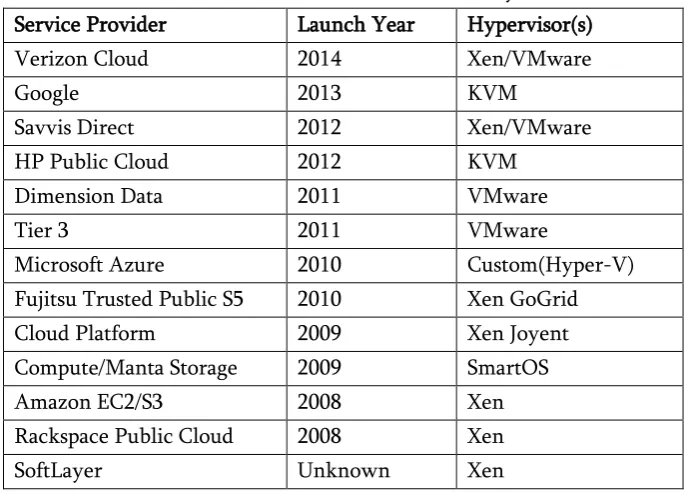
In this section, we have a tendency to summarize the mechanisms and approaches that major industrial CSPs use to guard each their customers and themselves from malicious attacks. to confirm that we've a representative read of the cloud computing trade, we have a tendency to examine the highest thirteen CSPs known in Gartner’s study of industry-leading IaaS suppliers [Gartner 2013], that area unit listed in Table. The launch date given indicates the year the service became typically accessible and
doesn't embrace any closed betas that the service might have had. we have a tendency to note that Gartner states that it didn't embrace Google Cloud Platform in its 2013 report as a result of it had not reached general accessibility at the time the Gartner report was written, and therefore the Gartner report solely enclosed the VMware-based personal cloud providing of Verizon.
In several of those cases, the surveyed CSPs conjointly had alternative lines of cloud-related business like ancient hosting services and services to rent sections of their knowledge centres out as “private clouds,” that aren't enclosed during this study—the data given here pertains solely the general public IaaS cloud part of their offerings.
Table 1. Cloud Service Providers Surveyed
Service Provider Launch Year Hypervisor(s)
Verizon Cloud 2014 Xen/VMware
Google 2013 KVM
Savvis Direct 2012 Xen/VMware
HP Public Cloud 2012 KVM
Dimension Data 2011 VMware
Tier 3 2011 VMware
Microsoft Azure 2010 Custom(Hyper-V)
Fujitsu Trusted Public S5 2010 Xen GoGrid
Cloud Platform 2009 Xen Joyent
Compute/Manta Storage 2009 SmartOS
Amazon EC2/S3 2008 Xen
Rackspace Public Cloud 2008 Xen
SoftLayer Unknown Xen
II.
ACADEMIC CLOUD SECURITY
PERSPECTIVE
Confidentiality And Information Leakage:
One of the best issues that customers face once deciding whether or not to makeover in private closely-held infrastructure to the general public cloud is that the threat of loss of confidentiality of their knowledge and computations. an oversized body of labour has emerged finding out the
Image Sharing Leakage:
One results of widespread cloud adoption is that the creation of secondary markets wherever cloud users will produce and publish VM pictures that different users can buy or use at no cost. However, 2 studies have shown that this on the face of it innocuous and helpful development has conjointly become a major channel for the run of sensitive info. Wei et al. [2009] show that in making the machine image, the publisher could use authentication credentials, that the publisher could then forget to get rid of before commercial enterprise the image. albeit the publisher will delete the credentials, VM pictures usually contain a disk image of the guest OS, that might still hold the deleted knowledge as a result of file systems usually unlink deleted files rather than truly deleting them from the disk. different sensitive info may} be leaked during this approach might embody browsing history and also the browser cache. additionally to leaky personal info, the authors conjointly establish image sharing as a possible attack vector for malware as a result of the publisher might introduce malware into the image or leave a backdoor that will enable it to achieve access to the image when it's deployed by another user.
Leak Prevention:
Since employing a CSP may be a potential vector for loss of confidentiality, researchers have conjointly worked on mechanically modifying applications to stop the run of sensitive info to a CSP. Silverline [Puttaswamy et al. 2011] demonstrates the way to mechanically establish and discover sensitive knowledge in a very net application and encode it before causing it to the cloud. Sedic [Zhang et al. 2011] mechanically splits map scale back jobs between personal and public cloud nodes, keeping the roles that handle sensitive knowledge on the personal cloud nodes and causing the roles that don’t handle sensitive knowledge to the general public cloud nodes. each of those solutions illustrate the utility of hybrid cloud use, within which customers maintain a non-public cloud that they use to handle sensitive knowledge and use the general public cloud
to handle non-sensitive knowledge. Duppel [Zhang ¨ and Reiter 2013] may be a system residing on a tenant VM that might, while not requiring extra changes to the underlying hypervisor, discover and forestall cache-based sidechannel attacks. Similarly, focusing specifically on preventing run of cryptanalytic keys, Greek deity [Pattuk et al. 2014] partitions the keys into random shares, that ar hold on in numerous VMs, and uses periodic resharing to stop partial extraction.
III. CONCLUSION
We find that the safety mechanisms that are standardized across the IaaS business are principally comprised of well-known security mechanisms. On the opposite hand, at this time, there exists associate degree array of offerings for security mechanisms for brand spanking new threats that are distinctive to IaaS clouds, like dedicated VMs for cross-VM run, cloud-side secret writing for confidentiality, and authentication and authorization ways, so indicating the potential for future analysis and innovation.
Ultimately, we tend to believe that 2 trends going forward can drive analysis publically IaaS cloud security and also the relationship between academe and firms during this business. the primary is that there's possible attending to be larger standardization because the trade goods implementations of cloud management stacks like OpenStack emerge. Like previous software system parts, like operative systems and hypervisors, once one or a number of
implementations reach essential mass, their
IV. AUTHORS
Dr V. GOUTHAM is a Professor and Head of the Department of Computer Science and Engineering at Teegala Krishna Reddy Engineering College affiliated to J.N.T.U Hyderabad. He received Ph.D. from Acharya Nagarjuna University M.Tech from Andhra University.His research interests are Software Reliability Engineering, software testing, software Metrics, and cloud computing.
V.
REFERENCES
[1].Amazon AWS. 2013. Amazon Web Services Risk
and Compliance.
https://media.amazonwebservices.com/
AWS_Risk_and_Compliance_Whitepaper.pdf, Last accessed: June 2015.
[2].Amazon AWS. 2014. Amazon Web Services
Overview of Security Processes. https://media. amazonwebservices.com/pdf/AWS_Security_Wh itepaper.pdf, Last accessed: June 2015.
[3].Ittai Anati, Shay Gueron, Simon Johnson, and Vincent Scarlata. 2013. Innovative technology for CPU based attestation and sealing. In Proceedings of the Workshop on Hardware and Architectural Support for Security and Privacy. [4].Michael Armbrust, Armando Fox, Rean Griffith,
Anthony Joseph, Randy Katz, Andy Konwinski, Gunho Lee, David Patterson, Ariel Rabkin, Ion Stoica, et al. 2010. A view of cloud computing. Communications of the ACM 53, 4, 50-58.
[5].Giuseppe Ateniese, Randal Burns, Reza
Curtmola, Joseph Herring, Osama Khan, Lea Kissner, Zachary Peterson, and Dawn Song. 2011. Remote data checking using provable data possession. ACM Transactions on Information and System Security (TISSEC) 14, 1, 12.
[6].Giuseppe Ateniese, Randal Burns, Reza
Curtmola, Joseph Herring, Lea Kissner, Zachary Peterson, and Dawn Song. 2007. Provable data possession at untrusted stores. In Proceedings of the 14th ACM Conference on Computer and Communications Security (CCS’07). 598-609.
[7].Giuseppe Ateniese, Roberto Di Pietro, Luigi V. Mancini, and Gene Tsudik. 2008. Scalable and efficient provable data possession. In Proceedings of the 4th International Conference on Security and Privacy in Communication Networks (SECURECOMM’08).