0214-6282/2001/$25.00 © UBC Press
Printed in Spain
www.ijdb.ehu.es
1 Present address: Zentrum für Molekulare Neurobiologie Hamburg, Hamburg University, Martinistrasse 52, D-20246, Hamburg, Germany.
*Address correspondence to: M. Kessel. Max-Planck-Institut für Biophysikalische Chemie. Am Fassberg, D-37077 Göttingen. FAX: +49-551-201-1504. e-mail: [email protected]
The discovery of the avian organizer
A wealth of experimental studies on the early embryology of the chick were performed after the groundbreaking work of K.E. von Baer (von Baer, 1828). The discovery of an organization center for the amphibian gastrula by Spemann and Mangold in 1924 (Spemann and Mangold, 1924) initiated a search for homologous structures or processes in other vertebrates, including birds. However, in 1924 not only work in amphibia, but also in the chick still suffered from the lack of culturing methods. These were introduced in the early thirties by J. Holtfreter, who developed a simple salt solution suitable for culturing amphibian embryos (Holtfreter, 1931), and by C.H. Waddington, who succeeded in cultivating chick embryos on plasma clots containing embryonic extract (Waddington, 1932). When Waddington trans-planted a node or a piece of the anterior streak below the peripheral ectoderm of a cultivated embryo, he observed the induction of an ectopic neural plate, or the formation of a partial embryonic axis containing neural tube, notochord and somites (Waddington, 1932; Waddington and Schmidt, 1933; Waddington, 1934). It became clear that the avian primitive streak is homologous to the blastopore, and its tip, “Hensen’s node”, to the dorsal blastopore lip of an amphibian embryo. The three features of an organizer described by Spemann and Mangold, namely self differentiation towards axial mesoderm, re-programming (“assimilation”) of surrounding tissue and neuralization of ectoderm also applied to Hensen’s node, which was therefore
considered as the functional homolog of the amphibian organization center. Thus, the principal conservation of a major biological phe-nomenon was strongly suggestive.
Since these early experiments, the chick as an experimental system has come a long way. Methods were improved, detailed fate maps were established (Spratt, 1952; Schoenwolf and Sheard, 1990; Selleck and Stern, 1991; Psychoyos and Stern, 1996; and further references therein), and a precise staging system was introduced (Hamburger and Hamilton, 1951; Eyal-Giladi and Kochav, 1976). Normal development was manipulated in ovo, in vitro or in explants. Findings obtained in other experimental systems were systematically transferred and reinvestigated. The advent of mo-lecular techniques renewed the interest in early vertebrate develop-ment and thus in a molecular interpretation of gastrulation and neurulation. Today, avian versions of most developmental control genes have been cloned and characterized, and are instrumental in pushing our knowledge about the gastrula to a new level.
In this review we summarize our current understanding of the avian organizer. Many aspects of our discussion would normally require also comparative descriptions of the situation in amphibia. We kept those as concise as possible and refer to published reviews instead. We follow the chick embryo through its early developmental steps, first describing the developmental processes leading towards the establishment of an organizer, and then the phenomenon itself. We will review the relevance of the posterior marginal zone, of
The avian organizer
THOMAS BOETTGER
1, HENDRIK KNOETGEN, LARS WITTLER and MICHAEL KESSEL*
Max-Planck-Institut für Biophysikalische Chemie. Göttingen, Germany
ABSTRACT The development of avian embryos is characterized by the large amount of yolk present from the one-cell stage until late phases of organogenesis. In the chick, an axis of bilateral symmetry is established already before egg laying, when the egg rotates in the uterus. There is evidence for an active Wnt-catenin pathway in the vegetal cells in the periphery of the multi-cellular embryo. It overlaps with the posteriorly restricted expression of genes characterizing the vegetal hemisphere in amphibia. The zone of overlap bears several functional characteristics of a Nieuwkoop center, which is first apparent in the posterior marginal zone, but continues into the early primitive streak. Only the anterior part of the late streak is capable of direct neural induction, and only its tip, Hensen's node, can induce an anterior neural identity. This latter activity leaves the node together with the cells representing the anterior mesendoderm. Thus, although the constraints and dynamics of avian development make comparisons with the amphibian situation a complex undertaking, Hensen's node comes as close as possible to an organizer in Spemann and H. Mangold's definition.
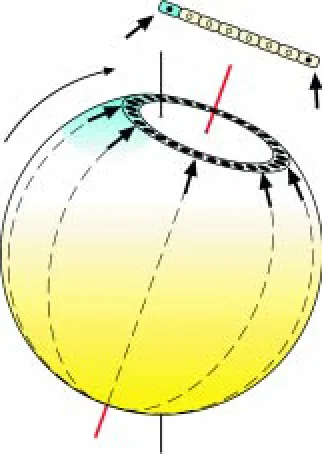
ment, all blastomeres are open to the yolk, and only later the central cells become separated by tangential membranes. The animal pole of the intrauterine avian embryo lies in the center of the blastoderm, and the vegetal pole on the opposite side of the yolk sphere. Noteworthy, animal-vegetal polarity also exists along the meridians, so that the periphery of the embryo, where cells remain open to the yolk for the longest time, can be considered to be its most vegetal area (Fig. 1). Later, the periphery develops into extra-embryonic tissues.
The egg with the multi-cellular embryo rotates in the uterus around its longitudinal axis. Thereby, under the influence of gravity the blastoderm comes into an oblique position relative to the compara-tively inert yolk (Fig. 1). The significance of this rotation for the formation of the embryonic axis was first observed by K.E. von Baer, who found that in most cases a chick embryo lies transversely to the long egg axis, with the head facing forward, if the pointed end of the egg faces leftward (von Baer, 1828). His rule was later confirmed under experimental conditions indicating that the upper part of a tilted
Two pathways necessary for the introduction of bilateral
symmetry
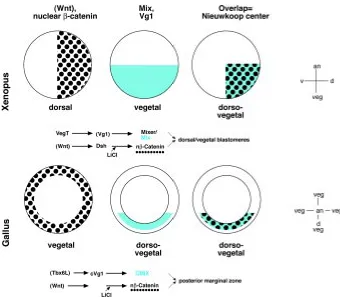
Determinants from vegetal cells are important for the axial speci-fication of echinoderms, fishes, amphibia and probably many more animals (Eyal-Giladi, 1997). On a molecular level, the specification of the early axes is best understood in the frog Xenopus laevis (Fig. 2; Harland and Gerhart, 1997; Heasman, 1997). The translocation of a vegetally derived signal to the dorsal hemisphere is critical for the introduction of bilateral symmetry. A key role is played by the Wnt/β -catenin pathway, which starts with a secreted Wnt-factor (or an equivalent signal), involves a downstream signal of the dishevelled gene, and culminates in the nuclear localization of the cell membrane protein β-catenin in the dorsal hemisphere. The nuclear localization of β-catenin can be achieved experimentally by exposure to lithium ions, which specifically inhibits the enzyme GSK3, a negative effector of the Wnt pathway and leads to hyperdorsalization of the embryo. A second important reaction system consists of the T-box factor VegT, the homeodomain proteins MIX.1 and/or Mixer, and the
TGF-β related factor Vg1, all of which are finally involved in the specifica-tion of a vegetal identity in Xenopus laevis (Fig. 2; Lemaire et al., 1998; Zhang et al., 1998; Zorn et al., 1999). The activities of this VegT/Vg1/MIX system overlap with the Wnt/β−catenin pathway in the dorso-vegetal blastomeres of the frog blastula. These cells possess a unique inductive potential, namely to induce an organizer without taking part in the induced structure themselves. The cell biological and molecular significance of this so-called “Nieuwkoop center” in amphibia is discussed in detail elsewhere (Harland and Gerhart, 1997; Heasman, 1997).
In chick embryos, there is no indication for a nuclear localization of β−catenin during intrauterine development. However, by the time of egg laying, nuclear β−catenin was found in the periphery of the blastoderm (Fig. 2; Roeser et al., 1999). The nuclear localization could be induced by exposure to lithium ions, indicating a similarity to the amphibian Wnt pathway (Fig. 3). Before streak formation many putative developmental control genes are transcribed in a polarized fashion restricted to the prospective posterior part, most probably as a consequence of the tilting process described above (Fig. 1, Lemaire and Kessel, 1997). Among those are the VegT homologous gene Tbx-6L (Knezevic et al., 1997), the homeobox gene CMIX (Peale et al., 1998; Stein et al., 1998) and the chicken cVg1 gene (Seleiro et al., 1996; Shah et al., 1997; Fig. 2). Although not yet shown for the avian embryo, it can be suspected based on work in Xenopus, that these genes are involved in a common regulatory system.
In summary, there is evidence for an active Wnt/β−catenin path-way within the vegetal region of the chick embryo, which is radially distributed around the epiblast. In contrast, the Tbx6L/cVg1/CMIX system is restricted to the posterior vegetal region of the embryo. The activities of the two pathways overlap spatially in the posterior marginal zone (PMZ), which thus becomes a focal structure of early avian development.
The posterior marginal zone - an avian Nieuwkoop center?
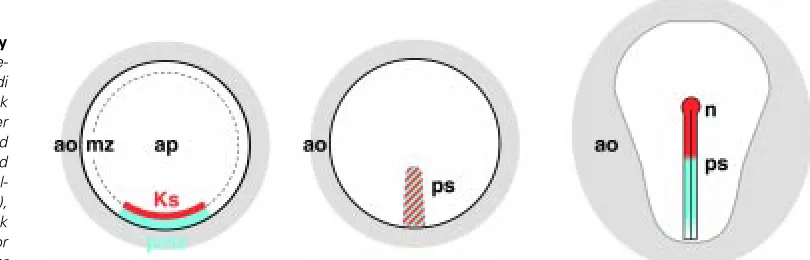
At the time of egg laying, the avian blastoderm consists of a translucent area pellucida, surrounded by the area opaca. Between these two zones lies, morphologically more or less obvious, the marginal zone (Fig. 4). The posterior marginal zone is demarcated anteriorly by Koller’s sickle (see discussion below), and posteriorly by the inner edge of the area opaca. Thus, an axis of bilateral symmetry, which will later be the antero-posterior axis, can already be recog-nized in these early embryos.
A transplanted PMZ is capable of inducing an ectopic primitive streak in epiblast tissue from an early pre-streak embryo lacking a PMZ of its own (Khaner and Giladi, 1986; Khaner and Eyal-Giladi, 1989; Khaner, 1998). It could be demonstrated by cell labeling that PMZ cells do not take part in the formation of the axis they induce (Bachvarova et al., 1998). An important secreted protein in the PMZ is the TGFβ related factor cVg1 (Seleiro et al., 1996; Shah et al., 1997). cVg1 secreting cells are able to promote the formation of a streak expressing organizer markers when transplanted to the epiblast of the marginal zone, but not of the central disc. The restriction to the marginal zone possibly correlates with the presence of nuclear β−catenin, and thus the activity of a Wnt pathway (Roeser et al., 1999). However, the activity of a Wnt factor is difficult to prove, since these proteins cannot be produced easily in soluble form. Some evidence for the role of a Wnt factor in avian axis induction, organizer induction and cooperation with cVg1 could be obtained applying cells producing the Wnt1 protein (Joubin and Stern, 1999). In order to understand the organizer inducing function of a Nieuwkoop center in zebrafish and Xenopus, it was of great help to identify the homeobox genes dharma/nieuwkoid (Koos and Ho, 1998; Yamanaka et al., 1998) and siamois (Lemaire et al., 1995),
respectively, which are direct targets of the Wnt/β−catenin pathway (Carnac et al., 1996; Brannon et al., 1997).The transcription of siamois and dharma/nieuwkoid is directly under the control of a transcription factor complex including β−catenin, and expressing cells induce non-cell-autonomously the expression of the organizer marker goosecoid. Corresponding avian homeobox genes for siamois as well as for dharma/nieuwkoid were so far not identified. At the moment, the only known PMZ specific homeobox gene is CMIX. Its polarized expression in the chick may indicate a different role from its frog homolog (Mix.1), which is not enough for axis formation on its own.
In conclusion, it appears that the avian PMZ fulfills major postu-lates for a functional Nieuwkoop center, namely the potential for organizer induction without itself contributing to the new structure and the involvement of genes homologous to the amphibian center.
Koller’s sickle and the primitive streak primordium: the
induction of gastrulation
Koller’s sickle is the morphological landmark of the chick embryo before the onset of gastrulation (Fig. 4). While the epiblast is only one cell thick, a multi-cellular layer of yolk rich cells extends from the germ wall underlying the area opaca, to the marginal zone, and to the sickle, where they are particularly densely packed (Bachvarova et al., 1998). Cells from the epiblast above and from middle layer of the sickle are fated to the primitive streak, the node, and later to the prechordal mesendoderm (Izpisúa-Belmonte et al., 1993; Bachvarova et al., 1998). The mesendoderm is also the fate of the bottle cells in the dorsal blastopore lip of the frog. Not only the fate, but also gene expression patterns indicate a role of the sickle as a part of the avian organizer. Thus, cells near the sickle and/or the PMZ express a whole Fig. 2. The overlap of two pathways towards
battery of genes related to genes associated with the amphibian organizer, such as Goosecoid (GSC), GSX, CNOT1, CNOT2, Hnf3β, OTX2 and Chordin (Bally-Cuif et al., 1995; Ruiz i Altaba et al., 1995; Stein and Kessel, 1995; Stein et al., 1996; Lemaire et al., 1997; Streit et al., 1998). All these expression domains are initially sickle shaped, i.e. spread more or less broadly and transversely to the future longitudinal axis.
During the first hours of egg incubation these expression domains begin to converge and become longitudinally oriented, now repre-senting the primordium of the primitive streak. It was recently suggested, that this must not necessarily occur due to posterolateral cell migrations (Wei and Mikawa, 2000). The formation of the early primitive streak could in essence be the result of polarized cell divisions from a spatially restricted area of the blastoderm adjacent to the PMZ. It is remarkable that the genes associated with the putative Nieuwkoop center, the PMZ, as well as with the organizer are represented in the early phase of the primitive streak. This could indicate a prolonged phase of organizer induction, still active while the first meso- and endodermal cells are already migrating.
Transplantation of sickle fragments to competent ectoderm in-duces the formation of a primitive streak, identifiable with the pan-mesodermal marker Brachyury (Ch-T), complete with a node, as identified by the expression of GSC or Chordin (Izpisúa-Belmonte et al., 1993; Callebaut and Van Nueten, 1994; Bachvarova et al., 1998). As expected from the behaviour of sickle cells in their endogenous situation, they also contribute to the induced streak or node in an ectopic position (Bachvarova et al., 1998). In this respect, sickle mediated inductions differ significantly from the PMZ transplanta-tions, where no contribution to the induced structures occurs. Re-markable is, however, that the sickle with its cells fated to the node and prechordal plate, is not sufficient to induce neural tissue directly.
Grafts of Koller’s sickle contain cells producing Chordin, a factor expressed in epiblast cells anterior to the sickle and in the underlying cell layer (Streit et al., 1998). Chordin is not capable of neural induction in avian ectoderm, but elicits the formation of a primitive streak expressing also organizer markers. (Streit et al., 1998). This finding was at first sight unexpected after the identification of chordin as a bona fide neural inducer in Xenopus (Kessel and Pera, 1998). It appears that neural inducing factors are not yet expressed in or near Koller’s sickle. Alternatively, they may already be present but are antagonized by other factors.
In summary, Koller’s sickle contains precursor cells for the node and the prechordal plate, which also express classical organizer markers. Based on fate and gene expression the first aspects of an avian organizer can be recognized in Koller’s sickle. However, the inductive capacity of the sickle and of the streak primordium is restricted to the induction of an organizer and a primitive streak, and does not include a capacity for neural induction. Thus, a major criterion for an organizer in the Spemann-Mangold sense, i.e. neural induction, is not fulfilled.
Hensen’s node: the evolving capacity for
neural induction
The primitive streak reaches its full length after the incubation of an egg for about nineteen hours. At the tip of the extended streak forms a thickened structure, where the three germ layers are tightly associated. Since its discovery by V. Hensen in a study on rabbit embryos (Hensen, 1876), the term “Hensen’s node”, abbreviated the node, is widely used. Some of the cells in the node are derived from Koller`s sickle or from the primitive streak primordium (Izpisúa-Belmonte et al., 1993). However, many of these cells have left the membrane (A) or in the nucleus (B). Data from (Roeser et al., 1999) with permission.
Fig. 4. Structural landmarks of early chick embryos. Depicted is a pre-streak embryo (stage X; Eyal-Giladi and Kochav, 1976), an early streak embryo (stage HH2/HH3; Hamburger and Hamilton, 1951) and an extended streak embryo (HH3+/HH4). Indicated
are the area opaca (ao), the area pel-lucida (ap), the marginal zone (mz), Koller’s sickle (Ks), the primitive streak (ps) and the node (n). The blue color indicates the expression of molecular
streak already by the time of node formation (Joubin and Stern, 1999). They are replaced by cells from the surrounding epiblast, which migrate towards the node and leave it readily, indicating a dynamical change of the cellular composition in the node. The cells derived from the tip of the streak are initially fated to the definitive endoderm, which spreads concentrically under the epiblast. The formation of Hensen’s node in the second phase of primitive streak elongation is accompanied by molecular and functional changes. The expression of genes such as cVg1, cWnt8c, CMIX, or GSX, which characterized the complete streak in its early phase, now become restricted to its posterior portion (Hume and Dodd, 1993; Seleiro et al., 1996; Lemaire et al., 1997; Shah et al., 1997; Stein et al., 1998). Other early markers, such as Chordin, GSC, HNF3β, now become restricted to the anterior streak and finally to the node (Izpisúa-Belmonte et al., 1993; Ruiz i Altaba et al., 1995; Streit et al., 1998).
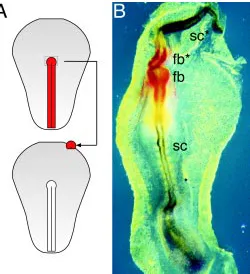
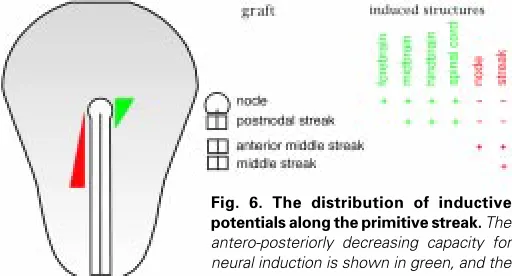
Grafting of Hensen’s node below competent ectoderm induces a neural plate, elevated neural folds, or even a closed neural tube (for an example see Fig. 5). This remarkable inductive potential of the node was first demonstrated by Waddington, and served to recog-nize the node as the equivalent of the dorsal blastopore lip in amphibia, the Spemann-Mangold organizer (Waddington, 1932). It has by now been investigated to a great detail both on a functional and a molecular level (e.g. Dias and Schoenwolf, 1990; Storey et al., 1992; Lemaire et al., 1997; Pera et al., 1999). Molecular markers demonstrate readily that node-induced neural axes are regionally structured into fore-, mid-, hindbrain and spinal cord quality (Fig. 5). It is typical for such inductions that the basal membrane at the grafting site does not become interrupted, and therefore no mesoderm is formed. The potential for the induction of anterior neuroectoderm is restricted to the node at the extended streak stages, i.e. when it contains cells fated to the definitive endoderm or the mesendoderm. An efficient contribution of a node graft to the host endoderm normally is accompanied by efficient neural induction (Dias and Schoenwolf, 1990). The development of an endodermal layer appears to be essential for the formation of a neural plate (Pera et al., 1999). The inductive potentials of different primitive streak segments are significantly different (Fig. 6). After transplantation to the anterior extraembryonic region (Fig. 5A), post-nodal grafts still induce neur-oectoderm, but fail to induce anterior markers (Knoetgen et al., unpublished). The potential of even further posterior streak grafts is restricted to the induction of secondary primitive streaks. These are more likely to express also anterior streak markers, i.e. the classical organizer markers (Chordin, GSC, HNF3β; Lemaire et al., 1997), if they contain cells from the anterior middle portion of the streak (Fig. 6). In contrast, secondary streaks induced by fragments from the middle of the streak do not express these genes and are restricted to more general streak markers, in particular Brachyury (Ch-T; Gallera and Nicolet, 1969; Lemaire et al., 1997).
Today, we know a number of secreted proteins, including chordin, noggin, and follistatin, which can induce neural ectoderm in amphibia (for review see Hemmati-Brivanlou and Melton, 1997). These prod-ucts of the dorsal blastopore lip appear to function by binding BMP proteins and thus creating a zone free of unbound BMP4, the neural plate. In the chick, BMP4 is not expressed in the neural plate surrounding Hensen’s node, whereas the expression of avian homologs of chordin and noggin was identified in the node (Connolly et al., 1997, Streit, 1998 #3524; Schultheiss et al., 1997). Thus, it is not evident how BMP antagonism could be the primary mechanism to induce neural ectoderm in the chick. Neither is BMP4 capable of suppressing neuralization completely, nor can neuralization be
in-duced de novo by the application of chordin or noggin. BMP4 or the BMP-antagonist noggin merely affect the extent of the neural plate at its periphery (Knoetgen et al., 1999b; Pera et al., 1999).
Apart from its neural inducing capacity, the node possesses also the other features of an organizer in Spemann’s definition, assimila-tion and self-differentiaassimila-tion. When a chick node is placed in an environment of lateral, i.e. ventral, mesoderm the induced embryonic axis will also contain somites, which result from a reprogramming or dorsalization of the surrounding mesoderm. A transplanted node will mainly differentiate into a chordoid or notochordal structure underly-ing the induced neural epithelium except for its anterior, forebrain-like region. It is remarkable that node transplants will not induce an organizer in return. On the one hand, this appears to be a conse-quence of the absence of organizer inducing factors (cVg1, possibly cWnt8C) from the tip of the elongated streak. In addition, an anti-organizer factor, the anti-dorsalizing morphogenetic protein ADMP, is expressed in the node and is responsible for restricting organizer activity to the node (Joubin and Stern, 1999).
In conclusion, pure neural induction is restricted to the tip and pure mesoderm induction to the middle of the elongated streak. In-between, there is an anteroposterior decrease of neural inducing, and an increase of a mesoderm inducing potential. In addition, more anterior grafts induce more anterior markers in the ectoderm or the mesoderm.
The prechordal mesendoderm: the separation of head
and trunk organizer and the anteriorization of the neural
plate
The cells leaving the node can be divided into three categories according to their fate (e.g. Selleck and Stern, 1991). The first to emigrate form the definitive endoderm. They are followed by a mesendodermal population of cells which migrates anteriorly to reach a position under the developing forebrain. These become on the one hand part of the definitive gut endoderm, but also constitute a mesodermal population, the prechordal mesoderm, between the anterior endo- and ectoderm (for discussion see Knoetgen et al., 1999a). A third population generates the notochord which extends from the midbrain to the tail region.
The inductive potential of the node changes dramatically when the mesendodermal, GSC expressing cells have left the node. From now on anterior neural ectoderm can no longer be induced by the node, and the general, neural inducing potency decreases quickly (Dias and Schoenwolf, 1990; Storey et al., 1992). However, the GSC expressing mesendodermal cells maintain the capacity to induce anterior neural ectoderm. After transplantation to the extraembryonic region they evoke the expression of forebrain markers such as the homeobox genes GANF, CNOT1, or NKX2.1 (Pera and Kessel, 1997; Knoetgen et al., 1999b). The change of inductive potential of the node closely mimics the features of the amphibian blastopore lip. Only the young lip can induce forebrain structures, and it loses this capacity fast. This was the key obser-vation leading to the concept of separate head and trunk organiz-ers (Spemann, 1931), and in this respect there appears to be no major difference between amphibia and birds. However, a major difference lies in the timing of neural induction in general and the anteriorization of the neuroectoderm. In the chick, the early neural plate forming around the node does not express anterior neural markers, such as GANF or NKX2.1 (Pera and Kessel, 1998; Knoetgen et al., 1999b). In Xenopus laevis, the anterior markers are switched on as soon as evidence for neural induction is obtained (Harland and Gerhart, 1997). It appears that the chick neural plate is initially not regionalized and becomes so only after interacting with the prechordal mesendoderm.
ent in the early stages of life. Despite this, the analysis of the organizer phenomenon has revealed numerous conserved aspects in fish, amphibia, birds and mammals. Most striking are the similari-ties in the molecular repertoire, and the majority of the key molecules was found in all model species. In the chick, gravity is the external cue creating a local asymmetry establishing the first patterning center of the chick embryo at the prospective posterior pole of the embryo. This center becomes reoriented along the future longitudinal axis with the formation of the primitive streak. The complex events leading to the establishment of the primitive streak require more than ten hours from the first initiation of organizer development to the final establish-ment of a bona fide organizer with a neural inducing potential. This prolonged induction phase indicates that developmental mecha-nisms related to the organizer must differ from those in amphibia. Indeed, several molecular concepts deduced from work on the frog could not directly be transferred to the chick. Thus, in spite of a fast growing knowledge, several questions concerning the avian organ-izer still remain unresolved. In the future two major induction proc-esses, namely mesoderm and neural induction, still await an under-standing on a molecular level.
References
BACHVAROVA, R.F., SKROMNE, I. and STERN, C.D. (1998). Induction of the primitive streak and Hensen’s node by the posterior marginal zone. Development 125: 3521-3534.
BALLY-CUIF, L., GULISANO, M., BROCCOLI, V. and BONCINELLI, E. (1995). c-otx2 is expressed in two different phases of gastrulation and is sensitive to retinoic acid treatment in chick embryos. Mech. Dev. 49: 49-63.
BRANNON, M., GOMPERTS, M., SUMOY, L., MOON, R.T. and KIMELMAN, D. (1997). A beta-catenin/XTcf-3 complex binds to the siamois promoter to regulate dorsal axis specification in Xenopus. Genes Dev. 11: 2359-70.
CALLEBAUT, M. and VAN NUETEN, E. (1994). Rauber’s (Koller’s) sickle: the early gastrulation organizer of the avian blastoderm. European Journal of Morphology 32: 35-48.
CARNAC, G., KODJABACHIAN, L., GURDON, J.B. and LEMAIRE, P. (1996). The homeobox gene Siamois is a target of the Wnt dorsalisation pathway and triggers organiser activity in the absence of mesoderm. Development 122: 3055-65.
CONNOLLY, D.J., PATEL, K. and COOKE, J. (1997). Chick noggin is expressed in the organizer and neural plate during axial development, but offers no evidence of involvement in primary axis formation. Int. J. Dev. Biol. 41: 389-396.
DIAS, M.S. and SCHOENWOLF, G.C. (1990). Formation of ectopic neurepithelium in chick blastoderms: age-related capacities for induction and self-differentiation following transplantation of quail Hensen’s nodes. Anatomical Record 228: 437-48.
EYAL-GILADI, H. (1997). Establishment of the axis in chordates: facts and specula-tions. Development 124: 2285-96.
EYAL-GILADI, H. and FABIAN, B.C. (1980). Axis determination in uterine chick blastodiscs under changing spatial positions during the sensitive period for polarity. Developmental Biology 77: 228-32.
EYAL-GILADI, H. and KOCHAV, S. (1976). From cleavage to primitive streak forma-tion: a complementary normal table and a new look at the first stages of the development of the chick. I. General morphology. Dev. Biol. 49: 321-337.
GALLERA, J. and NICOLET, G. (1969). Le pouvoir inducteur de l’endoblaste presomptif potentials along the primitive streak. The
contenu dans la ligne primitive jeune de poulet. J. Embryol. Exp. Morph. 21: 105-18.
HAMBURGER, V. and HAMILTON, H.L. (1951). A series of normal stages in the development of the chick embryo. J. Morph. 88: 49-92.
HARLAND, R. and GERHART, J. (1997). Formation and function of Spemann’s organizer. Ann. Rev. Cell. Dev. Biol. 13: 611-67.
HEASMAN, J. (1997). Patterning the Xenopus blastula. Development 124: 4179-91.
HEMMATI-BRIVANLOU, A. and MELTON, D. (1997). Vertebrate embryonic cells will become nerve cells unless told otherwise. Cell 88: 13-7.
HENSEN, V. (1876). Beobachtungen über die Befruchtung und Entwicklung des Kaninchens und Meerschweinchens. Z. Anat. Entw. Gesch. 1: 353-423.
HOLTFRETER, J. (1931). Über die Aufzucht isolierter Keime des Amphibienkeimes. II. Roux’ Archiv für Entwicklungsmechanik 124: 404-466.
HUME, C.R. and DODD, J. (1993). Cwnt-8C: a novel Wnt gene with a potential role in primitive streak formation and hindbrain organization. Development 119: 1147-60.
IZPISÚA-BELMONTE, J.C., DE ROBERTIS, E.M., STOREY, K.G. and STERN, C.D. (1993). The homeobox gene goosecoid and the origin of organizer cells in the early chick blastoderm. Cell 74: 645-659.
JOUBIN, K. and STERN, C.D. (1999). Molecular interactions continuously define the organizer during the cell movements of gastrulation. Cell 98: 559-571.
KESSEL, M. and PERA, E. (1998). Unexpected requirements for neural induction in the avian embryo. Trends in Genetics 14: 169-171.
KHANER, O. (1998). The ability to initiate an axis in the avian blastula is concentrated mainly at a posterior site. Dev. Biol. 194: 257-266.
KHANER, O. and EYAL-GILADI, H. (1986). The embryo-forming potency of the posterior marginal zone in stages X through XII of the chick [published erratum appears in Dev. Biol. 1986 Oct; 117(2):680]. Dev. Biol. 115: 275-81.
KHANER, O. and EYAL-GILADI, H. (1989). The chick’s marginal zone and primitive streak formation. I. Coordinative effect of induction and inhibition. Dev. Biol. 134: 206-14.
KNEZEVIC, V., DE SANTO, R. and MACKEM, S. (1997). Two novel chick T-box genes related to mouse Brachyury are expressed in different, non-overlapping mesoder-mal domains during gastrulation. Development 124: 411-9.
KNOETGEN, H., TEICHMANN, U. and KESSEL, M. (1999A). Head-organizing activi-ties of endodermal tissues in vertebrates. Cell. Mol. Biol. 45: 481-492.
KNOETGEN, H., VIEBAHN, C. and KESSEL, M. (1999B). Head induction in the chick by primitive endoderm of mammalian, but not avian origin. Development 126: 815-125.
KOCHAV, S. and EYAL-GILADI, H. (1971). Bilateral symmetry in chick embryo determination by gravity. Science 171: 1027-9.
KOOS, D.S. and HO, R.K. (1998). The nieuwkoid gene characterizes and mediates a Nieuwkoop-center-like activity in the zebrafish. Current Biology 8: 1199-206.
LEMAIRE, L. and KESSEL, M. (1997). Gastrulation and homeobox genes in chick embryos. Mechanisms of Development 67: 3-16.
LEMAIRE, L., ROESER, T., IZPISUA-BELMONTE, J.-C. and KESSEL, M. (1997). Segregating expression domains of two goosecoid genes during the transition from gastrulation to neurulation in chick embryos. Development 124: 1443-1452.
LEMAIRE, P., DARRAS, S., CAILLOL, D. and KODJABACHIAN, L. (1998). A role for the vegetally expressed Xenopus gene Mix.1 in endoderm formation and in the restriction of mesoderm to the marginal zone. Development 125: 2371-80.
LEMAIRE, P., GARRETT, N. and GURDON, J.B. (1995). Expression cloning of Siamois, a Xenopus homeobox gene expressed in dorsal-vegetal cells of blastulae and able to induce a complete secondary axis. Cell 81: 85-94.
PEALE, F.V., JR., SUGDEN, L. and BOTHWELL, M. (1998). Characterization of CMIX, a chicken homeobox gene related to the Xenopus gene mix.1. Mechanisms of Development 75: 167-70.
PERA, E. and KESSEL, M. (1998). Demarcation of ventral territories by expression of the NKX2.1 homeobox gene in the chick embryo. Development, Genes, and Evolution 208: 168-171.
PERA, E., STEIN, S. and KESSEL, M. (1999). Ectodermal patterning in the avian embryo: Epidermis versus neural plate. Development 126: 63-73.
PERA, E.M. and KESSEL, M. (1997). Patterning of the chick forebrain anlage by the prechordal plate. Development 124: 4153-62.
PSYCHOYOS, D. and STERN, C.D. (1996). Fates and migratory routes of primitive streak cells in the chick embryo. Development 122: 1523-34.
ROESER, T., STEIN, S. and KESSEL, M. (1999). Nuclear localization of b-catenin in normal and LiCl exposed chick embryos. Development 126: 2955-2965.
RUIZ I ALTABA, A., PLACZEK, M., BALDASSARE, M., DODD, J. and JESSELL, T.M. (1995). Early stages of notochord and floor plate development in the chick embryo defined by normal and induced expression of HNF-3 beta. Dev. Biol. 170: 299-313.
SCHOENWOLF, G.C. and SHEARD, P. (1990). Fate mapping the avian epiblast with focal injections of a fluorescent-histochemical marker: ectodermal derivatives. J. Exp. Zool. 255: 323-39.
SCHULTHEISS, T.M., BURCH, J.B. and LASSAR, A.B. (1997). A role for bone morphogenetic proteins in the induction of cardiac myogenesis. Genes & Develop-ment 11: 451-62.
SELEIRO, E.A., CONNOLLY, D.J. and COOKE, J. (1996). Early developmental expression and experimental axis determination by the chicken Vg1 gene. Current Biology 6: 1476-86.
SELLECK, M.A. and STERN, C.D. (1991). Fate mapping and cell lineage analysis of Hensen‘s node in the chick embryo. Development 112: 615-626.
SHAH, S.B., SKROMNE, I., HUME, C.R., KESSLER, D.S., LEE, K.J., STERN, C.D. and DODD, J. (1997). Misexpression of chick Vg1 in the marginal zone induces primitive streak formation. Development 124: 5127-38.
SPEMANN, H. (1931). Über den Anteil von Implantat und Wirtskeim an der Orientierung und Beschaffenheit der induzierten Embryonalanlage. Archiv für Mikroskopische Anatomie und Entwicklungsmechanik 123: 390-516.
SPEMANN, H. and MANGOLD, H. (1924). Über die Induktion von Embryoanlagen durch Implantation artfremder Organisatoren. Roux Arch. Entwiclungsmech. 100: 599-638.
SPRATT, N.T. (1952). Localization of the prospective neural plate in the early chick blastoderm. J. Exp. Zool. 120: 109-130.
STEIN, S. and KESSEL, M. (1995). A homeobox gene involved in node, notochord and neural plate formation of chick embryos. Mech. Dev. 49: 37-48.
STEIN, S., NISS, K. and KESSEL, M. (1996). Differential activation of the clustered homeobox genes CNOT2 and CNOT1 during notogenesis in the chick. Dev. Biol. 180: 519-533.
STEIN, S., ROESER, T. and KESSEL, M. (1998). CMIX, a paired-type homeobox gene expressed before and during formation of the avian primitive streak. Mech. Dev. 75: 175-177.
STOREY, K.G., CROSSLEY, J.M., DE ROBERTIS, E.M., NORRIS, W.E. and STERN, C.D. (1992). Neural induction and regionalisation in the chick embryo. Development 114: 729-741.
STREIT, A., LEE, K.J., WOO, I., ROBERTS, C., JESSELL, T.M. and STERN, C.D. (1998). Chordin regulates primitive streak development and the stability of induced neural cells, but is not sufficient for neural induction in the chick embryo. Develop-ment 125: 507-19.
VON BAER, K.E. (1828). Über Entwickelungsgeschichte der Thiere. Bornträger: Königsberg.
WADDINGTON, C.H. (1932). Experiments on the development of chick and duck embryos, cultivated in vitro. Philos. Trans. R. Soc. London B 221: 179-230.
WADDINGTON, C.H. (1934). Experiments on embryonic induction. J. Exp. Biol. 11: 211-227.
WADDINGTON, C.H. and SCHMIDT, G.A. (1933). Induction by heteroplastic grafts of the primitive streak in birds. Arch. f. Entw. Mech. Org. 128: 522.
WEI, Y. and MIKAWA, T. (2000). Formation of the avian primitive streak from spatially restricted blastoderm: evidence for polarized cell division in the elongating streak. Development 127: 87-96.
YAMANAKA, Y., MIZUNO, T., SASAI, Y., KISHI, M., TAKEDA, H., KIM, C.H., HIBI, M. and HIRANO, T. (1998). A novel homeobox gene, dharma, can induce the organizer in a non-cell-autonomous manner. Genes & Development 12: 2345-53.
ZHANG, J., HOUSTON, D.W., KING, M.L., PAYNE, C., WYLIE, C. and HEASMAN, J. (1998). The role of maternal VegT in establishing the primary germ layers in Xenopus embryos [see comments]. Cell 94: 515-24.