CSEIT11726309 | Received : 01 Dec 2017 | Accepted : 29 Dec 2017 | November-December-2017 [(2)6: 1163-1167 ]
International Journal of Scientific Research in Computer Science, Engineering and Information Technology © 2017 IJSRCSEIT | Volume 2 | Issue 6 | ISSN : 2456-3307
1163
Research Issues and Software Testing Methodologies and
Mechanisms for Better Performance using Cloud Testing
K. Venkat Raman
*1, Dr. G. Ranjith
2*1Research Scholar, Department of CSE, Allahabad Central University, Allahabad, Uttar Pradesh, India 2Associate Professor, Department of CSE, Warangal Institute of Technology and Science, Warangal, Telangana, India
ABSTRACT
Cloud Computing is an on-demand internet based virtualized system which is one of the most fast-growing information technology based mechanism that is adopted by software industry all over the world. Software Testing is the process of checkingfunctionality or activity that performed on cloud computing, it introduces features or capabilities of verification of software and reconstructed software for bug fix, Some-times new changes may impact on the existing functionality, this is also managed or identified by the testing methodologies. The main purpose is to give quality assurance about existing or recently introduced functionality or activity, so that it does not affect the existing functionality. The main objective of designing a new approach in software testing is to improve the quality of software after testing and after modifications that are done in the software, it also focuses on the side effects that are designed or progressed after modifications. We also discussed different testing methodologies that can be implemented on cloud computing for better performance along with the optimal Approximation Algorithm. The test bed simulation is done for experimental analysis, final results are given along with the graphical analysis. we also discussed on the future work and research issues that can be adopted for better performance of cloud computing and all the possibilities of mechanisms and methods that can be adopted or implemented using the software testing for bug fix.
Keywords : Software Engineering, Testing Methodologies, Cloud Computing.
I.
INTRODUCTION
Software testing is the procedure of recognising mistakes, and liabilities present within the software product, and needs to be verification and validated to obtain the probable outcome as stated in the client requirement specification. It is an evaluating the system based on different procedures, policies and mechanisms, itis an activity based on different integrated testing methodologies, which identifies more and more complex errors or problems thatallows modifications at a very large scale with their applications in different domains that intent to satisfy certain requirements. The manual testing and automation testing are the basic methods of software testing schemes. To face challenges in software testing different divisions or testing methodologies are used such as performance testing, regression testing, functional testing, application testing and penetration testing, where
automated using different automation tools for testing parameters such, as handling load, stress,latency, throughput and so on which comes under performance testing is more versatile in its nature and identified as broadly used to diagnose and fix the errorsduringsoftware testing phase of development process. Further, the software is tested to understand its performance is termed as non-functional testing. Therefore, the software testing is always a kind of continuous verification and validation process for better performance at cloud based software testing [1].
II.
RELATED WORK
Cloud Testing is a revolution for Software Testing where different challenges and defences procedures, mechanisms are introduced. Application testing in cloud is a form of cloud testing, which utilizes the resources as and when required from cloud vendor. The traditional testing has many limitations, the first challenge is cost, for example a company wants to test, it requires a large quantity of hardware, if it wants to increase the testing capability more hardware should be added, this makes a company to invest more and more, even maintenance is also another obstacle in traditional testing, to avoid this cloud testing is performed just by subscribing resources needed in the testing process from the cloud service provider. It allows companies to test virtually through web and mobile applications, at large scale, with high capabilities and performance without the limitation of traditional load and stress testing. The major benefits of Cloud Testing include challenges and defences for network and cloud security from risks, threats and attacks in cloud computing [2].
III. RESEARCH ISSUES IN CLOUD TESTING
1.
Service Function Testing, the testing focuses on the graphic user interface and application protocol based interface related to service functions and the testing methodologies are used at the software as a service cloud testing, inside a cloud. It is a Testing online-based application servicefunctions on a cloud, it also functions over the infrastructure service [3].2.
Integration Testing, it mainly focuses on the Software as a Service interactions and Cloud connections, where software as a service oriented testing inside a cloud is a vendor specificcomponent and service integration inside a private or a public cloud, where the integration is done between the online clients and back-end servers on the cloud. Where the cloud based Application testing over the cloud is done by the end to end application integration over clouds, it integrates with legacy systems in the clouds [4].
3.
Application Program Interface Testing, it Interfaces on the connectivity protocols such as Hyper Text Transfer Protocols, Representational State Transfer Protocols, Simple Object Access Protocols and Remote Method Innovation Protocols. It is a testing application service based on user centered service API and verify the connectivity on cloud [5].4.
Performance and Scalability Testing,it checks the performance and scalability based on the Service Level Agreement, it is used to test the stress, load, storage volume and scalability, where memory monitoring tools are used for testing the storage volume of a cloud. Scalability testing informs the cloud user whether is there any requirement of upgrading and adding the work load volumes for improvement of the capability of the system and additional resources [6].5.
Penetration Testing, which is also known as the security testing is broadly used to identify the vulnerabilities, risks, threats and attacks [7].6.
Interoperability and Compatibility Testing, it identifies and validates the cloud that are compatibles with other cloud, where it evaluates the compatibility and interoperability between the multiple hypervisors and clouds.7.
Regression Testing,which is for checking the updated software, software product once tested and evaluated, the errors will be corrected and updated with new code, feature or functionality, retesting of software product, that is tested thoroughly to detect if there is any negative impact or side effects occurred by added code is known as regression testing.IV. A Cloud Test Using SOASTA
real-world usagesituation. SOASTA is a web based cloud testing service that provides cloud service vendors to evaluate by maximizing the web performance which performs test, that is required to implement the end to end optimization techniques to calculate the load balancing, bandwidth, application code, database and user connectivity, this application can be executed to apply directly the load tests on databases, to check the connectivity and to check the SQL statements. Once the test accomplishes its task, the results will be delivered by the cloud service providers and analytics back to researcher or IT professionals through real-time dashboards for a full complete analysis of how their applications and the internet will perform during peak volumes. SOASTA‟s CloudTest uses exclusive methods to investigate and analyse terabytes of data and provide a variety of test metrics in real time. It allows performance engineers to evaluate different performance metrics as the real-time environment and allows to debug very vastly and reports performance issues on screen [8].
V.
Mathematical Analysis of Integrated Cloud Testing MethodologiesIntegration Cloud Testing Methodologies is the technique in which each software module is tested as a group. It fits cloud computing system in the context of overall business strategy. Integration of cloud becomes necessary for business and enterprise that adopts a cloud based solution that requires integration of data and interface in the cloud with on-demand application. It is mainly responsible for connecting source and target system, extracting data from source system, mediating semantics and syntax of data and publishing the data to target system.
The present broker will divide an application into multiple subtasks when it receives the requests of the application. Let denote the subtask set of the present applications, and each subtask is allocated to the corresponding Virtual Machine whose resources of CPU, memory, and disk are already known. The Virtual Machine is then placed on a specific computation node. What we should do is to determine the final computation node that a subtask is allocated to VlA ∊A, denotes the subtask that belongs to the application A where 1 ≤ l ≤ L and denotes the number of subtasks
Let PA = {P1, P2, P3, ……., Pl, ….., PL} denote the distribution path of the subtasks of A where Plrepresents the allocated host of subtask VlA(Pl ∊ H). We can define the file storage matrix as
The cloud storage is defined in the form of a matrix,
where the problem of an application deployment can
be adapted to the problem of reducing completion time of all the subtasks as much as possible. denotes the overall completion time of application. We can condenseor compress the overall completion time based on the definitions of subtasks and the cloud model that we discussed above and finally get the allocation path. The subtasks are then allocated to computation nodes based on optimal approximation methodology.
The key to solve the optimization problem is to present and settle the placement problem of every subtask so that we can get the final path of the application. We can use anoptimal approximation placement algorithm of subtasks to get the overall optimal placement of the application and this algorithm.
VI.
Optimal Approximation AlgorithmIt involves with scenario ofcloud computing test methodologies, concerning the placement of computation nodethat is Virtual Machines Placements for Data Nodes (VMPDN).the primary idea of this algorithm is to employ the threshold (t) technique.
Input: A graph G = (D Մ V, E) with weightdab associated with all eab∊E.
1:Index all edges in E in a nondecreasing order of the weights;
2:m ← 0; 3:while m<|E| do 4:m ← m +1;
5:t ← the weight of the edge with index m;
7:Return the assignment A; 8:end if
9:end while
10:Return no feasible solution;
Finally, any feasible solution of tVMPDN is a feasible
solution of the new problem. Where the algorithm
that targets the task placement problem ofdata-intensive application in a cloudcomputing system is proposed, so thedata transmission time between subtasks and storage nodes but also the communication traffic between the subtasks is taken into account. It can obtain shorter completion time of applications compared with other several algorithms. And the application completion time of the proposed algorithm is close to that of the optimal solution obtained by using linear programming approach and even reduce the completion time of an application, there remains a problem that needs to be solved, namely, the increasing complexity of the initialization time and execution time because of the excessive number of subtasks,then simplify the initialization process and cut down the dimension of subtasks. Therefore, the execution efficiency and accuracy of the algorithm can be improved.
VII.
Experimental Analysis of Cloud
Testing
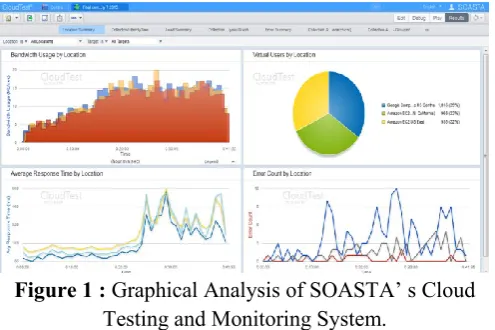
SOASTA‟s cloud testing and monitoring tool, which is majorly used for testing the cloud and making it more accessible and actionable than ever before. Tests can be created quickly and then run on your own infrastructure allows users to easily integrated test of different test with scalable pay of their cloud environment.
Figure 1 : Graphical Analysis of SOASTA‟ s Cloud Testing and Monitoring System.
The SOASTA platform reduces the complexity and time, because of the Scalability that is, pay as you use, the testing cost reduces, no need to invest amount for
cloud test infrastructure. Cloud-Test SOASTA‟s dashboards associationwith different testing options for data from the test controller viewpoint with data from the servers inside the security system and firewall.Systems Monitoring Data is an additional data stream that strength present during a successful cloud test is the monitoring data (Processors, CPU, Memory, etc.). Whether the data is coming from SOASTA‟s monitoring agents themselves or from third party auditors, the data is always relayed on SOASTA‟s agent called „Conductor‟. While this data is not generally considered sensitive, as it is only related to the fitness of systems under test, it can be encrypted for further security and transferred over HTTPS.
The cloud based test approachmust be
evidentlyresponseand solution what is proposed to be accomplished by affecting testing to the cloud, including easy access to testing software, platform and infrastructure, cost savings, reduction in cycle times, etc. The risks connected will identified through duration of the tests, where the approach and procedure should bedefined, the type of tests to be performed in the cloud [9].
VIII.
CONCLUSION
According to such problems as the potential software failure existing in the field operation process of the software testing methodologiesof lower cost, pay per use and minimization of upfront capital investment using the software testing as a service using cloud computing and the software testing efficiency of SOASTAwhich is based on online analytical engine, being relatively low, this paper has designed a integrated software testing cloud service system, and researched the design and implementation mechanism about the software testing cloud service system from trusted access control, data encryption transmission and storage, optimized scheduling of system resources.
IX.
REFERENCES[1] J. Chen, C. Wang, F. Liu and Y. Wang, "Research and Implementation of a Software Online Testing Platform Model Based on Cloud Computing", 2017 Fifth International Conference on Advanced Cloud and Big Data (CBD), Shanghai, 2017, pp. 87-93.
[2] Chandu P. M. S. S and D. Kata, "Integrating and enhancing the quality of services in cloud computing with software testing", 2016 International Conference on Wireless Communications, Signal Processing and Networking (WiSPNET), Chennai, 2016, pp. 2008-2010.
[3] M. S. N. Murthy and V. Suma, "Software testing and its scope in CLOUD : A detailed survey", 2017 International Conference on Innovative Mechanisms for Industry Applications (ICIMIA), Bangalore, 2017, pp. 269-273.
[4] Marri Rami Reddy, P.Yalla, J. Vijaya Chandra, “Design and implementation of integrated testing tool based on metrics and quality assurance”, International Journal of Applied Engineering Research, Volume 9, Issue 21, Pages10463-10472, 2014.
[5] J. Wang, X. Bai, H. Ma, L. Li and Z. Ji, "Cloud API Testing", 2017 IEEE International Conference on Software Testing, Verification and Validation Workshops (ICSTW), Tokyo, 2017, pp. 385-386.
[6] L. Xiaobing, C. Wei, Z. Feng, X. Bin and S. Zhiqiang, "Design of a security smart meter software testing cloud service system", 2016 IEEE Information Technology, Networking,
Electronic and Automation Control Conference, Chongqing, 2016, pp. 874-878.
[7] J. Vijaya Chandra, Dr. NarasimhamChalla, Dr. Sai Kiran Pasupuleti, Dr. V. Krishna Reddy, Dr. K. Thirupathi Rao, “Numerical Formulation and Simulation of Social Networks Using Graph Theory on Social Cloud Platform”, Global Journal of Pure and Applied Mathematics, Volume 11, Issue 3, Pages 1253-1264, 2015. [8] P. Stephanow and C. Banse, "Evaluating the
Performance of Continuous Test-Based Cloud Service Certification", 2017 17th IEEE/ACM International Symposium on Cluster, Cloud and Grid Computing (CCGRID), Madrid, 2017, pp. 1117-1126.
[9] P. Stephanow and K. Khajehmoogahi, "Towards Continuous Security Certification of Software-as-a-Service Applications Using Web Application Testing Techniques", 2017 IEEE 31st International Conference on Advanced Information Networking and Applications (AINA), Taipei, 2017, pp. 931-938.