Methods For Constructing Lexicon-Grammar Resources: The Example Of
Measure Expressions
Matthieu Constant*
* University of Marne-la-Vallée 5,bld Descartes
Champs-sur-Marne 77454 Marne-la-Vallée Cedex 2
Abstract
We construct, in the framework of the lexicon-grammar theory, a set of grammars dealing with measure expressions. First, we manually represent compounds with graphs: determiners such as ten pounds of and prepositions such as 34 miles from. Then, by the means of lexicon-grammar matrices, graphs and a semi-automatic process, we build a set of grammars of kernel sentences e.g. the door is 2-meter high. Finally, we evaluate our methods and grammars according to three points: production, maintenance and concrete application.
1. Introduction
The representation of numerical expressions is a significant issue in Natural Language Processing (NLP) due to their very frequent occurrences in texts. In this paper, we build a set of grammars representing measure expressions in French and in English in the framework of lexicon-grammar methodology and with the aid of finite state technology. We first briefly present some points of the lexicon-grammar theory useful in our work (section 2). Then, we describe the process of constructing grammars of compounds in the form of graphs (section 3) and grammars of sentences (section 4). Finally, we evaluate our grammars (section 5).
2. Lexicon-Grammar Theory And Finite
State Technology
2.1. Theoretical Bases
The Lexicon-Grammar is a systematic description of linguistic facts based on a transformational theory (Harris 1968; Gross 1975, 1994). The minimal unit of description is the elementary sentence. Predicates (verbs, nouns and adjectives) are systematically studied and encoded in Lexicon-Grammar Matrices (LGMs). Each lexical entry enters in an elementary surface structure according to which it is classified:
John eats a cake := N0 eat N1 1 Mary believes that John’s wrong := N0 believe that S 2
John makes a friend of Mary := N0 Vsup a friend of N1 3
Their transformational properties are systematically examined. Each lexical entry has its own behaviour, such as the French verbs obéir (to obey) and penser (to think) with the same elementary structure N0 V à N1 (V for verb):
1
Ni stands fot the ith nominal agrument of a given predicate, where i is an integer.
2
S stands for a sentence. 3
Noun predicates enter in constructions with support verbs (Vsup).
Luc obéit à Max = Luc lui obéit 4 Luc pense à Max = * Luc lui pense 5
Nominalization and adjectivization are also treated as in the following examples:
John analyses this problem
= John makes an analysis of this problem Mary has courage
= Mary is courageous
In these cases, related predicates such as the noun analysis and the verb to analyse are encoded separately because they have different properties, but they are related to each other in the LGMs. Note also that constructions with noun predicates can be reduced into Noun Phrases (NPs): Max approves the analysis of this problem by John.
2.2. Linguistic Resources
Natural Language Processing (NLP) requires precise and large-scale linguistic databases. For this purpose, the informal European network of laboratories RELEX accumulates, in the framework of the Lexicon-grammar theory, linguistic components of three types in several languages (French, English, Portuguese, Italian, Korean, etc.): electronic dictionaries, local grammars and lexicon-grammar matrices (Leclère et al., 1991).
2.2.1. Electronic Dictionaries
Large-coverage morphological dictionaries of simple words have been built in order to recognize graphical words in electronic texts (Courtois & Silberztein, 1990). Inflection codes are associated to canonical entries to automatically generate their inflected forms. Compound words have also been encoded in compound dictionaries. These dictionaries are part of the DELA system. They are compressed in the form of Finite State Transducers (FSTs), therefore improving access performances.
2.2.2. Local Grammars
Local Grammars are in the form of graphs and describe local constraints (Gross, 1997). They are
4
If S1 and S2 are sentences that have a transformational relation (in this case, pronominalization), they are equivalent in some ways and we write S1 = S2.
5
equivalent to FSTs after a few compiling operations: they can be seen as compound dictionary extensions. In terms of production and maintenance, this compact representation is a clear advantage in comparison with the list representation of electronic dictionaries. The use of sub-graphs makes it very modular. Local grammars can be applied to texts e.g. with the software INTEX (Silberztein, 1993) in order to recognize and tag utterances (cf. section 3).
2.2.3. Lexicon-Grammar Matrices
For each predicate (verbs, nouns and adjectives), syntactic properties and syntactic and semantic information on arguments are systematically encoded in the form of LGMs. Each column corresponds to a given property (e.g. pronominalization, passivation). Each row corresponds to one lexical entry. At the intersection of a row and a column, a plus sign indicates that the corresponding lexical entry has the corresponding property, a minus sign, that it has not; and finally, a string indicates lexical information (Cf. section 4.1). Part of the LGMs can automatically be transformed into FSTs e.g. to construct a syntactic parser (E. Roche, 1993, 1999). With each LGM entry, we associate a graph representing the set of its equivalent surface forms as shown in Figure 16. The different paths of the graph are equivalent. Graph representation can be seen as a factorization of the frames and the slots in the EAGLES terminology (Barnett et al., 1996). The optionality of an argument is marked by the presence of an empty transition in parallel with the argument.
Figure 1: give
3. Compounds And Measure Expressions
3.1. Base Structure
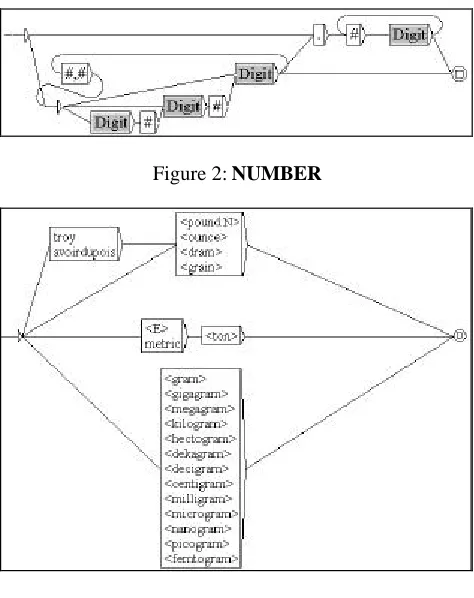
Our first objective is to represent determiner phrases like ten meters of and compound locative prepositions like ten miles from, containing measure expressions of the form Dnum Unit (=: fifty meters). Dnum stands for a numerical determiner described in a set of graphs that recognize utterances such as 34.4 and sixty-one (Chrobot, 2000). Unit symbolizes units of measurement also represented in the form of graphs on the basis of Constant (2000) and describes utterances such as meter, foot plus their prefixed forms (e.g. kilometer), and their abbreviations (e.g. ft). Graph NUMBER7 shown in Figure 2 is part of Dnum and represents sequences of digits (e.g.
6
This graph is a theoretical and simple example in order to help the reader’s understanding.
7
A symbol s in a grey box represents a call to graph s. Graph
Digit recognizes numbers from 0 to 9. x#y means that the space character is forbidden between the words x and y.
123 and 1.7). GRAM8 (Figure 3) represents English weight units and has been established with the aid of an on-line dictionary of units of measurement (www.unc.edu/~rowlett/units/). It is included in Unit.
Figure 2: NUMBER
Figure 3: GRAM
We also need to use graphs of predeterminers (PredDnum) and postdeterminers (PostDnum) that occur frequently before and after Dnum Unit, such as in environ 30 kilomètres (about 30 kilometers) and 30 kilomètres environ.
In English, currency units have a slightly different behaviour from other units: currency symbols are always located before Dnum: £10.
3.2. Determiner Phrases
We construct manually formal descriptions of compound determiners with the following basic forms:
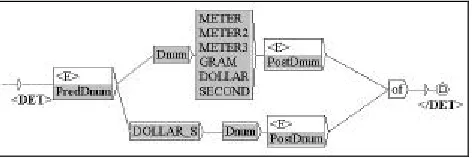
(Det + E) Dnum Unit of =: ten square meters of (Det + E) Dnum Unit de =: dix mètres carrés de These determiner phrases have been studied in Buvet (1993). We propose a description with graphs. Their construction consists in assembling the graphs of section 3.1 and in choosing appropriate unit graphs (GRAM =: gram, METER =: meter, METER2 =: square meter,
METER3 =: cubic meter, DOLLAR =: dollar+ yen,
DOLLAR_S =: £, SECOND =: second + year). A
simplified English graph is shown in Figure 49.
8
<E> is the empty symbol. For a given canonical form x, <x> stands for all inflected forms of x that are encoded in the dictionaries.
9
Figure 4: Measure determiner phrase
When the graph is applied to a text, the utterances recognized are automatically tagged as in the following example:
Independent States sold the European Union <DET>3,000 tons of</DET> uranium
Semantic information could clearly be added in outputs because such compound determiners contain significant meaning. For example, 3,000 tons of uranium can be related to the underlying sentence the uranium has a weight of 3,000 tons (Buvet, 1993, cf. section 4).
3.3. Locative Prepositions
We now describe semi-frozen locative prepositions (Loc) with the following basic forms:
Dnum METER from =: 30 kilometers from à Dnum METRE de =: à 30 kilomètres de
They enter in elementary constructions with locative support verbs (Gross, 1996): N0 Vsup Loc N1 (=: John is 30 kilometers from London). This sentence can be semantically interpreted by the distance d between the geographical positions P0 and P1 of N0 and N1: d(John, London) = 30 km10. Such an interpretation can be performed with FSTs containing variables (Silberztein, 1999) as shown in the theoretical graph in Figure 5. Let u be a sub-sequence of an utterance recognized by the graph. If u is recognized by a part of the graph between indexed parentheses (i), then u is indexed and is symbolized by the variable $i. Thus, if the utterance John is ten meters from the swimming-pool is recognized, the result of the interpretation is d(John, the swimming-pool) = ten meters.
Figure 5: A semantic interpreter
The insertion of a direction involves the notion of vector such as in the sentences:
Mary is 10 km north of your house The plane is 5km above John
In the case where P0 is within a circle the center of which is P1, Loc has the forms:
within a Dnum METER radius of
dans un rayon de Dnum METER autour de
10
Unit can be interpreted by the application of transducers that convert each unit into a standard one, e.g. kilometre 1000 m. Dnum can be converted into a sequence of digits, such as sixty-one 61 (Chrobot 2000). Thus, Dnum Unit can be seen as a simple multiplication.
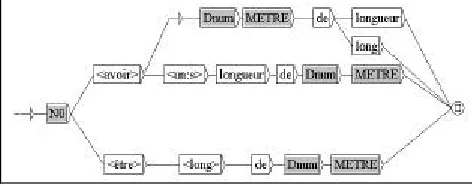
We show in Figure 6 a simplified English graph of the locative prepositions containing the unit METER.
Figure 6: graph of locative prepositions
4. Sentences and measure expressions
4.1. Theory And Lexicon-Grammar Matrix Encoding
This section is based on a linguistic study by Giry-Schneider (1991). The elementary sentences we are concerned with have the following surface structures:
(1) N0 have a N of Dnum Unit =: Max has a weight of 80 kg (2) N0 avoir un N de Dnum Unit = : Max a un poids de 80 kg
Each N has an appropriate set of units that can be represented by a graph. For example, graph GRAM
describes the set of units appropriate to the noun weight. Constructions (3) and (4) are equivalent to (2):
(3) N0 avoir Dnum Unit de N (4) N0 avoir Dnum Unit de N-a11 Cette corde a une longueur de 10 m (This rope has a length of 10 m)
= Cette corde a 10 m de (longueur + long) However, this permutation is not possible for all Ns as shown in the following example:
Cette voiture a une vitesse de 10 km/h (This car has a speed of 10 km per hour) = * Cette voiture a 10 km/h de vitesse
The adjectivi zation transformation on elementary sentences (1) and (2) yields the following structures:
N0 is Dnum Unit N-a
=: The rope is 10-meter long N0 être N-a de Dnum Unit =: la corde est longue de 10 m
Sentences (1) and (2) can also be the result of a nominalization of the sentences:
(5) N0 N-v Dnum Unit12 = : Le stylo coûte un euro =: The pen costs one euro
Constructions (1) and (2) can also be reduced into NPs of the form (6). In some cases, N can be zeroed as in (7).
(6) N0 de un N de Dnum Unit = N0 de Dnum Unit de (N + N-a)
une porte d’une hauteur de 3 m
11
N-a (=: long) is the adjective morphologically and semantically associated to N (=: length). Some Ns have no N-a, e.g. speed.
12 N-v (=: to weigh) is the verb morphologically and
= une porte de 3 m de (hauteur + haut) (7) un homme d’une taille de 1,83 m = un homme de 1,83 m
From these observations, we build a LGM a selection of which is shown in Table 1. C1 indicates the Ns described. C2 provides the names of the graphs representing the sets of units appropriate to N. C3 and C4 give respectively N-a and N-v. C5 indicates if N enters in construction (3). In our selection, the French word tension has two entries: the first one means tension, the other one means blood pressure. They have different appropriate units: the blood pressure has an empty unit symbolized by <E> while volt is associated to the electric tension. They also have different transformational properties:
Max a 13 de tension
* Cette ampoule a 60 V de tension
Note also that we could add a new column in the LGM to indicate appropriate modifiers of N, such as artérielle (arterial) for tension (blood pressure) or électrique (electric) for the other tension.
C1 C2 C3 C4 C5
longueur :METRE long - +
Poids :GRAMME - peser -
Tension :VOLT - - -
Tension <E> - - +
Vitesse :KMH - - -
Table1: Measure sentence LGM
4.2. Reference Graph And Lexicon-Grammar Matrices
In section 2.2.3, it has been mentioned that an LGM can be semi-automatically transformed into graphs. A simple way of doing this is to build a reference graph that contains the set of all possible surface forms as shown in Figure 7. A transition @i (where i is an integer) is seen as a variable that refers to the ith column (or property) of the matrix. For each lexical entry (or each row), a new graph is automatically constructed from the reference graph by: - removing the transition @i when the intersection
of the ith column and the current row is ‘-‘ - replacing @i by <E> (the empty element) when
‘+’
- replacing @i by the content of the intersection of the ith column and the current row, by default The result of the process for the entry longueur is shown in Figure 8.
Figure 7: A sentence reference graph
Figure 8: longueur
With the same process, we build reference graphs representing the NPs, reductions of the elementary sentences. Thus, with each N, we associate a NP graph.
5. Evaluation
We evaluate our methods and our grammars by taking into account three points: production, maintenance and application.
5.1. Production And Maintenance
Through the examples shown previously, it should be clear that graph formalism facilitates the production of grammars13. The application of our methods has to be manually controlled in order to construct precise lexicons based on linguistic facts: each lexical entry has a specific syntactic behaviour that cannot be entirely automatically predicted. Nevertheless, the use of automatic tools extracting information from large corpora makes this work less time-consuming. For example, in order to build our compound grammars, we built unit graphs with the aid of specific dictionaries, and then their application to a large corpus provided a list of occurrences. By examining their left and right contexts, we manually extracted relevant information e.g. the list of predeterminers. Furthermore, the use of LGMs, reference graphs and the semi-automatic process shown in section 4 avoids duplicating graphs by hand.
Maintenance is possible with our formalism. In graphs, the insertion of a new path is a very simple operation: inserting new transitions. The modification of a sentence grammar is also extremely simple and cheap. For example, the addition of a new property to a sentence grammar (e.g. appropriate modifiers) only requires adding a column in the LGM, modifying the reference graph and automatically generating the modified graphs for each lexical entry.
5.2. Concrete Application
The graphs of compounds shown previously are simplified and theoretical. Thus, we need to improve them in order to apply them to texts, which complicates graphs. We provide below a list of examples of improvement.
The theoretical sequence Dnum Unit used to describe the basic form of measure expressions does not exactly correspond to usage though most expressions of this type occur in texts. Each unit has its own syntax, e.g.
2 hours, 15 minutes and 2 seconds 5 feet and 2 inches
13
Thus, instead of dividing the sequence Dnum Unit into two graphs for each set of unit (e.g. Dnum METER, Dnum GRAM, etc.), we have to construct one graph DnumUnit (e.g. DnumMETER). As explained previously, these modifications in graphs are very simple to make. In column C2 of the Table 1, we replace Unit (=: GRAM) by DnumUnit (=: DnumGRAM) and then modify the reference graph.
The working corpus may also have a specific way of dealing with measure expressions. We shall adapt our grammars to it. For example, the electronic version of the newspaper Herald Tribune often juxtaposes measures in British units and their conversion into standard units, e.g. It produced 1.2 million ounces (34,000 kilograms) of gold last year.
Application to sentences is more difficult than to locally constrained expressions such as compounds because they rarely occur in their theoretical elementary form14. Measure expressions most of the time occur in the
form of NPs and Adjective Phrases (APs)
transformationally related to the elementary sentence. With the aid of transformational properties, NPs and APs, when recognized, are automatically related to their elementary sentences.
a 13-meter-long rope
une corde de 13 mètres de long a five-day waiting period
une période d’attente de cinq jours a 23-foot-long, three-ton hot dog
6. Conclusion
In this paper, we have described, in the framework of the lexicon-grammar theory, the construction of a set of finite state grammars of measure expressions in French and in English: compounds and sentences. We have also shown that our grammars based on the lexicon and the syntax is of great interest for the semantic interpretation of such expressions.
7. Acknowledgments
I would like to thank my director Eric Laporte for his help.
8. References
Barnett, R. et al. (1996). EAGLES recommendations on subcategorisation. EAGLES document EAG-CLWG-SYNLEX
Buvet, P.A. (1993). Les déterminants nominaux quantifieurs. Thèse de doctorat en linguistique. Paris, Université Paris 13.
Chrobot, A. (2000). Description des déterminants numéraux anglais par automates et transducteurs finis. In A. Dister (ed.), Actes des Troisièmes Journées Intex (pp. 101--118). Revue Informatique et Statistique dans les Sciences Humaines. Liège, Université de Liège. Constant, M. (2000). Description d’expressions
numériques en français. In A. Dister (ed.). Actes des Troisièmes Journées Intex (pp. 119--135). Revue Informatique et Statistique dans les Sciences Humaines. Liège, Université de Liège
14
In order to obtain better results for elementary sentence application, we shall, for example, insert new support verbs, adverbials between arguments, …
Courtois, B. & Silberztein, M. (1990). Les dictionnaires électroniques du français. Langue Française 87. Paris: Larousse.
Giry-Schneider, J. (1991). Noms de grandeurs en avoir et noms d’unités. Cahiers de grammaire (pp. 29--49). Toulouse, Université de Toulouse-Le Mirail.
Gross, M. (1975). Méthodes en syntaxe. Paris: Hermann. Gross, M. (1994). Constructing Lexicon-Grammars. In B.T.S. Atkins and A. Zampolli (eds.), Computational Approaches to the Lexicon (pp. 213--263). Oxford: Oxford University Press.
Gross, M. (1996). Les formes être Prép X du français. Lingvisticae Investigationes, XX:2, 217--270.
Gross, M. (1997). The Construction of Local Grammars, in E. Roche and Y. Schabes (Eds). Finite State Language Processing (pp. 329--352). Cambridge, Mass.: The MIT Press.
Harris, Z.S. (1968). Mathematical Structures of Language. New York: John Wiley and sons.
Leclère, C. & Subirats-Rüggeberg, C. (1991). A bibliography of studies on lexicon-grammar. Lingvisticæ Investigationes, XV:2, 347--409.
Roche, E. (1993), Analyse syntaxique transformationnelle du français par transducteurs et lexique-grammaire. Thèse de doctorat en informatique, Université Paris 7. Roche, E. (1999). Finite state transducers: parsing free and
frozen sentences. In A. Kornai (ed.). Extended finite state models of language (pp. 108--121). Cambridge Press.
Silberztein, M. (1993). Dictionnaires électroniques et analyse automatique de textes : Le système INTEX. Paris: Masson.