Test Collections for Spoken Document Retrieval from Lecture Audio Data
Tomoyosi Akiba
(1), Kiyoaki Aikawa
(2), Yoshiaki Itoh
(3),
Tatsuya Kawahara
(4), Hiroaki Nanjo
(5), Hiromitsu Nishizaki
(6),
Norihito Yasuda
(7), Yoichi Yamashita
(8), Katunobu Itou
(9)(1)Toyohashi Univ. of Technology, 1-1 Hibarigaoka, Tenpaku, Toyohashi, Aichi, JAPAN ([email protected]) (2)Tokyo Univ. of Technology,(3)Iwate Prefectural Univ.,
(4)Kyoto Univ.,(5)Ryukoku Univ.,(6)Univ. of Yamanashi,(7)NTT,(8)Ritsumeikan Univ.,(9)Hosei Univ. Abstract
The Spoken Document Processing Working Group, which is part of the special interest group of spoken language processing of the Information Processing Society of Japan, is developing a test collection for evaluation of spoken document retrieval systems. A prototype of the test collection consists of a set of textual queries, relevant segment lists, and transcriptions by an automatic speech recognition system, allowing retrieval from the Corpus of Spontaneous Japanese (CSJ). From about 100 initial queries, application of the criteria that a query should have more thanfive relevant segments that consist of about one minute speech segments yielded 39 queries. Targeting the test collection, an ad hoc retrieval experiment was also conducted to assess the baseline retrieval performance by applying a standard method for spoken document retrieval.
1. Introduction
The lecture is one of the most valuable genres of audiovi-sual data. Previously, however, lectures have mostly been archived in the form of books or related papers. The main reason is that spoken lectures are difficult to reuse because browsing and efficient searching within spoken lectures is difficult.
Spoken document processing is a promising technology for solving these problems. Spoken document processing deals with speech data, using techniques similar to text process-ing. This includes transcription, translation, search, align-ment to parallel materials such as slides, textbooks, and re-lated papers, structuring, summarizing, and editing. As this technology is developed, there will be advanced applica-tions such as computer-aided remote lecture systems and self-learning systems with efficient searching and brows-ing. However, spoken document processing methods are difficult to evaluate because they require subjective judg-ment and/or the checking of large quantities of evaluation data. In certain situations, a test collection can be used for a shareable standard of evaluation.
To date, test collections for information retrieval research have been constructed from such sources as newspaper ar-ticles (Kitani et al., 1998), Web documents (Oyama et al., 2005), and patent documents (Fujii et al., 2005). Test col-lections for cross-language retrieval (Gey and Oard, 2001; Kishida et al., 2005), open-domain question answering (Voorhees and Tice, 1999; Kato et al., 2005), and text sum-marization (Hirao et al., 2004) have also been constructed. A test collection for Spoken Document Retrieval (SDR) is usually based on a broadcast news corpus. Compared to broadcast news, lectures are more challenging for speech recognition because the vocabulary can be technical and specialized, the speaking style can be more spontaneous, and there is a wider variety of speaking styles and structure types for lectures. Moreover, a definition of the semantic units in lectures is ambiguous because it is highly depen-dent on the queries. We aim to construct a test collection for ad hoc retrieval and term detection.
The rest of this paper is organized as follows. Section 2. describes how we constructed the test collection for spoken document retrieval, targeting lecture audio data. In Section 3., we evaluate the test collection by investigating its base-line retrieval performance, which was obtained by applying the conventional document retrieval method.
2. Constructing a Test Collection for SDR
A test collection for text document retrieval comprises three elements: (1) a huge document collection in a target do-main, (2) a set of queries, and (3) results of relevance judg-ments, i.e., sets of relevant documents that are selected from the collection for each query in the query set.In the spoken document case, the text collection should not merely be replaced with a spoken document collection. Two additional elements are necessary for an SDR test col-lection: (4) manual transcriptions, and (5) automatic tran-scriptions of the spoken document collection. The manual transcriptions are necessary for relevance judgment by the test collection constructors and can be used as a “gold stan-dard” for automatic transcription by test collection users. The automatic transcriptions obtained by using a Large Vo-cabulary Continuous Speech Recognition (LVCSR) system are also desirable for supporting those researchers who do not have their own facilities for speech recognition or are interested only in aspects of text processing in SDR. These elements of our SDR test collection are described in the following subsections.
2.1. Target Document Collection
Table 2: Statistics for the results of the relevance judgment. Label Passages Unique lectures Utterances
per query per query per passage
Relevant 11.18 7.90 10.39
Relevant & Partially Relevant 12.69 9.26 10.88
Word Error Rate (%)
# lectures
Figure 2: Distribution of word error rates in 70 academic lectures.
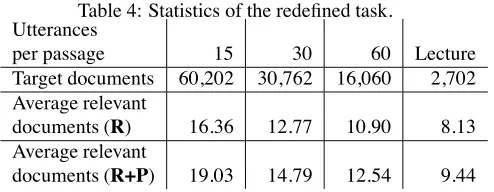
Table 4: Statistics of the redefined task. Utterances
per passage 15 30 60 Lecture Target documents 60,202 30,762 16,060 2,702 Average relevant
documents (R) 16.36 12.77 10.90 8.13 Average relevant
documents (R+P) 19.03 14.79 12.54 9.44
For thefirst attempt, we decided to use the recognition re-sults in a closed setting. The Word Error Rate (WER) was about 20%, which is comparable with that of the TREC SDR task.
2.5. Summary of the Test Collection
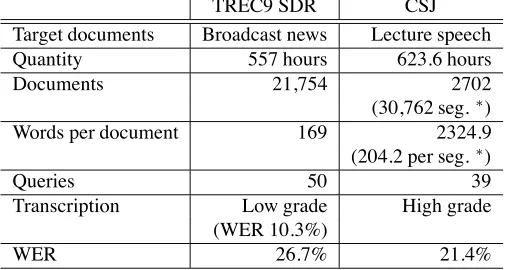
Table 3 shows a summary of the constructed test collection compared with the TREC-9 SDR test collection.
3. Evaluation
To evaluate the test collection and to assess the base-line retrieval performance obtained by applying a standard method for SDR, an ad hoc retrieval experiment targeting the test collection was conducted.
3.1. Task Definition
The primary task of our test collection, i.e., to find pas-sages with variable utterance length, is not conventional. Because we wanted to evaluate the performance obtained by applying the standard method for SDR, and to compare the results with other studies in SDR and IR research, we redefined the conventional retrieval task, instead of search-ing for variable length segments in the collection.
Firstly, we defined pseudopassages by automatically seg-menting each lecture into sequences of segments withfixed
㻓 㻖 㻙 㻜 㻔㻕 㻔㻘
ࠤ㻜 㻔㻓ࠤ㻔㻗 㻔㻘ࠤ㻔㻜 㻕㻓ࠤ㻕㻗 㻕㻘ࠤ㻕㻜 㻖㻓ࠤ㻖㻗 㻖㻘ࠤ
㻔㻘㻃㼘㼗㼗㼕㻑 㻖㻓㻃㼘㼗㼗㼕㻑
Figure 3: The distribution of the relevant documents.
numbers of sequential utterances: 15, 30, and 60. When 30 utterances are used in a segment, the number of pseudopas-sages is 30,762 and the number of words in a document is 204.2 on average, which are comparable numbers to those for TREC SDR.
Next, we assigned retrieved pseudopassages a relevance la-bel as follows: if the pseudopassage shared at least one ut-terance that came from the relevant passage specified in the “goldenfile”, then the pseudopassage was labeled as “rel-evant”. Two kinds of relevance degree were used for the evaluation as follows.
R The passages labeled “Relevant” are used for deciding the relevant pseudopassages.
R+P The passages labeled either “Relevant” or “Partially relevant” are used for deciding the relevant pseudopas-sages.
Table 4 shows the size of the target documents (the number of pseudopassages) and the number of relevant documents for each task. Figure 3 shows the distribution of the relevant documents found in our redefined ad hoc retrieval task.
3.2. Ad hoc Retrieval Methods
All pseudopassages were then indexed by using either their words, their character bi-grams, or a combination of the two. The vector space model was used as the re-trieval model and TF–IDF (Term Frequency–Inverse Doc-ument Frequency) with pivoted normalization (Singhal et al., 1996) was used for term weighting. We compared three representations of the pseudopassages: the 1-best ically transcribed text, the union of the 10-best automat-ically transcribed texts, and the reference manually tran-scribed text.
3.3. Evaluation Metric
We used 11-point average precision (Teufel, 2007) as our evaluation metric, which is obtained by averaging the fol-lowingAP over the queries.
Table 3: A comparison between TREC-9 SDR and our CSJ SDR test collections. TREC9 SDR CSJ
Target documents Broadcast news Lecture speech Quantity 557 hours 623.6 hours
Documents 21,754 2702
(30,762 seg.∗) Words per document 169 2324.9 (204.2 per seg.∗)
Queries 50 39
Transcription Low grade High grade (WER 10.3%)
WER 26.7% 21.4%
∗A succession of 30 utterances is considered to be a segment.
Table 5: 11-points average precisions using 15 utterances as a pseudopassage.
Indexing unit Word
Relevance Char. + char.
degree Transcription Word 2-gram 2-gram Reference 0.180 0.165 0.185 R 10-best 0.177 0.145 0.167 1-best 0.155 0.135 0.146 Reference 0.181 0.166 0.188 R+P 10-best 0.179 0.150 0.171 1-best 0.159 0.143 0.152
Table 6: 11-points average precisions using 30 utterances as a pseudopassage.
Indexing unit Word
Relevance Char. + Char.
degree Transcription Word 2-gram 2-gram Reference 0.249 0.216 0.240 R 10-best 0.225 0.205 0.232 1-best 0.213 0.188 0.207 Reference 0.249 0.220 0.242 R+P 10-best 0.227 0.210 0.234 1-best 0.211 0.194 0.211
AP = 111 10 i=0
IP(10i ),
whereRiandPiare the recall and the precision up to the i-th retrieved documents, respectively. In practice, we re-trieved 1000 documents for each query to calculate theAP.
3.4. Results
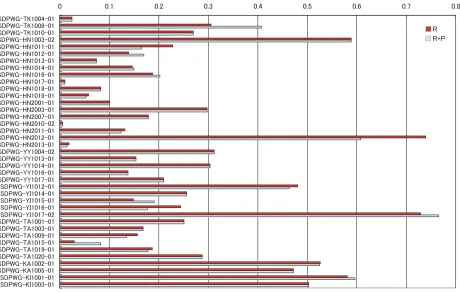
Figure 4 shows the 11-point average precision for each query, where 30 utterances were used as a pseudo-passage and the reference transcriptions were used for indexing. It
Table 7: 11-points average precisions using 60 utterances as a pseudopassage.
Indexing unit Word
Relevance Char. + Char.
degree Transcription Word 2-gram 2-gram Reference 0.294 0.269 0.297 R 10-best 0.256 0.236 0.265 1-best 0.251 0.227 0.253 Reference 0.305 0.278 0.308 R+P 10-best 0.261 0.243 0.271 1-best 0.256 0.235 0.263
Table 8: 11-points average precisions using th whole lec-ture as a pseudopassage.
Indexing unit Word
Relevance Char. + Char.
degree Transcription Word 2-gram 2-gram Reference 0.453 0.443 0.468 R 10-best 0.399 0.384 0.414 1-best 0.411 0.397 0.426 Reference 0.473 0.454 0.489 R+P 10-best 0.413 0.400 0.428 1-best 0.423 0.409 0.441
indicates that the variance of the difficulty is high. For ex-ample, the hardest query canfind only one (Rdegree) rele-vant passage in the 100-best candidates. On the other hand, the easiest query canfind eight (Rdegree) relevant passages in the 10-best candidates.
㻓 㻓㻑㻔 㻓㻑㻕 㻓㻑㻖 㻓㻑㻗 㻓㻑㻘 㻓㻑㻙 㻓㻑㻚 㻓㻑㻛
㻶㻧㻳㻺㻪㻐㻷㻮㻔㻓㻓㻗㻐㻓㻔 㻶㻧㻳㻺㻪㻐㻷㻮㻔㻓㻓㻛㻐㻓㻔 㻶㻧㻳㻺㻪㻐㻷㻮㻔㻓㻔㻓㻐㻓㻔 㻶㻧㻳㻺㻪㻐㻫㻱㻔㻓㻓㻖㻐㻓㻕 㻶㻧㻳㻺㻪㻐㻫㻱㻔㻓㻔㻔㻐㻓㻔 㻶㻧㻳㻺㻪㻐㻫㻱㻔㻓㻔㻕㻐㻓㻔 㻶㻧㻳㻺㻪㻐㻫㻱㻔㻓㻔㻖㻐㻓㻔 㻶㻧㻳㻺㻪㻐㻫㻱㻔㻓㻔㻗㻐㻓㻔 㻶㻧㻳㻺㻪㻐㻫㻱㻔㻓㻔㻙㻐㻓㻔 㻶㻧㻳㻺㻪㻐㻫㻱㻔㻓㻔㻚㻐㻓㻔 㻶㻧㻳㻺㻪㻐㻫㻱㻔㻓㻔㻛㻐㻓㻔 㻶㻧㻳㻺㻪㻐㻫㻱㻔㻓㻔㻜㻐㻓㻔 㻶㻧㻳㻺㻪㻐㻫㻱㻕㻓㻓㻔㻐㻓㻔 㻶㻧㻳㻺㻪㻐㻫㻱㻕㻓㻓㻖㻐㻓㻔 㻶㻧㻳㻺㻪㻐㻫㻱㻕㻓㻓㻚㻐㻓㻔 㻶㻧㻳㻺㻪㻐㻫㻱㻕㻓㻔㻓㻐㻓㻕 㻶㻧㻳㻺㻪㻐㻫㻱㻕㻓㻔㻔㻐㻓㻔 㻶㻧㻳㻺㻪㻐㻫㻱㻕㻓㻔㻕㻐㻓㻔 㻶㻧㻳㻺㻪㻐㻫㻱㻕㻓㻔㻖㻐㻓㻔 㻶㻧㻳㻺㻪㻐㻼㻼㻔㻓㻓㻗㻐㻓㻕 㻶㻧㻳㻺㻪㻐㻼㻼㻔㻓㻔㻖㻐㻓㻔 㻶㻧㻳㻺㻪㻐㻼㻼㻔㻓㻔㻗㻐㻓㻔 㻶㻧㻳㻺㻪㻐㻼㻼㻔㻓㻔㻙㻐㻓㻔 㻶㻧㻳㻺㻪㻐㻼㻼㻔㻓㻔㻚㻐㻓㻔 㻶㻧㻳㻺㻪㻐㻼㻬㻔㻓㻔㻕㻐㻓㻔 㻶㻧㻳㻺㻪㻐㻼㻬㻔㻓㻔㻗㻐㻓㻔 㻶㻧㻳㻺㻪㻐㻼㻬㻔㻓㻔㻘㻐㻓㻔 㻶㻧㻳㻺㻪㻐㻼㻬㻔㻓㻔㻙㻐㻓㻔 㻶㻧㻳㻺㻪㻐㻼㻬㻔㻓㻔㻚㻐㻓㻕 㻶㻧㻳㻺㻪㻐㻷㻤㻔㻓㻓㻔㻐㻓㻔 㻶㻧㻳㻺㻪㻐㻷㻤㻔㻓㻓㻖㻐㻓㻔 㻶㻧㻳㻺㻪㻐㻷㻤㻔㻓㻓㻜㻐㻓㻔 㻶㻧㻳㻺㻪㻐㻷㻤㻔㻓㻔㻘㻐㻓㻔 㻶㻧㻳㻺㻪㻐㻷㻤㻔㻓㻔㻜㻐㻓㻔 㻶㻧㻳㻺㻪㻐㻷㻤㻔㻓㻕㻓㻐㻓㻔 㻶㻧㻳㻺㻪㻐㻮㻤㻔㻓㻓㻕㻐㻓㻔 㻶㻧㻳㻺㻪㻐㻮㻤㻔㻓㻓㻘㻐㻓㻔 㻶㻧㻳㻺㻪㻐㻮㻬㻔㻓㻓㻔㻐㻓㻔 㻶㻧㻳㻺㻪㻐㻮㻬㻔㻓㻓㻖㻐㻓㻔
㻵 㻵㻎㻳
Figure 4: 11-point average precision for each query (using 30 utterances as a document, and manual transcription for the indexing.)
㻓 㻓㻑㻔 㻓㻑㻕 㻓㻑㻖 㻓㻑㻗 㻓㻑㻘
㻔㻘 㻖㻓 㻙㻓 㼏㼈㼆㼗㼘㼕㼈
㻔㻐㼅㼈㼖㼗 㻔㻓㻐㼅㼈㼖㼗 㼕㼈㼉㼈㼕㼈㼑㼆㼈
Figure 5: 11-point average precision using 1-best, 10-best, and reference transcriptions for indexing documents.
of the two).
Comparing the indexing units, using words is more effec-tive than using character 2-grams. Using both words and character 2-grams slightly improves the retrieval perfor-mance, especially for the longer target document lengths, i.e., using 60 utterances or a whole lecture as a document. Comparing the two kinds of relevant degree,R+P consis-tently gives better results thanR, but the difference is not large.
Figure 5 summarizes the results using the word as index-ing unit and R degree for the relevancy, to compare the
three kinds of representation of the target documents. It shows that using the 1-best automatically transcribed text decreases the IR performance by 10% to 15% compared with using the reference transcription. We also found that the use of 10-best candidates was effective for tasks with shorter passages, namely 15 and 30 utterances, but is less effective for those with longer passages, namely 60 utter-ances and whole lectures.
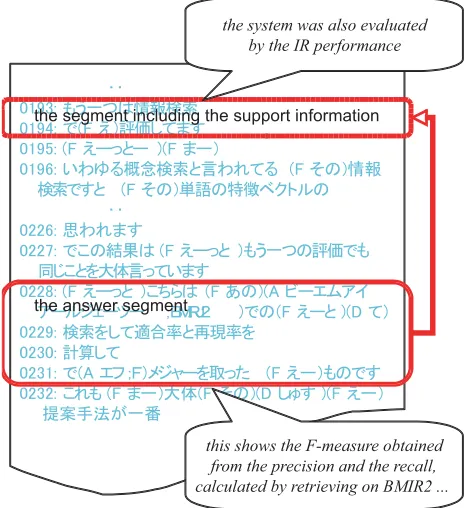
As a whole, the evaluation results show that the ad hoc re-trieval task for lecture audio data is much more difficult than that for broadcast news, where the precision was re-ported to be around 0.45 for a task condition comparable to our 30-utterances condition. Except when the whole lec-ture is used as a passage, the retrieval performance is very low. This is partly because a relevant passage often has its supporting segments separated from it in the same docu-ment, meaning that the relevant passage does not always have self-contained information.
researchers in variousfields.
To evaluate the test collection and to assess the base-line retrieval performance obtained by applying a standard method for SDR, an ad hoc retrieval experiment targeting the test collection was conducted. It revealed that the ad hoc retrieval task for lecture audio data was much more difficult than that for broadcast news.
We are now constructing another test collection for the term detection task. We will also prepare another automatic tran-scription with moderate WER by using an acoustic model and a language model trained in open conditions.
5. References
Atsushi Fujii, Makoto Iwayama, and Noriko Kando. 2005. Overview of patent retrieval task at NTCIR-5. In Pro-ceedings of the Fifth NTCIR Workshop Meeting, pages 269–277.
John S. Garofolo, Cedric G. P. Auzanne, and Ellen M. Voorhees. 1999. The TREC spoken document retrieval track: A success story. InProceedings of TREC-9, pages 107–129.
Fredric C. Gey and Douglas W. Oard. 2001. The TREC-2001 cross-language information retrieval track: Search-ing arabic usSearch-ing english, french or arabic queries. In Pro-ceedings of TREC-10, pages 16–25.
Tsutomu Hirao, Manabu Okumura, Takahiro Fukusima, and Hidetsugu Nanba. 2004. Text summarization chal-lenge 3 – text summarization evaluation at NTCIR work-shop 4. InProceedings of the Fourth NTCIR Workshop. Tsuneaki Kato, Jun’ichi Fukumoto, and Fumito Masui.
2005. An overview of NTCIR-5 QAC3. InProceedings of the Fifth NTCIR Workshop Meeting, pages 361–372. Tatsuya Kawahara, Hiroaki Nanjo, Takahiro Shinozaki, and
Sadaoki Furui. 2003. Benchmark test for speech recog-nition using the corpus of spontaneous Japanese. In ISCA & IEEE Workshop on Spontaneous Speech Pro-cessing and Recognition, pages 135–138.
Kazuaki Kishida, Kuang hua Chen, Sukhoon Lee, Kazuko Kuriyama, Noriko Kando, Hsin-Hsi Chen, and Sung Hyon Myaeng. 2005. Overview of CLIR task at thefifth NTCIR workshop. InProceedings of the Fifth NTCIR Workshop Meeting, pages 1–38.
Tsuyoshi Kitani, Yasushi Ogawa, Tetsuya Ishikawa, Haruo Kimoto, Ikuo Keshi, Jun Toyoura, Toshikazu Fukushima, Kunio Matsui, Yoshihiro Ueda, Tetsuya Sakai, Takenobu Tokunaga, Hiroshi Tsuruoka, Hidekazu Nakawatase, and Teru Agata. 1998. Lessons from BMIR-J2: A test collection for Japanese IR systems. In Proceedings of ACM SIGIR, pages 345–346.
Akinobu Lee, Tatsuya Kawahara, and K. Shikano. 2001. Julius — an open source real-time large vocabulary recognition engine. InProceedings of European Confer-ence on Speech Communication and Technology, pages 1691–1694, Sept.
Kikuo Maekawa, Hanae Koiso, Sadaoki Furui, and Hitoshi Isahara. 2000. Spontaneous speech corpus of Japanese. InProceedings of LREC, pages 947–952.
Keizo Oyama, Masao Takaku, Haruko Ishikawa, Akiko Aizawa, and Hayato Yamana. 2005. Overview of the
NTCIR-5 WEB navigational retrieval subtask 2. In Pro-ceedings of the Fifth NTCIR Workshop Meeting, pages 423–442.
Amit Singhal, Chris Buckley, and Mandar Mitra. 1996. Pivoted document length normalization. InProceedings of ACM SIGIR, pages 21–29.
Simone Teufel. 2007. An overview of evaluation methods in TREC ad hoc information retrieval and TREC ques-tion answering. In Laila Dybkj¨ar, Holmer Hemsen, and Wolfgang Minker, editors,Evaluation of Text and Speech Systems, number 37 in Text, Speech and Language Tech-nology, pages 163–186. Springer.