Simple-Clips ongoing research: more information with less data by
implementing inheritance
Riccardo Del Gratta, Nilda Ruimy, Antonio Toral
Istituto di Linguistica Computazionale Consiglio Nazionale delle Ricerche
Via Moruzzi,1 56124 Pisa Italy
{riccardo.delgratta, nilda.ruimy, antonio.toral}@ilc.cnr.it
Abstract
This paper presents the application of inheritance to the formal taxonomy (is-a) of a semantically rich Lexical Resource (LR) based on the Generative Lexicon theory, SIMPLE-CLIPS. The aim is to lighten the representation of its semantic layer by reducing the number of encoded relations. A prediction calculation on the impact of introducing inheritance as regards space occupancy is carried out, which yields a significant space reduction of22%. This is corroborated by its actual application that reduces the number of explicitly encoded relations in this lexicon by18.4%.Later on, we study the issues that inheritance poses to the Lexical Resources and discuss sensitive solutions, illustrated by examples, to tackle each of them. Finally, we present a discussion on the application of inheritance, from which two advantages arise: consistency enhancement and inference capabilities.
1.
Introduction
In order to encode semantic information in the four-layered Italian computational lexicon PAROLE-SIMPLE -CLIPS (PSC), a template-driven approach was adopted (Lenci et al., 2000). Such an approach, designed in the framework of the SIMPLE model, allowed providing a highly refined description of word meanings while ensuring a uniform, harmonized, consistent and model-conformant structuring of semantic information throughout the descrip-tion of different languages. Coherence in the representadescrip-tion of meaning was all the more necessary because of the sen-sitive issue to be tackled, namely the semantic typing of heads and arguments. The template-driven methodology aimed at guiding the lexicographer by presenting her/him, after the semantic type assignment, a lexically underspec-ified schema of type-defining properties to be instantiated in each entry. This clearly contributed to speed up the encoding process to a certain extent. But still, since the database management tool did not allow for the computa-tion of inheritance, every single property of each semantic unit (SemU) expressed either as features or semantic re-lations had to be explicitly specified in the corresponding entry.
Since its completion, the PSClexicon has been constantly maintained and updated and has undergone periodic checks with a view to monitoring space occupancy and internal co-herence. In addition, the recent formalization of the Gen-erative Lexicon-based semantic layer, SIMPLE-CLIPS, into OWL has allowed assessing its internal structure and the correct application of Generative Lexicon principles (Toral et al., 2007). Besides, the use of the lexical resource in a number of applications has provided interesting critical feedback to the developers and has allowed to evaluate coherence and performance from both a linguistic and a database administration perspective.
2.
Current research
2.1. The semantic databaseThe SIMPLE-CLIPS database consists of 57,000entries, 28,500of which are fully encoded with both mandatory and optional semantic features and relations foreseen by the SIMPLEmodel. For the sake of clarity, let us briefly remind that the core of SIMPLE relations is theExtended Qualia Structurewhich consists of four roles (formal,constitutive,
agentive andtelic). Each role subsumes a set of seman-tic relations1 that encode the componential aspect of word meaning and capture the nature of the relationships holding among word senses.
Two main issues have emerged from the analysis of feed-backs and checks of the SIMPLE-CLIPSdatabase:
1. the inexistence of some conceptual links, inexpress-ible through lack of appropriate representational vo-cabulary in the SIMPLEmodel (section 2.2.);
2. the high degree of information redundancy in the lex-icon, especially as far as semantic relations are con-cerned ( section 2.3.).
2.2. Missing links
To express the relationships holding between word senses, the SIMPLEmodel offers a large set of semantic relations. Among these are 60Extended Qualia relations, the rele-vance and expressive power of which is largely acknowl-edged. These relations allow for the expression of very fine-grained distinctions, both for structuring the informa-tion regarding the componential aspect of word meanings and for capturing the nature of the relationships holding among word senses.
This relation set, however, does not provide the means to account for some conceptual links holding between events
1
SIMPLEsemantic relations relate two word senses orSemUs:
θ∼1.7M b(22%)
Hence, the expected space occupancy gain obtained by ap-plying inheritance reaches22%.
We applied this strategy to the current database. We calcu-lated that, so far,7,663instantiated links belonging to51 types of semantic relations defined in the SIMPLEmodel (both prototypical and essential) can be physically re-moved from the descendant entries and inherited from their ancestor entries. In other words, more than18%of the re-lations explicitly encoded in the database until now (7,663 /42,3494) could be implicitly instantiated by applying in-ference based on inheritance.
This result is coherent with the value obtained in the pre-diction calculus.
4.
Inheritance issues
In the previous section we calculated the extent to which the implementation of inheritance principle can lighten the semantic data of the SIMPLEdatabase; in this section, we point out challenges that this principle may cause and tackle them. We foresee the following issues:
1. relation ˜R has to be added, but with a different target;
2. the target of relation ˜R has to be replaced;
3. relation ˜R has to be removed.
In the first scenario, conflicts may emerge between the tar-gets of relation ˜R, while in the second and third situations two factors enter into play, namely the cardinality of rela-tions and the acceptability of a given relation with respect to the other ones defined for aSemU. To limit semantic in-consistencies in relations defined at the descendant level, we add anacceptanceflag. This flag is managed by lexi-cographers and set to false when the inherited relation does not apply to the currentSemU. In such a case, the inherited relation is saved into the database also for the descendant
SemU, but since itsacceptance flag is equal to false, this relation is filtered out by the software. This means that only “accepted” relations are shown to the users.
To address the three issues above we have to answer the following questions:
1. Can we add the same relation ˜R with a different target?
2. Can we override the relation ˜R ?
3. How can we manage relation scope ?
The rationale of distinguishing between the is-a relation and the others is that, contrary to the formal relation, the cardinality of the orthogonal ones is not limited to1. There-fore, if ˜R is an orthogonal relation defined for aSemU at levelj and instantiatedC times, every hyponym inherits
C relations of type ˜R. Then, to provide specific informa-tion about the hyponym, lexicographers have no need to overwrite the target of these inherited relations: they sim-ply add any number of instances of the same relation they
4
Total number of relations in SIMPLE-CLIPSexcluding the is-a relis-ations.
deem necessary, provided no semantic conflict exists be-tween the targetSemUsof inherited and new relations5. In this way, the relation(s) ˜R defined for one of the hyponym are the only relations of type ˜R explicitly instantiated for this hyponym in the database.
From the database management tool point of view, in the hyponym’s entry, the new relation(s) of type ˜R are (explic-itly) editable whereas theC inherited relations ˜R are not. Moreover, as explained above, lexicographers may edit in-herited relations for special reasons.
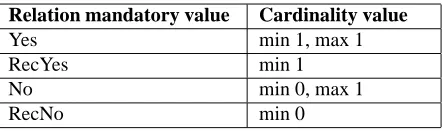
Table 1 below, shows the type of cardinality available for relations. The first question can be answered by using
car-Relation mandatory value Cardinality value
Yes min 1, max 1
RecYes min 1
No min 0, max 1
RecNo min 0
Table 1: Relation cardinality
dinality, i.e. the allowed number of instances of each se-mantic relation entering in the definition of a sese-mantic type. If a relation is defined asRecYesorRecNo, then, it can be instantiated more than once. TwoSemUs linked by an is-a relation either share a semantic type membership or be-long to semantic types related by a subsumption relation. So, when applying the inheritance principle to prototypi-cal relations only, we do not care of (possible) conflicts among the ˜R relations instantiated for the direct descendant
SemU (SemU child) and the ˜R relations inherited from its direct ancestor (SemU father). In fact, prototypical rela-tions should be consistent when implemented for children
SemUs. Here, consistency simply means that the target of the ˜R relations for both father and childSemUs share the same semantic type.
Cardinality also contributes to answer question2: in fact, if a relation ˜R is not recursive, we can specify for children
SemUsthe relation ˜R with a different target.
From both a theoretical and implementative perspective, points 1 and 2 represent the same problem and can be solved with the same strategy. In the database, in fact, we add records for both father and childSemUs. The differ-ence is that, in1, the record(s) for the childSemU are sim-ply added to the father’s ones, while in2, the record for the childSemU overrides the father’s ones.
To address this situation we introduce the notion ofscope
of relations. This concept allows both to answer point3 and to manage relation overriding issues. Let us consider the following (abstract) example:
SemUf ather R˜ T argetf ather
SinceSemUchildis-aSemUf atherthen:
SemUchild R˜ T argetf ather, s= 0
5Actually, we have decided not to implement semantic
In this case, the targets of the relation has helicity are in an is-a relation and the target value for the childSemU has to be one of the allowed fatherSemU.
5.
The S
IMPLE-C
LIPSDatabase and the
Implementation of Inheritance
The implementation of the inheritance principle had a significant positive side effect, viz. a considerable en-hancement of consistency of the SIMPLE-CLIPSdatabase. A correct inheritance of properties being in fact highly dependent on a coherent encoding, a preliminary ‘clean-ing’ and harmonization of the lexical data was in fact performed, with a rigorous consistency check of semantic relations and, in particular, of hyperonymic links. As to a possible coverage extension, it can reasonably be assumed that the insertion of new data should not generate further inconsistencies. Actually, lexicographers will now be less prone to encoding errors, as they only need to explicit specific (orthogonal) links in a word entry, but no more the relations already defined for their parent nodes.On the other hand, a first cost-free benefit of implementing the inheritance principle is internal to the lexical resource. In fact, provided they bear the formal is-a relation, the 28,500 SIMPLE-CLIPS entries not fully encoded will inherit orthogonal relations. Well then, right recently hyperonymic links were added to a large number of those entries, in the framework of the ILC project for linking the SIMPLE-CLIPSand the ItalWordNet databases. Besides, in the event of importing in the SIMPLE-CLIPSdatabase new semantic units (along with their hyperonymic link) from other lexical resources, the new entries will freely acquire these inherited relations.
5.1. Exploiting inheritance in the enriched database The extension of the SIMPLE-CLIPS database with new links holding between events and their participants and among co-participants in events is being carried out in a costless and low-effort semi-automatic way. This is pos-sible thanks to the extraordinary richness of information of the SIMPLEmodel and the possibility offered by the lexicon management tool to investigate every single feature of the lexical data. Using existing syntactic and semantic infor-mation, the pairs of word senses candidate to a new relation are in fact automatically identified and extracted, through a tangle of queries and constraints (Ruimy and Toral, 2008). The drawback of this enrichment process is, however, the considerable increase of the relation number in the database. More than5,000new relations were in fact in-stantiated for the six relation types encoded so far, viz. involved agent, involved location, involved instrument, volved result, role instrument and role location. The in-stantiation of these new links, and particularly the one re-lating events to their agents, has determined a further ex-ponential growth of information redundancy in the lexicon and has considerably increased the size of a large number of entries7. Some of them would now be scarcely manageable
7
This is, in particular, the case of high frequency verb entries, e.g.165involved agent relations in the entry of the verb lavorare
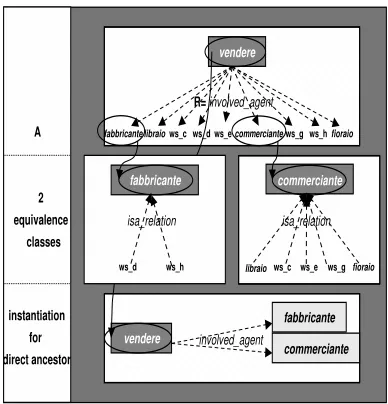
if all properties were explicitly represented. The enriched SIMPLE-CLIPSlexicon offers therefore an ideal testbed for assessing the impact of using the inheritance principle. Essentially, our reasoning is the following one. Let A be the set ofSemUs target of a given relation ˜R; let K be the cardinality, i.e. the number of elements of A. Theis-a re-lation creates a quotient set on A, by defining equivalence classes. This means, for example, that it is possible to find, in the K elements, M direct ancestors which divide the set A in M subsets. The relation ˜R can be instantiated only for these M direct ancestors8.
Figure 1: Theis-arelation creates a quotient set
Let us take, for example, the verb vendere, ‘to sell’. Vendere is the target SemU of the telic relation is the activity of (which corresponds to the EuroWordNet relation role agent) in 67 entries of profession-denoting nouns, among which ‘bookseller’, ‘florist’ but also more generic terms such as ‘shopkeeper’ or ‘sales assistant’. Now,62out of these67entries are hyponyms of these last two words. Implementing the inheritance, these entries will inherit this telic relation from their hyperonym and62 ex-plicitly encoded relations will therefore be removed. The same holds for63building-denoting nouns, which will in-herit from their hyperonym ‘shop’ the role location rela-tion whose target is vendere. As to the lexical entry for vendere, see figure 1, it includes now69semantic relations, among which the67newly added involved agent ones. Im-plementing the inheritance, the verb will only be related to the most generic terms such as ‘shopkeeper’ or ‘sales as-sistant’ and the like and, again,62relations will turn inher-ited. So, while vendere was involved in74relations in the original database and in273ones after the addition of new links, thanks to the inheritance of properties, it will now be effectively involved in only23relations while the other250 links will be inherited.
‘(to work)’ 8
6.
Conclusions
This paper reports on the practical application of the inher-itance principle to theis-ataxonomy of a semantically rich Lexical Resource, SIMPLE-CLIPS. The aim is to lighten its semantic representation by reducing the number of encoded relations, without losing any piece of information. By im-plementig inheritance, we avoid representing explicitly all relations for a semantic entry: those that are inherited from an ascendant do not need to be encoded.
A prediction calculation on the impact of introducing in-heritance as regards space occupancy has been carried out, which yelds a significant space reduction of22%.This is corroborated by its actual application that reduces the num-ber of explicitly encoded relations in this lexicon by18,4%.
Applying inheritance poses some issues to the Lexical Re-source. However, these have been carefully studied and successfully solved, as discussed and clarified through ex-amples. It is important to mention that besides the space reduction, the implementation of inheritance provides two notable advantages. On one hand inheritance enhances the consistency of the lexicon. On the other, it allows to gain further knowledge with respect to the one explicitly en-coded by inference.
Finally, we have demonstrated the effectiveness of the in-heritance principle by applying it to the enriched SIMPLE -CLIPSdatabase.
7.
References
Ted Briscoe, Valeria de Paiva, and Ann Copestake, editors. 1993. Inheritance, Defaults, and the Lexicon. Cam-bridge University Press, CamCam-bridge.
Alessandro Lenci, Federica Busa, Nilda Ruimy, Elisabetta Gola, Monica Monachini, Nicoletta Calzolari, and Anto-nio Zampolli, 2000. SIMPLE Linguistic Specifications. N Ruimy and A. Toral. 2008. More semantic links in
the SIMPLE-CLIPS database. In Proceedings of the 6th Language Resources and Evaluation Conference, Mar-rakech, Morocco.
N. Ruimy. 2007. Enhancing SIMPLE semantic relations: A proposal. In Proceedings of 3rd Language & Tech-nology Conference, Fundacja Uniwersytetu im A. Mick-iewicza, Pozna´n.