205
Personality-dependent Neural Text Summarization
Pablo Botton da Costa University of S˜ao Paulo
S˜ao Paulo, Brazil
Ivandr´e Paraboni University of S˜ao Paulo
S˜ao Paulo, Brazil
Abstract
In Natural Language Generation (NLG) systems, personalization strategies - i.e., the use of information about a target au-thor to generate text that (more) closely re-sembles human-produced language - have long been applied to improve results. The present work addresses one such strategy - namely, the use of Big Five person-ality information about the target author - applied to the case of abstractive text summarization using neural sequence-to-sequence models. Initial results suggest that having access to personality informa-tion does lead to more accurate (or human-like) text summaries, and paves the way for more robust systems of this kind.
1 Introduction
Computational approaches to text summarization may be divided into two general categories: ab-stractive and extractive summarization. Extrac-tive summarization consists of selecting relevant pieces of text to compose a subset of the original sentences, whereas the more complex abstractive summarization involves interpreting the input text and rewriting its main ideas in a new, shorter ver-sion. Both strategies may be modelled as a ma-chine learning problem by making use of unsuper-vised (Ren et al., 2017), graph-based and neural methods (Wan and Yang,2006;Cao et al.,2015), among others. The present work focuses on the is-sue of neural abstractive summarization, address-ing the issue of personalized text generation in sys-tems of this kind.
Text-generating systems may in principle pro-duce always the same fixed output from a given in-put representation. In order to generate more nat-ural (or ‘human-like’) output, however, systems of
this kind will often implement a range of stylis-tic variation strategies. Among these, the use of computational models of human personality has emerged as a popular alternative, and it is com-monly associated with the rise of the Big Five model of human personality (Goldberg, 1990) in many related fields.
The Big Five model is based on the assump-tion that differences in personality are reflected in natural language use, and comprises five fun-damental dimensions of personality: Extraver-sion, Agreeableness, Conscientiousness, Neuroti-cism, and Openness to experience. Given its lin-guistic motivation, the Big Five personality traits have been addressed in a wide range of studies in both natural language understanding and gen-eration alike. Thus, for instance, the work in Mairesse and Walker(2007) introduces PERSON-AGE, a fully-functional NLG system that pro-duces restaurant recommendations. PERSON-AGE and many of its subsequent extensions sup-port multiple stylistic variations that are controlled by personality information provided as an input.
The use of personality information for text sum-marization, by contrast, seems to be far less com-mon, and we are not aware of any existing work that addresses the issue of personality-dependent neural text summarization. Based on these ob-servations, this paper introduces a personality-dependent text summarization model that makes use of a corpus of source and summary text pairs labelled with personality information about their authors. In doing so, our goal is to use personal-ity information to generate summaries that more closely resemble those produced by humans.
reports two experiments comparing the proposed models against a number of alternatives, and Sec-tion5presents final remarks and future work.
2 Background
Due to the capacity of neural language generation models to learn and automatically induce repre-sentations from text (Rush et al., 2015;Nallapati et al.,2016;Mikolov et al.,2013), neural abstrac-tive summarization has attracted a great deal of attention in the field. Architectures of this kind may not only produce high-quality summaries, but may also embed external information easily (See et al., 2017). Accordingly, these models have achieved significant results, at least in terms of intrinsic evaluation measures such as BLEU ( Pa-pineni et al., 2002) or ROUGE (Lin and Hovy, 2003), when comparing to extractive approaches (Celikyilmaz et al.,2018).
2.1 Sequence-to-sequence Learning
Neural text summarization models are often grounded on a particular kind of neural network, the sequence-to sequence architecture (Sutskever et al., 2014a; Cho et al., 2014). In models of this kind, input text is modelled as a sequence of representations carrying any contextual informa-tion from end to end in the generainforma-tion process. More formally, a sequence-to-sequence model is defined inGoodfellow et al.(2016) as a neural net-work that directly models the conditional proba-bilityp(y|x)of a source sequence,x1, ..., xn, to a
target sequence,y1, ..., ym1.
A basic form of sequence-to-sequence model consists of two main components: (i) an encoder that computes a representation sfor each source sequence; and (ii) a decoder that generates one tar-get token at a time, decomposing the conditional probability as follows:
p(y|x)=Pm
j=1(yj|y<j, s)
A common strategy for learning sequence rep-resentations is by making use of Recurrent Neural Networks (RNN) (Rumelhart et al., 1986). Ac-cording to Hochreiter and Schmidhuber (1997), a RNN generalizes the concept of feed-forward neural network to sequences. Given a tempo-ral sequence of inputs (x1, ..., xt), the standard
1Sentences are assumed to start with a special
‘start-of-sentence’ token< bos >and end with an ‘end-of-sequence’ token< eos >.
RNN computes a sequence of outputs(y1, ..., yt)
mapped onto sequences using the following equa-tion (Sundermeyer et al.,2012):
ht=sigmoid(Whxxt+Whhht−1)
yt=Wyhht
A simple strategy for general sequence learn-ing is to map the input sequence to a fixed-sized vector using a RNN, and then map the vector to the target sequence by using a second RNN. This may in principle be successful, but long term de-pendencies may make the training of the two net-works difficult (Bengio et al., 1994; Hochreiter, 1998). As an alternative, Long Short-Term Mem-ory (LSTM) networks (Hochreiter and Schmid-huber, 1997), and their simplification known as Gated Recurrent Unit (GRU) (Cho et al.,2014) are known to learn problems with long range temporal dependencies, and may therefore succeed in this setting.
The goal of a LSTM/GRU network is to es-timate the conditional probability p(y|x), where
(x1, ..., xt0) is an input sequence and (y1, ..., yt)
is its corresponding output sequence whose length t0 may differ fromt(Cho et al.,2014). The con-ditional probability is computed by first obtaining the fixed dimensional representation v of the in-put sequence(x1, ..., xt0)given by the last hidden
state of the network, and by computing the proba-bility of (y1, ..., yt) with a standard LSTM/GRU
formulation in which the initial hidden state is set to the representation v of (x1, ..., xt0).
Fi-nally, eachp(yj|s, y1, ..., yj−1)distribution is
rep-resented with a softmax over all the words in the vocabulary.
GRUs are distinct from LSTMs in that a GRU architecture contains only a single unit to control when the current states ‘forgets’ a piece of infor-mation (Goodfellow et al.,2016). Due to this sim-plification, GRUs can directly access all hidden states without bearing the price of a memory state (Cho et al.,2014).
need to pay regard to contextual dependency when modelling phrases and sentences.
Bidirectional GRUs (Bi-GRUs) are applied to a wide range of tasks to scan and learn both left-to-right and right-to-left dependencies, which can capture complementary types of information from its inputs. The left and right hidden represen-tations produced by GRUs can be linearly com-bined (θ) to form a final representation ( Goodfel-low et al.,2016):ht=h←t θ h→t .
2.2 Attention Mechanism
Sequence-to-sequence architectures have been successfully applied to a wide range of tasks, in-cluding machine translation and natural text gen-eration (Cho et al.,2014;Sutskever et al.,2014a) and, accordingly, have been subject to a great deal of extensions and improvements. Among these, the use of more context-aware sequence genera-tion methods (Cho et al.,2014) and the use of at-tention mechanism to score and select words that best describe the intended output are discussed be-low.
In natural language generation, attention mod-els as introduced in Cho et al. (2014) and Sutskever et al.(2014a) are intended to generalize the text generation task so as to handle sequence pairs with different sizes of inputs and outputs. This approach, subsequently called sequence-to-sequence with attention mechanism, applies a mapping strategy from a variable-length sentence to another variable-length sentence. This mapping strategy is a scoring system over the contextual information from the input sequence (Cho et al., 2014), making a set of attention weights.
Attention-based models (Sutskever et al., 2014b; Luong et al., 2015) are sequence-to-sequence networks that employ an encoder to rep-resent the text utterance and an attention-based de-coder that generates the response, one token at a time. More specifically, neural text summarization can be viewed as a sequence-to-sequence prob-lem (Sutskever et al., 2014a), where a sequence of input language tokensx = x1, ..., xm
describ-ing the input text are mapped onto a sequence of output language tokens y1, ..., yn describing the
target text output. The encoder is a GRU unit (Cho et al.,2014) that convertsx,..., xminto a
se-quence of context-sensitive embeddingsb1, ..., bm.
A general-attention decoder generates output to-kens one at a time. At each time stepj, the decoder
generatesyj based on the current hidden statesj,
and then updates the hidden statesj+1based onsj
andyj. Formally, the attention decoder is defined
by original equation proposed inCho et al.(2014):
s1 =tanh(W(s)bm)
p(yj =w|x, y1:j−1)α exp(U[sj, cj])
sj+1=GRU([φ(out)(yj), cj], sj)
wherei {1, ..., m},j {1, ..., m}and the context vectorcj, is the result of general attention (Luong
et al., 2015). The matrices W(s), W(α), U and the embedding functionφ(out)are decoder param-eters.
3 Current Work
Our basic model is generally inspired from the architecture in Cho et al.(2014), with an added personality embedding layer. As in many other sequence-to-sequence models with attention, our model takes as an input a sentence, and produces as an output a set of words that summarizes the given input. The actual rendering of this output as structured text is presently not addressed.
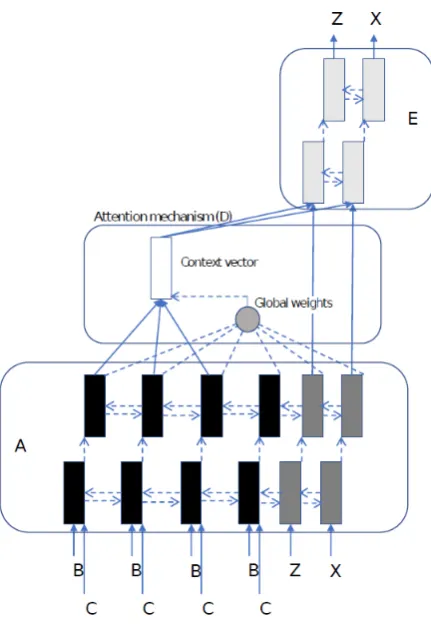
The proposed architecture is illustrated in Fig-ure 1, which is adapted from Cho et al. (2014), and further discussed below.
In this example, B B B B represent the input sequence from the target sequence Z X, andC is the personality embedding representation. The five main components of the architecture are as follows.
(A) a bidirectional GRU that maps words to per-sonality types
(B) a word embedding layer
(C) a personality embedding layer
(D) an attention mechanism
(E) a bidirectional GRU that outputs word encod-ings
The input bidirectional GRU (A) produces a word-to-personality compositional representation of each word. This serves two main purposes: combining the composite sequences of words and personality information, and combining attention weights over sequences in our decoder model.
Figure 1: Model architecture
and pre-trained word embeddings. The latter are Skip-gram 300 word embeddings taken from Hart-mann et al.(2017).
Word embeddings are complemented with in-duced personality embeddings (C) for each tar-get author. The role of this layer is twofold. First, it is intended to learn the probability P(Y|X, personality), that is, the personality representation of each author for each word in the vocabulary. Second, this layer is also intended to decide which profile value should be selected (from the corpus gold standard annotation) in or-der to generate a summary.
The attention mechanism (D) attempts to learn a general representation from the most important parts of the input text at each time step. To this end, the experiments described in the next section will consider two score function alternatives: gen-eral attention and dot product.
Finally, the output bidirectional GRU (E) com-bines the attention weight representations, and produces a final encoding for each word. A loss function describe the overall generation probabil-ity, and it is intended to optimize the above param-eters. This function is described as follows.
`1(θ, D(c), D(x, y))
=− X
(X,Y) Dc∪Dpr
logP(Y|X, < ki, vi>)
=− X
(X,Y) Dc
logPf r(Y|X)
The first term of the function is the negative log likelihood of observingD(c) and the second term for D(pr). D(pr) consists of pairs where a sum-mary is related to a profile key and its response match to the summary, andD(c) has only general
text-summary pairs. < ki, vi > is the
personal-ity representation. The decoderPf rdoes not have shared parameters. A simple epoch-based training strategy using gradient descendent is performed.
4 Evaluation
We envisaged two experiments on neural text sum-marization based on the model described in the previous section. The first experiment aims to assess whether a general or a dot product atten-tion mechanism is more suitable to the task. The second experiment focuses on our main research question, that is, on whether the use of personality information does improve summarization results.
As in many (or most) sequence-to-sequence ap-proaches to text generation, our work focuses on the selection of text segments to compose an ab-stract summary, but it does not address the actual rendering of the final output text, which would normally require additional post-processing. Each of the two experiments is discussed in turn in the following sections, but first we describe the dataset taken as their basis.
4.1 Data
We make use of the text and caption portions of the b5 corpus inRamos et al.(2018), calledb5-text andb5-caption. The corpus conveys 1510 multi-and single-sentence image description pairs, all of which labelled with Big Five personality informa-tion about their authors. Table1 summarizes the corpus descriptive statistics.
Dan-Table 1: Corpus descriptive statistics. Data Words Average Types Average text 84463 559.4 37210 246.4 caption 4896 32.4 4121 27.3
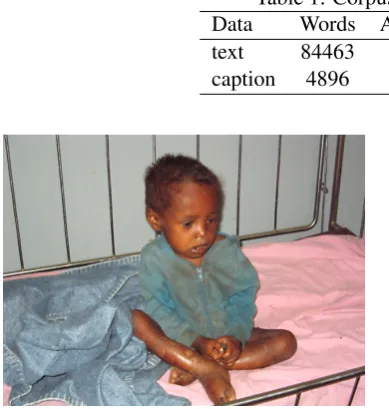
Figure 2: Stimulus image from GAPED ( Dan-Glauser and Scherer,2011).
Glauser and Scherer,2011). From a set of 10 se-lected images with valence degrees in the 3 to 54 range, participants were first instructed to describe everything that they could see in the scene (e.g., as if helping a visually-impaired person to un-derstand the picture) and, subsequently, were re-quested to summarize it in a single sentence (sim-ilar to a picture caption.)
An example of stimulus image is illustrated in Figure 2. We notice however that in the present work we only consider the text elicited from these images, and not the images themselves.
Based on scenes as in Figure 2, the following is a possible long description (translated from the Portuguese original text) of the kind found in the corpus.
‘A black baby, about one year old. He’s in a cradle. He is dressed in a dirty blue blouse, on a pink sheet, without a pil-low. A blue blanket is next to the baby. It seems that he has not taken a shower for a while.’
A single-sentence summary for the same scene (and which would have been written by the same participant in the data collection task) may be rep-resented as the following example.
‘A sad-looking baby.’
In the experiments described in the next sec-tions, texts were pre-processed by removing punc-tuation and numerical symbols. In addition to that,
Table 2: Data split Split Samples
Train 1358
Validation 152
Total 1510
the first data split performed for the purpose of cross-validation is shown in Table2.
4.2 Experiment 1: Basic Neural Summarization with Attention Mechanism
In Encoder-Decoder Recurrent Neural Networks, the global attention mechanism may be seen as a model-inferred context vector computed as a weighted average of all inputs by making use of a score function. The choice of score function may have a great impact on the overall performance of the model, and for that reason in what follows we examine two alternatives: using the dot product over the context vectors of the source, and using the learned representation over the context states.
To this end, our first experiment evaluates our basic summarization model (cf. the previous sec-tion) in two versions, namely, using general and dot product attention mechanisms. Both of these models, hereby called sDotandsGen, will make use of encoder/decoder randomized word embed-ding of size300, and two encoder/decoder hidden units of size600.
Both models were trained using Adam opti-mization with mini batches of size128. The ini-tial learning rate was set to 0.0001 with a gra-dient clipping based on the norm of the values. We also applied different learning rates for the de-coder module, set to five times the learning rate of the encoder. In order to reduce over-fitting, a0.5
drop-out regularization was applied to both em-bedding layers.
Model optimization was performed by using gradient descendent with masked loss, and by applying early stopping when the BLEU scores over the evaluation dataset did not increase for20
Table 3: 10-fold cross validation BLEU scores for text summarization using dot product (sDot) and general (sGen) attention. the best result is high-lighted.
Model BLEU
sGen 13.88
sDot 13.63
parameters were initialized by sampling from a uniform distribution U(−sqrt(3/n), sqrt(3/n)), wherenis the parameter dimension.
We performed 10-fold cross-validation over our corpus data, and we compared the output sum-maries produced by both models using BLEU2. Results are presented in Table3.
From these results, we notice that the attention mechanism based on the general function insGen outperforms the use of dot function in sDot. Al-though the difference is small, the use of a gen-eralized network to learn how to align the con-textual information is superior to simply concate-nating contextual information obtained from the global weights. Based on these results, the gen-eral attention strategy will be our choice for the next experiment.
4.3 Experiment 2: Personality-dependent Summarization
Our second and main experiment assesses the use of personality information in text summarization. To this end, two models are considered: the full personality-aware model presented in Section 3, hereby calledsPers, and a simplified baseline ver-sion of the same architecture without access to per-sonality information, hereby calledsBase. In do-ing so, our goal is to show that summaries pro-duced bysPersresemble the human-made texts (as seen in the corpus) more closely than those pro-duced bysBase.
Both sPers andsBase make use of pre-trained skip-gram 300 word embeddings for the Brazil-ian Portuguese language taken from Hartmann et al. (2017). Both models also make use of encoder/decoder randomized word embedding of size300, and two encoder/decoder hidden units of size600with general attention.
2
We are aware that, although popular in machine transla-tion and text generatransla-tion, BLEU may not be the ideal metrics for the present task (Liu et al.,2011;Song et al.,2013), and that it may not co-relate well with, e.g., human judgments (Reiter and Belz,2009).
Table 4: 10-fold cross validation BLEU scores for text summarization with (sPers) and without (sBase) personality information. The best result is highlighted.
Model BLEU sBase 14.21 sPers 14.58
All optimization, training and other basic proce-dures are the same as in the previous experiment. Results are presented in Table3.
We notice that personality-dependent summa-rization as provided bysPersoutperforms standard summarization (i.e., with no access to personal-ity information) as provided bysBase. Although the difference is once again small (which may be explained by the limited size of our dataset), this outcome offers support to our main research hy-pothesis by illustrating that the use of author per-sonality information may improve summarization accuracy.
4.4 Selected Examples
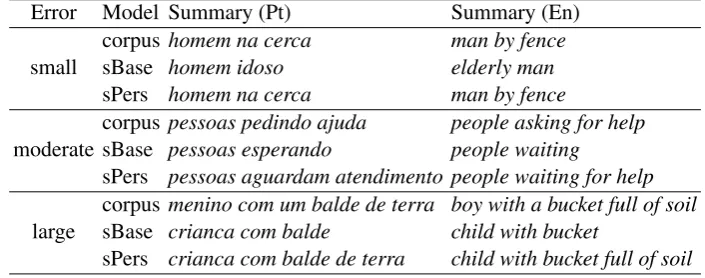
As a means to illustrate the kinds of output that may be produced by our models, Table5presents a number of examples taken from the original cor-pus summaries, and the corresponding summaries obtained from the same input by making use of the sBase baseline and by the personality-dependent sPersmodels. For ease of illustration, the exam-ples are informally grouped into three error cate-gories (small, moderate and large) according to the distance between the corpus summaries and their sPerscounterparts, and are presented in both orig-inal (Portuguese) and translated (English) forms.
5 Final Remarks
This paper addressed the use of Big Five person-ality information about the target author to gener-ate personalized summaries in neural sequence-to-sequence text summarization. The model - con-sisting of two bidirectional GRUs, word embed-dings and attention mechanism - was evaluated in two versions, namely, with and without an addi-tional personality embedding layer. Initial results suggest that having access to personality informa-tion does lead to more accurate (or human-like) text summaries.
Table 5: Selected examples taken from the corpus, baseline (sBase) and personality-dependent (sPers) summarization models, grouped by distance (small, moderate or large) between sPers and the expected (corpus) summary in original Portuguese (Pt) and translated English (En).
Error Model Summary (Pt) Summary (En) corpus homem na cerca man by fence small sBase homem idoso elderly man
sPers homem na cerca man by fence
corpus pessoas pedindo ajuda people asking for help moderate sBase pessoas esperando people waiting
sPers pessoas aguardam atendimento people waiting for help corpus menino com um balde de terra boy with a bucket full of soil large sBase crianca com balde child with bucket
sPers crianca com balde de terra child with bucket full of soil
strategies for text summarization. In particular, we notice that the increasing availability of text corpora labelled with author demographics in gen-eral (e.g., gender, age, education information etc.) may in principle support a broad range of speaker-dependent summarization models. Thus, as fu-ture work we intend to extend the current approach along these lines, and provide additional summa-rization strategies that may represent more signifi-cant gains over the standard, fixed-output summa-rization approach.
Acknowledgements
The authors acknowledge support by FAPESP grant 2016/14223-0 and from the University of S˜ao Paulo.
References
Yoshua Bengio, Patrice Simard, and Paolo Frasconi. 1994. Learning long-term dependencies with
gradi-ent descgradi-ent is difficult. IEEE transactions on neural
networks5(2):157–166.
Ziqiang Cao, Furu Wei, Sujian Li, Wenjie Li, Ming
Zhou, and Houfeng Wang. 2015. Learning
sum-mary prior representation for extractive
summariza-tion. InProceedings of the 53rd Annual Meeting of
the Association for Computational Linguistics and the 7th International Joint Conference on Natural Language Processing (Volume 2: Short Papers). vol-ume 2, pages 829–833.
Asli Celikyilmaz, Antoine Bosselut, Xiaodong He, and Yejin Choi. 2018. Deep communicating agents for
abstractive summarization. In Proceedings of the
2018 Conference of the North American Chapter of the Association for Computational Linguistics: Hu-man Language Technologies, Volume 1 (Long Pa-pers). pages 1662–1675.
Kyunghyun Cho, Bart van Merrienboer, Dzmitry Bah-danau, and Yoshua Bengio. 2014. On the properties of neural machine translation: Encoder–decoder
ap-proaches. InProceedings of SSST-8, Eighth
Work-shop on Syntax, Semantics and Structure in Statisti-cal Translation. Association for Computational Lin-guistics, Doha, Qatar, pages 103–111.
Elise S. Dan-Glauser and Klaus R. Scherer. 2011. The Geneva affective picture database (GAPED): a new 730-picture database focusing on valence and
nor-mative significance. Behavior Research Methods
43(2):468–477.
Lewis R. Goldberg. 1990. An alternative description
of personality: The Big-Five factor structure.
Jour-nal of PersoJour-nality and Social Psychology59:1216– 1229.
Ian Goodfellow, Yoshua Bengio, and Aaron Courville.
2016.Deep Learning. MIT Press.
Nathan Hartmann, Erick Fonseca, Christopher Shulby, Marcos Treviso, J´essica Rodrigues, and Sandra Alu´ısio. 2017. Portuguese word embeddings: Eval-uating on word analogies and natural language tasks. In 11th Brazilian Symposium in Information and Human Language Technology - STIL. Uberlˆandia, Brazil, pages 122–131.
Sepp Hochreiter. 1998. The vanishing gradient lem during learning recurrent neural nets and
prob-lem solutions. International Journal of
Uncer-tainty, Fuzziness and Knowledge-Based Systems
6(02):107–116.
Sepp Hochreiter and J¨urgen Schmidhuber. 1997.
Long short-term memory. Neural computation
9(8):1735–1780.
Chin-Ye Lin and Eduard Hovy. 2003. Automatic eval-uation of summaries using n-gram co-occurrence
statistics. InProceedings of HLT-NAACL 2003.
Chang Liu, Daniel Dahlmeier, and Hwee Tou Ng. 2011. Better evaluation metrics lead to better
ma-chine translation. InProceedings of the Conference
on Empirical Methods in Natural Language Pro-cessing. Association for Computational Linguistics, pages 375–384.
Thang Luong, Hieu Pham, and Christopher D.
Man-ning. 2015. Effective approaches to attention-based
neural machine translation. InProceedings of the
2015 Conference on Empirical Methods in Natu-ral Language Processing. Association for Compu-tational Linguistics, Lisbon, Portugal, pages 1412–
1421.https://doi.org/10.18653/v1/D15-1166.
Franc¸ois Mairesse and Marilyn Walker. 2007. PER-SONAGE: Personality generation for dialogue. In
45th Annual Meeting-Association For Computa-tional Linguistics. Association for Computational Linguistics (ACL), Sheffield, pages 496–503.
Tomas Mikolov, Scott Wen-tau, and Geoffrey Zweig.
2013. Linguistic regularities in continuous space
word representations. In Proc. of
NAACL-HLT-2013. Association for Computational Linguistics,
Atlanta, USA, pages 746–751.
Ramesh Nallapati, Bowen Zhou, Cicero dos Santos,
Caglar Gulcehre, and Bing Xiang. 2016.
Ab-stractive text summarization using
sequence-to-sequence RNNs and beyond. InProceedings of The
20th SIGNLL Conference on Computational Natu-ral Language Learning. Association for Computa-tional Linguistics, Berlin, Germany, pages 280–290. https://doi.org/10.18653/v1/K16-1028.
Kishore Papineni, Salim Roukos, Todd Ward, and
Wei-Jing Zhu. 2002. BLEU: a method for automatic
evaluation of machine translation. InProceddings of
ACL-2002. Association for Computational Linguis-tics, Philadelphia, PA, USA, pages 311–318.
Ricelli Moreira Silva Ramos, Georges Basile
Stavra-cas Neto, Barbara Barbosa Claudino Silva,
Danielle Sampaio Monteiro, Ivandr´e Paraboni, and
Rafael Felipe Sandroni Dias. 2018. Building a
corpus for personality-dependent natural language
understanding and generation. In11th International
Conference on Language Resources and Evaluation (LREC-2018). ELRA, Miyazaki, Japan, pages 1138–1145.
Ehud Reiter and Anja Belz. 2009. An investigation into the validity of some metrics for automatically
evalu-ating natural language generation systems.
Compu-tational Linguistics35(4):529–558.
Pengjie Ren, Zhumin Chen, Zhaochun Ren, Furu Wei, Jun Ma, and Maarten de Rijke. 2017. Leveraging contextual sentence relations for extractive
summa-rization using a neural attention model. In
Proceed-ings of the 40th International ACM SIGIR Confer-ence on Research and Development in Information Retrieval. ACM, pages 95–104.
David E. Rumelhart, Geoffrey Hinton, and Ronald J.
Williams. 1986. Learning representations by
back propagating errors. Nature 323:533–536.
https://doi.org/10.1038/323533a0.
Alexander M. Rush, Sumit Chopra, and Jason
We-ston. 2015. A neural attention model for
abstrac-tive sentence summarization. InProceedings of the
2015 Conference on Empirical Methods in Natu-ral Language Processing. Association for Computa-tional Linguistics, Lisbon, Portugal, pages 379–389. https://doi.org/10.18653/v1/D15-1044.
Abigail See, Peter J. Liu, and Christopher D. Manning. 2017. Get to the point: Summarization with
pointer-generator networks. InProceedings of the 55th
An-nual Meeting of the Association for Computational Linguistics (Volume 1: Long Papers). pages 1073– 1083.
Xingyi Song, Trevor Cohn, and Lucia Specia. 2013. Bleu deconstructed: Designing a better mt
evalua-tion metric.International Journal of Computational
Linguistics and Applications4(2):29–44.
Martin Sundermeyer, Ralf Schl¨uter, and Hermann Ney. 2012. Lstm neural networks for language modeling. InThirteenth annual conference of the international speech communication association.
Ilya Sutskever, Oriol Vinyals, and Quoc V Le. 2014a. Sequence to sequence learning with neural
net-works. InAdvances in neural information
process-ing systems. pages 3104–3112.
Ilya Sutskever, Oriol Vinyals, and Quoc V Le. 2014b. Sequence to sequence learning with neural
net-works. InAdvances in neural information
process-ing systems. pages 3104–3112.
Xiaojun Wan and Jianwu Yang. 2006. Improved affin-ity graph based multi-document summarization. In