Improving Event Detection with Dependency Regularization
Kai Cao Xiang Li Ralph Grishman Computer Science Department
New York University
719 Broadway, New York, NY, 10003
{kcao, xiangli, grishman}@cs.nyu.edu
Abstract
Event Detection (ED) is an Information Extraction task which involves identifying instances of specified types of events in text. Most recent research on Event De-tection relies on pattern-based or feature-based approaches, trained on annotated corpora, to recognize combinations of eventtriggers, arguments, and other con-textual information. These combinations may each appear in a variety of linguis-tic forms. Not all of these event expres-sions will have appeared in the training data, thus adversely affecting ED perfor-mance. In this paper, we demonstrate the effectiveness ofDependency Regular-ization techniques to generalize the pat-terns extracted from the training data to boost ED performance. The experimen-tal results on the ACE 2005 corpus show that our pattern-based system with the ex-panded patterns can achieve70.49%(with
2.57% absolute improvement) F-measure over the baseline, which advances the state-of-the-art for such systems.
1 Introduction
Event Detection (ED) involves identifying in-stances of specified types of events in text, which is an important but difficult Information Extraction (IE) task. Associated with each event mention is a phrase, the event trigger (most often a single verb or nominalization), which evokes that event. More precisely, our task involves identifying event trig-gers and classifying them into specific types. For instance, according to the ACE 2005 annotation guidelines1, in the sentence “She waskilledin an
1https://www.ldc.upenn.edu/ sites/www.ldc.upenn.edu/files/
english-events-guidelines-v5.4.3.pdf
automobile accident yesterday”, an event
detec-tion system should be able to recognize the word “killed” as a trigger for the event DIE. This task
is quite challenging, as the same event might ap-pear in the form of various trigger expressions and an expression might represent different events in different contexts. ED is a crucial component in the overall Event Extraction task, which also re-quires event argument identification and argument role labeling.
Most recent research on Automatic Content Extraction (ACE) Event Detection task relies on pattern-based or feature-based approaches to building classifiers for event trigger labeling. Al-though the training corpus is quite large (300,000 words), the test data will inevitably contain some event expressions that never occur in the training data. To address this problem, we propose
sev-eralDependency Regularization methods to help
generalize the syntactic patterns extracted from the training data in order to boost ED performance. Among the syntactic representations, dependency relations serve as important features or part of a pattern-based framework in IE systems, and play a significant role in IE approaches. These proposed regularization rules will be applied either to the de-pendency parse outputs of the candidate sentences or to the patterns themselves to facilitate detect-ing the event instances. The experimental results demonstrate that our pattern-based system with the expanded patterns can achieve 70.49% (with 2.57% absolute improvement) F-measure over the baseline, which is an advance over the state-of-the-art systems.
The paper is organized as follows: In Section 2, we will describe the role of dependency analysis in event detection and how dependency regulariza-tion methods can improve ED performance. We will describe our ED systems including the base-line and enhanced system utilizing dependency regularization in Section 3, and present
mental results in Section 4. We will discuss related work in Section 5, and Section 6 will conclude this work and list our research directions.
2 Dependency Regularization
The ACE 2005 Event Guidelines specify a set of 33 types of events; these have been widely used for research on event extraction over the past decade.
Some trigger words are unambiguous indicators of particular types of events. For example, the wordmurderindicates an event of typeDie. How-ever, most words have multiple senses and so may be associated with multiple types of events. Many of these cases can be disambiguated based on the semantic types of the trigger arguments:
• fire can be either an ATTACK event (“fire a
weapon”) or andEND-POSITION event (“fire
a person”), with the cases distinguishable by the semantic type of the direct object.
dis-chargehas the same ambiguity and the same
disambiguation rule.
• leavecan be either aTRANSPORTevent (“he
left the building”) or anEND-POSITIONevent
(“he left the administration”), again generally distinguishable by the type of the direct ob-ject.
Given a training corpus annotated with triggers and event arguments we can assemble a set of frames and link them to particular event types. Each frame will record the event arguments and their syntactic (dependency) relation to the trig-ger. When decoding new text, we will parse it with a dependency parser, look for a matching frame, and tag the trigger candidate with the correspond-ing event type.
One complication is that the frames may be em-bedded in different syntactic structures: verbal and nominal forms, relative clauses, active and passive voice, etc. Because of the limited size of the train-ing corpus, some triggers will appear with frames not seen in the training corpus. To fill these gaps, we will adopt a dual approach using a set of
de-pendency regularizationrules: in some cases we
will transform the syntactic structure of the input to reduce variation; in other cases we will expand the patterns to handle a wider variety of input.
We describe here three of the regularization rules we use:
1. verb chain regularization
2. transparent word regularization 3. nominalization regularization
2.1 Verb Chain Regularization
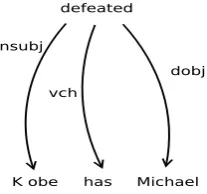
We use a fast dependency parser (Tratz and Hovy, 2011) that analyzes multi-word verb groups (with auxiliaries) into chains with the first word at the head of the chain. Verb Chain (vch) Regulariza-tionreverses the verb chains to place the main (fi-nal) verb at the top of the dependency parse tree. This reduces the variation in the dependency paths from trigger to arguments due to differences in tense, aspect, and modality. Here is an example sentence containing a verb chain:
Kobe has defeated Michael . (1)
has
defeated
dobj
Michael vch
nsubj
K obe
Figure 1: Original Dependency Tree
has defeated
K obe
dobj
Michael vch
nsubj
Figure 2: Dependency Tree withVerb Chain Reg-ularization
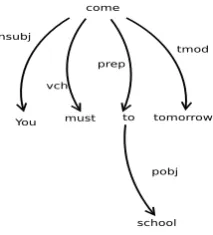
defeated)isvch. However, the semantic head of the sequence (the word which determines the event type) is the last word in the verb chain. To bring the trigger and its arguments closer, we regu-larize the dependency structure by making the last verb in this chain the head of the whole verb chain. A further example:
You must come to school tomorrow . (2)
must
come
to
school tomorrow nsubj
You
vch
prep
pobj
tmod
Figure 3: Original Dependency Tree
must come
to
school tomorrow nsubj
You vch
prep
pobj tmod
Figure 4: Dependency Tree withVerb Chain Reg-ularization
2.2 Transparent Word Regularization
Some words, such as those expressing quantities, are semantically ‘transparent’: they take on the se-mantic type of their object. For purposes of de-termining event types, we want to ‘look through’ such words in the dependency parse. We do so by restructuring the tree. This is one of the most useful dependency regularization rules, since the dependency path is shortened and the head should reach the “real” dependent directly.
The army killed thousands of people . (3)
The Ar my
killed
thousands
of
people det
nsubj dobj
pr ep
pobj
Figure 5: Original Dependency Tree
The Ar my
killed
thousands of people det
nsubj dobj
pr ep
pobj
Figure 6: Dependency Tree withTransparent Reg-ularization
In this case the semantic type of the object of the verb “kill” is determined by the word “ peo-ple” instead of the word “thousands”. Especially in the pattern-based framework, this kind of im-provement helps substantially in finding the roles of the events.
2.3 Nominalization Regularization
Most types of events can be expressed by verbal or nominal constructions. However, in a number of cases the ACE training corpus includes the ver-bal construction but not the corresponding nomi-nal one. We addressed this problem by automati-cally generating the nominal pattern from the ver-bal one. (The reverse case, with only a nominal pattern, was less frequent.)
Nomlex(NOMinalization LEXicon) is a
Methods P R F Sentence-level in (Ji and Grishman, 2011) 67.6 53.5 59.7 MaxEnt classifier with local features in (Li et al., 2013) 74.5 59.1 65.9 Joint beam search with local features in (Li et al., 2013) 73.7 59.3 65.7 Joint beam search with local and global features in (Li et al., 2013) 73.7 62.3 67.5 Cross-entity in (Ji and Grishman, 2011)† 72.9 64.3 68.3
AceJet baseline system 65.4 70.6 67.9
AceJet with dependency regularization 68.2 72.8 70.4
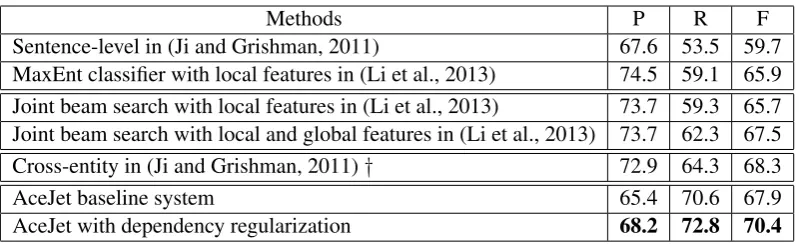
Table 1: Performance comparison (%) with the state-of-the-art systems.†beyond sentence level.
by verb triggers to patterns evoked by noun trig-gers. This translation is based on the correspon-dence between a verb with its arguments and a nominalization with its arguments.
For example, the sentence “Microsoft acquired Nokia yesterday” is an instance of the
Transfer-Ownershipevent. “The acquisition of Nokia from
Microsoft was successful yesterday” is also an
event instance of the same type. However, they do not share the same event pattern. Our heuristic methods of dependency regularization transform one pattern into the other.
There are three types of pattern transforma-tions, assigning different roles to the object of the verb. Let us suppose the original sentence is:
IBM appointed Alice Smith as vice president .
(4) Then we would automatically generate addi-tional patterns for:
1. DET-POSS: a possessive determiner.
Alice Smith’s appointment as vice president
(5)
2. N-N-MOD: a nominal modifier
the Alice Smith appointment as vice president
(6)
3. PP-OF: object of the preposition
the appointment of Alice Smith as vice president
(7)
In the sentences above , “Alice Smith” is the per-son who gets the job, and the phrase “vice presi-dent” is Alice’s position. Thus the sentences share the same arguments, although the syntactic pat-terns are different.
3 System Description
Jet, the Java Extraction Toolkit2, provides a set of
NLP components which can be combined to create information extraction systems. AceJet3is a
sub-system of Jet to extract the types of information (entities, relations, and events) annotated on the ACE corpora. The AceJet Event Extraction frame-work is a combination of a pattern-based system and feature-based system.
Training proceeds in three passes over the an-notated training corpus. Pass 1 collects all the event patterns, where a pattern consists of a trigger and a set of arguments along with the path from the trigger to each argument; both the dependency path and the linear sequence path (a series of noun chunks and words) are recorded. Pass 2 records the frequency with which each pattern is associ-ated with an event type – the ‘event score’. Pass 3 treats the event score as a feature, combines it with a small number of other features and trains a maximum entropy model.
At test time, to classify a candidate trigger (any word which has appeared at least once as a trig-ger in the training corpus) the tagtrig-ger finds the best match between an event pattern and the input sen-tence and computes an event score. This score, along with other features, serves as input to the maximum entropy model to make the final ED pre-diction.
We incorporate the proposed Dependency
Regularization techniques based on the AceJet
baseline system to improve the system perfor-mance.
2http://cs.nyu.edu/grishman/jet/jet. html
4 Experiment
In this section, we will introduce the evaluation dataset, compare the performance of applying de-pendency regularization with other state-of-the-art systems, and discuss the contributions of these dif-ferent dependency regularization rules.
4.1 Data set
We used the ACE 2005 corpus as our testbed. For comparison, we used the same test set with 40 newswire articles (672 sentences) as in (Ji and Gr-ishman, 2008; Liao and GrGr-ishman, 2010) for the experiments, and randomly selected 30 other doc-uments (863 sentences) from different genres as the development set. The remaining 529 docu-ments (14,840 sentences) are used for training.
Regarding the correctness criteria: following previous work (Ji and Grishman, 2008; Liao and Grishman, 2010; Ji and Grishman, 2011; Li et al., 2013), a trigger candidate is counted as correct if its event subtype and offsets match those of a ref-erence trigger. The ACE 2005 corpus has 33 event subtypes that, along with one class “None” for the non-trigger tokens, constitutes a 34-class classifi-cation problem in this work. Finally we use Preci-sion (P), Recall (R), and F-measure (F1) to evalu-ate the overall performance.
Table 1 presents the overall performance of the systems with gold-standard entity mention and type information. We can see that our system with dependency regularizations can improve the per-formance over our baseline setting, and also ad-vances the current state-of-the-art systems.
4.2 Contributions of different dependency regularizations
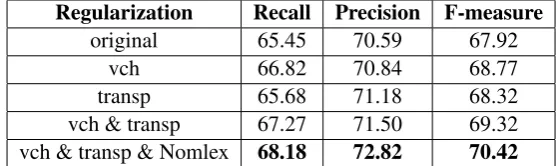
Table 2 lists the system performance applying the different dependency regularization rules. The last line shows the performance with the combination of three types of Nomlex pattern expansion.
Dependency Regularization could help match
patterns that failed in the original framework. For example,
1. With Verb Chain Regularization, the sen-tence “Taco ball isappealing.” is detected as an APPEAL event, which was ignored in the
original framework.
2. With Transparent Regularization, the sen-tence “The armykilledthousands of people.”
is detected as aDIEevent, which was ignored
in the original framework.
3. With Nomlex Regularization, the sentence “Theacquisitionof Banco Zaragozano...” is detected as aTRANSFER-OWNERSHIPevent,
which was ignored in the original framework. This is because all the relevant sentences in the training data use the same trigger “ ac-quire”.
5 Related Work
Although there have been quite a few distinct designs for event extraction systems, most are loosely based on using patterns to detect instances of events, where the patterns consist of a pred-icate, event trigger, and constraints on its lo-cal syntactic context. The constraints may in-volve specific lexical items or semantic classes. Some recent studies use high-level information to aid local event extraction systems. For exam-ple, Finkel et al. (2005), Maslennikov and seng Chua (2007), Ji and Grishman (2008) and Pat-wardhan and Riloff (2007) tried to use discourse, document, or cross-document information to im-prove information extraction. Other research ex-tends these approaches by introducing cross-event information to enhance the performance of multi-event-type extraction systems. Liao and Grishman (2010) use information about other types of events to make predictions or resolve ambiguities regard-ing a given event. Li et al. (2013) implements a joint model via structured prediction with cross-event features.
Event extraction systems have used patterns and features based on a range of linguistic represen-tations. For example, Miwa et al. (2014) used both a deep analysis and a dependency parse. The original NYU system for the 2005 ACE evalua-tion (Grishman et al., 2005) incorporated GLARF, a representation which captured both notions of transparency and verb-nominalization correspon-dences.4 However, assessment of the impact of
individual regularizations has been limited; this prompted the investigation reported here.
6 Conclusion and Future Work
In this paper we have proposed several Depen-dency Regularizationsteps to improve the
perfor-4The official evaluations were made with a complexvalue
Regularization Recall Precision F-measure original 65.45 70.59 67.92
vch 66.82 70.84 68.77
transp 65.68 71.18 68.32 vch & transp 67.27 71.50 69.32 vch & transp & Nomlex 68.18 72.82 70.42
Table 2: Trigger identification performance (%) with different dependency regularizations, where origi-nal – origiorigi-nal dependency parse output without regularization,vch– verb chain regularization,transp– transparent regularization, andNomlex– Nomlex regularization.
mance of theEvent Detectionframework, includ-ingVerb Chain Regularization,Transparent Regu-larization, andNomlex Regularization. The exper-imental results have demonstrated the effective-ness of these techniques, which has helped our pattern-based system achieve 70.49% (with 2.57% absolute improvement) F-measure over the base-line, which significantly advances the state-of-the-art systems.
Dependency regularization is only one of the measures we can take to improve performance. The training corpus cannot include all possible trigger words or all the senses of the triggers it does include. Simply enlarging the training corpus by sequential annotation would yield small gain at a large cost. In parallel work we have shown that carefully targeted active learning of new triggers and senses can produce significant improvement in event detection at modest cost.
References
Jenny Rose Finkel, Trond Grenager, and Christopher Manning. 2005. Incorporating non-local informa-tion into informainforma-tion extracinforma-tion systems by gibbs sampling. InProceedings of ACL.
Ralph Grishman, David Westbrook, and Adam Meyers. 2005. NYU’s English ACE 2005 system descrip-tion. In Proceedings of the ACE 2005 Evaluation Workshop.
Heng Ji and Ralph Grishman. 2008. Refining event ex-traction through cross-document inference. In Pro-ceedings of ACL.
Heng Ji and Ralph Grishman. 2011. Using cross-entity inference to improve event extraction. In Proceed-ings of ACL.
Qi Li, Heng Ji, and Liang Huang. 2013. Joint event extraction via structured prediction with global fea-tures. InProceedings of ACL.
Shasha Liao and Ralph Grishman. 2010. Using doc-ument level cross-event inference to improve event extraction. InProceedings of ACL.
Mstislav Maslennikov and Tat seng Chua. 2007. A multi-resolution framework for information extrac-tion from free text. InProceedings of ACL.
Makoto Miwa, Paul Thompson, Ioannis Korkontze-los, and Sophia Ananiadou. 2014. Comparable study of event extraction in newswire and biomed-ical domains. In Proceedings of COLING 2014, the 25th International Conference on Computational Linguistics: Technical Papers.
Siddharth Patwardhan and Ellen Riloff. 2007. Ef-fective information extraction with semantic affin-ity patterns and relevant regions. InProceedings of EMNLP.