1031
Self-Attentional Models Application
in Task-Oriented Dialogue Generation Systems
Mansour Saffar Mehrjardi, Amine Trablesi, Osmar R. Za¨ıane Department of Computing Science, University of Alberta
{saffarme,atrabels,zaiane}@ualberta.ca
Abstract
Self-attentional models are a new paradigm for sequence modelling tasks which differ from common sequence modelling methods, such as recurrence-based and convolution-recurrence-based sequence learning, in the way that their architecture is only based on the attention mechanism. Self-attentional models have been used in the creation of the state-of-the-art models in many NLP tasks such as neural machine translation, but their usage has not been explored for the task of training end-to-end task-oriented dialogue generation systems yet. In this study, we apply these models on the three different datasets for training task-oriented chatbots. Our finding shows that self-attentional models can be exploited to create end-to-end task-oriented chatbots which not only achieve higher evaluation scores compared to recurrence-based models, but also do so more efficiently.
1 Introduction
Task-oriented chatbots are a type of dialogue gen-eration system which tries to help the users accom-plish specific tasks, such as booking a restaurant table or buying movie tickets, in a continuous and uninterrupted conversational interface and usually in as few steps as possible. The development of such systems falls into the Conversational AI do-main which is the science of developing agents which are able to communicate with humans in a natural way (Ram et al.,2018). Digital assistants such as Apple’s Siri, Google Assistant, Amazon Alexa, and Alibaba’s AliMe are examples of suc-cessful chatbots developed by giant companies to engage with their customers.
There are mainly two different ways to cre-ate a task-oriented chatbot which are either using set of hand-crafted and carefully-designed rules or use corpus-based method in which the chatbot can be trained with a relatively large corpus of conversational data. Given the abundance of di-alogue data, the latter method seems to be a bet-ter and a more general approach for developing task-oriented chatbots. The corpus-based method also falls into two main chatbot design architec-tures which are pipelined and end-to-end archi-tectures (Chen et al.,2017). End-to-end chatbots are usually neural networks based (Shang et al.,
2015;Dodge et al., 2015; Wen et al., 2016;Eric and Manning, 2017a) and thus can be adapted to new domains by training on relevant dialogue datasets for that specific domain. Furthermore, all sequence modelling methods can also be used in training end-to-end task-oriented chatbots. A se-quence modelling method receives a sese-quence as input and predicts another sequence as output. For example in the case of machine translation the in-put could be a sequence of words in a given lan-guage and the output would be a sentence in a sec-ond language. In a dialogue system, an utterance is the input and the predicted sequence of words would be the corresponding response.
Transformer, applies the Adaptive Computation Time (ACT) (Graves, 2013) technique on the Universal Transformer model which makes the model train faster since it saves computation time and also in some cases can increase the model accuracy. The ACT allows the Universal Transformer model to use different recurrence time steps for different tokens.
We know, based on reported evidence that trans-formers are potent in NLP tasks like translation and question answering. Our aim is to assess the applicability and effectiveness of transformers and universal-transformers in the domain of task-oriented conversational agents. In the next section, we report on experiments to investigate the us-age of self-attentional models performance against the aforementioned models for the task of training end-to-end task-oriented chatbots.
4 Experiments
We run our experiments on Tesla 960M Graphical Processing Unit (GPU). We evaluated the models using the aforementioned metrics and also applied early stopping (with delta set to 0.1 for 600 train-ing steps).
4.1 Datasets
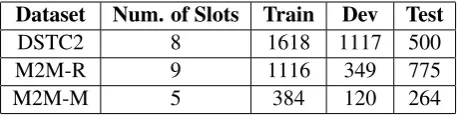
We use three different datasets for training the models. We use the Dialogue State Tracking Com-petition 2 (DSTC2) dataset (Williams et al.,2013) which is the most widely used dataset for research on task-oriented chatbots. We also used two other datasets recently open-sourced by Google Research (Shah et al., 2018) which are M (dataset in movie domain) and M2M-sim-R (dataset in restaurant domain)1. M2M stands for Machines Talking to Machines which refers to the framework with which these two datasets were created. In this framework, dialogues are created via dialogue self-play and later augmented via crowdsourcing. We trained on our models on different datasets in order to make sure the results are not corpus-biased. Table1shows the statistics of these three datasets which we will use to train and evaluate the models.
The M2M dataset has more diversity in both language and dialogue flow compared to the the commonly used DSTC2 dataset which makes it appealing for the task of creating task-oriented
1 https://github.com/google-research-datasets/simulated-dialogue
Dataset Num. of Slots Train Dev Test
DSTC2 8 1618 1117 500
M2M-R 9 1116 349 775
M2M-M 5 384 120 264
Table 1: Statistics of DSTC2, R, and M2M-M Datasets
chatbots. This is also the reason that we decided to use M2M dataset in our experiments to see how well models can handle a more diversed dataset.
4.1.1 Dataset Preparation
We followed the data preparation process used for feeding the conversation history into the encoder-decoder as in (Eric and Manning, 2017a). Con-sider a sample dialogue D in the corpus which consists of a number of turns exchanged between the user and the system. Dcan be represented as (u1, s1),(u2, s2), ...,(uk, sk)wherekis the num-ber of turns in this dialogue. At each time step in the conversation, we encode the conversation turns up to that time step, which is the context of the dialogue so far, and the system response after that time step will be used as the target. For ex-ample, given we are processing the conversation at time stepi, the context of the conversation so far would be(u1, s1, u2, s2, ..., ui)and the model has to learn to output(si)as the target.
4.2 Training
We used the tensor2tensor library (Vaswani et al.,
2018) in our experiments for training and evalua-tion of sequence modeling methods. We use Adam optimizer (Kingma and Ba,2014) for training the models. We set β1 = 0.9, β2 = 0.997, and
Dataset Split Model BLEU Per Turn. Acc Per Diag. Acc Entity F1
test LSTM (bs=1) 5.75 17.70 0.0 5.63
LSTM + Attention (bs=2) 30.84 18.08 0.15 32.16
Bi-LSTM (bs=2) 30.38 18.04 0.0 24.34
Bi-LSTM + Attention (bs=2) 38.64 26.04 0.62 43.52
Transformer (bs=2) 51.83 39.02 1.7 64.20
UT (bs=2) 44.93 36.62 1.08 57.98
UT + ACT (bs=2) 39.40 30.00 0.15 61.49
development LSTM 16.13 10.33 0.0 6.54
LSTM + Attention 31.05 18.68 0.31 32.59
Bi-LSTM 30.92 19.07 0.31 25.91
Bi-LSTM + Attention 39.12 27.28 0.96 44.15
Transformer 54.18 41.09 0.62 66.02
UT 47.95 39.01 0.31 61.27
UT + ACT 39.27 29.30 0.31 62.50
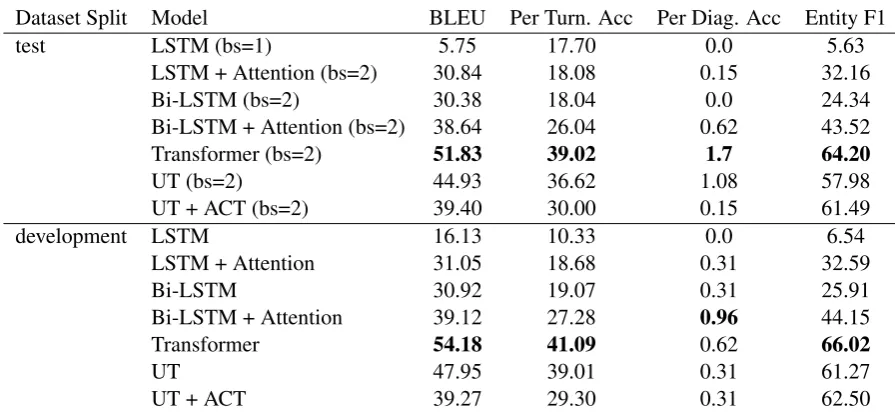
Table 2: Evaluation of Models on DSTC2 dataset for both test and development datasets (bs: shows the best beam size in inference; UT: Universal Transformers)
github repository2.
4.3 Inference
In the inference time, there are mainly two meth-ods for decoding which are greedy and beam search (Freitag and Al-Onaizan, 2017). Beam search has been proved to be an essential part in generative NLP task such as neural machine trans-lation (Wu et al., 2016). In the case of dialogue generation systems, beam search could help alle-viate the problem of having many possible valid outputs which do not match with the target but are valid and sensible outputs. Consider the case in which a task-oriented chatbot, trained for a restau-rant reservation task, in response to the user ut-terance “Persian food”, generates the response
“what time and day would you like the reserva-tion for?” but the target defined for the system is“would you like a fancy restaurant?”. The re-sponse generated by the chatbot is a valid rere-sponse which asks the user about other possible entities but does not match with the defined target.
We try to alleviate this problem in inference time by applying the beam search technique with a different beam sizeα∈ {1,2,4}and pick the best result based on the BLEU score. Note that when
α = 1, we are using the original greedy search method for the generation task.
4.4 Evaluation Measures
BLEU: We use the Bilingual Evaluation
Under-2https://github.com/msaffarm/chatbot-exp
study (BLEU) (Papineni et al.,2002) metric which is commonly used in machine translation tasks. The BLEU metric can be used to evaluate di-alogue generation models as in (Eric and Man-ning, 2017a;Li et al., 2015). The BLEU metric is a word-overlap metric which computes the co-occurrence of N-grams in the reference and the generated response and also applies the brevity penalty which tries to penalize far too short re-sponses which are usually not desired in task-oriented chatbots. We compute the BLEU score using all generated responses of our systems.
Per-turn Accuracy: Per-turn accuracy mea-sures the similarity of the system generated re-sponse versus the target rere-sponse. Eric and Man-ning (2017a) used this metric to evaluate their sys-tems in which they considered their response to be correct if all tokens in the system generated re-sponse matched the corresponding token in the tar-get response. This metric is a little bit harsh, and the results may be low since all the tokens in the generated response have to be exactly in the same position as in the target response.
Per-Dialogue Accuracy: We calculate per-dialogue accuracy as used in (Bordes et al.,2016;
Dataset Split Model BLEU Per Turn. Acc Per Diag. Acc Entity F1
M2M-R LSTM(bs=2) 6.00 2.3 0.0 7.99
(test) LSTM+Att.(bs=1) 7.9 1.84 0.0 16.77
Bi-LSTM(bs=1) 8.15 1.8 0.0 19.61
Bi-LSTM+Att.(bs=1) 8.3 0.97 0.0 24.12
Transformer(bs=1) 10.28 1.76 0.0 36.92
UT(bs=2) 9.15 1.88 0.0 25.44
UT+ACT(bs=2) 8.54 1.43 0.0 23.12
M2M-M LSTM(bs=4) 7.7 3.36 0.0 31.07
(test) LSTM+Att.(bs=2) 8.3 3.27 0.0 31.18
Bi-LSTM(bs=2) 9.6 2.09 0.0 28.09
Bi-LSTM+Att.(bs=2) 10.62 2.54 0.0 32.43
Transformer(bs=1) 11.95 2.36 0.0 39.89
UT(bs=2) 10.87 3.15 0.0 34.15
UT+ACT(bs=2) 10.48 2.46 0.0 32.76
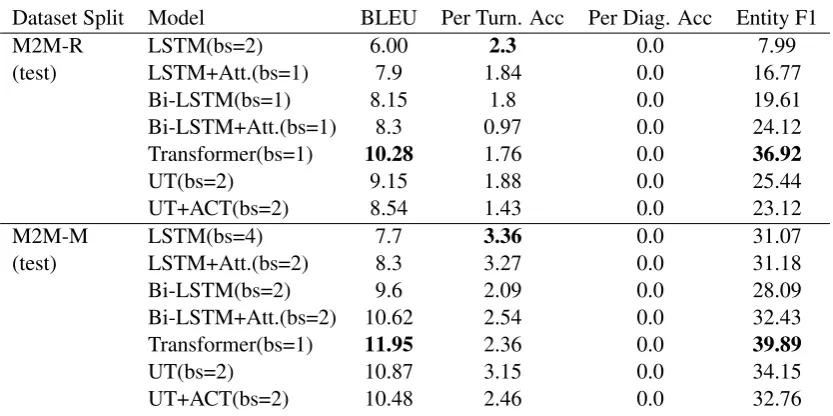
Table 3: Evaluation of models on M2M restaurant (M2M-R) and movie (M2M-M) dataset for test datasets (bs: The best beam size in inference; UT: Universal Transformers)
dialogue should be the same as the target and in the right order.
F1-Entity Score: Datasets used in task-oriented chores have a set of entities which repre-sent user preferences. For example, in the restau-rant domain chatbots common entities are meal, restaurant name, date, time and the number of peo-ple (these are usually the required entities which are crucial for making reservations, but there could be optional entities such as location or rating). Each target response has a set of entities which the system asks or informs the user about. Our models have to be able to discern these specific en-tities and inject them into the generated response. To evaluate our models we could use named-entity recognition evaluation metrics (Jiang et al.,2016). The F1 score is the most commonly used metric used for the evaluation of named-entity recogni-tion models which is the harmonic average of pre-cision and recall of the model. We calculate this metric by micro-averaging over all the system gen-erated responses.
5 Results and Discussion
5.1 Comparison of Models
The results of running the experiments for the aforementioned models is shown in Table 2 for the DSTC2 dataset and in Table 3 for the M2M datasets. The bold numbers show the best per-forming model in each of the evaluation met-rics. As discussed before, for each model we use different beam sizes (bs) in inference time
and report the best one. Our findings in Table2
show that self-attentional models outperform com-mon recurrence-based sequence modelling meth-ods in the BLEU, Per-turn accuracy, and entity F1 score. The reduction in the evalution numbers for the M2M dataset and in our investigation of the trained model we found that this considerable re-duction is due to the fact that the diversity of M2M dataset is considerably more compared to DSTC2 dataset while the traning corpus size is smaller.
5.2 Time Performance Comparison
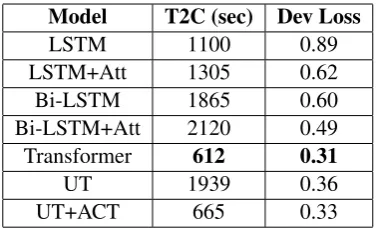
Table4 shows the time performance of the mod-els trained on DSTC2 dataset. Note that in or-der to get a fair time performance comparison, we trained the models with the same batch size (4096) and on the same GPU. These numbers are for the best performing model (in terms of evaluation loss and selected using the early stopping method) for each of the sequence modelling methods. Time to Convergence (T2C) shows the approximate time that the model was trained to converge. We also show the loss in the development set for that spe-cific checkpoint.
5.3 Effect of (Self-)Attention Mechanism
Model T2C (sec) Dev Loss
LSTM 1100 0.89
LSTM+Att 1305 0.62
Bi-LSTM 1865 0.60
Bi-LSTM+Att 2120 0.49
Transformer 612 0.31
UT 1939 0.36
UT+ACT 665 0.33
Table 4: Comparison of convergence performance of the models
when augmented with an attention mechanism. This leads to the question whether we can in-crease the performance of recurrence-based mod-els by adding multiple attention heads, similar to the multi-head self-attention mechanism used in attentional models, and outperform the self-attentional models.
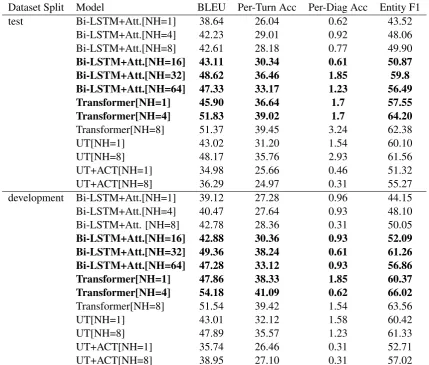
To investigate this question, we ran a number of experiments in which we added multiple atten-tion heads on top of Bi-LSTM model and also tried a different number of attention heads in self-attentional models in order to compare their per-formance for this specific task. Table 6 shows the results of these experiments. Note that the models in Table 6 are actually the best mod-els that we found in our experiments on DSTC2 dataset and we only changed one parameter for each of them, i.e. the number of attention heads in the recurrence-based models and the number of self-attention heads in the self-attentional models, keeping all other parameters unchanged. We also report the results of models with beam size of 2 in inference time. We increased the number of atten-tion heads in the Bi-LSTM model up to 64 heads to see its performance change. Note that increas-ing the number of attention heads makes the train-ing time intractable and time consumtrain-ing while the model size would increase significantly as shown in Table5. Furthermore, by observing the results of the Bi-LSTM+Att model in Table 6 (both test and development set) we can see that Bi-LSTM performance decreases and thus there is no need to increase the attention heads further.
Our findings in Table 6 show that the self-attention mechanism can outperform recurrence-based models even if the recurrence-recurrence-based mod-els have multiple attention heads. The Bi-LSTM model with 64 attention heads cannot beat the best Trasnformer model with NH=4 and also its
results are very close to the Transformer model with NH=1. This observation clearly depicts the power of self-attentional based models and demonstrates that the attention mechanism used in self-attentional models as the backbone for learn-ing, outperforms recurrence-based models even if they are augmented with multiple attention heads.
Model T2C (sec) Dev Loss
Bi-LSTM+Att.[NH=1] 2120 0.49
Bi-LSTM+Att.[NH=4] 3098 0.47
Bi-LSTM+Att.[NH=8] 3530 0.44
Bi-LSTM+Att.[NH=16] 3856 0.44
Bi-LSTM+Att.[NH=32] 7320 0.36
Bi-LSTM+Att.[NH=64] 9874 0.38
Transformer[NH=1] 375 0.33
Transformer[NH=4] 612 0.31
Transformer[NH=8] 476 0.31
Table 5: Comparison of convergence performance of the models
6 Conclusion and Future Work
We have determined that Transformers and Universal-Transformers are indeed effective at generating appropriate responses in task-oriented chatbot systems. In actuality, their performance is even better than the typically used deep learn-ing architectures. Our findlearn-ings in Table 2 show that self-attentional models outperform common recurrence-based sequence modelling methods in the BLEU, Per-turn accuracy, and entity F1 score. The results of the Transformer model beats all other models in all of the evaluation metrics. Also, comparing the result of LSTM and LSTM with at-tention mechanism as well as the Bi-LSTM with Bi-LSTM with attention mechanism, it can be observed in the results that adding the attention mechanism can increase the performance of the models. Comparing the results of self-attentional models shows that the Transformer model out-performs the other self-attentional models, while the Universal Transformer model gives reasonably good results.
Dataset Split Model BLEU Per-Turn Acc Per-Diag Acc Entity F1
test Bi-LSTM+Att.[NH=1] 38.64 26.04 0.62 43.52
Bi-LSTM+Att.[NH=4] 42.23 29.01 0.92 48.06
Bi-LSTM+Att.[NH=8] 42.61 28.18 0.77 49.90
Bi-LSTM+Att.[NH=16] 43.11 30.34 0.61 50.87
Bi-LSTM+Att.[NH=32] 48.62 36.46 1.85 59.8
Bi-LSTM+Att.[NH=64] 47.33 33.17 1.23 56.49
Transformer[NH=1] 45.90 36.64 1.7 57.55
Transformer[NH=4] 51.83 39.02 1.7 64.20
Transformer[NH=8] 51.37 39.45 3.24 62.38
UT[NH=1] 43.02 31.20 1.54 60.10
UT[NH=8] 48.17 35.76 2.93 61.56
UT+ACT[NH=1] 34.98 25.66 0.46 51.32
UT+ACT[NH=8] 36.29 24.97 0.31 55.27
development Bi-LSTM+Att.[NH=1] 39.12 27.28 0.96 44.15
Bi-LSTM+Att.[NH=4] 40.47 27.64 0.93 48.10
Bi-LSTM+Att. [NH=8] 42.78 28.36 0.31 50.05
Bi-LSTM+Att.[NH=16] 42.88 30.36 0.93 52.09
Bi-LSTM+Att.[NH=32] 49.36 38.24 0.61 61.26
Bi-LSTM+Att.[NH=64] 47.28 33.12 0.93 56.86
Transformer[NH=1] 47.86 38.33 1.85 60.37
Transformer[NH=4] 54.18 41.09 0.62 66.02
Transformer[NH=8] 51.54 39.42 1.54 63.56
UT[NH=1] 43.01 32.12 1.58 60.42
UT[NH=8] 47.89 35.57 1.23 61.33
UT+ACT[NH=1] 35.74 26.46 0.31 52.71
UT+ACT[NH=8] 38.95 27.10 0.31 57.02
Mike Schuster and Kuldip K Paliwal. 1997. Bidirec-tional recurrent neural networks. IEEE Transactions
on Signal Processing45(11):2673–2681.
Pararth Shah, Dilek Hakkani-T¨ur, Gokhan T¨ur, Ab-hinav Rastogi, Ankur Bapna, Neha Nayak, and Larry Heck. 2018. Building a conversational agent overnight with dialogue self-play. arXiv preprint
arXiv:1801.04871.
Lifeng Shang, Zhengdong Lu, and Hang Li. 2015. Neural responding machine for short-text conversa-tion. arXiv preprint arXiv:1503.02364.
Nitish Srivastava, Geoffrey Hinton, Alex Krizhevsky, Ilya Sutskever, and Ruslan Salakhutdinov. 2014. Dropout: a simple way to prevent neural networks from overfitting. The Journal of Machine Learning
Research15(1):1929–1958.
A¨aron Van Den Oord, Sander Dieleman, Heiga Zen, Karen Simonyan, Oriol Vinyals, Alex Graves, Nal Kalchbrenner, Andrew W Senior, and Koray Kavukcuoglu. 2016. Wavenet: A generative model for raw audio. SSW125.
Ashish Vaswani, Samy Bengio, Eugene Brevdo, Fran-cois Chollet, Aidan N Gomez, Stephan Gouws, Llion Jones, Łukasz Kaiser, Nal Kalchbrenner, Niki Parmar, et al. 2018. Tensor2tensor for neural ma-chine translation. arXiv preprint arXiv:1803.07416
.
Ashish Vaswani, Noam Shazeer, Niki Parmar, Jakob Uszkoreit, Llion Jones, Aidan N Gomez, Łukasz Kaiser, and Illia Polosukhin. 2017. Attention is all you need. InAdvances in neural information pro-cessing systems. pages 5998–6008.
Tsung-Hsien Wen, David Vandyke, Nikola Mrksic, Milica Gasic, Lina M Rojas-Barahona, Pei-Hao Su, Stefan Ultes, and Steve Young. 2016. A network-based end-to-end trainable task-oriented dialogue system. arXiv preprint arXiv:1604.04562.
Jason Williams, Antoine Raux, Deepak Ramachan-dran, and Alan Black. 2013. The dialog state track-ing challenge. InProceedings of the SIGDIAL 2013
Conference. pages 404–413.
Jason D Williams, Kavosh Asadi, and Geoffrey Zweig. 2017. Hybrid code networks: practical and efficient end-to-end dialog control with super-vised and reinforcement learning. arXiv preprint
arXiv:1702.03274.
Jason D Williams and Geoffrey Zweig. 2016. End-to-end lstm-based dialog control optimized with su-pervised and reinforcement learning. arXiv preprint
arXiv:1606.01269.
Yonghui Wu, Mike Schuster, Zhifeng Chen, Quoc V Le, Mohammad Norouzi, Wolfgang Macherey, Maxim Krikun, Yuan Cao, Qin Gao, Klaus Macherey, et al. 2016. Google’s neural ma-chine translation system: Bridging the gap between
human and machine translation. arXiv preprint
arXiv:1609.08144.
Fisher Yu and Vladlen Koltun. 2015. Multi-scale con-text aggregation by dilated convolutions. arXiv