25
Enhancing Phrase-Based Statistical Machine Translation by Learning
Phrase Representations Using Long Short-Term Memory Network
Benyamin Ahmadnia1andBonnie J. Dorr2
1Department of Computer Science, Tulane University, New Orleans, LA, USA 2Institute for Human and Machine Cognition (IHMC), Ocala, FL, USA
[email protected] , [email protected]
Abstract
Phrases play a key role in Machine Trans-lation (MT). In this paper, we apply a Long Short-Term Memory (LSTM) model over conventional Phrase-Based Statistical MT (PBSMT). The core idea is to use an LSTM encoder-decoder to score the phrase table generated by the PBSMT de-coder. Given a source sequence, the en-coder and deen-coder are jointly trained in order to maximize the conditional prob-ability of a target sequence. Analyti-cally, the performance of a PBSMT sys-tem is enhanced by using the conditional probabilities of phrase pairs computed by an LSTM encoder-decoder as an addi-tional feature in the existing log-linear model. We compare the performance of the phrase tables in the PBSMT to the performance of the proposed LSTM and observe its positive impact on translation quality. We construct a PBSMT model us-ing the Moses decoder and enrich the Lan-guage Model (LM) utilizing an external dataset. We then rank the phrase tables using an LSTM-based encoder-decoder. This method produces a gain of up to 3.14 BLEU score on the test set.
1 Introduction
The three most essential components of a Sta-tistical Machine Translation (SMT) system are: (1) Translation Model (TM); (2) Language Model (LM); and (3) Reordering Model (RM). Among these models, the RM plays an important role in Phrase-Based SMT (PBSMT) (Marcu and Wong,
2002; Koehn et al., 2003), and it still remains a major focus of intense study (Kanouchi et al.,
2016;Du and Way,2017;Chen et al.,2019).
The RM is required since different languages exercise different syntactic ordering. For instance, adjectives in English precede the noun, while they typically follow the noun in Spanish (the cloudy sky versusel cielo nublado); in Persian the verb precedes the subject, and in Chinese the verb comes last. As a result, source language phrases cannot be translated and placed in the same order in the generated translation in the target language, but phrase movements have to be considered. This is the role of the RM. Estimating the exact distance of movement for each phrase is too sparse; there-fore, instead, the lexicalized RM (Koehn, 2009) estimates phrase movements using only a few re-ordering types, such as a monotonous order, where the order is preserved, or a swap, when the order of two consecutive source phrases is inverted when their translations are placed in the target side.
Neural Machine Translation (NMT) has been receiving significant attention due to its impressive translation performance (Bahdanau et al., 2015). NMT differs from SMT in its adoption of a large neural network to perform the entire translation process in one shot, for which an encoder-decoder architecture is widely used. In this approach, a source sentence is encoded into a continuous vec-tor representation. Subsequently, the decoder uses that representation to generate the corresponding target translation.
Recurrent Neural Networks (RNNs) ( Rumel-hart et al.,1986) are a class of artificial neural net-work that has recently resurfaced in the field of MT (Schwenk, 2012). Unlike feed-forward net-works, RNNs leverage recurrent connections that enable the network to refer to prior states and, thus, to process arbitrary sequences of input. The cornerstone of RNNs is their ability to connect previous information to the present task. For ex-ample, given a LM that predicts the next word based on previous words, no further context is needed to predict the last word inthe clouds are in the sky.
When the gap between the relevant information and the place that it is needed is small, RNNs learn the next word from past information. But there are cases where more context is needed, e.g., in the prediction of the last word in I grew up in Spain and I speak fluent Spanish. The wordSpain sug-gests that the last word is probably the name of a language, but to narrow down that language, ac-cess to a larger context is needed. It is entirely possible for the gap between the relevant informa-tion and the point where it is needed to become in-definitely large. Unfortunately, as that gap grows, RNNs are increasingly unable to learn to connect the information.
Long Short-Term Memory (LSTM) networks (Hochreiter and Schmidhuber, 1997) are an ex-tension of RNNs, capable of learning such long-term dependencies. RNNs are a chain of repeat-ing modules of neural network and, in their sim-plest form, the repeating module has a single layer. LSTMs also have this chain-like structure, but the repeating modules have four interacting layers.
This paper presents a PBSMT model based on the Moses decoder (Koehn et al.,2007) with a LM that is enriched by an external dataset. Scoring of the phrase table generated by Moses is achieved through a LSTM encoder-decoder, and the result is then evaluated in an English-to-Spanish trans-lation task. Specifically, the model is trained to learn the translation probabilities between English phrases and their corresponding Spanish ones. The trained model is then used as a part of a classical PBSMT system, with each phrase pair scored in the phrase table. Our evaluation proves that this approach enhances the translation perfor-mance. Although Moses itself is able to score phrases as a part of the coding process, our ap-proach includes the scoring of phrases using the
LSTM-based encoder-decoder, thus yielding im-provements in quality. Sentences with the highest scores are selected as the translation output.
The rest of this paper is organized as follows: Section 2 discusses the previous related work. Sections 3 and 4 describe our PBSMT framework and LSTM encoder-decoder integration, respec-tively. Section 5 presents the key elements of our approach, bringing together PBSMT and LSTM encoder-decoder for phrase scoring. The experi-mental results are covered in Section 6. Finally, Section 7 presents conclusions and future work.
2 Related Work
Recently, various neural network models have been applied to MT. However, few approaches have made effective use of neural networks to en-hance the translation quality of SMT.
Sundermeyer et al.(2014) designed a neural TM that uses LSTM-based RNNs and Bidirectional RNNs, wherein the target word is conditioned not only on the history but also on the future source context. The result was a fully formed source sen-tence for predicting target words.
Feed-forward neural LMs, first proposed by
Bengio et al.(2003), were a breakthrough in lan-guage modeling. Mikolov et al.(2011) proposed the use of recurrent neural network in language modeling, thus enabling a much longer context history for predicting the next word. Experimen-tal results showed that the RNN-based LM signifi-cantly outperforms the standard feed-forward LM.
Schwenk(2012) proposed a feed-forward neu-ral network to score phrase pairs. They em-ployed a feed-forward neural network with fixed-size phrasal inputs consisting of seven words, and with zero padding for shorter phrases. The sys-tem also had fixed-size phrasal output consisting of seven words. Similarly, Devlin et al. (2014) utilized a feed-forward neural network to gener-ate translations, but they simultaneously predicted one word in a target phrase. The use of feed-forward neural networks demands the use of fixed-size phrases to work properly.
Zou et al.(2013) also proposed bilingual learn-ing of word and phrase embeddlearn-ings, which were used to compute the distance between phrase pairs. The result was an additional annotation to score the phrase pairs of an SMT system.
LSTM encoder-decoder. In such an approach, the problem would be recast in the form of the fol-lowing implementation: given a source phrase, the LSTM encoder-decoder generates a list of target phrases (Schwenk, 2012). However, in this al-ternative, an expensive sampling procedure must be performed repeatedly. In our approach, the only phrase pairs that are rescored are those in the phrase table.
6 Experiments and Results
Numerous large resources are available for build-ing an English-Spanish SMT system, many of which have become community standards, used in translation tasks in annual workshops and confer-ences on SMT hosted by ACL, NAACL, EACL, and EMNLP (SMT 2006-2015 and WMT 2016-2019). Bilingual datasets include Europarl, News-Commentary, UN, and two crawled corpora.4 For our purposes, we have trained the Spanish LM us-ing about 700M words of crawled newspaper ma-terial.5
We select a subset of 350M words for language modeling as well as a subset of 300M words for training the LSTM encoder-decoder. We use the test set newstest2011 and newstest2012 for data selection and weight tuning with Minimum Er-ror rate Training (MERT) (Och,2003), and new-stest2013 as our test set. Each set has more than 70K words and a single reference translation.
For training the neural networks, including our LSTM encoder-decoder, we limited the source and target vocabulary to the most frequent 10K words for both English and Spanish. This covers ap-proximately 90% of the dataset. All the Out-Of-Vocabulary (OOV) words were mapped to a spe-cial token (<UNK>).
The baseline PBSMT system is built on top of Moses (Koehn et al., 2007) with default settings. Moses is an SMT decoder that enables automatic training of TMs for any language pair using a large parallel corpus. Once the model is trained, an ef-ficient search algorithm finds the highest proba-bility translation among the exponential number of candidates. Training the Moses decoder yields a phrase model as well as a TM which, together, support translation between source and target lan-guages. Moses scores each phrase in the phrase table with respect to a given source sentence and
4
These two corpora are quite noisy.
5Word counts refer to Spanish words, after tokenization.
produces the best-scored phrases as output. For the training phase of SMT, we apply the fol-lowing steps:
• Tokenization: Insert spaces and punctuation between words.
• True-casing: Convert initial words in each sentence to their most probable casing, to re-duce data sparsity.
• Cleaning: Remove both long and empty sen-tences, as they may cause misalignment is-sues within the training pipeline.
The LM is built with the target language (in our case-study, Spanish is the target language) to ensure fluent and well-formed output. KenLM (Heafield, 2011), which comes bundled with the Moses toolkit, is used for building our LM. Also to train the TM, GIZA++ (Och and Ney,2003) is used for word alignment. Finally, the phrases are extracted and scored as well. The generated phrase table is later used to translate test sentences that are compared to the results of the LSTM encoder-decoder.
The following steps are applied to build the NMT system with the LSTM Encoder-Decoder:
• Vocabulary building: Generate vocabulary corpus for both source and target sides.
• Corpus shuffle: Shuffle the vocabulary cor-pus of both source and target languages.
• Dictionary building: Create dictionary by leveraging an alignment file to replace the
<UNK>words.
The files mentioned above are fed to the LSTM encoder for the training phase of the NMT system. The number of epochs is set to 1000. LSTM cells are used with the Adam optimizer (Kingma and Ba,2014), also 0.001 and 512 are as error rate and batch size, respectively. The validation split of 0.1 is used for the training as well. After the training step, the LSTM decoder will be used to translate given sentences.
SMT system with respect to a given source sen-tence. The scoring of the phrases provided by the LSTM encoder-decoder is similar to the scoring of the phrases provided by the phrase table of the SMT system as the quality of the translation is ap-proximately the same.
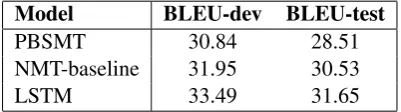
We employ BLEU (Papineni et al.,2001) as the evaluation metric. BLEU is calculated for individ-ual translated segments by comparing them with a dataset of reference translations. The scores, be-tween 0 and 100 are averaged over the whole eval-uation dataset to reach an estimate of the transla-tion overall quality. Table 1 shows the results on both development set as well as test set.
Model BLEU-dev BLEU-test
PBSMT 30.84 28.51
NMT-baseline 31.95 30.53
LSTM 33.49 31.65
Table 1: BLEU scores computed on the develop-ment and test sets using PBSMT, NMT-baseline and LSTM systems.
LSTM encoder-decoder scores indicate in over-all improvement in translation performance in terms of BLEU scores. As seen in Table 1, our LSTM encoder-decoder outperforms the NMT-baseline by 1.12 BLEU points while it outper-forms the PBSMT by 3.14 BLEU points. Our LSTM encoder-decoder is able to score a pair of sequences (in terms of a conditional probability) or to generate a target sequence given a source se-quence.
We evaluated the proposed model with the SMT task, using the LSTM encoder-decoder to score each phrase pair in the phrase table. Qualita-tively, we showed that this model captures linguis-tic regularities in the phrase pairs and also that the LSTM encoder-decoder proposes well-formed target phrases. We also found that the LSTM encoder-decoder contribution is orthogonal to the existing use of neural networks in the SMT sys-tem. We conclude that further performance im-provements are likely if we were to use the LSTM encoder-decoder and the neural LM together.
7 Conclusions and Future Work
In this paper, we described a PBSMT implementa-tion within which the phrase table is generated by using an LSTM encoder-decoder, and sentences with the highest scores are selected as output. We
compared the resulting translation quality of the LSTM against PBSMT and a NMT baseline, and demonstrated a BLEU score increase of up to 3.14 and 1.12, respectively. We also noticed that SMT works well for long sentences while NMT works well for short sentences.
Since NMT systems usually have to apply a certain-sized vocabulary to avoid time-consuming training and decoding, such systems suffer from OOV issues. Furthermore, NMT lacks a mech-anism to guarantee/control translation of all the source words and favors short translations, result-ing in fluent but inadequate translations.
Issues outlined above are fodder for future work. For example, the incorporation of SMT fea-tures into the NMT model within the log-linear framework may be a future next step to address the training/decoding issue above.
Acknowledgments
We would like to express our sincere gratitude to Dr. Michael W. Mislove (Tulane University, USA) for all his support. We also would like to ac-knowledge the financial support received from the School of Science and Engineering, Tulane Uni-versity (USA). In addition, we are grateful to the RANLP anonymous reviewers for all their helpful comments and discussions.
References
Benyamin Ahmadnia, Parisa Kordjamshidi, and Gho-lamreza Haffari. 2018. Neural machine transla-tion advised by statistical machine translatransla-tion: The case of farsi-spanish bilingually low-resource sce-nario. In Proceedings of the 17th IEEE Interna-tional Conference on Machine Learning and Appli-cations. pages 1209–1213.
Benyamin Ahmadnia and Javier Serrano. 2015. Hier-archical phrase-based translation model vs. classical phrase-based translation model for spanish-english statistical machine translation system. In Proceed-ings of the 31st Conference of the Spanish Society for Natural Language Processing.
Benyamin Ahmadnia, Javier Serrano, and Gholamreza Haffari. 2017. Persian-spanish low-resource statisti-cal machine translation through english as pivot lan-guage. InProceedings of Recent Advances in Natu-ral Language Processing. pages 24–30.
Ben-bidirectional recurrent neural networks. In Proceed-ings of the Conference on Empirical Methods in Nat-ural Language Processing. pages 14–25.
Xing Wang, Zhaopeng Tu, Deyi Xiong, and Min Zhang. 2017. Translating phrases in neural machine translation. In Proceedings of the Conference on Empirical Methods in Natural Language Process-ing. pages 1421–1431.