CSEIT183171 | Received : 12 Jan 2018 | Accepted : 29 Jan 2018 | January-February-2018 [(3) 1 : 544-548]
International Journal of Scientific Research in Computer Science, Engineering and Information Technology © 2018 IJSRCSEIT | Volume 3 | Issue 1 | ISSN : 2456-3307
544
Comprehensive Analysis of Feature Based Methods on Image
Stitching Techniques
A. Rajarajeswari
Assistant Professor, Department of Computer Applications, NGM College, Pollachi, Tamil Nadu, India
ABSTRACT
In the field of computer vision the important research is image stitching. Image stitching is the process of combining multiple photographic images with overlapping fields of view to produce a segmented panorama image. Stitching process has three stages, namely Registration, Calibration, and Blending. In recent years many algorithms have been proposed widely to tackle image stitching problem. A discussion is made on all the recent approaches and review is done. In addition we also discuss the image stitching process for the understanding of the reader. Here some of the techniques used for image stitching process are given here. Finally, the current challenges of image stitching will be discussed.
Keywords: Direct method, feature based method, Image Registration, Image Calibration, Image Blending.
I.
INTRODUCTION
Image processing is a technique which is applied to execute some operations over an image, in order to get an enhanced image or to remove some useful information from the existing. It is a process in which the mathematical operations can be performed on images using any form of signal processing in which the inputs shall be an image or a series of images or video such as a photograph or video frames [1]. Either an image or a set of characteristics or parameters related to the image are the outputs produced by image processing.
Image Stitching is the process in which assembling a succession of images and combining them together to form an uninterrupted flawless photographic representation of the image surface. In order produce seamless results most approaches of image stitching requires nearly exact overlapping between images. Merging images together to create a larger image is referred as Stitching, preferably without it being at all noticeable that the produced image has been
created by computer [2]. It has extensive applications in the field of video conferencing, video matting, video stabilization, 3D image reconstruction, video summarization, video compression, satellite imaging, and several medical applications (Medical image stitching has many applications in clinical diagnosis, such as diagnosis of cardiac, retinal, pelvic, renal, abdomen, liver, tissue and other disorders). The ability to summarize and compress videos taken with a panning camera [3] is an interesting application of image stitching .Here figure 1 represents the image stitching components.
II.
DIFFERENT KINDS OF IMAGE STITCHING
The different kinds of image stitching are,
Mosaic - stitching multiple rows of images that were taken without rotating the camera around a single point, but with the camera kept perpendicular with the focus.
Panorama (single-row) - stitching a single row of images (created by rotating the camera around a single point in a flat plane, which is normally parallel with the horizon).
Panorama (multi-row) - stitching multiple rows of images (created by rotating the camera around a single point in a flat plane but lean or position the camera up and/or down so that for each row of pictures the lens is not necessarily parallel with the plane of rotation).
Panorama (pano-camera) - The ends of panoramic picture created with a panoramic camera are stitched.
Spherical panorama - stitching any number of pictures in such a way as to
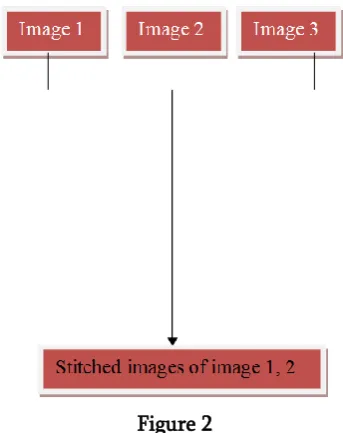
Figure 2
Create a spherical panorama, the vital difference between this spherical and single or multi-row panoramas is that the "poles" (i.e. the very top and bottom of the image) must be stitched so that the user can view straight above and below through which a smoothly blended image can be seen.
III. IMAGE MOSAICING METHODS
Image mosaicing methods are broadly classified into Direct Method and Feature Based Method.
Direct Method uses information from all pixels. It repetitively updates an estimate of homography so that a particular cost function is decreased. Sometimes Phase-Correlation is used to evaluate the few parameters of the homography. Minimizing the sum of absolute differences between overlapping pixels is the main advantage of the direct method. In this method, each pixel is measure up with each other so it’s a very composite technique. They are not invariant to image scale and rotation. Direct method optimally used the information grouped from the image alignment. It measures the input of every pixel in the image. The main difficulty of direct method techniques is that they have a inadequate range of convergence [4].
capability to recognize panoramas by robotically detecting the adjacency relationship between an ordered set of images. These features are best suited for fully automated stitching of panoramas. Feature based methods rely on exact detection of image features. Correspondence between features leads to computation of the camera motion which can be tested for alignment. This kind of approach is likely to fail in the absence of distinctive features.
A. Image Registration
Image registration is geometrically aligning two or more pictures which are sense from different viewpoint, at different time and using the different sensors. Out of these pictures one is a reference image and all others are called as sensed images.The sensed image undergoing the registration algorithm and its pixel coordinates are transformed into reference image pixel coordinates is the main idea behind any image registration algorithm. In this way, the transformed sensed image is got and then this transformed sensed image is super imposed on the reference image in visually plausible way. Once both the images are super imposed a larger 2D view of the scene or highly informative single output image are received. The image registration is classified into the four classes depending upon how the images which are to be registered are acquired [7].
Multi View Image Registration: Images of the
Multimodal Modal Image Registration: Pictures of the similar scene are acquired by different sensors.
Scene to Model Registration: Images of a scene and a outline of the scene are registered
Steps involved in the registration processes in [8] are as follow:
1. Feature Detection: Salient and distinctive objects in both reference and sensed images are perceive.
2. Feature Matching: The communication between the features in the reference and the sensed image are established.
3. Transform Model Estimation: The type and parameters of the so-called mapping functions, aligning the sensed image with the reference
Image calibration minimizes the differences between an ideal lens model and the camera-lens combination that was used. These differences are resulted from optical defects such as distortions and exposure differences between images [9].Intrinsic and extrinsic camera parameters are improved in order to restructure the 3D structure of a scene from the pixel coordinates of its image points. Extrinsic camera parameters define the location and orientation of the camera reference frame with respect to a known global reference frame. Intrinsic camera parameters link the pixel coordinates of an image point with the corresponding coordinates in the camera reference frame [10]. The choice of deform is a compromise between a smooth distortion and one which achieves a good match. Smoothness can be ensure by assuming a parametric form for the deform or by constrain it using deferential equations. Matching can be specified by points to be brought into alignment, by local measures of correlation between images, or by the coincidence of boundaries.
then it can be revamped. There are two different methods for generation of an image for any type of distortion.
Forward-mapping: A given mapping from sources to images is directly applied.
Reverse-mapping: For a given mapping from sources to images, the source is found from the image.
In forward warping, the resource image is mapped onto a cylindrical surface, but it can disappear holes in the target image as some pixels may never get mapped there. Therefore, inverse warping is commonly used where each pixel in the target image is mapped to the resource image.
C. Blending
Image blending is the method which changes the image grey levels in the locality of a boundary to get a smooth evolution between images by deleting and creating a blended image by determining how a pixel in an overlapping area should be prescribed. Image blending involves executing the adjustments figured out in the calibration stage, combined with the remapping of the images to an output projection [11].
Images are blended together and visibility of seams between images is minimized by the seam line adjustment. Once the source pixels have been mapped onto the final composite surface, the next step is to blend them in order to create a gorgeous looking panorama. If all of the images are in perfect registration and identically expose, it becomes an easy problem. There are many image stitching consists of different pixels blending methods such as feathering image blending, gradient domain and Image Pyramid blending[12].Blending can be performed by using a binary mask in which the object overwrites the pixel values of one image with the pixel values of an another image. Blending can also be performed in a single series of steps, combining the pixels of one image with those of the next image. Feathering image blending is a technique used in computer graphics software to smoothen or
blur the edges of a feature; it is the simplest approach, in which the pixel values in the blended regions are weighted and average are calculated from the two overlapping images [13].When all the images were taken at the same time and using high quality tripods very simple algorithm brings out the perfect results.
IV. CHALLENGES ACCOSICATED WITH IMAGE
STITCHING
There are many issues in image stitching such as [14]: Noisy image data or data with uncertainties: An image is often destroyed by noise in its acquisition and transmission, the cost of bring out features is decreased by taking a cascade filtering approach. Very larger image collection are needed for efficient indexing large amount of images may lead to high processing time, since each image needs necessary.
The main challenge on image stitching is the usage of handled camera that leads to the presence of parallax, small scene motions such as waving tree branches, and large-scale scene motions such as people moving in and out of pictures. This problem can be handled by bundle adjustment. Another frequent problem in creating photo-mosaics is the elimination of visible seams, for which a variety of techniques have been developed over the years [15].
V.
CONCLUSION
In this paper the various image stitching techniques are reviewed. Image stitching is useful for variety of tasks in perception and computer graphics. The three main stages of image stitching such as registration, calibration, blending the image were discussed and some of the fundamental and basic techniques used in image mosaicing are discussed in this paper.
VI. REFERENCES
[2]. Pranoti Kaleand K.R.Singh, A Technical Analysis of Image Stitching Algorithm, International Journal of Computer Science and Information Technologies, vol. 6, 2015.
[3]. Ebtsam Adel, Mohammed Elmogy, Hazem Elbakry Image Stitching based on Feature Extraction Techniques: A Survey, International Journal of Computer Applications (0975 –8887) Vol 99–No.6, Aug 2014.
[4]. Shreyas Mistry, Prof. Arpita Patel Image stitching using Harris Feature Detection IRJET Vol 03 Issue: 04, Apr-2016.
[5]. Soo-Hyun CHO, Yun-Koo CHUNG and JaeYeon LEE, Automatic Image Mosaic SystemUsing Image Feature Detection and Series, In Proceedings of the 7th InternationalConference on Digital Image Computing: Techniques and Applications, Sydney, Australia,2003, pp. 549-556.
[6]. Shikha Arya, A Review On Image Stitching and its Different Methods, International Journal of Advanced Research in Computer Science and Software Engineering, vol 5, issue 5, May 2015.
[7]. Vrushank H. Gandhi, Sandip R. Panchal Feature Based Image Registration Techniques: An Introductory Survey, IJEDR Vol 2, Issue 1 ISSN: 2321-9939, 2014
[8]. Medha V. Wyawahare, Dr. Pradeep M. Patil, and Hemant K. Abhyankar, Image Registration Techniqus: An overview, International Journal of Signal Processing, Image Processing and Pattern Recognition, Vol. 2, No.3, Sep 2009. [9]. K.Shashank, N. G. A Survey and Review over
Image Alignment and Stitching Methods The International Journal of Electronics & Communication Technology (IJECT), ISSN:2230-7109 (Online),Mar 2014.
[10]. Zhang, Z. A Flexible New Technique for Camera Calibration. IEEE Trans. Pattern Anal. Mach. Intell., vol 22 issue 11, 1330-1334,Nov 2000.
[11]. V. Rankov, R.J. Locke, R.J. Eden, P.R. Barber, B. Vojnovic, An algorithm for Image Stitching
& Blending, Proceedings of SPIE, Vol. 5701, Mar 2005.
[12]. Eden A, Uyttendaele&Szeliski, Seamless Image Stitching of Scenes with Large Motions and Exposure Differences, Proceedings of the 2006 IEEE Computer Society Conference on Computer Vision and Pattern Recognition, Vol 2, 2006.
[13]. K.Shashank, N. G., A Survey and Review over Image Alignment and Stitching Methods, The International Journal of Electronics & Communication Technology (IJECT), 2014. [14]. Szeliski, R., Image Alignment and Stitching,
Technical report.