International Journal of Scientific Research in Computer Science, Engineering and Information Technology © 2018 IJSRCSEIT | Volume 3 | Issue 1 | ISSN : 2456-3307
Processing Skyline Queries Based on huge and incomplete
Datasets in Various Database
Mercy Bhikshavathi Kalluri*1, Ravindra Reddy E2
*1M.Tech Scholar, St. Mary's Group of Institutions, Guntur, Andhra Pradesh, India
2Department of CSE, Assistant Professor, St. Mary's Group of Institutions, Guntur, Andhra Pradesh, India
ABSTRACT
Personalized recommendation and therefore the process of time period data exemplify the process of huge information that within the field of Internet-of-Things (IoT) received a good extent of attention in recent literature. The integrity of huge information within the IoT is widespread. getting customized info from the incomplete information set continues to be nonplussed by looking out efficient and correct strategies at the present. Skyline query may be a wide used processing technique, particularly within the field of multi-objective call analysis and information mental image. To eliminate the negative effects on huge processing in IoT, a unique skyline preference question strategy supported huge and therefore the incomplete information set is projected during this paper. This strategy merely separates and divides huge and incomplete information set into 2 elements consistent with dimension importance and executes skyline question, severally. The strategy chiefly resolves the matter of extracting personalized info from huge and incomplete information set and improves the efficiency of skyline question on huge and incomplete information set. First, this paper presents a skyline preference question strategy supported strict bunch and implements it on dimensions that have higher importance. Second, a skyline preference query strategy supported loose bunch is enforced on dimensions that have lower importance. Finally, integrating native skyline question results, this paper calculates world skyline question results by victimization info entropy theory. The efficiency and effectiveness of Skyline Preference question (SPQ) algorithmic rule are evaluated in terms of latent period and result set size through the comparative experiments with I Skyline algorithm and sort-based incomplete information skyline algorithmic rule. an outsized variety of simulation results show that the efficiency of SPQ algorithmic rule is more than that of different common strategies.
Keywords: Preference Queries, Skylines, Skyline Queries, Algorithms, Incomplete Data, Database, information entropy.
I.
INTRODUCTION
Prior to the first introduction of the skyline operator into database community by Borzsony et al. (2001), there was a problem called maximum vector problem or Pareto optimum that has been addressed by (Bentley et al., 1978). Skyline queries attempt to return a set of data items S from a database, where S contains only those data items whose dimension values are not dominated by any other data item exist
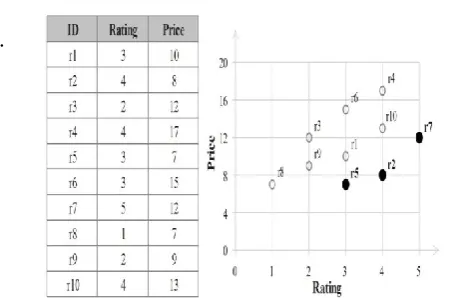
details of 10 restaurants, in which each restaurant consists of two dimensions. The first dimension represents the rating of each restaurant given by customers while the second dimension indicates the price of the food served in each restaurant. Figure 1(B) illustrates the representation of the restaurant database example in 2-Dimensions space. Assume a user is looking for the best restaurant in the city where the price is the cheapest and the restaurant rate is the highest. Based on skyline definition and from the database example, it can be seen that restaurants r8, r9, r3, r1 and r6 are partially dominated by r5 or r2 either based on the first dimension (price) or the second dimension (rate). While restaurants r4 and r10 are partially dominated by restaurant r7 only. It can be noticed for restaurant r8 and r5 their price values are cheapest among all other restaurants but r8 do not have the better rating than any of the other restaurants. Therefore, r8 is dominated by r5. Similarly, restaurant r7 has higher price value compare with r1 and r9; however, it has better rating value compare with any other restaurant. Hence, restaurant r7 is not dominated by any other restaurant in the restaurant database. As demonstrated in Figure 1(A), the result of applying skyline technique on restaurant database example will retrieve r5, r2 and r7 as the skylines of the restaurant database.
.
Figure 1. Example of skyline query Incomplete Dataset
A database is said to be incomplete if and only if values of some dimensions are not present (missing). Otherwise, it is complete.
dominated by one another and therefore the skyline process fails to decide the best car for the tourist.
In this study, we are focusing on examining and discussing the previous approaches proposed for processing skyline queries with incomplete data in three different databases, namely: centralized, distributed and cloud databases. These approaches have been analyzed thoroughly describing the strengths and the weakness of these approaches. Furthermore, we also discuss the current research trends related to skyline queries in some other environments and highlight the most issues concern skyline queries in these contexts.
II.
LITERATURE REVIEW
Lian et. al., 2011[1] proposed a probabilistic least influenced set query techniques over uncertain objects in databases. The high probability query objects do not affect the retrieval of uncertain object. The technique is improved with the influence of monochromatic and dichromatic applications that answers well the given queries. Minmax, Candidate pruning and Regional pruning methods effectively reduces the search space by integrating the query procedures. The method is tested over both static and moving objects over business planning datasets.
Lin and Hong, 2012[2] proposed a frequent mining datasets in transactional databases. The technique is proposed to find the availability of data in uncertain dataset using probability values 0 or 1. The processing in uncertain database is carried out with UF-tree structure that involves uncertain frequent pattern tree. The same item sets are merged in tree branch even if the transaction probabilities are different. The technique with uncertain frequent pattern tree seems better computation UF – tree.
Azeem et. al., 2015[3] designed a framework over uncertain query ranks and dataset distribution threshold tuned and ceiling-tuned distributed top-k algorithm for finding the top-k tuples. Efficient ranks and reduced communication rounds are achieved
while finding the tuples with efficient computation over distributed database. The threshold tuned algorithm proved to be effective than the other one in terms of finding top-k tuples.
Ahmed et. al., 2016[4] combined Weighted Uncertain Interesting Pattern tree structure with additional measures like wUConf and uConf to find the frequent item set. This technique helps in mining the uncertain dataset using correlated patterns. Firstly, the weights of individual measures are calculated using correlated patterns and secondly using the measures, the performance of mining is calculated. The method helps in finding the valued patterns faster than conventional approaches.
Lin et. al., 2016[5] used potential high-utility item set mining technique to discover the frequent patterns in the dataset. The itemset has high utility than others and high existence probabilities are founded out with tuples uncertainty model. An upper bound mining algorithm uses level wise search and repeated scanning is avoided using PU list algorithm. The scalability of the system is improved with mining datasets and not generating the candidates over real life and synthetic datasets. The algorithms is tested with total patterns, runtime and memory usage with two algorithms.
Lian and Chen, 2016 [6] used probabilistic top-k dominating query technique to identify the k-uncertain objects in the database. The search speech using this technique is avoided with pruning techniques. Furthermore, arbitrary subspaces are used to compute the probabilistic top-k query and testing is done to prove its effectiveness in query retrieval.
The above techniques proved efficient in terms of uncertain database with uncertain queries but the usage of skyline queries in such database brings more
robustness in algorithm computations. The
Skyline Approaches
There are severe drawbacks in applying skyline queries over user preferences that leads to impractical skyline or non-dominating results from skyline queries. To avoid such congenital problems in skyline querying various researches have spotted the problems and eradicated it with special solutions. Few of which are presented here.
To handle impractical skyline size, Lee et. al., 2012[7]
proposed interactive preference elicitation
framework that collects user preference and updates skyline iteratively. This technique reduces the user interaction and increase the size of skyline reduction. The query formulation remains intuitive and efficient over several experimental testing.
For reverse skyline operations, Gao et. al., 2012 [8] precompiled skyline behavior using reverse skyline using skyline approximation technique that provides a node with multiple accessing. This technique is further improved with constrained reverse skyline query for constrained specific region. Full reuse and global skyline based reverse skyline algorithms are designed and tested over real and synthetic datasets.
The continuous monitoring on skyline dynamic data, Lu et. al., 2013 [9] proposed an approach with 11 algorithms for each stage processing. The main aim is to distribute the centralized load and thus reducing the bandwidth consumption. The experimental evaluation on wide area sensor networks is tested with both real and synthetic datasets.
The sliding technique with probabilistic threshold is processed over uncertain datasets by [10] Zhanget al., 2013 [10]. The technique initially computes the element type and then the skyline size is determined to identify the query composition. The probabilistic query technique is applied over continuous high-speed datasets to identify the top tuples with multiple probability thresholds.
Lian and Chan, 2013[11] proposed probabilistic group subspace skyline technique to reduce uncertainty in sensor data analysis. The technique
looks similar to [4] in terms of its faster process and pruning reduces the cost and search space [1].
Chung et. al., 2013 [12] proposed combinatorial skyline query technique to identify the perfect combinations. Past skyline query is added to it for enhancing the prediction capability of skyline queries. The brute force and decomposition algorithms are used in improving the decision-making capability, business plan, market analysis and economic research.
Lee et. al., 2013 [13] proposed Fast algorithm that processes static data on data streams. The technique is designed to handle multiple queries with filtering, discriminate analysis for discarding and determining objects, respectively.
Similar to [1], jiang et. al., 2014 [14] used monochromatic and bichromatic applications over mutual skyline query that retrieves the skyline object in dynamic environment. Reverse skyline query is used to find the query object in task allocation, market analysis and personalized matching.
To study the incomplete data in skyline environment due to privacy preservation and device failure, Gao et. al., 2014[15] proposed k-sky band query technique. Baseline and virtual point algorithm are designed to process the missing data. Concepts like shadow, expired skyline and thickness warehouse boosts the performance, and further tackles constrained and group-by skyline queries in real and synthetic data sets.
With reduced computation overhead, Yong et. al., 2015[16] identified top-k tuples using BFS and peeling algorithm with R-tree. This algorithm obtains the tuples with the concept of dependency and independency. The system is tested over synthetic datasets to measure dimensionality, cardinality, retrieval size and distribution.
with sorting and partition operation. Skytree technique is considered to include point insertion and deletion using recursive point space partitioning. Greedy algorithm is further added with sky tree to perform faster than conventional techniques.
Similar to [11], saad et. al., 2015[18] proposed SkyQUD framework that computes skyline points using probabilistic technique in uncertain dataset. Harvesting is the initial phase performing elimination operation and strict selection is the final phase that extracts the dominating point.
Kulkarni and Momin, 2015 [19] optimized response time in static dataset using QPSkyline and theQPUpdateSkyline algorithms. This identifies the nearest frequent dataset and updates it in the profiler. The former algorithms is applicable over static datasets and latter on frequent real life datasets.
Jiang et. al., 2015[20]evolved a technique that selects the k-combination points with monotonic preference variable. This is done with top-k combinatorial metric skyline query technique with Incremental Combination Sorting and Top-k Combinatorial Metric Skyline Algorithms. The algorithms are designed to provide better skyline points in location based applications possessing real and synthetic datasets.Ying Zhang et. al., 2015[21] used random algorithm with Œ-approximation guarantee to find the Tok points in the skyline datasets. The skyline points are computed using exact and p-rand algorithms in real and synthetic datasets.
Li et. al., 2015 [22] used GDPS approach to improve the global knowledge in uncertain environment. This uses optimal feedback that optimizes the query using grid technology. Moreover, use of tuples-k selection, localized and server pruning over real and synthetic datasets improvised the correctness of datasets. hen and Lee, 2015[23] computed s-neighbor skyline query technique to find the non-dominating points. Rs-N skyline points are computed using BBS algorithm with new index tree procedure. This algorithm works well with s-neighbor skyline
Park et. al., 2015 [24] used Map Reduce algorithm to compute continuous and discrete datasets in big data environment. This technique uses two algorithms (PS-QP-MR, PS-BR-MR and PS-BRF-MR) with initial pruning procedure or filtering approaches to clean the irrelevant data in synthetic datasets.
In [8], reverse skyline operation is performed for skyline query and Gao et. al., 2015[25] proposed similar reversek-skyband (RkSB) query technique with five various algorithms. This effectively returns the query skyline points with initial computation, reusing and pruning procedure. Further, ranked reverse skyline technique is applied over real and synthetic datasets to effectively minimize the score with pruning heuristics.
Gao et. al., 2015[26] proposed most desirable skyline object query technique returns the top dominating points using weights calculation and ranking procedure. Further, three algorithms and constrained procedure is added with the technique that improved the search results in real and synthetic datasets. The top dominating points in uncertain time series datasets are computed by He et. al., 2016 [27]. It is a dual step technique with three pruning technique that obtains skyline points on interval basis. Another two methods were designed to compute the probabilistic skyline in dataset and pruning is improved further with adjacent interval technique.
Lee et. al., 2016[28] proposed bucket skyline sort with bucket orders and point level orders for pair wise comparison in incomplete dataset. If no skyline point occurs, parameters with monotonicity properties are applied over synthetic and real life dataset to obtain accurate points.
III.
RELATED WORK
This section provides a set of necessary definitions and notations that facilitate the process of understanding the concept of skyline queries in incomplete databases. This includes definitions related to the dominance theory of the skyline, the skyline queries, incomplete database, comparable, distributed databases and dynamic databases. These terms are further explained as follows.
A relation of the database D is denoted by R (d1, d2, ..., dm) where R is the name of the relation with m-arity and d = (d1, d2, ..., dm) is the set of dimensions.
Definition 1 Dominance
Given two data items pi and pj∈D database with d dimensions, pi dominates pj (the greater is better) (denoted by pi ≻ pj) if and only if the following condition holds: ∀ dk∈d, pi.dk ≥ pj.dk, Λ∃dl, ∈d, pi.dl>pj.dl .
Definition 2 Skyline Queries
Select a data item pi from the set of D database if and only if pi is as good as pj (where i ≠ j) in all dimensions (attributes) and strictly better than pj in at least one dimension (attribute). We use Sskyline to denote the set of skyline data items, Sskyline = (pi∀ pi, pj∈D, pi≻ pj).
Definition 3 Incomplete Database
Given a database D (R1, R2, ..., Rn), where Ri is a relation denoted by Ri (d1, d2, ..., dm), D is said to be incomplete if and only if it contains at least a data item pj with missing values in one or more dimensions dk (attributes); otherwise, it is complete.
Definition 4 Comparable
Let the data items ai and aj∈R, ai and aj are comparable (denoted by aiε aj) if and only if they have no missing values in at least one identical dimension; otherwise ai is incomparable to aj (denoted by ai ε/aj).
Definition 5 Dynamic Database
A database D is said to be dynamic if its contents are persistently change through many update operations such as DELETE, UPDATE or INSERT.
In dynamic databases processing skyline is quite challenging due to the continuous update of the data in the database. This frequent change might impact negatively on the validity of the skyline and force users to re-compute the skyline process whenever the data is updated. Re-evaluating the skylines by accessing the whole database is an exhaustive process that incurs longer processing time and higher overhead for the skyline process. Therefore, this approach should be avoided and provide a solution that partially scans the database when there is an update on the contents of the database.
IV.
PROPOSAL WORK
Skyline Preference Query Strategy
A. Skyline Preference Query Strategy Based On Strict Clustering
The skyline preference query strategy based on strict cluster-ing performs in two steps. Firstly, this strategy implements strict clustering on tuples from IS’ and then executes skyline preference query algorithm based on attribute value ordering on tuples that aren't dominated by others.
The processing of skyline preference query algorithm based on attribute value ordering can be divided into four phases.
in Candidate_Set has two values, one is the number of being processed that is denoted as processedCount and the other is the number of character '1' in a tuple encoding the number of non-missing attributes is denoted as dimCount.
Phases 2: For the currently selected tuple, there are three cases. Case 1: If tuple p0 has never been processed and still be in the Candidate_Set, it can be compared with the tuple p0j that there is no comparison between them even if p0j has been dominated by tuple processed before. This is because p0j maybe dominates p0 I If there exists a tuple can dominate p0, tuple p0 should be removed from Candidate_Set. Case 2: If tuple p0 has never been processed but is dominated by tuple processed before that p0 will not be in Candidate_Set anymore. Therefore, tuple p0 only compares with the tuples which still be in Candidate_Set and there is no comparison between them. In case 1 and case 2, any tuple is dominated by tuple p0 will be removed from Candidate_Set. Case 3: If a tuple has been processed before, it will not compare to any tuple.
Special case: If there are two tuples, p0i and p0j, p0i dominates p0j only in few dimensions (less than the half number of dimensions), then p0i will dominate p0j regarding traditional skyline rule. However, considering user preference, the miss-ing dimensions in tuples might have higher weights than those available dimensions. We should take those missing dimen-sions into consideration to ensure the accuracy of dominance relation between incomplete tuples. Judging the dominance relation of two tuples only through comparable dimensions is inaccurate. Especially, this paper de nes the weak dominance relation among tuples with missing dimensions.
Phase 3: When the number of comparisons of tuple p equals to p dimCount, which is the number of non-missing dimensions of p. Then p will be removed from the Candi-date_set to the strict skyline result set SSRS.
Phase 4: When the candidate set is empty or all tuples are processed at least once, the rest of tuples in Candidate_Set are push back to the strict skyline clustering result set SSRS.
Algorithm 1 Dominate (p,q) 1. Input: tuple p,q 2. Output: Integer value 3. If p>q
4. Return 1; 5. Else if p> q
6. If p weight q weight 7. Return 1;
8. Else if q> p
9. If q weight p weight 10. Return 1;
11. Return 0
this is the algorithm to judge the dominance relation between two tuples.
The pseudo code of skyline preference query algorithm based on attribute value ordering is as follows:
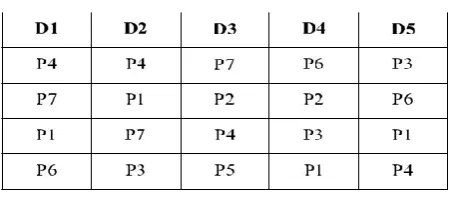
We also describe the skyline preference query algorithm based on attribute value ordering by taking an example of the incomplete data set from Table 1. The result of IS0 that is sorted by attribute value is shown in Table 2. p4 dominates p1, p2 weak dominates p4. However, p2 weight p4 weight, so p2 could not dominate p4. There is no dominance relation between p4 and p5. Similarly, there is also no dominance relation between p4, p6 and p7. After the rst iteration, p4 processedCount D 1. p1 and p5 are removed from Candidate_Set. Then, ptr1 also pointers to the rst tuple p4
of array D2. Since p4 has been processed before, it need not compare with any tuple. In the end of the second iteration, p4 processedCount is 2. In the third iteration, the tuple of array D3, p7 is processed and it should compare with p1 p3, p5 and p6. Actually, p7 is not dominated by p1 and p5 which have been removed from the Candidate_Set at the rst iteration. p7 weak dominates p2 and p7 weight > p2 weight , so p7 dominates p2. Similarly, p7 dominates p3 and p6. By the end of this iteration, p2, p3 and p6 are removed from Candidate_Set. When the iteration is carried out to the fourth time, p6 should be processed but it has not been at Candidate_Set hence it ful ls the condition of phase 2 of SAVO algorithm. It needs to compare with tuples still be in Candidate_Set and they should have never been compared with each other before. Currently, Candidate_Set only have two tuples, p4 and p7, which have been compared with p6. In the end, p6 processedCount is 1. Until the twelfth iteration,p7 processedCount D p7 dimCount D 3, so it can be removed from Candidate_Set to SSRS. By the eighteenth iteration, p5 is processed and there are no remaining tuples has not been processed. Therefore, SAVO algorithm reaches to its end. We attain two tuples, p4 and p7, which will become candidates' skyline points via strict clustering strategy and skyline preference query algorithm based on attribute value ordering.
B. Skyline Preference Query Strategy Based On Loose Clustering
According to the loose clustering rule described in Section III, we can attain the loose clusters on IS00. But tuples in each cluster might have no dominance relation. These tuples will also be the skyline query result return to users. Thus, users need to select what they want because tuples in the result set may not meet the needs of users.
Algorithm 2 Skyline Preference Query Algorithm Based on Attribute Value Ordering SAVO
1. Input: IS0
2. Output: SSRS
3. initialize Candidate_Set D IS0, SSRS D ;, iterD1
4. Foreach dimension si 2 IS0
5. This step sorts the attribute value at si by non-ascending order and stores corresponding tuple id in array Di. If tuples have the same attribute value, the smaller tuple id, the tuple has more priority to be stored.
6. The pointer ptri in array Di is initialized by 1.
7. Endfor
8. Foreach p0 2 IS0
9. Initialize p0 processedCount D 0I
10 p0 dimCountDthe number of dimensions that values are non-missing;
11. Endfor
12. While Candidate_Set6D;and at least one tuple has not been processed
13. nextDimDiter% ;
14. PDDnextDim[ptrnextDim]
15. P isDominatedDfalse; 16. If P processedCount D 0 17. If If P 2 Candidate_Set
18. For each q2 (IS0-Candidate_Set) 19. If (P has never compared with q) 20. If (dominate(P,q)DD0)
21. P isDomainated Dtrue; 22. Endif
23. Endif
24. Endfor
25. Endif
26. If P isDominatedDDfalse 27. Foreach (c in Candidate_Set)
28. If (there has no comparison between p and c before)
29. If(dominate(P,c)DD0) 30. P isDominatedDtrue; 31. Else
32. Remove c from Candidate_Set; 33. Endif
34. Endfor
35. Endif
36. If P isDominatedDDtrue and P in
Candidate_Set
38. Endif
39. Endif
40. P processedCount C C;
41. If (P in Candidate_Set andP processedCount DD P dimCount)
42. Remove P from Candidate_Set to SSRS;
43. Endif
44. IterCC; 45. ptrnextDim C CI
46. Endwhile
47. Return SSRS;
Considering this problem, we take the user preference as an important factor in the decision of dominance. A calculation method of dominance degree is proposed to reduce the redun-dancy of skyline query result set, which differs from most traditional methods. The dominance relation of tuples with user preference is determined by the degree of dominance between them. The following is the de nition of the degree of dominance:
De nition 5: The Degree of Dominance
The difference of attribute value of any two tuples can be regarded as their dominance distance. The degree of dom-inance between any two tuples at the same cluster can be recorded as the sum of the product of dominance distance and weight on comparable dimensions. w C1, w C2; : : : ; wd are the weights of dimensions. The missing values of each dimension of tuple pi are denoted by vij, j 2 [ C 1; d]. The degree of dominance between any two tuples pi and pjis domain i;j D d Pk Dd2 wk(v ik vjk), wherein k represents thekthcomparable dimension of a tuple. If domaini;j > 0, thenpj < pi . If domaini;j < 0, pj > pi . If domaini;j D 0, there areno dominance relation between piand pj In each cluster, we calculate the degree of dominance ofany two tuples. After the eliminating tuples that are dominated by others, remaining tuples at clusters will be added into loose clustering skyline query result set, RSRS
Regarding the incomplete and missing information within the Field of Internet-of-Things, this paper studies the customized recommendation which mixes the large knowledge of the Internet-of-Things with user preference. we have a tendency to propose a sky-line preference skyline strategy supported huge and incomplete data set, as well as encryption and clustering strategy, 2 methods of skyline preference question supported dimension importance clump and a variety strategy supported data entropy theory. As way as sensible implementations, we have a tendency to style a comparative experiment with Skyline algorithmic program and SIDS algorithmic program regarding 3 aspects: knowledge size, knowledge dimension, and knowledge missing rate. Experimental results supported synthetic knowledge sets manifest that SPQ algorithmic program is competitively a lot of efficient and positive in results accuracy than alternative algorithms.
VI.
REFERENCES
[1]. D. Gil, A. Ferrandez, H. Mora-Mora, and J. Peral, 'Internet of Things: A review of surveys based on context aware intelligent services,'' Sensors, vol. 16, no. 7, p. E1069, Jul. 2016. [2]. H. Song, D. Rawat, S. Jeschke, and C. Brecher,
Cyber-Physical Systems: Foundations,
Principles and Applications. Boston, MA, USA: Academic, 2016, p. 514.G. G. Zhang, Y. Bi, C. Li, Y. Zhang, and C. Zeng, 'Security processing model research based on massive loT data,'' J. Chin. Comput. Syst., no. 9, 2090 2094, Sep. 2013.
[3]. L. Zhang, Y. Wang, B. Y. Song, X. Li, and X. Hao, 'Geometry-based spatial skyline query in wireless sensor network,'' in Proc. 11th Web Inf. Syst. Appl. Conf., Tianjin, China, Sep. 2014, pp. 27 32.
[5]. Y. Gu, G. Yu, X. J. Li, and Y. Wang, 'RFID data interpolation algo-rithm based on dynamic probabilistic path-event model,'' J. Softw., no. 3,438 451, Mar. 2010.
[6]. Y. Wang, B. Yin, G. H. Liu, B. Y. Song, and J. L. Wang, 'Skyline query of massive incomplete
data based on combinational
dimensions,''Frontiers Comput. Sci. Technol., no. 4, pp. 495 503, Sep. 2016.
[7]. S. Jeschke, C. Brecher, H. Song, and D. Rawat, Industrial Internet of Things. Switzerland: Springer, 2017, p. 715.
[8]. L. L. Ding, J. C. Xin, G. R. Wang, and S. Huang, 'Ef cient skyline query processing of massive data based on Map-Reduce,'' Chin. J. Comput., vol. 34, pp. 1786 1796, Oct. 2011.
[9]. S. Borzsonyi, D. Kossmann, and K. Stocker, 'The skyline operator,'' in Proc. 17th ICDE, 2001, pp. 421 430.
[10]. J. J. Cao, X. C. Diao, S. Chen, and Y. Z. Shao, 'Data cleaning and its general system framework,'' Comput. Sci., vol. 39, pp. 207 211, Nov. 2011.
[11]. Y. H. Lin, C. H. Zhang, and J. Liu, 'Realization of data cleaning based on editing rules and master data,'' Comput. Sci., vol. 39, pp. 174 176, Nov. 2012.
[12]. W. Chen and Q. L. Ding, 'Cleaning method for
incomplete data in data cleaning,''
Microcomput. Appl., no. 2, pp. 44 45, Feb. 2005.
[13]. X. J. Wei, J. Yang, C. P. Li, and H. Chen, 'Skyline query processing,''Softw., vol. 19, pp. 1386 1400, Jun. 2008.
[14]. L. Zhu, J. H. Guan, and S. G. Zhou, 'Review of skyline computing research,'' Comput. Eng. Appl., no. 6, pp. 160 165, Feb. 2008.
[15]. Z. Zhang, H. Lu, B. C. Ooi, and A. K. Tung, 'Understanding the meaning of a shifted sky: A general framework on extending skyline query,'' VLDB J., vol. 19, no. 2, pp. 181 201, Feb. 2010.
[16]. Y. Y. Li, Z. Y. Li, M. X. Dong, W. Y. Qu, C. Q. Ji, and J. F. Wu, 'Ef cient subspace skyline
query based on user preference using mapreduce,'' Ad Hoc Netw., vol. 35, pp. 105 115, Nov. 2015.
[17]. M. E. Khalefa, M. F. Mokbel, and J. J. Levandoski, 'Skyline query processing for incomplete data,'' in Proc. 24th ICDE, 2008, pp. 556 565.
[18]. R. Bharuka and P. S. Kumar, 'Finding skylines for incomplete data,'' in Proc. 24th ADC, 2013, pp. 109 117.
[19]. L. Zhang, P. Zou, Y. Jia, and L. Tian, 'Continuous dynamic skyline queries over data stream,'' J. Comput. Res. Develop., vol. 48, pp. 77 85, Jan. 2011.
[20]. K. Ahmed, N. S. Na , and M. A. Gregory, 'Enhanced distributed dynamic skyline query for wireless sensor networks,'' J. Sens. Actuators Netw., vol. 5, no. 1, p. 2, Mar. 2016. [21]. Y. Park, J. K. Min, and K. Shim, 'Parallel
computation of skyline and reverse skyline queries using mapreduce,'' Proc. VLDB Endowment, vol. 6, no. 14, pp. 2002 2013, Sep. 2013.