A New Method for Evaluating Automatically Learned Terminological
Taxonomies
Paola Velardi
†
, Roberto Navigli
†
, Stefano Faralli
†
, Juana Ruiz Martinez
‡
†Dipartimento di Informatica,‡Facultad de Inform`atica
†Sapienza Universit`a di Roma, Italy,‡Campus de Espinardo, Murcia, Spain
{velardi,navigli,faralli}@di.uniroma1.it, [email protected]
Abstract
Evaluating a taxonomy learned automatically against an existing gold standard is a very complex problem, because differences stem from the number, label, depth and ordering of the taxonomy nodes. In this paper we propose casting the problem as one of comparing two hierarchical clusters. To this end we defined a variation of the Fowlkes and Mallows measure (Fowlkes and Mallows, 1983). Our method assigns a similarity valueB(l,r)i to the learned (l) and reference (r) taxonomy for each cutiof the corresponding anonymised
hierarchies, starting from the topmost nodes down to the leaf concepts. For each cuti, the two hierarchies can be seen as two clusterings
Cli,C i
rof the leaf concepts. We assign a prize to early similarity values, i.e. when concepts are clustered in a similar way down to the
lowest taxonomy levels (close to the leaf nodes). We apply our method to the evaluation of the taxonomy learning methods put forward by Navigli et al. (2011) and Kozareva and Hovy (2010).
Keywords: taxonomy learning, gold standard evaluation, hierarchical cluster
1.
Introduction
Ontology evaluation is a hard task that is difficult even for humans. One reason is that different taxonomies might model the domain of interest equally well. Nonetheless, in the literature a variety of different methods have been pro-posed for evaluating the quality of a taxonomy. These in-clude (Brank et al., 2006; Maedche et al., 2002): i) manual evaluation performed by domain experts, ii) structural eval-uation of the taxonomy, iii) automatic evaleval-uation against a gold standard, iv) application-driven evaluation, in which a taxonomy is assessed on the basis of the improvement its use generates within an application. Other quality indica-tors have also been analysed in the literature, such as accu-racy, completeness and consistency (Volker et al., 2010), and more theoretical features such as essentiality, rigid-ity and unrigid-ity (Guarino and Welty, 2002). As regards lex-icalised taxonomies, the focus of interest in this paper, the most popular approach (adopted e.g. by Snow et al. (2006), Yang and Callan (2009) and Kozareva and Hovy (2010)) is that of attempting to reconstruct an existing taxonomy (Maedche et al., 2002), like WordNet (Fellbaum, 1998) or the Open Directory Project1. This method is applicable
when the set of taxonomy concepts is given and the evalua-tion task is restricted to measuring the ability to reproduce hypernymy links between concept pairs. However, the eva-lution is far more complex when learning a taxonomy is performed entirely from scratch, as is done by Navigli et al. (2011) and Kozareva and Hovy (2010). In reference tax-onomies, the granularity and cotopy (Maedche et al., 2002) of an abstract concept might vary according to the scope of the taxonomy and the expertise of the team who created it. For example, the term chiaroscurois classified under
picture, image, iconin Wordnet, along withcollage, but in
1
http://www.dmoz.org/
the Art and Architecture Thesaurus (AA&T)2 chiaroscuro
is a perspective and shading technique, while collage is classified under image-making processes and techniques. As long as it is commonsense, non-specialised knowledge that is being considered, it is still feasible for an automated system to replicate an existing classification, because the Web will provide abundant evidence for it. For example, Kozareva and Hovy (2010) are very successful in reproduc-ing the WordNet sub-taxonomy foranimals, since dozens of definitional patterns are to be found on the Web that clas-sify, e.g., lion, as either a carnivorous feline mammal, or
carnivorous, orfeline. Instead, reconstructing an existing taxonomy in more technical domains is almost impossible, as can be inferred from the foregoing AA&T example. To tackle this problem we here propose a novel proce-dure for evaluating a taxonomy against a gold standard, based on reformulating the problem in terms of compari-son between hierarchical clusters (cf. Section 2.). To this end the non-leaf concepts of the learned and reference tax-onomies are labelled with the transitive closure of their hy-ponym relations. The procedure is then applied to the task of comparing four automatically acquired taxonomies with the corresponding reference taxonomies (cf. Section 3.), namely: the virology sub-hierarchy of the MeSH3medical taxonomy, and three sub-hierarchies of WordNet4(animal,
plants and vehicles). In Section 4. we compare the pro-posed methodology with other approaches in the literature. Finally, Section 5. is dedicated to concluding remarks.
2.
Evaluation Method
In this section we propose a novel, general measure for the evaluation of a learned taxonomy against a gold stan-dard. We borrow Brank et al.’s (2006) idea of exploiting the analogy with unsupervised clustering but, rather than repre-senting the two taxonomies as flat clusterings (see Section
2
http://www.getty.edu/vow/AATHierarchy
3
http://www.nlm.nih.gov/mesh/
4
hi-(H1)
1
1
2 2
2
3 3 3 3 2 2
a b c d e f
(H2)
1
1 1
2 2 2 2 2
a b c d e g
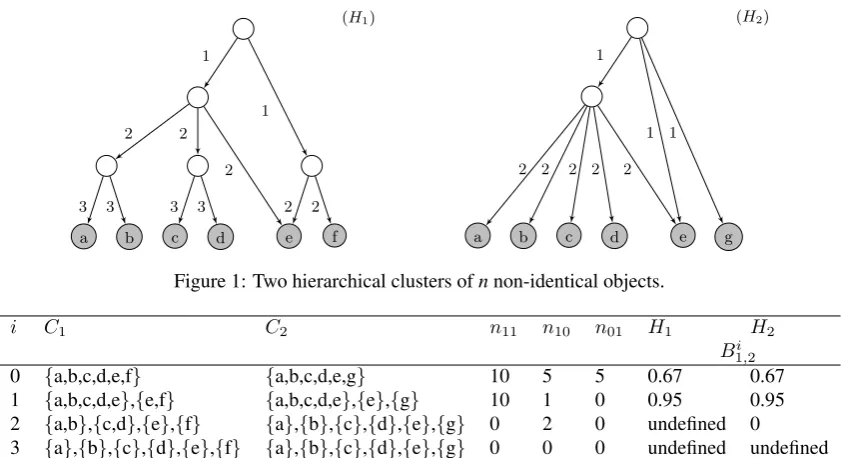
Figure 1: Two hierarchical clusters ofnnon-identical objects.
i C1 C2 n11 n10 n01 H1 H2
Bi
1,2
0 {a,b,c,d,e,f} {a,b,c,d,e,g} 10 5 5 0.67 0.67 1 {a,b,c,d,e},{e,f} {a,b,c,d,e},{e},{g} 10 1 0 0.95 0.95 2 {a,b},{c,d},{e},{f} {a},{b},{c},{d},{e},{g} 0 2 0 undefined 0
3 {a},{b},{c},{d},{e},{f} {a},{b},{c},{d},{e},{g} 0 0 0 undefined undefined
Table 1: Application of the evaluation method to the hierarchies of Figure 1. The values ofBi1,2are shown both whenH1
andH2are the learned taxonomy (penultimate and last column, respectively).
We first start with a summary description of the ontology learning algorithms proposed in (Navigli et al., 2011) and (Kozareva and Hovy, 2010). Then, we compare the learned taxonomies againts the reference ones, using formulas (1) and (2). This analysis proves particularly helpful in pin-pointing some significant and recurrent phenomena. Fi-nally, we perform an in-vitro assessement of the method – as was done in (Zavitsanos et al., 2011) and (Brank et al., 2006) – introducing artificial modifications (concept swap-ping, adding/deleting intermediate nodes, etc.) into refer-ence taxonomies, in order to evaluate their effect on the proposed similarity measure.
3.1. Summary of analyzed taxonomy learning methods
3.1.1. OntoLearn Reloaded
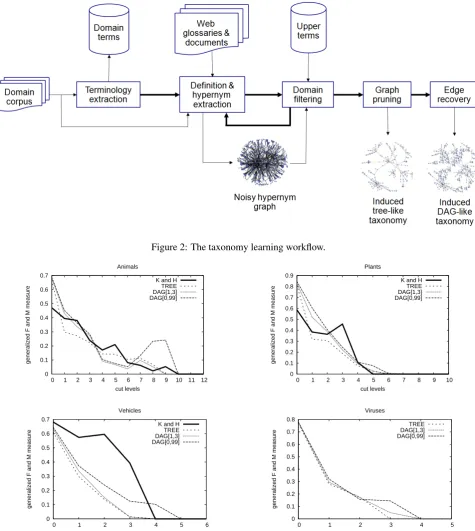
In (Navigli et al., 2011) we presented a system, named On-toLearn Reloaded, whose objective was to produce a do-main taxonomy starting only from a dodo-main corpus and the Web. To this end we devised a methodology based on two “core” algorithms for definition extraction and graph-based taxonomy induction, empowered by some pre- and post-processing steps. Our graph-based taxonomy induc-tion approach consists of five steps, as shown in Figure 2. We start from an initially-empty directed graphGnoisy =
(Vnoisy, Enoisy), where Vnoisy := ∅ andEnoisy := ∅.
From a corpus of domain documents we acquire a domain terminologyT, using a terminology extraction tool. For all the terms inT, we mine the corpus and the Web in search of definitional expressions, from which we obtain a set of hypernymsH using a lattice based definition classifier and hypernym extractor (Navigli and Velardi, 2010).
Non-domain definitions are eliminated on the basis of the number of domain-related words in the definition. The re-trieved hypernyms are then used for a new Web search, and the process iterates until a termination condition is satisfied. The result is a highly dense hypernym graph with several
cycles and possibly disconnected components. Over this directed graph, we apply an algorithm for finding an opti-mal branching. Finally, since in many practical applications DAGs (directed acyclic graphs) represent a more appropri-ate abstraction than tree-like taxonomies, we apply an edge recovery strategy to re-attach some of the hypernym edges deleted during the optimal branching step.
In our previously published experiments we applied On-toLearn Reloaded to the task of acquiring a brand new tax-onomy for the domain of Artificial Intelligence, for which we performed a manual assessment since no gold standard taxonomies were available for this domain. In this paper, instead, we apply OntoLearn Reloaded to the task of induc-ing four taxonomies for which a gold standard reference is available. We evaluate three outputs of the OntoLearn algorithm:T REE,DAG[1−3]andDAG[0−99], corre-sponding respectively to the output obtained after optimal branching, and to the DAGs obtained with two different edge recovery policies, of which the first is more conser-vative (Velardi et al., 2012).
3.1.2. Doubly Anchored Patterns
Kozareva and Hovy (2010)[K&H] create a hypernym graph in three steps. Given few root concepts (e.g.,ANIMAL) and basic level concepts or instances (e.g.,lion), they:
1) harvest new basic and intermediate con-cepts from the Web in an iterative fashion, using doubly-anchored patterns (DAP) like
‘hrooti such as hseedi and ∗’ and inverse DAP
(i.e., DAP−1) like ‘∗such ashterm1iandhterm2i’;
2) rank the extracted DAP and DAP−1 nodes by out-degree and in-out-degree, respectively, to prune out less promising terms;
using a variety of surface patterns along the line of Hearst (1992).
4) finally, they eliminate cycles, as well as nodes with no predecessor or no successor, and they select the longest path in case of multiple paths between node pairs.
As remarked in the introduction, K&H do not actually ap-ply their algorithm to the task of creating a new taxonomy, but instead try to reproduce three WordNet taxonomies, un-der the assumption that the taxonomy nodes are known. In other terms, when given a reference taxonomy, during the graph growing steps 1 and 2, they reject nodes that do not belong to the reference.
3.2. Results
Figure 3 shows, for each domain ((a) ANIMALS, (b)
PLANTS, (c) VEHICLES, and (d) VIRUSES), and for each
“anonymized” hierarchy, a plot of Bi
1,2 values multiplied
by the penalty factor. The generally decreasing values of
Bi1,2 in Figure 3 show that, as expected, mimicking the clustering criteria of a taxonomy created by a team of ex-perts proves very difficult at the lowest levels, while perfor-mance grows in the subsequent generalization steps. As far as the comparison with K&H is concerned, we note that, though K&H obtain in general better performance5, On-toLearn Reloaded has higher coverage over the domain, as is shown by the highest values for i = 0, and, especially withDAG[0−99], has a higher depth of the derived hier-archy. Another recurrent phenomenon is that K&H curves gracefully degrade from the root to the leaf nodes, possi-bly with a peak in the intermediate levels, while OntoLearn Reloaded has a hollow in the mid-high region (see the re-gion 4-6 for ANIMALSand 1-2 for the other three hierar-chies) and often a relative peak in the lowest levels. In what follows we explain these recurrent phenomena.
As we move from leaf nodes to the upper ontology, the extracted terms become progressively more general and consequently more ambiguous. OntoLearn uses a context-based disambiguation strategy which is rather successful at the lowest levels, but is more error-prone when moving to-wards the upper levels. But why are these errors frequent at the intermediate levels and not at the highest levels? An ex-ample in theANIMALdomain is represented by the induced hypernymy sequencef awn←color←race←breed←
domestic animal, where the wrong hypernymcolorwas
originated by the definition “FAWN is a light yellowish brown COLOR that is usually used in reference to a dog’s coat color.“. Here, the word ”dog” caused the sentence to be considered in-domain. In many cases, wrong hypernyms do not accumulate sufficient weight and create “dead-end” hypernymy chains, which are pruned during the optimal branching step (see Section 3.1.), but unfortunately a do-main appropriate definition is found forcolor: “a COLOR
5
Again we remark that K&H, when reproducing a reference taxonomy, reject nodes that do not belong to the reference, while OntoLearn Reloaded is only provided with a set of ”leaf” nodes. In this experiment, we used the same set of seeds as in (Kozareva and Hovy, 2010)
Experiment VIRUSES ANIMALS PLANTS VEHICLES
TREE 0.123 0.102 0.174 0.092
DAG [1,3] 0.139 0.091 0.217 0.094 DAG [0,99] 0.165 0.162 0.251 0.132
K&H n.a. 0.11 0.229 0.518
Table 2: Values ofB1,2for the domains ofVIRUSES,ANI
-MALS,PLANTS,VEHICLES.
is a RACE with skin pigmentation different from the white race”. On the other hand, this new sentence produces an at-tachment that, in a sense, rectifies the error, becauseraceis a “good” domain concept that eventually ends up in subse-quent iterations to the upper nodedomestic animal. Many examples like this can be found in all domains. Clearly, K&H do not experience the same phenomenon, since they assume that the set of ontology concepts is known and re-ject any non gold standard node.
At the lowest taxonomy levels, errors are caused by two contrary phenomena: overgeneralization and overspecial-ization. For example,macaquehasmonkeyas a direct hy-pernym in WordNet, while we findshort-tailed monkeyas a direct hypernym ofmacaque. An opposite case isganoid
which is ataleostanin WordNet and simply afishin our taxonomy. The first case does not reward the learned taxon-omy (though, unlike for theoverlapping factor(Maedche et al., 2002), it does not cause a penalty), while the second is quite penalizing.
Finally, in Table 2 we show the cumulativeB1,2values for
the four domains, according to formula 2. Here, except for the VEHICLESdomain, the unconstrainedDAG[0,99] performs best.
3.3. Artificial Evaluation
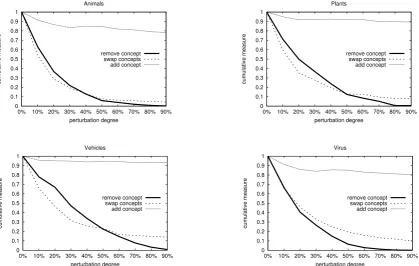
In (Zavitsanos et al., 2011) and (Brank et al., 2006) the eval-uation methodology is assessed in a controlled experimen-tal setting, by using a set of damage operators on a reference gold standard taxonomy. In this Section we apply the same assessment technique on the four taxonomies of Figure 3 and on the GENIA ontology6. We apply the same damage
operators introduced in (Zavitsanos et al., 2011), namely: swap concept, remove concept, add concept, add relation. We did not include the operatorchange concept representa-tionbecause it only applies to their methodology, summa-rized in Section 4..
For each damage type, we apply a growing perturbation de-gree, from 10% to 100%, to monitor the system behaviour under realistic conditions, since rarely in the literature does the overlapping factor between a learned and a reference taxonomy exceed 50%. To compare with (Zavitsanos et al., 2011), for the GENIA ontology we also applied a differ-ent strategy with only 10 perturbations. For each perturba-tion, we ran 50 different tests, thus performing 500 tests per damage type as was done in (Zavitsanos et al., 2011). When comparing the two measures, see Figures 5 (a) and (b), it is interesting to observe that only the “add relation” perturbation produces more or less the same effect. Vicev-ersa, the comparison shows that the F&M evaluation model is less penalizing for ”add concept” and ”swap concept”,
6
Figure 2: The taxonomy learning workflow.
0 0.1 0.2 0.3 0.4 0.5 0.6 0.7
0 1 2 3 4 5 6 7 8 9 10 11 12
generalized F and M measure
cut levels Animals
K and H TREE DAG[1,3] DAG[0,99]
0 0.1 0.2 0.3 0.4 0.5 0.6 0.7 0.8 0.9
0 1 2 3 4 5 6 7 8 9 10
generalized F and M measure
cut levels Plants
K and H TREE DAG[1,3] DAG[0,99]
0 0.1 0.2 0.3 0.4 0.5 0.6 0.7
0 1 2 3 4 5 6
generalized F and M measure
cut levels Vehicles
K and H TREE DAG[1,3] DAG[0,99]
0 0.1 0.2 0.3 0.4 0.5 0.6 0.7 0.8
0 1 2 3 4 5
generalized F and M measure
cut levels Viruses
TREE DAG[1,3] DAG[0,99]
Figure 3: Gold standard evaluation of our three versions of OntoLearn Reloaded against WordNet (Animals, Plants and Vehicles) and MeSH (Viruses). A comparison with K&H is also shown for the first three domains.
and more so for ”remove concept”. This is a desired ef-fect, because discovering new concepts does not necessar-ily mean producing an error (remember, e.g., the short-tailed monkeyexample), while removing concepts certainly implies a loss of information. Finally the global damage of a swap is reduced in our F&M model, since the hierarchical clustering methodology eventually cancels the error (soon or later the swapped concepts rejoin).
4.
Related Work
same set of instances.
To summarize, our modified F&M measure has several ad-vantages over previous approaches, since:
i) it allows comparison at different levels of depth of the hierarchy, penalizing errors at the highest cuts of the hierarchy;
ii) it does not require that the two hierarchies have the same depth, nor that they have the same number of leaf nodes;
iii) the measure can be extended to lattices, e.g. it is not required that each object belongs precisely to one clus-ter;
iv) it penalizes the introduction of new concepts (which cannot be a-priori considered as errors) to a lesser de-gree and assigns a graded penalty to concept swaps, depending on their hierarchical distance in the learned taxonomy.
5.
Conclusions
In this paper we proposed a methodology for evaluating a taxonomy learned entirely from scratch against an exist-ing gold standard. The method has some advantages over existing approaches, such as (Zavitsanos et al., 2011) and (Brank et al., 2006). Our methodology was assessed both through the evaluation of four automatically learned tax-onomies and through artificial perturbation experiments.
Acknowledgments
Roberto Navigli and Stefano Faralli grate-fully acknowledge the support of the ERC Starting Grant MultiJEDI No. 259234.
6.
References
J. Brank, D. Mladenic, and M. Grobelnik. 2006. Gold stan-dard based ontology evaluation using instance assign-ment. InProc. Fourth Workshop Evaluating Ontologies for Web EON 2006.
C. Fellbaum, editor. 1998. WordNet: An Electronic Database. MIT Press, Cambridge, MA.
E.B. Fowlkes and C.L. Mallows. 1983. A method for com-paring two hierarchical clusterings. In Journal of the American Statistical Association, volume 78, pages 553– 569.
N. Guarino and C. Welty. 2002. Evaluating ontological de-cisions with ontoclean. InCommunications of the ACM, volume 45, pages 61–65.
M.A. Hearst. 1992. Automatic acquisition of hyponyms from large text corpora. InProc. of COLING, pages 539– 545.
Z. Kozareva and E. Hovy. 2010. A semi-supervised method to learn and construct taxonomies using the web. In Proceedings of Empirical Methods in Natural Lan-guage Processing (EMNLP), pages 1110–1118, Cam-bridge, MA, October.
A. Maedche, V. Pekar, and S. Staab. 2002. Ontology learn-ing part one: On discoverlearn-ing taxonomic relations from the web. InProceedings of Web Intelligence, pages 301– 322.
L. C. Morey and A. Agresti. 1981. An adjustment to the rand statistic for chance agreement. InThe Classification Society Bulletin, volume 5, pages 9–10.
R. Navigli and P. Velardi. 2010. Learning Word-Class Lat-tices for definition and hypernym extraction. In Proceed-ings of ACL, pages 1318–1327, Uppsala, Sweden. R. Navigli, P. Velardi, and S. Faralli. 2011. A
graph-based algorithm for inducing lexical taxonomies from scratch. InProceedings of the22ndInternational Joint Conference on Artificial Intelligence, pages 1872–1877, Barcelona, Spain.
W. M. Rand. 1971. Objective criteria for the evaluation of clustering methods. InJournal of the American Statisti-cal Association, pages 66(336):846–850.
R. Snow, D. Jurafsky, and A. Ng. 2006. Semantic taxon-omy induction from heterogeneous evidence. InProc. of COLING-ACL, pages 801–808.
P. Velardi, S. Faralli, and R. Navigli. 2012. Ontolearn Reloaded: A graph-based algorithm for taxonomy induc-tion. Submitted to Computational Linguistics.
J. Volker, J. Vrandecic, J. Sure, and A. Hotho. 2010. Aeon - an approach to the automatic evaluation of ontologies. InJournal of Applied Ontology, volume 3, pages 41–62. S. Wagner and D. Wagner. 2007. Comparing clusterings
-an overview. Analysis, 4769:1–19.
H. Yang and J. Callan. 2009. A metric-based framework for automatic taxonomy induction. In Proceedings of ACL, pages 271–279, Stroudsburg, USA.
E. Zavitsanos, G. Paliouras, and G. A. Vouros. 2011. Gold standard evaluation of ontology learning meth-ods through ontology transformation and alignment. In