Evaluating Multi-focus Natural Language Queries over Data Services
Silvia Quarteroni, Vincenzo Guerrisi, Pietro La Torre
DEI - Politecnico di Milano via Ponzio, 34/5 - 20133 Milan, Italy
[email protected], [email protected], [email protected]
Abstract
Natural language interfaces to data services will be a key technology to guarantee access to huge data repositories in an effortless way. This involves solving the complex problem of recognizing a relevant service or service composition given an ambiguous, potentially ungrammatical natural language question. As a first step toward this goal, we study methods for identifying the salient terms (or foci) in natural language questions, classifying the latter according to a taxonomy of services and extracting additional relevant information in order to route them to suitable data services. While current approaches deal with single-focus (and therefore single-domain) questions, we investigate multi-focus questions in the aim of supporting conjunctive queries over the data services they refer to. Since such complex queries have seldom been studied in the literature, we have collected an ad-hoc dataset, SeCo-600, containing 600 multi-domain queries annotated with a number of linguistic and pragmatic features. Our experiments with the dataset have allowed us to reach very high accuracy in different phases of query analysis, especially when adopting machine learning methods.
Keywords:Question Answering, Web Data Services, Machine Learning
1.
Introduction
Web data providers have recently made a wealth of infor-mation available, be it via APIs as in Google Fusion Tables1 or via search-specific languages such as the Yahoo Query Language2. Data sources are usually wrapped asdata
ser-vicesspecified by input and output parameters, supporting complex Web queries.
While it is generally possible for experts only to write log-ical queries or set up query interfaces to data services, it is widely believed that natural language (NL) interfaces will be key to guarantee effortless access to huge data reposito-ries to a large community of non-expert users (Kaufmann and Bernstein, 2007). However, supporting a NL interface involves resolving the ambiguity of free-text queries and performing an accurate mapping from the lexical level of the question to the semantic level needed to compose a log-ical query, i.e. a statement describing relevant data services and their join criteria, constraints and selection conditions. We refer to this process asquery analysis.
In Section 2. of this paper, we discuss related work on the NL query analysis problem leading to the creation of logi-cal queries, a vital process in the Search Computing project (SeCo) that aims at on-the-fly composition of data services via a variety of application types (Braga et al., 2011). Since it is a requirement in SeCo to support conjunctive queries over data services but related work is centered on single-domain questions, Section 3. introduces the multi-focus, multi-domain NL question corpus that we have collected for the purpose of our studies. The corpus, named SeCo-600, has served as an evaluation dataset for a number of query analysis approaches, described in Section 4. evalu-ated in Section 5.
2.
Related Work
In the Semantic Web area, natural language (NL) inter-faces to ontologies have been proposed in a number of
1
code.google.com/apis/fusiontables 2developer.yahoo.com/yql
studies as an alternative to keyword-based interfaces or interfaces based on query languages (Damljanovic et al., 2010b; Kaufmann and Bernstein, 2007). Generally speak-ing, methods in this field attempt to perform an exact map-ping of the NL query into a logical formula in order to ac-cess knowledge, structured in e.g. RDF triples. Typical approaches in this direction involve a combination of sta-tistical techniques (syntactic parsing) and semantic opera-tions to identify ontology concepts in the user’s input. For instance, QUERIX (Kaufmann et al., 2006) combines the Stanford probabilistic parser (Klein and Manning, 2003) with the WordNet3 lexical database to obtain RDF triples from natural language user queries. Similarly, in (Daml-janovic et al., 2010a), the question is parsed, then the most relevant data service based on terminological similarity as found in a reference ontology; PANTO (Wang et al., 2007) translates the parse tree of a natural language query into SPARQL by exploiting a reference lexicon.
With respect to the above approaches, we aim at solving a different problem: not only we expect search engine-style, potentially ungrammatical interaction, but we also deal with a variety of heterogeneous data sources for which there isa priorino reference ontology. For these reasons, we cannot assume to have fully parsable queries or a con-sistent, stable domain lexicon.
A widely adopted method for the analysis of NL queries over ontologies isfocus extraction, i.e. the identification of the question’s salient term in the purpose of matching it to a relevant ontology concept. For instance, the method in (Damljanovic et al., 2010a), based on deep syntactic pars-ing, identifies the focus based on pre-preterminal nodes4 in the query’s parse tree: in particular, it returns the first pre-preterminal node tagged as a noun or noun phrase. Fol-lowing this approach, the question “Where are cheap
ac-3wordnet.princeton.edu
4A node is a pre-preterminal if all its children are preterminals,
commodation and a Japanese restaurant near Covent Gar-den?” syntactically parsed as in Figure 1, would be given focus cheap accommodation. The approach in (Li, 2010) exploits the chunked textual annotation obtained via a shal-low parser, so that the rightmost noun phrase chunk before any prepositional phrase or adjective clause is marked as the syntactic focus. Following this rule, the above ques-tion, chunked as in Figure 2., would therefore have focusa Japanese restaurant.
It may be noted that both methods are designed for single-focus queries, making them unfit to locate the two foci in the example (cheap accommodationanda Japanese restau-rant). The fact that they are rule-based and dependent on the deep annotation of text structure makes them struggle in capturing the semantics of queries with multiple foci, a task that however is the fundamental pre-requisite in SeCo as the identification of relevant data services depends on a correct identification of NL query foci.
Indeed, when it comes to identifying a relevant data service given question terms, we can take advantage of a large body of literature in the Question Answering field that has ef-fectively applied machine learning approaches joined with lexical and shallow syntactic features toquestion classifi-cation(Li and Roth, 2002). We pursue a similar direction in Section 4.3., as our classification problem is analogous; however, in this case we need to account for questions char-acterized by multiple foci, i.e. to deal with the problem of splitting questions based on the span of their foci and then matching each sub-question to a data service class. This
question segmentationproblem is similar to the automatic segmentation of a spoken conversational turn into dialog act spans, for which we have observed effective results us-ing machine learnus-ing solutions (Quarteroni et al., 2011). Finally, the step of identifying relevant additional attributes of the query in order to route it to the most appropriate ser-vice is an information extraction problem for which differ-ent methods exist; generally speaking, such methods draw from both open-domain models for the identification of in-stances of generic entities (e.g. Named Entity recogniz-ers) to handwritten (e.g. rule-based) methods for domain-specific extraction. We illustrate a number of these ap-proaches in Section 4.4.
3.
The SeCo-600 corpus
The SeCo-600 corpus7contains 600 spontaneous
multido-mainuser queries collected to fit scenarios relevant to the SeCo project, such as finding accommodation and restau-rants in a tourist area or interesting events taking place nearby. Such queries were collected in order to evaluate the four phases of NL query analysis in SeCo:
1. focus extraction, i.e. the identification of a question’s salient noun(s) or noun phrase(s);
2. question segmentationaccording to its foci, leading to its subquestions;
3. (sub)question classification, i.e. the categorization of each (sub)question according to a chosen taxonomy;
7
Available at:http://search-computing.it/
4. intent modifier extraction, i.e. the interpretation of rel-evant (sub)question terms to provide the constraints leading to a full-fledged logical query.
For instance, in the question “Where can I find cheap ac-commodation in London?”, the focus ischeap accommoda-tion, that can be further reduced to its headaccommodation
using e.g. the rules in (Collins, 1999). Question class de-pends on a chosen taxonomy; in SeCo this coincides with the 7 following data service classes:Cinema, Movie, Hotel, Restaurant, Event, Point of Interest (POI)andOther (see Table 4 for relative frequencies). In the current example, the correct class label would beHotel. Finally,cheapand
in London are values ofintent modifiers, i.e. constraints to be included in the logical query. Intent modifiers may be modeled as attributes of entities in a given domain rep-resentation, e.g. Location.countryandRestaurant.namein a restaurant reservation domain. In SeCo, we have repre-sented 14 different intent modifier types, characterized by a large coverage of SeCo scenarios: these appear in 1229 instances throughout the corpus.
SeCo-600 queries are delivered in both a textual version and an annotated version, as described below.
3.1. Textual version
The textual version of the corpus reports one question per line without any filter or normalization. Due to its spontaneous nature, the corpus offers a variety of syn-tax forms, ranging from keyword-style queries (“nice ho-tel paris cheap events of design”, “movies with sean con-nery shown in Medusa cinemas”) to full-fledged natural language containing anaphora (“where could i find a well-ness center in palermo and a mcdonald close toit?”).
3.2. Annotated version
In the annotated version of the corpus, question representa-tions are separated by empty lines. First, quesrepresenta-tions have been automatically annotated with linguistic features de-rived using state-of-the-art resources. As questions have been manually split into sub-queries and each sub-query has been manually tagged according to its syntactic focus and to the 7 SeCo service classes. Additional information regarding each question’s intent modifier has been added. As a result, each questionq is represented in column for-mat, where each row corresponds to a question word wi
and columns report the following annotation:
WORD wias it appears in the textual query file
POS wi’s Part-of-Speech tag, obtained via the OpenNLP chunker8
CHUNK label of the syntactic chunk wi belongs to,
ob-tained via the OpenNLP chunker (in IOB notation)
CLASS class of the subquestion where wi is located (in IOB notation)
FOCUS whetherwiis within or outside the syntactic head of a question focus (in IOB notation)
Table 1: Sample question from the SeCo-600 corpus: “single or double room in Rouen and nearest cinema”
WORD POS CHUNK CLASS FOCUS INTENT MODIFIER
single JJ B-NP B-hotel O O
or CC I-NP I-hotel O O
double JJ I-NP I-hotel O O
room NN I-NP I-hotel B-FOCUS O
in IN B-PP I-hotel O O
Rouen NNP B-NP I-hotel O B-IM LocCity
and CC I-NP B-cinema O O
nearest JJS I-NP I-cinema O O
cinema NN I-NP I-cinema B-FOCUS O
whetherwis situated at the beginning of a new segment or not. An evident criterion to make this distinction appears to be the word neighborhood: for instance, the absence of a previous word is a useful indicator for the beginning of a segment. POS tags are also potentially useful features, as e.g. a conjunction (CC tag) is a strong indicator of the presence of a new sub-query.
To leverage the above criteria, we adopt the same features devised for focus extraction (see Section 4.1.) – i.e. word and POS unigrams and bigrams – to build a binary CRF classifier for sub-question identification. Our results are re-ported in Section 5.2.
4.3. Subquestion Classification
Starting from a multi-domain question and given a taxon-omy of available services as labels (e.g. Cinema, Hotel), the goal of question classification is to map each subquery
qiof a questionqto its most likely labelci.
The (sub)question classification problem is different from the problem of labeling a question word was “focus” or “subquestion starter” in various respects: we are dealing with a multi-classification problem, the boundaries of qi
are known from previous steps (this task relies heavily on an accurate segmentation of q), and finally long-distance relationships between words are potentially useful. We therefore conduct the classification task using a differ-ent discriminative approach, i.e. the learning of Support Vector Machine classifiers (SVMs), based on the set of pre-viously split questions. A binary classifier is built for each question class, and results are combined according to a one-vs-all regime in order to assign the strongest label ci to each subqueryqi. Due to the limited amount of sub-queries (about 700) in comparison with the number of labels (7) and the consequent data sparsity issue, we only study two types of features:
1. the bag-of-words (BOW) feature, consisting of all the words inqistemmed following (Porter, 1980) for spar-sity reduction;
2. the FOCUS feature, representingqi’s focus head.
These features are combined by summing linear kernel functions in SVM-light (Joachims, 1999): our results are reported in Section 5.3.
4.4. Intent Modifier Extraction
The final step in understanding the user question is the iden-tification of relevant terms expressing constraints for the logical query – intent modifiers. Such terms include lo-cations, dates, proper nouns and (optionally) other domain-specific attributes; recognizing instances of these will result in the choice of a specific data service over another belong-ing to the same data service class. For instance, identifybelong-ing a location instance in a question classified asCinemamight result in choosing to route the query to a service returning cinemas based on their location rather than one returning cinemas based on movie titles.
SeCo scenarios cover heterogenous domains and applica-tions encompassing a wide variety of entity types; we fo-cused on the effective recognition of the generic types of entities using domain-independent approaches. We here il-lustrate our location extraction models as a representative case of intent modifier extraction: locations are not only among the most widespread named entities (the SeCo-600 corpus contains about 250 distinct cities and 75 countries), but also the most challenging as they often require disam-biguation, e.g. as distinguishing between New York in-tended as a city or as a state.
An obvious choice for location recognition is to use sta-tistical NER systems, such as LingPipe10: however, these identify entities at a coarse-grained level, e.g. referring to cities, countries or states with the more general notion of “Location”. Therefore, additional methods may be needed to conduct the classification at a finer level as a subsequent step of the identification.
Furthermore, we consider methods based on lexicon lookup. We built two gazetteers based on instances ex-tracted from GeoNames11for both cities and countries, ad-dressing the identification of these entities by looking for exact or approximate matching (for the latter case, we con-sider an edit distance-based similarity exceeding 0.75 as a match).
The disambiguation issue is addressed by the use of wik-ifiers, i.e. tools that annotate phrases in text in terms of relevant Wikipedia page by disambiguating amongst alter-natives based on the distribution of hyperlinks to Wikipedia
10
pages12. Our choice fell on TagMe (Ferragina and Scaiella, 2010), due to its robustness to short and badly structured text (such as SeCo queries). We connected annotations output by TagMe (e.g.http://en.wikipedia.org/ wiki/Lodi,_Italy) to entities in the YAGO reference knowledge base (Suchanek et al., 2007), most of which re-fer to Wikipedia via thehasWikipediaURLproperty. This allowed us e.g. to identify entities of typeyagoGeoEntity
as locations.
5.
Experimenting with the SeCo Corpus
We now illustrate our experiments on focus extraction, question segmentation and question classification using the SeCo-600 corpus. We evaluate the accuracy of each task in terms of F1 measure, a standard information retrieval met-ric combining precision (P) and recall (R):F1 = 2((PP+∗RR)).
5.1. Focus Extraction
We have reimplemented the (Damljanovic et al., 2010a) and (Li, 2010) to serve as a baseline for evaluating focus extrac-tion on the SeCo-600 corpus. As reported in Table 2, both methods, designed for single-focus queries, yield an F1 be-low 65%.
Table 2: Focus extraction results on the SeCo-600 dataset
Method Accuracy (F1)
(Damljanovic et al., 2010a) 57.0%
(Li, 2010) 63.1%
CRF W[0,0] 85.3%±3.0%
CRFW[-2,2]+POS[-2,2] 94.0%±1.5%
Further to rule-based methods, we experimented with Con-ditional Random Fields combining different combinations of the features described in Section 4.1. using the CRF++ implementation (Kudo, 2005). We evaluate classification performance via ten-fold cross-validation to ensure the con-sistency of our results and report the F1 measure of each classifier in Table 2. On the SeCo-600 corpus, the bag-of-words (BOW) model, using only the current question word as the only feature feature, reaches a very high value of 85.3% compared to the best-performing rule-based model (Li, 2010), achieving 63.1%. Further feature combinations, joining the contribution of word and POS in the [-2,2] word range, yield a very satisfying 94% average accuracy, con-firming the effectiveness of the CRF approach.
5.2. Question Segmentation
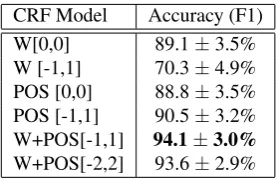
Table 3 reports the performance of the question segmen-tation algorithm on the SeCo-600 corpus (containing 888 question segments) using different feature combinations. These highlight a similar situation to the one observed for focus extraction, with the BOW model (W[0,0]) starting at 89.1% and increasing to 94.1% for the best found feature combination, joining the word and POS feature in a neigh-borhood spanning from the previous to the following word [-1,1].
12en.wikipedia.org
Table 3: Question segmentation results: F1-measure of dif-ferent CRF models on the SeCo corpus
CRF Model Accuracy (F1) W[0,0] 89.1±3.5% W [-1,1] 70.3±4.9% POS [0,0] 88.8±3.5% POS [-1,1] 90.5±3.2% W+POS[-1,1] 94.1±3.0% W+POS[-2,2] 93.6±2.9%
5.3. Question Classification
We conducted the question classification task by learning binary classifiers for each class, so that the final class to be assigned to a specific subquery is chosen according to a one-vs-all regime. We adopted the SVM-light implemen-tation (Joachims, 1999) to learn different combinations of linear kernel functions based on the set of manually split questions in the SeCo-600 corpus. Our results, reported in Table 4, were obtained in a 10-fold cross validation regime to ensure robustness. As a general comment, overall results are very encouraging as, despite the small training dataset, classification accuracy reaches 86.1% with the BOW model and 92.7% with the BOW + FOCUS model.
A more detailed analysis suggests that the contribution of BOW combined with FOCUS leads to better results than BOW in most classes, and especially for Cinema. Class
Otherdenotes a low accuracy: indeed, it is chosen when-ever questions are too heterogeneous to be mapped to the remaining classes. Also, as the word “place” is strongly represented in the POIclass, expressions such as “places where to eat” are erroneously classified asPOIinstead of their actual classFood; indeed,POIreaches the lowest ac-curacy as the FOCUS feature is less helpful in this circum-stance and questions are strongly affected by lexical ambi-guity. Finally, we note that when a query for a specific en-tity type contains constraints involving other services (e.g. a cinema in proximity of a hotel), constraint terminology may lead to a wrong prediction.
Table 4: Question Classification accuracy on SeCo-600
Accuracy (F1)
Class Frequency BOW BOW+FOCUS
Hotel 22.8% 89.8±8.6 90.2±8.1
Food 19.4% 96.2±4.2 96.7±3.7
Other 15.0% 89.9±7.6 92.0±6.6
POI 11.3% 82.2±10.7 80.7±11.9
Event 10.6% 95.8±6.5 96.1±6.0
Cinema 12.6% 84.5±12.6 97.3±4.2
Movie 8.3% 86.1±15.3 95.1±7.7
Table 5: Intent Modifier extraction on the SeCo-600 corpus:Locationentity
Method Precision Recall F1
lexicon lookup (edit distance threshold = 0.75) 79.0% 54.7% 64.7%
statistical NER (Lingpipe) 71.0% 60.2% 65.2% TagMe + YAGO validation 74.4% 65.0% 69.4%
5.4. Intent Modifier Extraction
Intent modifier extraction results for instances ofLocation
are reported in Table 5. We note that while approaches based on general-purpose statistical NER systems such as LingPipe result in an F1 around 65% and the GeoNames-based approach has similar error rates, the TagMe approach described in Section 4.4. yields slightly higher results lead-ing to the best score of 69.4%13: this may be reconnected to the higher recall offered by a robust method referring to Wikipedia as a source of relevant entities.
6.
Conclusions
In this paper, we have addressed the requirements of nat-ural language interfaces to data services, highlighting the need to extract information from queries dealing with mul-tiple foci and domains. In particular, we concentrate on the four subsequent steps of focus extraction, question segmen-tation into sub-queries, sub-query classification and infor-mation extraction from subqueries, these lead to identifying relevant data services given a natural language question. Since related work highlights the shortcomings of rule-based approaches and deep syntactic analysis for the inter-pretation of multi-domain queries, we propose a variety of robust models based on Conditional Random Fields, Sup-port Vector Machines and shallow linguistic annotations to approach the above problems. The need to experiment with such data led us to the production of a corpus of 600 multi-focus, multi-domain annotated queries, the SeCo corpus, over which we have successfully evaluated our approaches to the above-mentioned tasks. In future work, we will con-tinue our research on natural language query processing over data services by performing an end-to-end evaluation of query analysis in the SeCo project.
Acknowledgments
This work has been partly funded by the Search Computing project (European Commission IDEAS grant no. 227793).
7.
References
D. Braga, M. Grossniklaus, F. Corcoglioniti, and S. Vadacca, 2011.Efficient Computation of Search Com-puting Queries, volume 6585 ofLNCS, pages 141–155. Springer.
M. Collins. 1999.Head-driven statistical models for natu-ral language parsing. Ph.D. thesis, University of Penn-sylvania.
13
the rho parameter was empirically set to 0.1
D. Damljanovic, M. Agatonovic, and H. Cunningham. 2010a. Identification of the question focus: Combining syntactic analysis and ontology-based lookup through the user interaction. InProceedings of LREC.
D. Damljanovic, M. Agatonovic, and H. Cunningham. 2010b. Natural language interfaces to ontologies: Com-bining syntactic analysis and ontology-based lookup through the user interaction. In Proceedings of ESWC, pages 106–120.
Paolo Ferragina and Ugo Scaiella. 2010. Tagme: on-the-fly annotation of short text fragments (by wikipedia en-tities). In Proceedings of CIKM’10, pages 1625–1628, New York, NY, USA. ACM.
T. Joachims. 1999. Making large scale SVM learning prac-tical.
E. Kaufmann and A. Bernstein. 2007. How useful are nat-ural language interfaces to the semantic web for casual end-users? InThe Semantic Web, volume 4825 ofLNCS, pages 281–294. Springer.
E. Kaufmann, A. Bernstein, and R. Zumstein. 2006. Querix: A natural language interface to query ontologies based on clarification dialogs. InProceedings of ISWC, pages 980–981. Citeseer.
D. Klein and C.D. Manning. 2003. Accurate unlexicalized parsing. InProceedings of ACL, pages 423–430. ACL. Taku Kudo. 2005. CRF++: Yet another CRF toolkit. J. Lafferty. 2001. Conditional random fields: Probabilistic
models for segmenting and labeling sequence data. In
Proceedings of ICML, 2001.
X. Li and D. Roth. 2002. Learning question classifiers. In
Proceedings of ACL.
X. Li. 2010. Understanding the semantic structure of noun phrase queries. In Proceedings of ACL, pages 1337– 1345.
M.F. Porter. 1980. An algorithm for suffix stripping.
Program: electronic library and information systems, 14(3):130–137.
S. Quarteroni, A. V. Ivanov, and G. Riccardi. 2011. Simul-taneous dialog act segmentation and classification from human-human spoken conversations. InICASSP, pages 5596–5599.
Fabian M. Suchanek, Gjergji Kasneci, and Gerhard Weikum. 2007. YAGO: a core of semantic knowledge unifying WordNet and Wikipedia. In Proceedings of WWW ’07, pages 697–706.