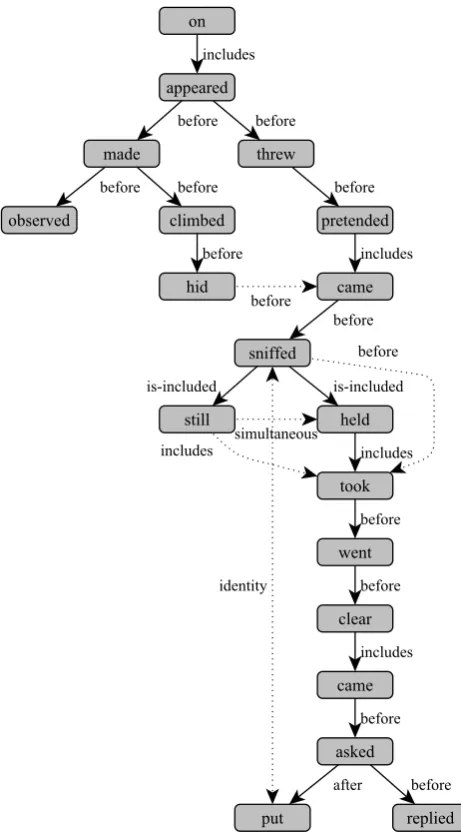
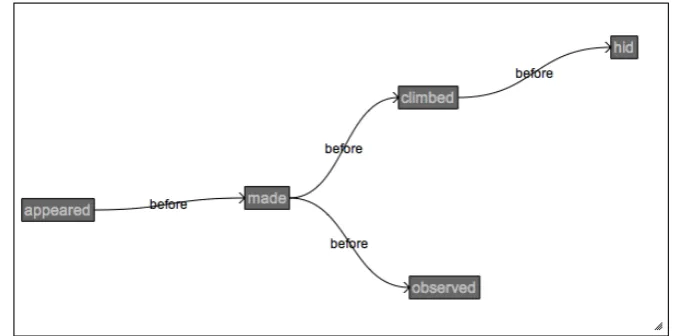
Figure 1: Event timeline for the story of the Travellers and the Bear. Nodes are events and edges are temporal relations. Solid edges are temporal relations signaled by linguistic cues in the text (annotators are expected to identify these). Dashed edges denote other temporal relations, including those that require deeper world knowledge (annotators are not expected to annotate these). Temporal relations that can be inferred via transitivity are not shown (or annotated).
are the events from the story, and the edges are the temporal relations between those events. Note that the solid edges – the edges most motivated by linguistic cues in the story, and the only edges we expect annotators to identify – form a tree structure, withon (the road)as the root node.
3.
Which events should be annotated?
To annotate story timelines as these temporal dependency structures, we must provide guidelines for annotating both the nodes (events) and the edges (temporal relations). For annotating events, we consider three different annotation schemes:
TimeML Annotators follow the standard TimeML guide-lines which annotate all “situations that happen or
oc-cur” that are “punctual . . . or last for a period of time” or that are “predicates describing states or circumstances in which something obtains or holds true.” TimeML events may appear as verbs, nouns, adjectives or prepo-sitional phrases. When events are phrasal, only the head is annotated, for example:
• has been[eventscrambling]
• [eventset]up
• the industry’s rapid[eventgrowth]
Both light verbs and aspectual verbs are tagged as in-dependent events, for example:
• [eventdemonstrations]have[eventtaken]place
• private sector[eventbegan] [eventestablishing]
The TimeML guidelines aim to be fairly exhaustive -identifying all words that could potentially play any role in the temporal structure of the story.
No speech or modal Annotators follow TimeML guide-lines except that they skip events in direct speech and negated, modal or hypothetical events. Events in di-rect speech often pose difficulties for novel readers and poor comprehenders, and tend to be less essential to the plot in children’s stories For example:
• “He told me never again totravelwith a friend whodesertsyou at the first sign ofdanger”
• The Fuller[eventthanked]him, but[eventreplied], “I couldn’tthinkof it, sir: why, everything Itake
such pains towhitenwould beblackenedin no time by your charcoal.”
• “That’sawkward,”[eventsaid]the Cat to herself: “the only thing to do is tocoaxthem out by atrick.”
Negated, modal and hypothetical events are often hard to place along a timeline. For example:
• . . . but he [event kept] perfectly [event still] and [eventpretended]to bedead, for theysaythat a bear will nottoucha dead body.
• Imagining the bird must bemadeof gold inside, they[eventdecided]tokillit in order tosecurethe whole store of precious metal at once.
• An Old Woman[eventmade]an[eventagreement] with him in the[eventpresence]of witnesses that she shouldpay him a high fee if hecured her, while if hefailedhe was toreceivenothing.
Essentially, this set of guidelines aims to simplify the annotation process by focusing on just the events that are most essential to constructing the timeline.
Paraphrasing Annotators follow theNo speech or modal
guidelines, and additionally, when they encounter phrasal events, select the word that best paraphrases the meaning. For example:
Figure 2: The interface for annotating events and temporal relations.
Number of annotators 2
Type of material children’s stories (Aesop’s fables) Annotator background computational linguistics
Annotator expertise expert; schema developers Annotator training several days with sample stories Annotation purpose corpus for machine learning Agreement index Krippendorff’s nominal Alpha
Table 1: Overview of the annotation and its evaluation.
them with each scheme. Table 1 gives some summary infor-mation about the annotation, following the suggestions for annotation studies in Bayerl and Paul (2011).
Krippendorff’s Alpha for nominal data (Krippendorff, 2004) was used to measure their inter-annotator agreement. For agreement on which words were events, Alpha was calcu-lated considering a binary decision for each word: is it an event or not? For agreement on which event pairs partici-pated in temporal relations, Alpha was calculated consid-ering a binary decision over each possible pairing of two events in the story: is there a relation here or not? For agree-ment on which temporal relation to assign to an event pair, Alpha was calculated considering a multi-class decision over each event pair where some relation was annotated: which temporal relations holds between these two events?
Table 2 shows the results of these evaluations for event
an-Stories Scheme Events
1-20 TimeML 0.729
1-20 No speech or modal 0.833 1-20 Paraphrasing 0.876 1-100 Paraphrasing 0.856
Table 2: Annotator agreement (Krippendorff’s Alpha) for the event annotation schemes, on which words should be identified as events.
notation. Agreement was higher using theNo speech or modalannotation scheme (0.833) than theTimeML anno-tation scheme (0.729), and highest when using the Para-phrasing annotation scheme (0.876). This suggests that restricting the sets of events to be tagged (e.g. excluding speech events, modal events and aspectual events) made it easier for annotators to agree on which words in the story represented events.
Table 3 shows the evaluation results for temporal relation an-notation. Two types of agreement were measured for tempo-ral relations: agreement on which pairs of events to link, and agreement on the temporal relation labels to assign a given pair of events. Agreement on which pairs of events to anno-tate was similar regardless of whether theBefore/Overlap
James Pustejovsky, Patrick Hanks, Roser Saur´ı, Andrew See, Robert Gaizauskas, Andrea Setzer, Dragomir Radev, Beth Sundheim, David Day, Lisa Ferro, and Marcia Lazo. 2003b. The TimeBank corpus. InCorpus Linguistics, volume 2003, page 40.
Marc Verhagen, Robert Gaizauskas, Frank Schilder, Mark Hepple, Graham Katz, and James Pustejovsky. 2007. SemEval-2007 task 15: TempEval temporal relation identification. In Proceedings of the Fourth Interna-tional Workshop on Semantic Evaluations (SemEval-2007), pages 75–80, Prague, Czech Republic, June. Asso-ciation for Computational Linguistics.