Comparison between two models of language for the automatic phonetic labeling
of an undocumented language of the South-Asia: the case of Mo Piu
Geneviève Caelen-Haumont
1, Sethserey Sam
21
MICA Institute, HUST, Hanoi, Vietnam
2
Institute of Technology of Cambodia, Pnomh Penh, Cambodia [email protected], [email protected]
Abstract
This paper aims at assessing the automatic labeling of an undocumented, unknown, unwritten and under-resourced language (Mo Piu) of the North Vietnam, by an expert phonetician. In the previous stage of the work, 7 sets of languages were chosen among Mandarin, Vietnamese, Khmer, English, French, to compete in order to select the best models of languages to be used for the phonetic labeling of Mo Piu isolated words. Two sets of languages (1° Mandarin + French, 2° Vietnamese + French) which got the best scores showed an additional distribution of their results. Our aim is now to study this distribution more precisely and more extensively, in order to statistically select the best models of languages and among them, the best sets of phonetic units which minimize the wrong phonetic automatic labeling.
Keywords
Phonetic labeling, assessment of automatic procedures, under-resourced languages, models of language, Hmong.
1.
Introduction
The present study belongs to the “Au Co” Project which started in 2008 in MICA Institute, which aims to help save endangered languages and cultures in Vietnam. This project is based on the collaboration of a wide variety of experts like French and Vietnamese linguists, Vietnamese specialists of minority languages, French specialists of speech in the domains of phonetics, phonology, prosody, French and Vietnamese anthropologists, specialists of minority groups in Northern Vietnam (Province of Lao Cai), and computer scientists.
First the project Au Co focused on an ethnic minority called "Mo Piu". This minority is located in the mountains of North Vietnam along the Chinese border. The Mo Piu village situated in a sort of cirque on the side of a hill, is named Nam Tu Thuong, meaning the “stream river spring up” in Tày language.
According to preliminary studies [1], the "Mo Piu” language is an endangered language because it is uncharted, undocumented, unwritten and spoken only by 237 people. Moreover, the 7 or 8 minority groups in their surrounding do not understand this language. The Mo Piu language being not documented at all, it is urgent to study it before the fusion with the dominant culture, the Vietnamese one.
Our purpose is then to carry on studying linguistic analysis and develop tools to save the Mo Piu culture and language, in the framework of two international CNRS-ANR-Blanc Projects “PI Language” and “AppSy”. In fact the study of the Mo Piu language is twofold: one devoted to the traditional linguistic investigation in speech (phonetic, tonal, lexical domains…), and the other one, to the automatic process of phonetic labeling of an under-resourced language (in this present case, it was unknown
before we started studying it). This paper is concerned with a human assessment of the automatic procedures.
2.
Automatic labeling for the Mo Piu
unknown language
Concerning the endangered languages, the lack of human language technologies (HLT) systems for these languages accelerates their extinction while on the other hand HLT could help to stop this trend by giving various resources to this people in order to facilitate the access to their language in the next decades and also from now on, to the linguistic analysis.
As no (or only limited) resources are available for such under-resourced languages, we are particularly interested in new techniques and tools for rapid development of spoken language technologies for this kind of languages. One way to document an unstudied language, especially if it is a language without writing, is to use computer tools to transcribe the speech segments in sequence of phonemes or words. As for such languages, no acoustic model, nor language model nor lexical model do exist, we propose for this task to use acoustic models of other languages. In a previous work [2] concerning the speech transcription of a new language for which neither adaptation nor learning of acoustic model was done, the acoustic-phonetic multilingual systems were given preference for this task over the monolingual system.
2.1. Multilingual acoustic-phonetic recognizers
On the whole, the first results (merging the right and close labels) are better for consonants identification than for vowels ones: vowel identification spreads from 11 to 37%, while the consonant one, from around 10 to 44%. The nasal consonants supply the best recognition (from 30 to 44%).
Concerning the sets of languages, the results of the assessment for the vowels, are ranking in such an order: VN-FR (46%) > MA-FR (44%) > VN-MA-KH-FR (42%) > VN-MA-KH-EN-FR = VN-MA (36%) > VN-MA-KH (33%).
Concerning the consonants, the scores are greater than for the vowels: MA-FR (58%) > VN-MA-KH-FR (54%) > VN-MA-KH-EN-FR = VN-MA-KH (51%) > VN-MA (48%) > VN-FR (44%). Surprisingly, VN-FR appeared as the best for vowels and the worst for consonant language assessments.
On the whole, for all the vowels and consonants included in our corpus, the final order is thus: MA-FR (51%) > FR (48%) > VN-FR (45%) > VN-MA-KH-EN-FR (43%) > VN-MA (41%) > VN-MA-KH (40 %).
3.2.Second experiment
The goal of the second experiment is to enlarge the set of data in order to thoroughly analyze the results concerning the best models of language found as such in the first experiment. According to the previous study, the best
models are French + Mandarin (FR-MA), and French + Vietnamese (FR-VN). In this paper we focus on the phonetic level, and we do not taking into account the question of the place of the boundary.
3.2.1. Choice of the new Mo Piu corpus
As we check fewer models of language than for the first experiment, we use a greater corpus. So for this new experiment, we chose 2 speakers, a woman (VTD01) and a man (VAP01). As previously the list of words is extracted from the Calmsea list, and concerns the body parts.
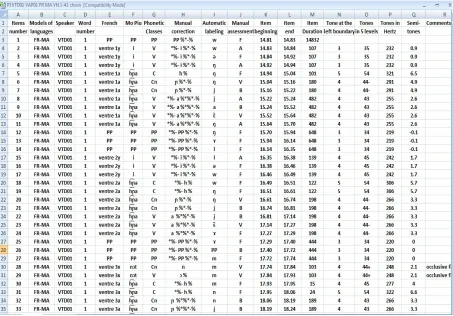
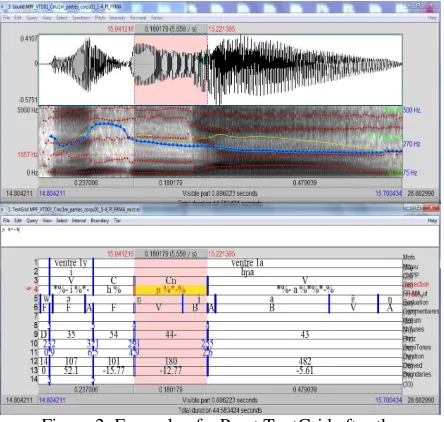
For the second experiment, the number of the words is now: 2 speakers x 44 words x 3 repetitions x 2 models of language = 528 words. In fact these 44 words are French ones, but in the Mo Piu language they generally result in several ones (classifier, determinant, simple or complex content words). These Mo Piu words are generating 6813 phonetic events (consonants, vowels, pauses). From these 6813 items, 5034 have been extracted, split up into 2777 consonants and 2257 vowels, which have been extracted and manually assessed. Putting apart the other symbols previously written on the other Praat TextGrid tiers, a total of 70 983 signs (symbols or letters) on the whole have been manually written on the different tiers in order to achieve this present assessment.
around of 4% in all the conditions, the difference (25/33%) concerning the wrong results (F/W) between the two models of language is mainly explained by the better scores for the right labeling (B/R, 20/16%) and the acoustic one (A, 22/18%), whereas the close one (C, 29/28%) is nearly the same in both cases.
Figure 3: Comparison between the two models of language FR-MA (2548 phonetic items)
and FR-VN (2486 items)
The next point to check is concerning the results between consonants and vowels according to the two models of languages. The question is thus: are these previous results for these two models of language remaining stable for consonants and vowels?
3.2.3.2. Consonant assessment
Concerning the 2777 consonant items checked, split up between 1369 for FR-MA and 1408 for FR-VN, the Figure 4 below shows that the results globally present the same trend than that of the global perspective (Figure 3 above).
Figure 4: Comparison of the two models of language (2777 consonantic items)
Nevertheless the difference between FR-MA and FR-VN is strengthened: the distance between the wrong results is increasing (F/W, 29/41%) while all the other FR-MA labels are benefiting from this difference (B/R 25/17%, V/C 22/19%, A 20/18%).
3.2.3.3. Vowel assessment
For this evaluation, 1179 vocalic items were labeled for FR-MA and 1078 for FR-VN, so on the whole, 2257 items were assessed (Figure 5 below).
Figure 5: Comparison of the two models of language (2257 vocalic items)
The Figure 5 presents a trend which is a little bit less in favour to FR-MA than previously. Whereas on the one hand the wrong results are indeed stable (respectively FR-MA, FR/VN, F/W, 21/22%), the right ones also (respectively FR-MA, FR/VN, B/R 14/15%), and the acoustic labels turn to be better for FR-MA (A, 24/19%), conversely on the other hand the close phonetic targets are benefiting to FR-VN (V/C, 36/40%). So nothing can be clearly establish for the model FR-VN, as neither the right results nor the wrong ones definitively settle the question.
3.2.3.4. The assessment of the phonetic cores
The first point concerns the global distribution of the percentages. The wrong results (consonantic shares respectively FR-MA, FR-VN 29/41%; vocalic ones, respectively FR-MA, FR-VN 21/22%) are no so great though the automatic procedure is labeling an unknown language with resources borrowed from another languages (French, Mandarin, Vietnamese). But conversely the right results are still less great (consonantic shares respectively MA, VN 25/17%; vocalic ones, respectively FR-MA, FR-VN 14/15%).
Until now the study was concerning the consonantic and vocalic items, whatever they could be, whole phonetic items or part(s) of them. We now focus on the phonetic items cores. As explained above, they are addressed by 3 labels, B/R, V/C, and F/W.
The figure 6 above presents the comparison between the two models of language (2133 consonants: FR-MA, 1042 items, FR-VN, 1091).
Figure 7 : Comparison of the two models of language (1680 vowels)
Concerning the consonants cores, FR-MA appears as the most efficient model of language: greater right results (respectively FR-MA, FR-VN, 33/22%), greater close results (respectively FR-MA, FR-VN, 29/25%), fewer wrong results (respectively FR-MA, FR-VN, 38/53%). The Figure 7 above shows the results concerning the vowels. This Figure presents an outstanding stability of the results between the two models of language (respectively FR-MA and FR-VN, B/R 20/20%, V/C 51/52%, F/W 29/29%).
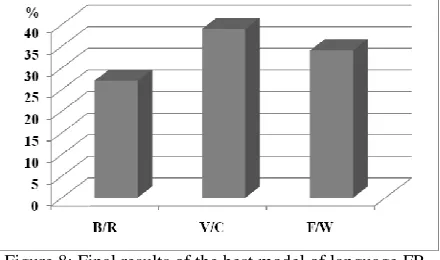
Thus the conclusion appears clearly as shown by the Figure 8 below.
Figure 8: Final results of the best model of language FR-MA for labeling the unknown Mo Piu phonetic units
(1883 consonants and vowels)
The model of language FR-MA is the more efficient for labeling the unknown Mo Piu consonants and vowels. Though the wrong labels (F/W) are reaching 34%, the close ones (V/C) perform 39%, and the right ones (B/R) 27%. Thus concerning the improvement of the automatic procedure, the main task –and perhaps at the same time the easiest one-, will consist in tipping up the number of
the close labels towards the right ones, and of course in trying to reduce the number of wrong labels.
4.
Discussion
To address the comparison between the first and the second study, some questions may be put.
On the whole are still the results better for the consonant labeling than for the vowel ones?
If we merged the right results with the close ones (B/R + V/C) as it has be done for the first study, the response is negative: FR-MA, FR/VN consonants are respectively reaching 47/36%, and vowels 50/55%. But if we consider only the right labels (B/R), the consonants results remain the better (25/17%) in comparison with the vowels ones (14/15%). In fact the close labels are much more numerous for the vowels than for the consonants.
Concerning the vowels, is the model of language FR-VN remaining first above the FR-MA?
In the second study, if we merge as above the results (B/R + V/C), FR-VN is first (55/50%) as for the previous study. If we consider only the core of the phonetic units, the results are strictly equivalent between FR-VN and FR-MA (see Figure 7).
Concerning the consonants, is the model of language FR-MA remaining first above the FR-VN?
The FR-MA remains the most efficient model of languages, whatever the conditions, ranking first for the right labels (B/R 25/17%), the close ones (V/C 22/19%), and the core results (B/R 33/22%; V/C 29/25%).
And in the whole, comparing all the results merging vowels and consonants, FR-MA is the best model of language for labeling the unknown Mo Piu phonetic items: wrong labels (F/W 34%), close ones (V/C 39%), right ones (B/R 27%).
5.
Conclusion
The second study encompassing many more data (from 11 words to 44, from one speaker to two ones), is in tune with the previous one. It supplies more precision to the assessment. Finally the model of language FR-MA is confirmed as the most efficient one for the task of the automatic labeling of an under-resourced language such as the Mo Piu one.
The French phonetic items contribute in increasing the results because in both cases of Mo Piu and French, there are surprisingly many nasal or nasalized vowels.
The next task will consist in reaching a consensus between 4 phonetician having labeled the same Mo Piu words, which will be soon achieved. This agreement will supply the first list of the Mo Piu phonemes. Then these phonemes will be included in the automatic procedure in order to improve the results.
6.
Acknowledgements
7.
References
[1] Caelen-Haumont, G., Cortial, B., Culas C., Hong T. D., Lê T. X., Salmon J.-P., Vittrant A., Vuong H. T., Song L. A. (2010). Mo Piu minority language: data base, first steps and first experiments. In Proceedings of the Second International Workshop on Spoken Languages, SLTU’10, Penang, Malaysia, pp. 42--50.
[2] Schultz, T., Kirchhoff, K. (2006). Multilingual Speech Processing, Academic Press, Elsevier.
[3] CCC resources (2005). Online, Chinese Corpus Consrtium Retrieved from http://www.dear.com/ CCC/resources.htm.
[4] Paul, D., Baker, J. (1992). The design for the Wall Street Journal-based CSR corpus. In Proceedings of the workshop on Speech and Natural Language, pp. 357--362.
[5] Lamel L., Gauvain, J., Eskenazi, M. (1991). BREF, a large vocabulary spoken corpus for French. In Proceedings of Eurospeech, pp. 24--26.
[6] Seng, S., Sam, S., Besacier, L., Bigi, B., Castelli, E. (2008). First Broadcast News Transcription System for Khmer Language, 6th edition of the Language Resources and Evaluation Conference (LREC), Marrakech, Morocco.
[7] Le, V., Tran, D., Castelli, E., Besacier, L., Serignat, J-F. (2004). Spoken and written language resources for Vietnamese. In Proceedings of LREC 2004, p. 599-602. [8] Schultz, T., Waibel, A. (2001). Language-independent and language-adaptive acoustic modeling for speech recognition, Speech Communication, 35, vol. 1, pp. 31--52.
[9] Boersma, P. (2001). Praat, a system for doing phonetics by computer, Glot international, 5, vol. 9/10, pp. 341--345.
[10] Caelen-Haumont, G., Sam, S., Castelli, E. (2011). Automatic Labeling and Phonetic Assessment of the Mo Piu Under-Resourced Asian Language: early results. In Proceedings of the International Conference on Asian Language Processing (IALP 2011), Penang, Malaysia, 160-3D.
[11] Matisoff, J. A. (1978). Variational semantics in Tibeto-burman: the 'organic' approach to linguistic comparison, Philadelphia: ISHI Publications.
[12] Swadesh, M. (1971). The origin and diversification of Language, Sherzer Joel (ed). Chicago : Adline. [13] Caelen-Haumont, G., Vittrant, A. (2012, to be
published). Transcrire, écrire et formaliser en analyse phonétique, mélodique et tonale: l’exemple d’une langue d’Asie du Sud-est tonale (mo piu) et du français. In Actes du 25e Colloque du Cercle Linguistique du Centre et de l’Ouest (CERLICO), Presses Universitaires de Rennes, France.
[14] Caelen-Haumont, G., (2012, to be published). Towards the Mo Piu Tonal System: First Results on an Undocumented South-Asian Language. In Proceedings of Speech Prosody, Shangaï, China.
[15] Caelen-Haumont, G. (2012, to be published). Towards the tonal system of an unknown language from south-east Asia: a deeper insight. In Proceedings of the Tonal Aspects of Languages, TAL 2012, Nanquing, China.
[16] Hirst, D. (2011). Online: http://uk.groups.yahoo.com
/group/praat-users/files/Daniel_Hirst/.
[17] Weber, B., Caelen-Haumont G., Pham B. H., Tran D.-D. (2012 to be published). MISTRAL+: A dedicated tool for under-resourced languages study/. In Proceedings of SLTU’12, Cape Town, South Africa. [18] Weber, B., Caelen-Haumont, G., Pham, B. H., Tra,n