DOI : https://doi.org/10.32628/CSEIT195454
An Algorithm Search Engine for Extracting Algorithm From PDF
Document
Akshata R. Sanas *, Pallavi S, Patil
Computer Science Engineering, Savitribai Phule Pune University, Pune, Maharashtra, India
ABSTRACT
Algorithms are used to developing, analysing, and applying in computer field and used for developing new application. It is used for finding solutions to any problems in different condition. It transforms the problems into algorithmic ones on which standard algorithms are applied. Day by day Scholarly Digital documents are increasing. AlgorithmSeer is a search engine used for searching algorithms. The main aim of it providing a large algorithm database. It is used to automatically encounter and take these algorithms in this big collection of documents that enable algorithm indexing, searching, discovery and analysis. An original set to identify and pull out algorithm representations in a big collection of scholarly documents is proposed, of scale able techniques used by AlgorithmSeer. Along with this, particularly important and relevant textual content can be accessed the platform and highlight portions by anyone with different levels of knowledge. In support of lectures and self-learning, the highlighted documents can be shared with others. However, different levels of learners cannot use the highlighted part of text at same understanding level. We can solve the problem of guessing new highlights of partially highlighted documents.
Keywords : Algorithms, Pseudo codes, Scholarly big data, Sentence Extractor, Steaming, TFIDF
I. INTRODUCTION
To solve problems, Algorithms are used everywhere in Computer field and over a exact technique. Algorithms have affected every single form of human life. Improvement of the current algorithms and evolution of new algorithms for unsolved problems is being made by researchers. Updating search engines are not optimized to searching any particular algorithm. In addition, they cannot be distinguished which documents contain an algorithm and which is not. They produce results in that contain a mixture and not usable data. For example, user enters a query into the search engine for searching a KNN algorithm. After processing search engine give the result that
contain KNN term but it any specific information with regarding to algorithmic aspects of KNNs.
This kind of system can be very useful to assist the indexing, finding and a vast quantity of required knowledge of the algorithm and carry out a detail study of evolution of the algorithm and may be increase the output quality of the user. The representation of algorithm is not written in specific format in that include symbols, mathematical expression, various font style etc. Therefore, it becomes a challenge to user for discovery and extraction of algorithms. To overcome this disadvantage we propose this system. In this system, we first detect PCs and APs by using different methods then we find the textual metadata that can be instantly extracted from various documents with the use of Application Program Interface and generate different types of models fitted to various levels from a group of documents that are highlighted of knowledge to forecast new output. We provide linking, indexing of the extracted Meta data and make it search able to the user and it can increase the productivity of user with the help of this system.
II. METHODSANDMATERIAL
A. Related Work
[1] Prasenjit Mitra (2016) et al have studied that to identify and extract algorithm representations from scholarly documents. A novel set of scale able techniques used by AlgorithmSeer. They use hybrid machine learning techniques for algorithm representation. These techniques to pull out meta data for each algorithm are used. The user searching some algorithm on the CiteSeerX data set, this site gives so many documents with his relevant search. On the search result all document index with his best ranking and extract all data related document. This document is in the form of synopsis, on the search keywords and the algorithm and gives out-put to user. Especially they suggested detecting algorithms in scholarly documents. For this purpose they used a group of scale able machine learning based methods. Finally they show how algorithms are indexed and made
searchable. All the extracted algorithms and their related textual meta-data are then cataloged using SOLR18, which then makes the algorithms searchable.
[2] Elena Baralis (2016) et al have studied that the concept of highlighter. They have introduced about a HIGHLIGHTER is a new technique to inevitably generating focus of learning documents. By using this concept, issue of automatically generating document highlights is resolved by them. Highlights are mark part of the textual content that can use regularly. For example, the most substantial parts of the text can be underlined, colored, or circled. The significance of highlighted points used for learning purpose. Teachers and learners can easily share the highlighted documents through e-learning platforms. Nevertheless, the manual generation of text highlights is time absorbing. So minimizing such problem, they generate classification models. These models are delivered to learners to increase the quality of their learning experience. To start the process of highlighting learning documents, they use text classification techniques. It appraises the capability level of the highlighting users to drive the generation of new highlights.
records the values of the X and Y coordinates for that point they developed a tool. They to overcome the problem of segmenting can address overlapping data points. The data and text extraction from the 2-D plots are accurate as indicated by experimental results.
[4] Bhatia et al have taken into account an algorithm search engine for software developers. To solve any problem developer first develop algorithms. Algorithms can be crucial and are very important for absolute software projects. In this system, they propose an algorithm search engine that keeps abreast of the latest algorithmic developments. Using a PDF to text converter all the files in the system are first converted to the text file. To sort out the algorithm that is filled out sequentially along with the metadata related to them. The extracted text is then examined cautiously. In the next the engine which is used for query processing then approves the appropriate query given by the user by taking into consideration the query interface and after that it task to search the index for associated similar algorithms. Then finally it shows sorted list by ranks of algorithms to the user.
[5] J.B.Baker et al have studied the methods of analysis of mathematical documents from the particular PDF. It is very challenging job of document analysis of mathematical part of PDF even if the digital document which is available in the standard format. In the context of PDF documents, they suggest the solution for this type of problems. To carry out the character recognition at the same time with the virtual link network generally used for structural analysis they found out OCR approach. To direct extraction of symbol information out from the PDF file, they used another approach with two-stage parser for pulling out layout and expression structure. In the context of mathematical expressions related to first character identification and second structural analysis, they match the efficiency and correctness of these specified to different techniques qualitatively as well as quantitatively in context of layout analysis.
[6] C.L.Giles. et al have studied that finding algorithms in scientific articles. Algorithms are very important part of computer science. To solve any problem first required algorithm. In this system to check whether there is a presence or not of algorithm they first examine documents. After that document text is examine to find out sentences which content the algorithm, if an algorithm is detected. Algorithm a like metadata which is present in document is pulled out and it is arranged I order. To calculate the connection of algorithms with query given by user, the information related with algorithm is used and with decreasing order of connection the algorithms got submitted to the users. In this system a vertical search engine which finds out the algorithm available in that document is delivered and pulled out to form a related metadata of the algorithm.
for calculating Bayes parameter. This module is used for showing different representation of given document.
[8] S.Bhatia et al focused on make summary of various items in the published scientific document such as algorithms, figures, tables . For document-elements to help in find out quickly algorithms, tables, figures, by user .The user are using this method for point out the problem of generating summary by them. To find out look alike sentences within given document text with the help of a specific group of features which subsequently uses context and content data relevant to this elements for machine-learning techniques is used by them. To finalize exact content to select in the summary relevant to the main part and original sentences from the elements of documents and uniqueness of the sentence to the original sentence they proposed a simple model. The model attempts to compare the content in the information and range of summary so that the collected information and would be output must be accurate and useful. To pull out useful data from the summary, which includes the elements of document at the same time system, uses the first set of methods. They use two different classifiers. In this first to finalize exact content to select in the summary relevant to the main part and original sentences from the elements of documents and uniqueness of the sentence to the original sentence they proposed a simple model. They study the problem of choosing the advantageous outcome synopsis size that shoots a balance between the information content and the size of the generated synopses.
[9] J.Kittler et al have studied that combining classifiers.
They focus on classifier combination. They develop structure for classifier grouping. Also, make a decision many current schemes can be taken into account where all the representations are used collectively. To
make up generally used combination schemes of classifier like sum rule, min rule, max rule, median rule, product rule f or calculating voting by majority they used different types of assumptions and various approximations. Then they equated experimentally different mixture of scheme. Interestingly outcome came out of this is very surprising. This mixture evolved with much different and restrictive assumption; from all classifier mixture schemes the sum rule is the best-performed scheme. They investigate all the mixture schemes to calculate errors in this finding. The sum rule is most flexible to estimation errors as shown by the sensitivity analysis. They follow two steps. In first step, they give theoretical ideas of given mixtures scheme for combining the suggestion of experts, giving a unique pattern representation. In second step to improve the understanding of their properties, they analyse the sensitivity of these schemes to calculate errors.
B. Methodology
Methodology of system includes stop word elimination, stemming, TFIDF and Algorithm identification to extract algorithms from documents. Stop word elimination: This process is useful to finding the stop words. It discards very common word from language during indexing. Examples of stop words are articles, prepositions, and conjunctions. In this process text is examine then those words are not usable which are rejected.
Algorithm Identification: This method is used for identify an algorithm. Plain text is extracted from the PDF file. For extracting purpose, we use PDFBox. By using this tool, we can pull out text and modify the information from a PDF document. This process is divided into three modules. First module is document segmentation, which is used for find sections in the document; second module is PC detection, which is used for find PC from documents, and third module is AP detection. It first cleans extracted text and repairs broken sentences after that identifies APs. After finding PC and AP, we link relevant algorithm together and give the final output that is unique algorithm to the user.
Following Fig.1 shows the architecture of proposed system:
Figure 1. Architecture of proposed system
III. RESULTS AND DISCUSSION
In this section, we evaluate the Effectiveness and efficiency of different search engine. We selected a set of 20 popular algorithms as test queries and tested them with our proposed system, Google Scholar and Google Web Search. Then it shows that the time required for getting result in our system is less as compared to other search system. Our proposed system achieves a precision of 81% at top 10 ranks as other.
Following figure shows the screenshot of the result page for the query DFS.
Figure 2. Screenshot of showing the result in Proposed System
A. Evaluations:
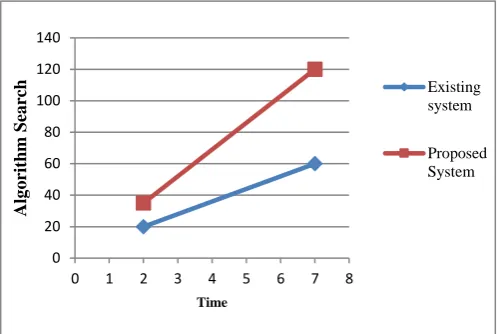
In this section, we show the comparison between proposed system and existing system. Following figure shows that time required for searching algorithms in proposed system is lesser than existing system. User getting faster output in this system
Figure 3. Time graph
B. Performance metrics:
Precision and Recall
• A dataset contains 100 pdf.
• A search was conducted on that 100 pdf.
• 80 Algorithms were retrieved.
• Out of the 80 Algorithms retrieved, 65 were relevant.
• Calculate the precision and recall scores for the search.
0 20 40 60 80 100 120 140
0 1 2 3 4 5 6 7 8
Alg
o
rith
m
S
ea
rc
h
Time
Existing system
Solution:
Using the designations above:
A = The number of relevant Algorithms retrieved, B = The number of relevant Algorithms not retrieved C = The number of irrelevant Algorithms retrieved.
In this example
A = 65, B = 35 i.e. (100-65) ,C = 15 i.e. (80-65). Recall = (65/(65+35))*100% => 65/100 * 100% = 65% Precision = (65/(65+15))*100% => 65/80 * 100% = 81%
Following table shows the precision and recall value
TABLEI.PRECISIONANDRECALLVALUE
No.of
Algorithm PRECISION RECALL
Algorithms 86 78
Abstract 90 86
Highlighted 86 76
IV.CONCLUSION
Professional researchers developed an enormous amount of high-quality algorithm. We have made prototype like AlgorithmSeer. It is a search engine for finding algorithms from PDF file. This engine is extracted algorithm and giving the unique algorithm to the user with highlighted document. User can store this algorithm on his email. Traditional prototype is improved to get better results. It reduces `the time for reading full document. So, this system helps user to find best algorithm.
In future, we will study the fault tolerance after this system failure; explore the semantic analysis of algorithms and how algorithms influence each other over time.
V. REFERENCES
[1] Sumit Bhatia, Prasenjit Mitra and C. Lee Giles.2016 “AlgorithmSeer: A System for Extracting and Searching for Algorithms in
Scholarly Big Data”, IEEE Transactions On Big
Data 2332-7790 (c) IEEE 2016.
[2] Elena Baralis, and Luca Cagliero. 2017.
“Highlighter: Automatic highlighting of electronic
learning documents”, IEEE Transactions on
Emerging Topics in Computing 2168-6750 (c) IEEE 2017.
[3] S. Kataria, W. Browuer, P. Mitra, and C. L. Giles. 2008 “Automatic extraction of data points and text blocks from 2-dimensional plots in digital
documents”, Proceedings of the 23rd national
conference on Artificial intelligence - Volume 2,AAAI08, pages 11691174. AAAI Press, 2008 [4] S. Bhatia, S. Tuarob, P. Mitra, and C. L. Giles. 2011.
“An Algorithm Search Engine for Software
Developers”, 2011
[5] J. B. Baker, A. P. Sexton, V. Sorge, and M. Suzuki.
2011, “Comparing approaches to mathematical
document anal-ysis from pdf”, ICDAR 11, pages
463467, 2011.
[6] S. Bhatia, P. Mitra, and C. L. Giles. 2010. “Finding
algorithms in scientific articles”, 2010.
[7] D. M. Blei, A. Y. Ng, and M. I. Jordan. 2003.
“Latent dirichlet allocation”, Journal of Machine
Learning Research 3 (2003) 993-1022, Mar. 2003. [8] J.Kittler, M. Hatef, R. P. W. Duin, and J. Matas.
1998. “On combining classifiers”, IEEE Trans. Pattern Anal. Mach. Intell., 20(3):226239, Mar. 1998.
[9] T.A. Asuncion, M. Welling, P. Smyth, and Y. W. Teh. 2009. “On smoothing and inference for topic
models”, In Proceedings of the Twenty-Fifth
Cite this article as :
Akshata R. Sanas, Pallavi S, Patil, "An Algorithm Search Engine for Extracting Algorithm From PDF Document ", International Journal of Scientific Research in Computer Science, Engineering and Information Technology (IJSRCSEIT), ISSN : 2456-3307, Volume 5 Issue 5, pp. 10-16, September-October 2019.
Available at doi :