DOI : https://doi.org/10.32628/CSEIT183833
Impact of Clone Refactoring on External Quality Attributes of
Open Source Softwares
Er. Himanshi Vashisht, Sanjay Bharadwaj, Sushma Sharma1Computer Science and Engineering Department, Haryana Engineering College, Jagadhri, Haryana, India 2,3Computer Science and Engineering Department, DAV College for girls, Yamunanagar, Haryana, India
ABSTRACT
Code refactoring is a “Process of restructuring an existing source code.”. It also helps in improving the internal structure of the code without really affecting its external behaviour”. It changes a source code in such a way that it does not alter the external behaviour yet still it improves its internal structure. It is a way to clean up code that minimizes the chances of introducing bugs. Refactoring is a change made to the internal structure of a software component to make it easier to understand and cheaper to modify, without changing the observable behaviour of that software component. Bad smells indicate that there is something wrong in the code that have to refactor. There are different tools that are available to identify and emove these bad smells. A software has two types of quality attributes- Internal and external. In this paper we will study the effect of clone refactoring on software quality attributes.
Keywords : Clone refactoring, Metrices, External Quality Attributes
I.
INTRODUCTIONRefactoring is basically the behavior preserving process. Code duplication is a serious problem with software. Due to code reuse, it leads to duplicate code in software. Roy et al.[2] discussed various clone detection tools and techniques.If a code segment is copied with some changes like addition or deletion of statements and alters its variables name, functions and type, then it comes under type-3 or near miss clones [4].
Software refactoring is the super-set of software restructuring. Martin Fowler [1] book “Improving the Design of Existing Code” describes different 22 bad smells in code and techniques to remove these bad smells. Refactoring is the method of altering the software system in such a way that its external behavior does not change but its internal structure is
enhanced. Refactoring only modifies the internal structure of software so that it will be easy to maintain the software in the future. Refactoring reduces the complexity of software and make it easy to understand for user.
Refactoring Techniques
The technique that is used to remove clones is called as Refactoring Techniques. These are set of measures and steps to keep software clean. There are some basic techniques for clone proposed by Fowler [1]:
Extract Method- is applied when the clone segment are to be found in methods that belong to the same class. In this condition, extract unified code in a new private method within the same class [5].
belong to different sub classes of the same super class. In this situation, unified code is placed in a new protected method in the super class [5].
Introduce Template Method- is a unique case of the refactoring techniques. If clones do not belong to previously clone types but have same return type and identical signature. Then we create an abstract method with same signature in super class where unified code is pulled up [5].
Introduce Utility Method- is applied when the clone segment is to be found in methods of dissimilar classes and the segments do not access any instance method or variables. In this situation, we extract a unified code into a static method placed within a utility class [5].
Quality Attributes
Software Quality Attributes are the characteristics of software by which quality is described and evaluated. It is divided into two groups- Internal Quality Attributes and External Quality Attributes. Metrics calculation tool will calculate internal quality attributes. External quality attributes are measured with the help of internal quality attributes.
Internal Quality Attributes are [6] -
Lack of Cohesion
Coupling
Number of Classes
Abstractness
Depth of Inheritance
Lines of Codes
Weighted Method per Class
Complexity
Hierarchies
Design Size
Polymorphism
Encapsulation
External Quality Attributes are [6] -
Functionality
Fowler et al. [1] described the 22 bad smells and their 72 respective techniques to refactor bad smells. They also associated refactoring rules with these bad smells, suggesting how to resolve these bad smells. They declared duplicate code as a serious kind of bad smell. It increased maintenance cost of software. Due to increasing use of open source software and its variants, there is also increased use of code reuse. Due to code reuse, it results in duplication of code.
The International Organization for
Standardization (ISO/IEC9126) et al. [2] published a set of international standards related to the software engineering, such as ISO 12207 and ISO 9126. However, there is a set of cross-references between the two standards. The ISO 9126 on software product quality and ISO 12207 on software life cycle processes had been analyzed to investigate the relationships between them and to make a mapping from the ISO 9126 quality characteristics to the ISO 12207 activities and vers versa. This study presented a set of comments and suggestions to improve the ISO 9126. The weaknesses of the cross references between the two ISO standards had been highlighted. In addition, this study provided a number of comments and suggestions to be taken into account on the next version of the ISO 9126 international standard.
using certain rules. This transformation regularizes the identifiers by partially removing the context information. A special token replaces the identifiers so that code portions with different variable names could be returned as clone pairs by the matching algorithm.
Garg and Tekchandani [4] introduce an approach to refactor the clones on the basis of their essentiality. The approach measures the maintenance overhead in terms of repetitiveness, size of clones and complexity. They find clones using CCFinder clone detection tool. After detection of clones, calculate efforts required in maintaining clones. They arrange clones according to their value of maintenance overhead. The clones which having high value should be refactor first.
Tstanalis et al. [5] propose an approach to check the refactorability of clones. They defined
pre-condition which are checked during
refactorability. If these pre-condition are satisfied, then we can remove clones easily. If these are violated, then refactorability of that clone is not possible. They used four clone detector tools- CCFinder, Deckard, CloneDR, Nicad.They found that clone with a close distance tends to be more refactorable than more distant. Type 1 clones are more refactorable than other types of clones.
Bansiya and Davis et al. [4] presented a QMOOD (Quality Model for Object Oriented Designed) that access quality attributes like reusability, functionality, extendibility, flexibility, understandability, effectiveness. QMOOD relates low level design properties such as encapsulation, coupling and cohesion to high level quality attributes. They weighted quality attributes accordance to their influence and importance in the system.
Fontana et al. [7] investigates the impact of clone refactoring on quality attributes internal quality attributes like complexity, coupling and cohesion.
They used three clone detection tools PMD, Bahumas and CodePro on two open source software– Ant and GhanttProject. Intellij IDEA tool is used for refactoring. They analyze that, after refactoring there is improvement in cohesion, decrement in coupling, complexity and lines of code.
Alshayed et al. [8] investigates the effect of refactoring on software quality attributes. He focused on quality attributes like adaptability, maintainability, reusability, understandability and testability. They apply refactoring on three open source software- terpPaint, UML tool and Rabtpad. But after refactoring, he concludes that it does not necessary that after refactoring there is increase in quality of software.
III.
PROPOSED STRATERGYCCFinder [19] is used as bad clone detector tool. Jdeodrant [15] is a refactoring plugin which is used to refactor the clones according to their respective techniques. Eclipse metrics plugin [27] used to calculates the internal quality attributes of source code. Object oriented open source software are JChart 2D 3.2.1 [14], apache-ant 1.7.0 [2], JMeter2 2.3.2 [17] and JEdit 4.2 [16].
Steps used to re-factor clones and to calculate the quality attributes are as following-
b. Make a small change i.e. a single refactoring without changing the outer behavior of the software.
c. Test Refactor code, if works and move on to the next refactoring.
d. If fails, rollback the last smaller change and repeat the refactoring in some different way. 4. After applying all the refactoring techniques,
calculate the internal quality metrics of software (Object Oriented Metrics) to determine the impact of refactoring.
5. Calculate the external quality attributes by using internal quality metrics.
6. Compare external quality attributes of software to predict the impact on software quality.
IV.
IMPLEMENTATION FRAMEWORK.
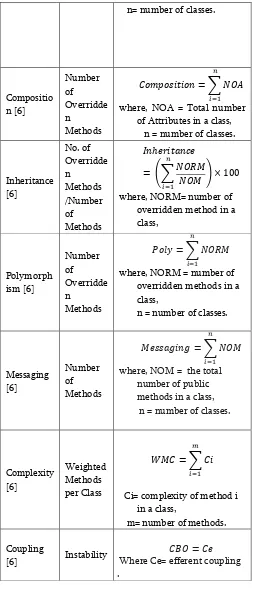
The external quality attributes are dependent on the internal quality attributes. Therefore, attributes can be calculated by using these formulas given by Bansiya and Davis [6].
Table 1- External Quality attributes Formula
Internal Quality attributes
Internal Quality attributes are calculated by Eclipse Metrics [14] plug-in .We interpret these values to calculate metrics used by Bansiya [6].
Table 2- Internal Quality Attributes formula
Design DIT = Depth of inheritance
tree. attributes in a class.
Cohesion methods accessing an attribute A, then Calculate the average of m(A) for all attributes,
m = total numbers of methods for all classes, a = total number of
attributes in a class External QA Formula Used for Calculation
Reusability -0.25*Coupling+0.25*Cohesion+0.5* Messaging+ 0.5*Design Size.
Flexibility 0.25*Encapsulation - 0.25*Coupling + 0.5*Composition + 0.5* Polymorphism. Understanda
Functionality 0.12*Cohesion + 0.22*Polymorphism + 0.22*Messaging + 0.22*Design Size +0.22*Hierarchies.
Extendibility 0.5*Abstraction - 0.5*Coupling + 0.5*Inheritance +0.5* Polymorphism. Effectiveness 0.2*Abstraction + 0.2*Encapsulation +
n= number of classes. of Attributes in a class, n = number of classes.
where, NORM= number of overridden method in a class, overridden methods in a class, Where Ce= efferent coupling .
V.
RESULTSIn this section, impact of clones refactoring on quality of softwares is analyzed by comparing various quality attributes.
Number of clones Detected in Software
In research work, three types of clones have been detected on four different open source softwares JChart 2D (3.2.1), apache-ant (1.7.0), JMeter (2.3.2), JEdit (4.2) using CCFinder. Table III provides information about the number of clones detected in the open source softwares using CCFinder tool.
Table 3- number of clones smell detected in software
Refactoring Impact on Internal Quality Attributes of Software
To To find the impact of clones refactoring, first calculate internal quality attributes of software without applying any refactoring technique. After removal of clones, calculate internal quality attributes. Internal quality attributes values before refactoring and after refactoring is shown in Table IV and Table V respectively.
Table 4 - Internal Quality Attributes of Software Before Refactoring
Softwares JChart2D
Apache-ant JMeter JEdit
TLOC 6693 115744 81307 81004
Table 5 - Internal Quality Attributes of Software After Refactoring.
Refactoring Impact on Complexity of Software
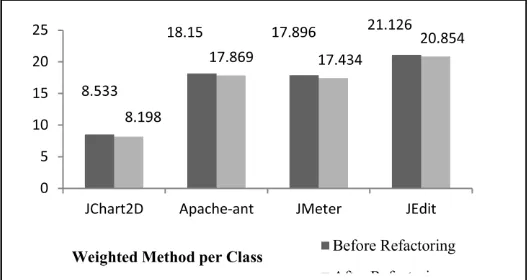
Table VI, Shows the refactoring impact on complexity of software. From Figure 1 and Figure 2, it is clear at after refactoring weighted method per class and MCcabe cyclomatic complexity of all the
software is reduced. So refactoring shows positive impact on complexity.
Table 6 - Impact of Refactoring On Complexity of Software
Comple xity
McCabe Cyclomatic Complexity
Weighted methods per Class
Software s
Before Refactor ing
After Refactor ing
Before Refactor ing
After Refactor ing JChart2
D
2.015 1.876(↓) 8.533 8.198 (↓)
Apache-ant
2.109 2.0699(↓
)
18.150 17.869(↓
)
JMeter 1.864 1.822(↓) 17.896 17.434(↓ ) JEdit 3.161 3.095(↓) 21.126 20.854
(↓)
Figure 1. Impact of clones refactoring on McCabe Cyclomatic Complexity of software
Figure 2. Impact of Clones refactoring on weighted method per class
Softwares Metrics
JChart2 D
Apache -ant
JMete
r JEdit
Design Size 9.727 11.361 5.406 21.47
1
Hierarchies 3.636 2.689 2.914 2.382
Abstraction 0.0851 0.086 0.111 0.078
Encapsulation 0.8403 0.405 0.035 0.467
Coupling 6.818 7.205 4.383 6.882
Cohesion 2.463 2.890 2.336 3.731
Composition 1.411 2.597 2.424 2.985
Inheritance 0.882 0.123 0.123 0.158
Polymorphis
m 0.467 1.024 1.091 0.901
Messaging 3.991 8.266 8.85 5.685
Complexity 8.533 18.15 17.896 21.12
6
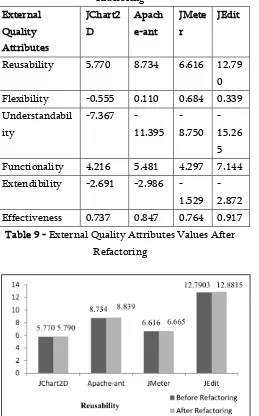
Refactoring Impact on External Quality Attributes The external quality attributes are calculated by using formulas given by Bansiya and Davis [6]. According to the formula given above, the values of external quality attributes are shown in Table VII and Table VIII.
Table 8- External Quality Attributes Values Before Rfactoring
External Quality Attributes
JChart2 D
Apach e-ant
JMete r
JEdit
Reusability 5.770 8.734 6.616 12.79
0
Flexibility -0.555 0.110 0.684 0.339
Understandabil ity
-7.367 -11.395
-8.750
-15.26 5 Functionality 4.216 5.481 4.297 7.144 Extendibility -2.691 -2.986
-1.529 -2.872 Effectiveness 0.737 0.847 0.764 0.917 Table 9 - External Quality Attributes Values After
Refactoring
Figure 3. Impact of Refactoring on Reusability of software
Figure 4. Impact of Refactoring on Flexibility of software
Figure 5. Impact of Refactoring on Understandability of software
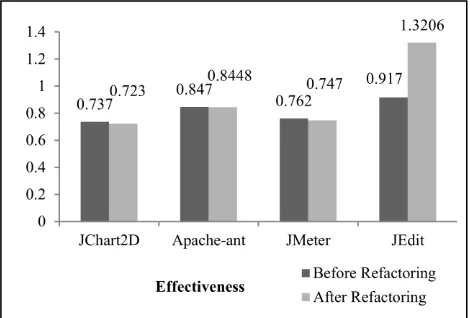
Figure 7. Impact of Refactoring on Effectiveness of software
Figure 8. Impact of Refactoring on Extendibility of software
As shown in Figures 3 and Figure 5, Reusability and functionality of all the four open source softwares increased when refactoring is applied. In Figure 4, flexibility of JChart2D, Apache-ant, JMeter is decrease, but only JEdit flexibility is increased. In Figure 5, understandability of JChart2D, Apache-ant, JEdit is decrease, but only JMeter show slight improvement. In Figure 7 and Figure 8, effectiveness and extendibility of JChart2D, apache-ant, JMeter decreased, only JEdit attributes values increased a huge amount.
VI.
CONCLUSION AND FUTURE WORKRefactoring makes code easy to use. In this work four, different softwares are used to analyze the impact of clones’ refactoring on quality of softwares.
From experimental results, conclusion comes out that the complexity of the softwares is reduced using refactoring. By applying refactoring on softwares, reusability and functionality of all the softwares is increased and other quality attributes like flexibility, understandability, effectiveness, extendibility is decreased.Some refactoring techniques improved the quality of softwares and some refactoring techniques shows negative effect on quality Result shows that refactoring techniques may also have inverse effect on software quality attributes.
VII.
REFERENCES[1]. M. Fowler, K. Back, J. Brant, W. Opdyke and D.B. Roberts, “Refactoring: improving the design of existing code,” Addison-Wesley, New York, 1992.
[2]. C.K. Roy, J.R. Cordy and R. Koschke, “Comparison and evaluation of code clone detection techniques and tools: A qualitative approach,” Science of Computer Programming ELSEVIER, vol. 74, pp. 470–495, 2009.
[3]. T. Kamiya, S. Kusumotoand K. Inoue, “CCFinder: a multilinguistic token based code clone detection system for large scale source code,” IEEE Transaction on Software Engineering, vol. 28, no. 7, pp. 654-670, 2002.
[4]. R. Gargand and R. Tekchandani, “Enhancing code clone management by prioritizing code clones,” Master’s Thesis, Thapar University, Patiala, 2014.
[5]. N. Tsantalis, M. Mazinanian and G.P. Krishnan, “Assessing the refactorability of software clones, ” IEEE Transactions on Software Engineering, vol. 41, No. 11, 2016.
[7]. F.A. Fontana, M. Zanoni, A. Ranchetti and D. Ranchetti, “Software Clone Detection and Refactoring,” ISRN Software Engineering, 2013.
[8]. M. Alshayeb, “Empirical investigation of refactoring effect on software quality, ” Information and Software Technology, ELSEVIER, 2009.
[9]. JDeodorant, URL - Retrieved from
https://marketplace.eclipse.org/content/jdeodor ant.
[10]. JChart2D Retrieved from https://sourceforge.net/projects/jchart2d/.
[11]. Apache-ant Retrieved from http://ant.apache.org/.
[12]. JMeter Retrieved from http://jmeter.apache.org.