CSEIT172371 | Received : 10 May 2017 | Accepted : 20 May 2017 | May-June-2017 [(2)3: 438-445]
International Journal of Scientific Research in Computer Science, Engineering and Information Technology © 2017 IJSRCSEIT | Volume 2 | Issue 3 | ISSN : 2456-3307
438
Performance Analysis of Scig and DFIG-Based Wind Turbines
Kishan V Dave, Nimish R Suchak
A. V. Parekh Technical Institute, Rajkot, Gujarat, India
ABSTRACT
This paper presents a comparative performance analysis of squirrel cage induction generator (SCIG) and doubly fed induction generator (DFIG) systems driven by wind turbines under different operating conditions. Also, the constant and variable-speed configurations are compared regarding short-term flicker severity, Pst. The constant speed configurations are based on SCIG in addition to SCIG equipped with static synchronous compensator (STATCOM) with the same generation capacity. In this paper, comprehensive models of wind turbine are used to analyze power and voltage fluctuations. The short-time flicker index is used to assess the emitted voltage fluctuation. The effects of grid short circuit capacity and impedance angle on flicker emission are investigated. The influences of site mean-wind-speed and turbulence intensity on voltage fluctuation are also examined. A flickermeter model is implemented according to the guidelines provided by IEC 61000-4-15 to evaluate the severity of voltage fluctuation emission. The models of different system components along with their control schemes are simulated using Matlab/Simulink® package.
Keywords : Wind Turbine, SCIG, DFIG, Maximum Power Point Tracking (MPPT), Voltage Flicker.
I.
INTRODUCTION
The growing demand for electric energy all over the world has highly motivated the use of renewable sources of energy. Among renewable-based energy sources that have been intensively studied, wind energy seems to have a vital role in the near future. Over the last ten years, the global wind energy capacity has increased rapidly and became the fastest developing renewable energy technology. Clean operation and minimal running cost requirements are some motivations of using more wind energy within power grids .
Most of the wind turbines use induction generators because of their advantageously characteristics; such as the over speed capability; make them suitable for integration with wind turbines; especially that are used squirrel cage induction generators (SCIG) because of its mechanical simplicity, high efficiency and low maintenance requirements, but at the present time doubly fed induction generator (DFIG) are widely used for large wind power plants .
The SCIG speed changes by only a few percent because of the generator slip caused by changes in wind speed. Therefore, this generator is often called the constant-speed wind generating system.
II.
System Modeling
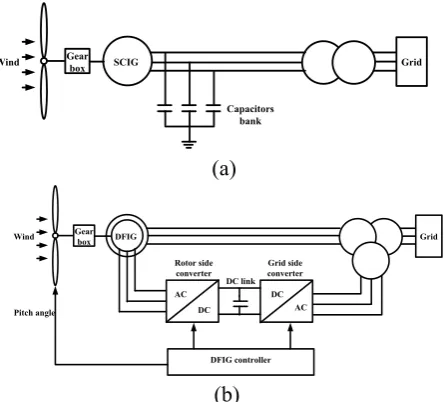
Wind energy conversion system converts wind kinetic energy to mechanical energy by means of wind turbine rotor blades. Then, the generator converts the mechanical power to electrical power that is being fed to the grid through power electronic converters. Fig.1 shows a simple layout of a 9 MW wind farm is simulated by three pairs of 1.5 MW wind turbines based on induction generators. A model for the system under study is implemented in Matlab/Simulink environment.
The WECS under study consists of two main parts:
a) Mechanical parts: include the aerodynamic system with the rotor blades and the gearbox.
b) Electrical parts: comprised of the induction generator (SCIG–DFIG) and the back-to-back converter set for DFIG system .
Gear
Figure 1. (a) Constant speed SCIG directly grid connected wind turbines
2.1 Mechanical Parts of Wind Turbine System
available wind speed, V, the wind generator has to run at a particular speed that corresponds to wind speed in such a way that the maximum power point is tracked as shown in Fig.2. The objective of operating in the maximum power point tracking (MPPT) mode is to maximize power extraction at low to medium wind speeds.Figure 2. Wind turbine mechanical power output rotor speed [12].
2.2 Electrical Parts of Wind Turbine System
2.2.1 Induction machine modelling
Due to the speed flexibility of asynchronous machines, they are widely used in wind generation installations. The d-q equivalent circuit diagram of an induction machine is shown in Fig. 3. The electrical equations of the induction machine based on the equivalent circuit
Figure 3. The d-q equivalent circuit of DFIG [1].
2.2.2 Converter control system
The control system is an important issue for the wind turbine performance. It maximizes the extracted power from the wind and also makes sure that the delivered power to the grid complies with the interconnection requirements. A back to back converter is used to connect the generator to the grid and it allows the full controllability of the system. It comprises two parts: the rotor-side and the grid-side converters, with specific target for each one. The first one controls the speed, active power and reactive power, while the second one
0 0.2 0.4 0.6 0.8 1 1.2 1.4
maintains the voltage on the DC-link at a constant value to transfer all generated power to the grid.
III. Performance Analysis of SCIG and
DFIG-Based Wind Turbine
To examine the performance of the SCIG and the implemented control schemes of DFIG based wind turbines, three cases studies considering different wind speed variations have been conducted.
3.1 Case (1) Step Change in Wind Speed Profile
A. Performance of SCIG-based wind turbine
It is assumed that the wind speed profile varies up and down as step function with mean wind speed 9 m/s, with a simulation time of 5 s, as illustrated in Fig. 6 (a). Fig.6 (b), describes the rotational speed of the generator, which varies with wind speed especially at sudden changes in wind speed profile, where the oscillation depends on the moment of inertia. As depicted in Fig.6 (c), the mechanical torque also changed with wind speed variation with negative values, indicating generation mode, and it is proportional to the cubic of wind speed. Fig.6 (d), shows the tip speed ratio, λ, varies with time and the wind turbine does not have the ability to maintain the
tip speed ratio at its optimal value (λopt = 8.1) except at t
= 1 s to 2.5 s, where the system operates at (Vwind =
9m/s). Consequently, the power coefficient Cp is
different from the optimal value that provides the MPPT except the period (t=1 s to 2.5 s), where Cp =
Cp_max = 0.48 as seen in Fig. 6 (e). Fig. 6 (f) shows that
the power injected to the grid is dependent average wind speed. The reactive power fed from the grid is shown in Fig. 6 (g), which describes the reactive power absorbed by the generator.
B. Performance of DFIG-based wind turbine
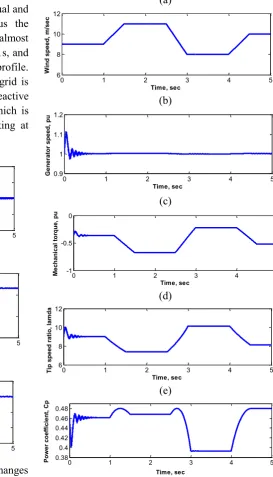
Fig.7 (a) shows the wind speed profile varies up and down as step functions with average value of 9m/s with a simulation time of 5 s. Fig.7 (b) describes the rotational speed of generator which takes the same wind speed profile except at sudden change, where the moment of inertia appeared. When the wind speed increases, the input mechanical torque also increases as seen in Fig.7 (c). The torque takes negative value for generating power. The controller succeeded to adjust the rotational speed with wind speed variation to maintain tip speed ratio λ at optimum value λopt, which
ensure maximum value of power coefficient Cp.
Consequently, MPPT is achieved as seen in Fig.7 (d) and Fig.7 (e) some notches appear at time 1 s and 2.5 s due to the sudden changes in wind speed.
(a)
(b)
(c)
(d)
(e)
0 1 2 3 4 5
6 8 10 12
Time, sec
Wind speed, m/sec
0.5 1 1.5 2 2.5 3 3.5 4 4.5 5
0.6 0.8 1
Time, sec
Generator speed, pu
0 1 2 3 4 5
-1 -0.8 -0.6 -0.4 -0.2 0
Time, sec
Mechanical torque, pu
0.5 1 1.5 2 2.5 3 3.5 4 4.5 5
6 7 8 9 10
Time, sec
Figure 4. Rotor side converter response for step changes in wind speed
To realize the feasibility of the grid side converter controller, Fig.8 (a), Illustrate the dc link voltage. The controller gives good agreement between the actual and reference values of the dc link voltage, thus the controller capable to maintain dc voltage is almost constant at nominal value 1200 V except for at 1s, and 2.5s due to the sudden change in wind speed profile.
Figure 5. Grid side converter response for step changes in wind speed
3.2 Case (2) Ramp Change in Wind Speed Profile
A. Performance of SCIG-based wind turbine
Wind speed profile varies up and down with smooth ramp rates with average value of 9.5 m/s over a time span of 5 s as seen in Fig.9 (a). Fig.9 (b), and Fig.9 (c), describe the rotational speed and the mechanical torque for the ramp wind speed, the generator rotational speed is almost constant with variation of wind speed. Fig.9 (d) and Fig.9 (e) demonstrate the tip speed ratio (λ) and power coefficient (Cp); it is obvious from these figures
that λand Cp are variation with time in constant speed
wind turbine. Consequently, the maximum power tracking is not achieved.
(a)
(b)
(c)
(d)
(e)
Figure 6. Constant speed System response for ramp changes in wind speed
B. Performance of DFIG-based wind turbine
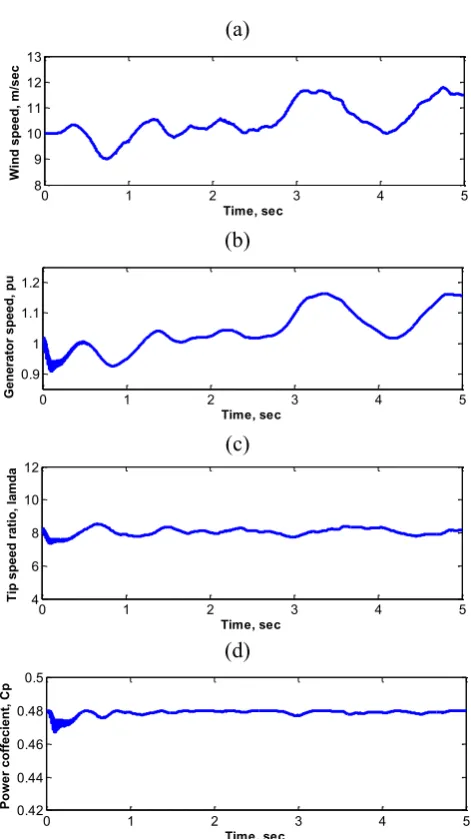
It is assumed that the wind speed profile varies up and down with smooth ramp rates with a mean wind speed of 9.5 m/s as seen in Fig.10 (a) with a simulation time of 5 s. As shown in Fig.10 (b) the rotational speed of the generator various with wind speed profile. In addition, the mechanical torque is shown in Fig.10 (c) Moreover, the torque is negative, indicating input torque to the system, and it is proportional to cubic wind speed.
As shown in Fig.10 (d) and Fig.10 (e) respectively, the maximum power tracking is achieved and hence, the tip speed ratio λ is maintained at the corresponding optimal values and the power coefficient Cp is maintained constant at its maximum value.
.
(a)
(b)
(c)
(d)
Figure 7. Constant speed System response for random changes in wind speed.
(a)
(b)
(c)
(d)
Figure 8. Variable speed System response for random changes in wind speed
IV. Simulation Results and Discussion for
Flicker Modeling
voltage fluctuation for constant speed wind turbines is essential. The impacts of different factors on the short-term flicker index, Pst, are presented in the following
subsections.
4.1 The effect of short circuit ratio (SCR)
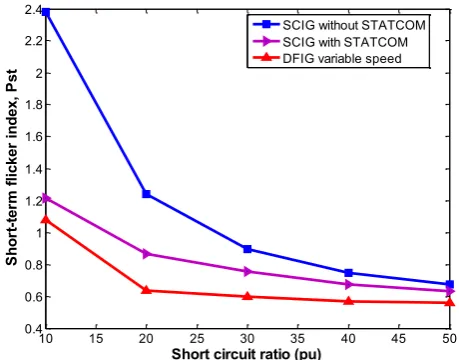
As a comparative between DFIG and SCIG in Table 1 and Fig. 15 shows the effect of SCR on the short-term flicker index Pst. This simulation is carried out, where
the mean wind speed at hub level is maintained at 10 m/s, the site turbulence is 12% and the X/R ratio equal to 10. From table 1 and Fig. 15, it can be seen that the flicker level decreases with the increase of short circuit ratio. In addition, the effect of the STATCOM is highly significant in weak grids; however, the STATCOM effect becomes weaker with stiff grids. Also, the variable speed DFIG-based wind turbines have shown better performance regarding voltage fluctuation compared to constant speed SCIG-based wind turbines for all values of SCR. The reason is that variable-speed operation of the rotor has the advantage that the sharp power variations are not transmitted to the grid due to the presence of interfacing converters. These results are agreed with results in [10].
Table 1: The effect of SCR on the Pst.
Figure 9. The effect of SCR on the short-term flicker index Pst.
4.2 The effect of grid impedance angle
As a comparative between DFIG and SCIG in Table 2 and Fig. 16 show the variation of the flicker emission with the impedance angle θ, (θ=tan-1(X/R)). The SCR is
maintained at 50 pu. The mean wind speed at hub level is 10 m/s and site turbulence is 12%. From table 2 and Fig. 16, it can be seen for constant speed operation that the flicker decreases with increase of θ to a certain minimum point and, then, the flicker increases again with increase of θ. The minimum point here is recognized at θ ≈ 45° at SCIG. In addition, the STATCOM reduces the flicker emission of constant-speed wind turbines. The effect of the STATCOM is significant when the grid impedance is highly inductive as illustrated in Fig. 16. On the other hand, the voltage flicker effect on DFIG is lower than the effect on SCIG, where the Pst is almost constant at very low
levels as shown in table 2 and Fig. 16.
Figure 10. Variation of Pstwith the grid impedance
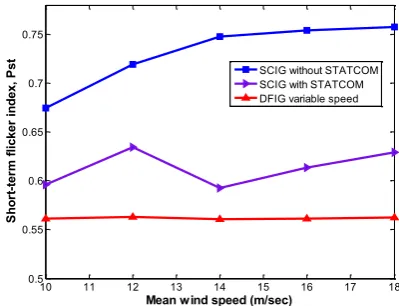
4.3 The effect of mean wind speed at hub level
As a comparative between DFIG and SCIG in Table 3 and Fig. 17 show the effect of mean wind speed on the short-term flicker index, Pst at X/R ratio equal to one
and turbulence intensity equal to 12%. The flicker emission increases with increasing wind speed. Saturation or flat variation is recognized when the mean wind speed exceeds the rated value. The flicker emission effect on DFIG increases slightly with the increase of the mean wind speed and the effect of the STATCOM is significant when the grid impedance is highly inductive (high X/R ratio). Consequently, the DFIG shows better performance than SCIG as shown in table 3 and Fig.17.
Table 3: Variation of Pst with the mean wind speed
Figure 11. Variation of Pst with the mean wind speed
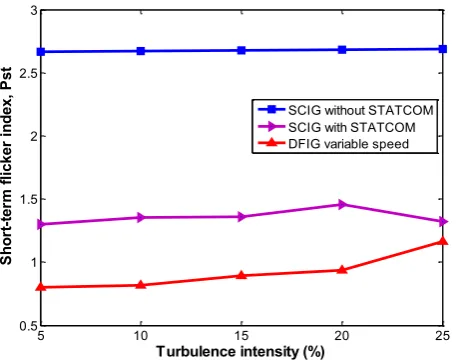
4.4 The effect of turbulence intensity
In this case, the mean wind speed at the hub level is maintained at 10 m/s, the fault current level is 10 pu, and the grid impedance angle is 45°.Table 4 and Fig. 18, show the variation of Pst with the turbulence intensity. The increase in the wind speed turbulence increases the power variability and thus, the flicker emission increases with the increase of the turbulence intensity. The effect of the STATCOM is significant with weak grids. From the table 4 and Fig. 18, the short-term flicker index, Pst, value for DFIG less than short-term flicker index, Pst, value for SCIG. Consequently; DFIG is better than SCIG regarding the flicker emission with the increase of the turbulence intensity.
Table 4: Variation of Pst with wind speed turbulence.
10 11 12 13 14 15 16 17 18
0.5 0.55 0.6 0.65 0.7 0.75
Mean wind speed (m/sec)
S
h
o
rt
-t
er
m
f
lic
ke
r
in
d
ex
, P
st SCIG without STATCOM
Figure 12. Variation of Pst with wind speed turbulence.
V.
CONCLUSION
This paper presented a comparative performance analysis and flicker emission of SCIG and DFIG based wind turbines. From simulation results the variable speed DFIG based wind turbines give better performance than constant speed SCIG based wind turbines under different wind speed conditions and to achieve maximum power point tracking (MPPT) due to the control flexibility. Based on the developed wind turbine model, the flicker emission of constant speed wind turbines with SCIG and variable speed wind turbines with DFIG are investigated. Simulation results show the flicker level increases with increasing in turbulence intensity and mean wind speed however, it decreases with the increase of the grid impedance angle and short circuit ratio. The STATCOM has showed significant effect when the grid impedance is highly inductive (high X/R ratio). Although the risk of flicker emission for resistive grids (low X/R ratio) is increased, the STATCOM effect becomes weaker than its effect for inductive grids. Generally, variable-speed wind turbines have shown better performance regarding the flicker emission compared to constant-speed wind turbines.
VI. REFERENCES
[1] W. S. E. Abdel-Latif, A. H. K. Alaboudy, H. E. Mostafa and M. Y. Fekry, " Evaluation and mitigation of voltage flicker caused by constant speed wind turbines," IEEE PES ISGT Middle East Conference, Saudi Arabia, Dec. 2011. [2] T. Ackermann, “Wind power in power systems,” book,
John Willey and Sons, 2005.
[3] S. Vitanova, V. Stoilkov and V. Dimcev, “Comparing SCIG and DFIG for wind generating conditions in Macedonia” International Conference on Renewable
Energies and Power Quality (ICREPQ‟11), Las Palmas de Gran Canaria (Spain), 13-15 April, 2011.
[4] M. Anju, and R. Rajasekaran, “Power system stability enhancement and improvement of LVRT capability of a DFIG based wind power system by using SMES and SFCL” International Journal of Electrical and Computer
Engineering (IJECE)vol. 3, no. 5, October 2013, pp.
618~628.
[5] B. Gandhi, K. K. Mohiuddin, and T.V.V P. Kumar “Enhancement and improvement of wind power system by using SMES and SFCL” International Journal of Computer
Science and Mobile Computing, vol.3, issue.10, pp.
387-392, Oct. 2014.
[6] A. Awasthi, R. Diwan and M. Awasthi,”Study for Performance Comparison of SFIG and DFIG Based Wind Turbines” International Journal of Latest Trends in
Engineering and Technology (IJLTET), vol. 2 Issue 4, July
2013.
[7] M. Machmoum, A. Hatoum, T. Bouaouiche, "Flicker mitigation in a doubly fed induction generator wind turbine system," Math. Comput. Simul, 2010.
[8] Å. Larsson, “Flicker emission of wind turbines during continuous operation,” IEEE Trans. Energy Conversion,
vol. 17, no. 1, pp. 114-118, Mar. 2002.
[9] C.Carrillo, E.Diaz-Dorado, and J.Cidras “PSCAD/EMTDC- based modling and flicker estimation for wind turbines” Europe Premier Wind Energy Event. EWEC, Marseille. 2009.
[10] Z. Chen, J. M. Guerrero, and F. Blaabjerg, "A review of the state of the art of power electronics for wind turbines"
IEEE Trans. Energy Conversion, vol. 24, no.8, Aug. 2009.
[11] M. E. Elshiekh, D. A. Mansour,,andA. M.Azmy “Improving fault ride-through capability of DFIG-based wind turbine using superconducting fault current limiter”
IEEE Trans. on Applied Superconductivity, vol. 23, no. 3,
June 2013.
[12] Walid S. E. Abdellatif , Ali H. Kasem Alaboudy ,and Ahmed M. Azmy” Evaluation of voltage flicker emissions of variable speed DFIG-based wind turbines” 3rd International Conference on Energy Systems and Technologies, , Cairo, Egypt, 16 – 19 Feb. 2015.
[13] H. Sang Ko, G. Yoon, N. H. Kyung and W. P. Hong “Modeling and control of DFIG-based variable-speed wind-turbine” Electric Power Systems Research, no. 78, pp. 1841–1849, 2008.
[14] H. Li, and Z. Chen, "Overview of different wind generator systems and their comparisons," IET Renew. Power
Geneerators, vol. 2, no. 2, pp. 123–138, 2008.
[15] A. H. K. Alaboudy, A. A. Daoud, S. S. Desouky, and A. A. Salem, “Converter controls and flicker study of PMSG-based grid connected wind turbines”, Ain Shams
Engineering Journal, Elsiever, vol. 4, issue 1, pp. 75-91,
Mar. 2013.
[16] F .Iov, A. D. Hansen, P. Sorensen, and F.Blaabjerg. "Wind turbine blackest in Matlab/Simulink," Research Project, Institute of Energy Technology, Alborg University, Mar. 2004.
[17] Y. Kim, A. Marathe and D. Won “ Comparison of various methods to mitigate the flicker level of DFIG in considering the effect of grid conditions” Journal of Power
Electronics, Vol. 9, No. 4, July 2009.